A few board lengths beyond a yacht’s stern, a sail that hung slack beside the hull can fill with a sharp crack. The back hand takes the load, the board turns, and the shelter that made launching feel easy is suddenly behind you. That small boundary is a useful place to begin thinking about windsurfing in the Indian Ocean. The wind beside the boat is not necessarily the wind we will sail in. The smoothest water is not necessarily the safest. We need to understand the return before enjoying the departure.
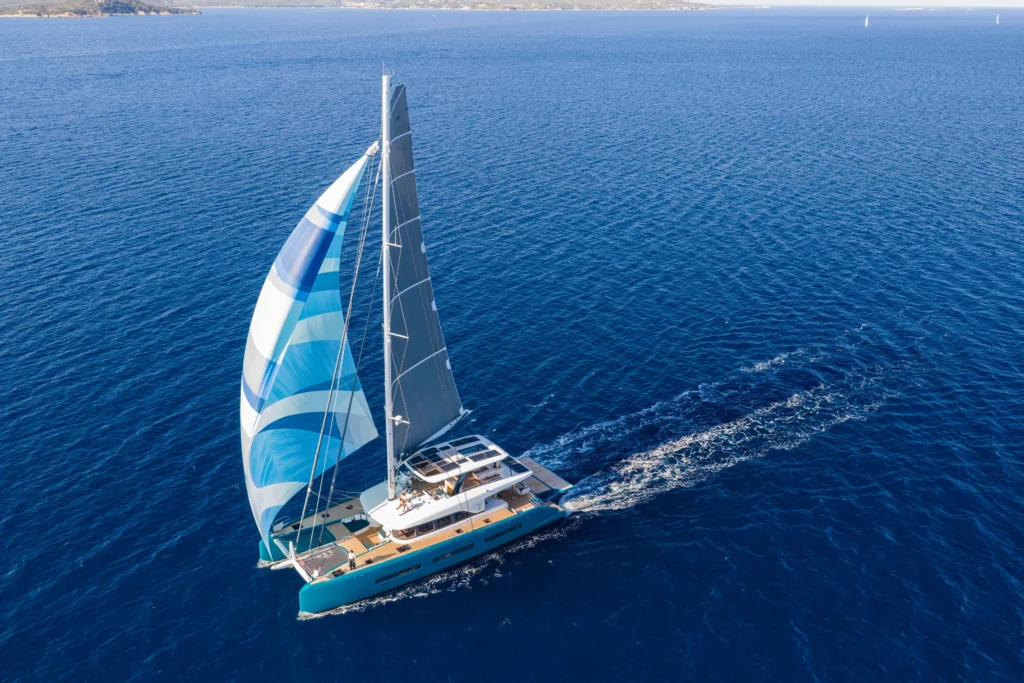
Aboard Discovery, the Lagoon Eighty2 sailing the Naora Global Expedition, the dismantled rig belongs to the quieter possibilities of the world route. It travels through passages when nobody needs it, occupying locker space and requiring attention even while unused. Its value is the afternoon it makes possible when the anchorage, the weather and the people aboard are ready together. There is no reason to force that afternoon.
Reading The Season For Windsurfing In The Indian Ocean
The Indian Ocean does not have one windsurfing season. Across much of its northern reaches, the broad southwest monsoon belongs to roughly June through September, while the northeast regime is most established around December through February. Those are background patterns, not dates on which a particular anchorage becomes suitable. Farther south, southeast trade winds may be more relevant than the northern seasonal reversal. Latitude, exposure and local geography change the answer.
The transition between monsoons deserves particular care because the word can suggest a gentle interval between stronger systems. It can mean lighter winds, but also variable direction, calms and convective weather. A promising breeze may be local and short-lived rather than the beginning of a settled afternoon. We would not describe transition season itself as a guarantee of consistent wind.
A steady 15 to 20 knots over sheltered water can be rewarding for an experienced windsurfer with suitable equipment. It can also be too much for someone still learning to turn or recover the sail. The number becomes useful only when we know how much the wind varies, what the rider can manage and what happens beyond the sailing area. A dependable moderate breeze is a different proposition from a light mean punctuated by hard gusts.
Sven, Naora’s founder and captain, plans every weather window and sails every leg himself. The same distinction between a broad forecast and the conditions in front of the boat matters here. Cloud growth, approaching rain, changes in wind direction and the texture of the water all belong in the decision. A sheltered anchorage suitable for the night may offer no worthwhile windsurfing at all. That is not a defect in the anchorage.
Choosing An Anchorage For Windsurfing In The Indian Ocean
Flat water is often made by something interrupting the sea. An island reduces the distance over which wind can build waves. A reef may break incoming swell. A headland can shelter a bay while accelerating the air around its edge. These mechanisms produce different sailing conditions, even when the view from the deck looks similarly inviting.
We want to distinguish shelter from waves from shelter from wind. Behind high land, the water may be smooth because the air reaching it is weakened and turbulent. Beyond the headland, the breeze may arrive much stronger. A low reef can leave the wind relatively unobstructed while reducing swell, but then depth, coral heads and water moving through gaps become central concerns. Smoothness tells us something about the surface. It says little about the route home.
An offshore wind can make a shoreline look wonderfully calm while carrying a disabled rider away from it. An onshore wind may offer a possible landing, but only if the shore is genuinely usable, without breaking surf, rocks or other hazards. We cannot borrow the safety assumptions of a familiar beach simply because the water has the same colour.
The yacht’s anchoring assessment and the board’s sailing assessment overlap without being interchangeable. Good holding ground beneath Discovery does not establish clear water throughout a windsurfing area. We need to understand the tide, the likely current, the depth available to the fin and the position of hazards at the lowest water expected during the session. Where coral is present, clearance is also a matter of leaving it untouched.
Nor does an uncrowded anchorage mean unused water. Fishing lines, moorings and small-boat routes may be difficult to see from the yacht. Local restrictions and protected areas still apply. Our sailing space has to fit around the place, rather than treating the absence of a marked watersports zone as permission to range anywhere.
What The Forward Locker Has To Protect
The mast separates into two sections for stowage. That makes it manageable inside the forward locker, but gives us a joint that deserves attention whenever it is assembled. Grit between the mating surfaces can prevent proper seating and make separation difficult later. A small gap left unnoticed can concentrate load where the mast was meant to work as a continuous structure.
The rolled sail needs protection from sharp edges and repeated rubbing. The boom needs restraint rather than room to knock against neighbouring equipment. A board secured on deck requires padded support and lashings arranged for passage motion, with access and working areas kept clear. A strap suitable for holding something still at anchor is not automatically a satisfactory offshore securing arrangement.
Before rigging, we look at the parts whose failure would leave a rider with a floating collection of separate objects: the mast base, universal joint, retaining pins and their connections. Downhaul and outhaul lines deserve inspection where they pass around pulleys or cleats, not only along the clean lengths that are easiest to see. Salt and sunlight continue their work while equipment appears to be doing nothing.
This is part of the real cost of carrying a rig around the world. It takes space, cleaning water, inspection time and repair materials. Maintenance does not become optional because the last session was brief. We carry the possibility of an afternoon’s sailing by looking after it during all the afternoons when the locker stays closed.
Rigging For The Wind Beyond The Yacht
A foredeck offers working space, but it is not a lawn beside a windsurfing beach. The yacht can swing. A loose sail can lift. Hardware can damage the deck, and rigging must not obstruct the equipment needed to look after the boat. We choose a clear, controlled area and secure components as they come out, rather than spreading everything around and hoping the wind remains polite.
Downhaul bends the mast and helps establish the sail’s intended shape and leech twist. Outhaul influences the depth of the sail between mast and clew. Their effects interact, and the useful adjustment range depends on the particular sail and mast. More tension is not a universal remedy for too much wind. Beyond the appropriate range, the answer is different equipment or a different afternoon.
The difference between the lower and upper end of a wind range is easy to underestimate. With air density unchanged, dynamic pressure at 20 knots is about 78 per cent greater than at 15 knots. That does not predict the exact pull on a moving windsurfer, because apparent wind, sail angle and trim also matter. It does explain why a modest-looking increase in the forecast can feel substantial in the hands.
We therefore rig for the exposed sailing area and its gusts, not for the lull behind Discovery. Rider size, board volume, ability and fatigue all influence sail choice. Being able to hold a sail briefly beside the yacht does not establish that someone can control it through a turn or lift it repeatedly after falling. A little less power can leave considerably more attention available for everything else.
A Launch With A Return Already Agreed
Launching from a yacht removes the forgiving interval in which a beach sailor stands in shallow water, arranges the rig and waits. Board and sail need to be controlled while they are passed down, with clearance from the hull, boarding equipment and anyone in the water. Any nearby tender propeller must be stopped during handling. The yacht’s wind shadow may make the transfer easier while making the first few metres harder.
Deep water does not automatically require a waterstart. A sufficiently buoyant board can allow an experienced rider to uphaul the sail. A lower-volume board may make a dependable waterstart essential. The important question is whether the rider can restart that particular equipment in the actual wind and chop, including the lighter air close to the yacht. An unfamiliar anchorage is a poor place to discover that the answer is no.
Before launch, the sailing boundary and return plan need to be understood by rider and support crew. We would favour initial reaches that preserve an upwind margin rather than accepting a long downwind run as the default session area. The route back must remain achievable under sail, without treating a tender pickup as the ordinary way home.
Nevertheless, recovery support belongs in the water and ready. That means a competent tender driver, a designated observer, sufficient fuel and a practical way to recover both a person and awkward equipment. Someone also remains responsible for the anchored yacht. A tender merely being aboard is not a recovery plan, and a crew member intermittently looking up from another task is not continuous observation.
A waterproof VHF secured where the rider can reach it is useful only if it can be operated in the water and somebody is listening. We agree communications and recall signals before separating. Suitable flotation, head protection and clothing are considered alongside the rig, not afterwards. If effective support cannot be maintained, we leave the board secured. The quality of the sailing does not change that decision.
Knowing When To Come Back
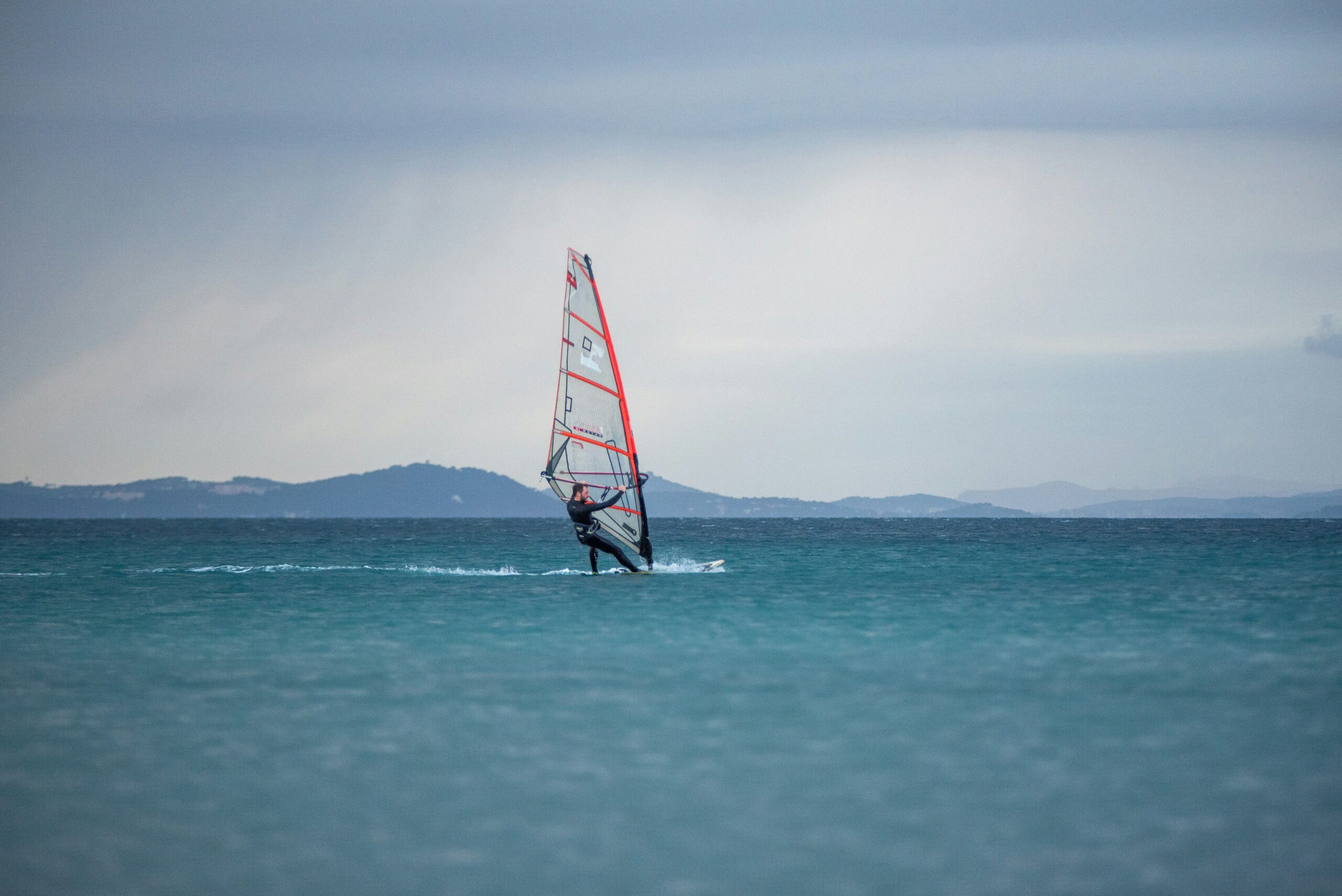
Once the board releases onto the plane, the change is physical before it is anything else. The drag falls away, the noise beneath the feet becomes a finer hiss, and the hands can soften if the rig is balanced. Spray reaches the face even over water that looked flat from the deck. Attention narrows to the pressure in the sail and the next patch of darker water. This is the pleasure we have made room for.
It is also why observation must continue outside the rider’s concentration. Someone enjoying a series of reaches may notice a changing current later than someone watching their position against the shore. Cloud can build behind their back. The useful sailing area can shrink while the sailing itself still feels good.
For scale, a steady current of 1 knot carries a drifting object 0.5 Nm in half an hour, before any additional movement caused by wind. That is an illustrative calculation, not a current prediction for an unnamed anchorage. Its meaning is simple: time spent trying to restart is also time spent travelling. Near reef gaps, headlands or an unusable shore, the direction of that travel can matter more than its speed.
Repeated failed starts, declining grip or difficulty holding an upwind course are reasons to finish early. Warm tropical water does not remove the effects of prolonged immersion and wind, especially once exertion stops. After a failure, remaining with a buoyant board is generally preferable to beginning a swim towards a yacht that looks deceptively close. Recovery should follow the agreed plan rather than becoming an improvised pursuit of loose equipment. There is nothing disappointing about returning with enough strength left to make the return uneventful.
The Afternoon After The Sail
The return deserves the same care as the launch. Tired hands are handling a wet rig beside a hard hull, and the sail still catches wind until it is controlled. Nobody gains much from rushing the last few minutes. The board has to be secured before attention moves elsewhere; lines and fittings need another look before the equipment disappears into storage.
Fresh water is most useful where salt and grit will cause trouble, particularly at joints, moving fittings and connections. A purposeful rinse is better than leaving a hose running over the whole deck. Where conditions allow, the sail dries before being rolled, and the mast joint is cleaned before its sections are put away. A worn line noticed now is a small maintenance job. Forgotten in the locker, it becomes a problem for a future session.
Afterwards there is the ordinary pleasure of being aboard again: shade on wet shoulders, a drink held in hands that still remember the boom, the quieter sound of water against the hull. The afternoon need not acquire another activity. We can watch the breeze travel across the anchorage without needing to follow it.
Members choose when and where they join Naora’s worldwide route, and how long they stay, one week or many. Discovery continues sailing between those arrivals and departures. The rig travels with her, available when conditions allow but never owed to a particular day. Sometimes its best contribution is a good sail. Sometimes it remains dry in the forward locker, while the anchorage is enough.