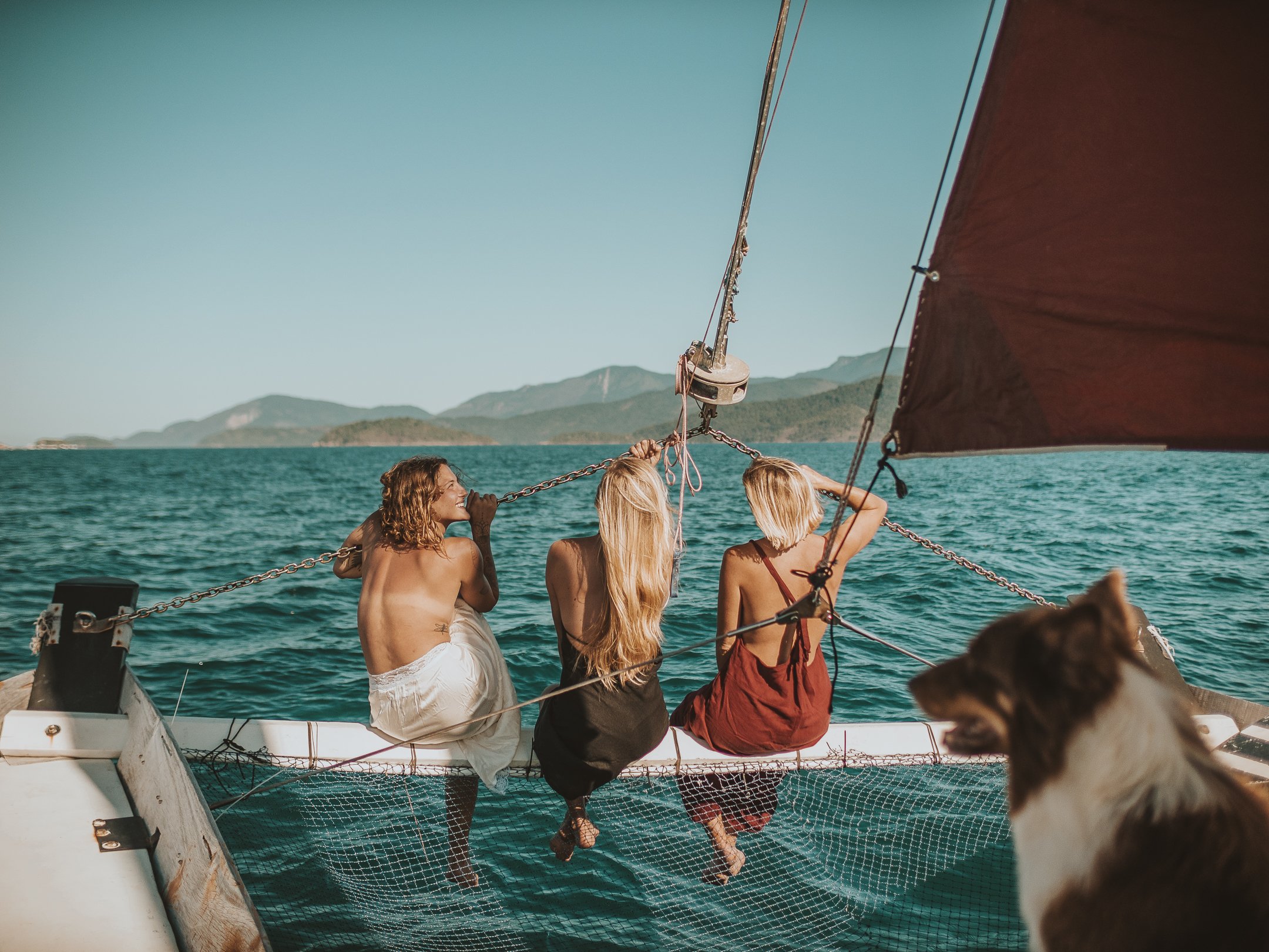
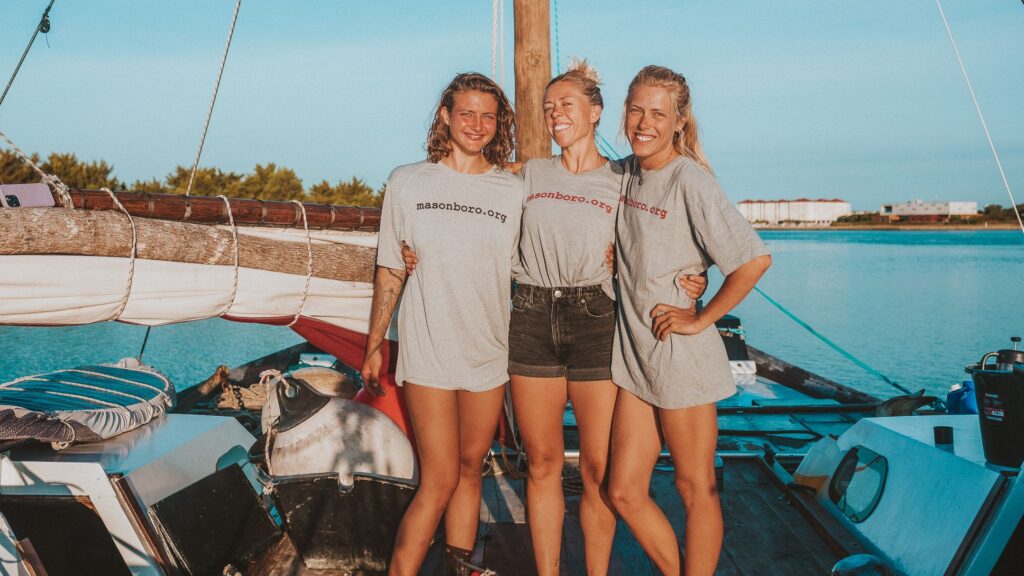
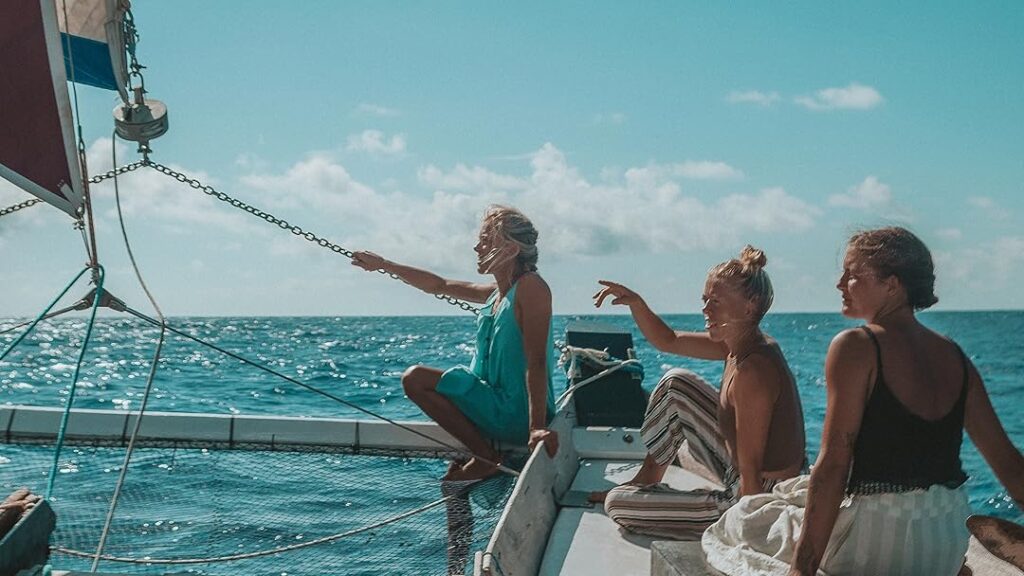
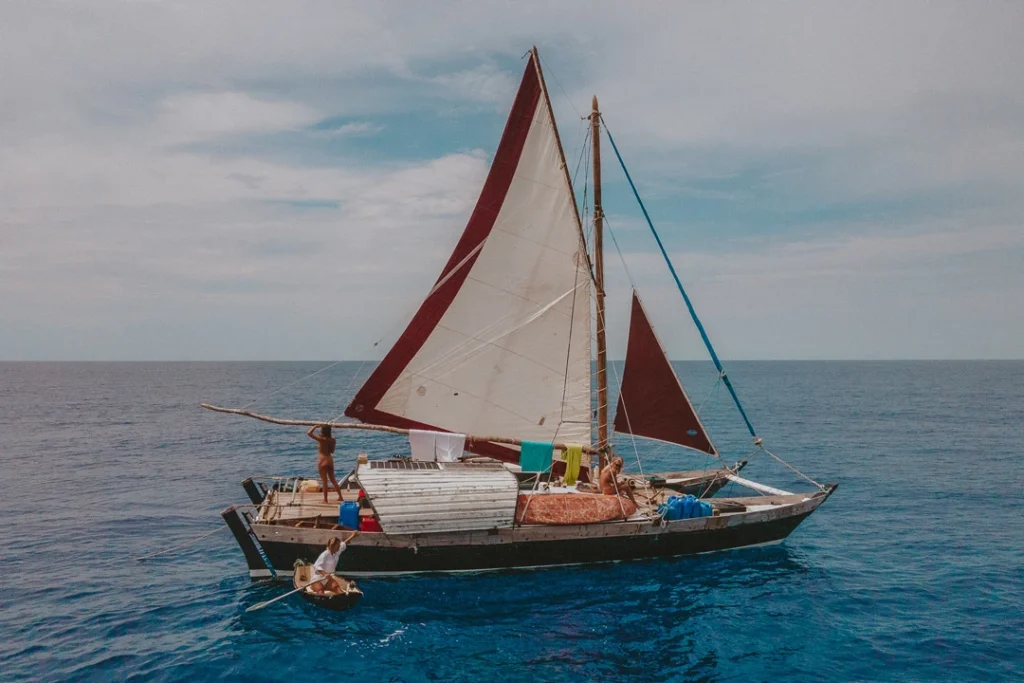
In 2022, three women sailed a 50-year-old wooden catamaran across the North Atlantic without an engine. Their route followed the trajectory of the ocean’s plastic pollution: the same currents that carry the debris from the coastlines of the world to the accumulation zones of the open ocean carried their boat westward from the Canary Islands to the Caribbean.
The documentary they made from the voyage, Women & the Wind, is one of the most honest accounts of what the ocean actually is that I have seen produced from a sailing vessel, and the reason it is honest is the same reason that most sailing media is not: the boat was too old and too simple and too real to allow the voyage to be anything other than what the ocean made it.
The boat was a Wharram-designed catamaran from 1971. Wooden. Restored by hand by Kiana Weltzien and Lærke Heilmann over a year of sawing and sanding and painting in the Florida heat before it was ready to cross the Atlantic. No engine. No generator. No watermaker. No infrastructure between the three women and the ocean except the hull that their hands had made seaworthy and the sails that the wind filled and the specific knowledge of what to do when the wind was absent or too much.
They sailed into the plastic gyres of the North Atlantic and documented what they found there and what it did to them and what the ocean, seen from that specific proximity without the buffer of the modern yacht’s systems, actually looks and smells and feels like.
We have been watching Women & the Wind since it was released and we want to describe what it means for the Naora voyage and why we are proud to support and amplify what Kiana and Lærke and Alizé Jireh built from that crossing.
The Same Water
The Naora voyage crosses the same North Atlantic that Women & the Wind documented. The Canary Islands to the Caribbean is not a section of the route that we avoid: it is the Atlantic crossing that every westbound circumnavigation makes, in the northeast trade winds, through the waters where the North Atlantic Gyre concentrates the plastic debris of the European and North American coastlines into the specific accumulation zones that the Women & the Wind documentary documents from within.
The Naora crew and members will see what the Women & the Wind crew saw. Not the mediated version of it, not the photograph of the ocean’s surface from an altitude that removes the specific texture of what is floating on it, but the view from the deck of a boat that is in it: the water that is sometimes clear and sometimes not, the debris that the Atlantic crossing produces as a daily encounter rather than a shocking exception.
This is the reality that the offshore sailing life provides that the land-based environmental campaign cannot: the encounter with the ocean’s actual state from the specific vantage point of the person who is inside it for three weeks rather than reporting on it from a distance.
The Naora members who cross the Atlantic will cross it with the specific awareness that Women & the Wind produced in everyone who watched it: the awareness of what the ocean contains and what it has been absorbing and what the trajectory of the plastic pollution, which follows the same trade wind currents that carry the boat, means for the places the circumnavigation visits across the following four years.
What the Documentary Asks and What We Do About It
Women & the Wind does not offer solutions. It offers the encounter: the three women in the Atlantic with the plastic that shares their ocean, the specific quality of what it produces in the person who is present for it without the distance that the documentary format usually maintains between the audience and the reality it describes.
The documentary asks, by showing rather than by arguing, the question that the offshore sailing life consistently poses to the people who are in it long enough: what is the relationship between the vessel that crosses the ocean and the ocean that the vessel crosses, and what does the person in the vessel owe to the ocean that carries them?
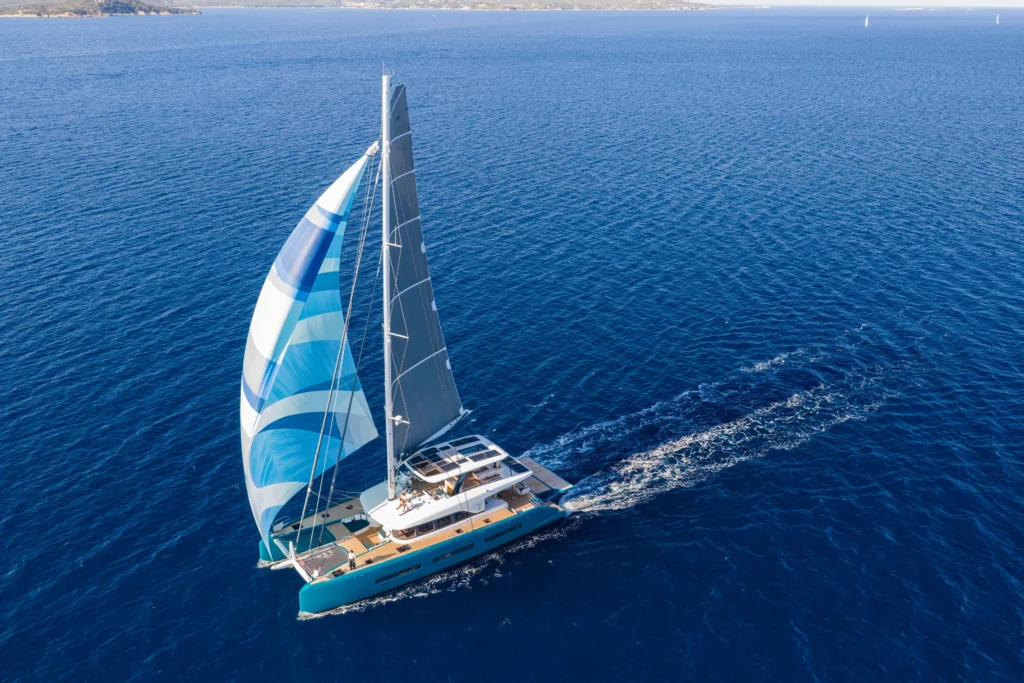
The Naora voyage has been thinking about this question since the beginning of its planning, and the answers it has arrived at are the specific choices that the Eighty2’s configuration reflects. Not as marketing. As the operational expression of the same values that the Women & the Wind documentary expresses in its documentary form: the belief that the ocean is not infrastructure for the sailing life but the specific environment that the sailing life is a guest in, and that the guest’s relationship with the host environment should reflect the guest’s understanding of what the host environment actually is.
We Make Our Own Water
We carry two independent watermaker systems: an AC primary and a DC backup, each capable of producing the fresh water the voyage requires from the seawater the ocean provides. The watermakers are the specific technological expression of the same principle that the Women & the Wind voyage demonstrated in its most basic form: the boat that is self-sufficient in fresh water is the boat that does not need to take what is scarce from the ports it visits, that does not add to the demand on the freshwater infrastructure of the remote island communities whose lagoons the Naora route anchors in, that carries its water production capability with it rather than depending on the places it visits to provide it.
In the outer Tuamotu atolls, the atolls that the Women & the Wind route crossed in the North Atlantic’s equivalent current system, fresh water is one of the most precious resources available. The communities that have lived on the atolls for generations have developed the specific knowledge of how to collect and store the rainwater that the atoll’s flat profile and limited catchment area produces.
The visiting boat that depletes the atoll’s fresh water supply for its own use is the boat that has not understood the relationship between the visitor and the place visited. The Naora watermaker is the piece of equipment that ensures the Eighty2 is never that boat.
We Only Take What We Need From the Ocean
The Naora voyage catches fish. The trolling line runs on the offshore passages and spearfishing provides protein at anchor. The fishing and the spearfishing are part of the voyage’s food provision system and they are part of the connection between the boat and the food environment that the Women & the Wind documentary celebrates in its account of the three women’s relationship with what the ocean provided during their crossing.
The principle that governs the fishing is the principle that the Women & the Wind crew applied to their relationship with the ocean throughout their crossing: take what is needed for feeding, nothing beyond. Not the sportfishing model where the catch is the trophy and the release is the statement. Not the commercial model where the catch is the maximum the line can produce.
The offshore subsistence model: the fish caught for the meal that the boat requires, in the quantity that the meal requires, from the species and the location that the spearfisher’s knowledge identifies as the right choice for the conditions. This is the oldest relationship between the sailor and the sea’s food system and it is, in the specific context of the circumnavigation, the only relationship that is sustainable across five years of presence in the same waters that the voyage is committed to protecting.
Nothing Goes Overboard
The Women & the Wind documentary follows the trajectory of plastic pollution across the North Atlantic. The Naora voyage has watched this documentary and its waste management system is the operational response to what the documentary shows.
The organic waste, the food preparation waste and the plate waste and the galley waste that a boat producing three meals a day for twelve people generates continuously, is processed through the onboard composting system that the Eighty2’s configuration includes. Composted organic material is not waste: it is the nutrient return that the food system requires and that the offshore composting system converts from the galley’s output to the garden soil that the boat carries for the deck herb cultivation that the chef uses for the fresh aromatics that the local markets do not always provide.
The grey water, the cooking and washing and cleaning water that the domestic life of twelve people aboard generates, is processed through the grey water treatment system before any discharge occurs. The specific treatment standard that the Eighty2 maintains meets the marine environment’s requirements rather than the minimum legal standard that the vessel’s operational area happens to require: the same standard in the outer Tuamotu as in the European marina, because the outer Tuamotu’s lagoon is not less deserving of the standard that the European marina’s inspection regime enforces.
The sewage treatment is the most specific and the most important of the waste management systems: the fully operational marine sanitation device that processes the biological waste of twelve people to the treatment standard that the most sensitive marine environments require, with the overboard discharge occurring only after the treatment is complete and only in the conditions that the marine environment’s own standards identify as appropriate.
Our boat does not dump untreated sewage in the Coral Triangle. This should not be a statement that requires making. It is nonetheless a statement that needs to be made, because most boats that anchor in the Coral Triangle operate on the assumption that the volume of the ocean makes the volume of their untreated discharge irrelevant. It does not.
The plastic and non-organic waste is sorted and stored aboard until the boat reaches a port with the recycling infrastructure to handle it correctly. The Eighty2 carries the specific storage system that the accumulation of a voyage’s non-organic waste across the distances between ports with adequate recycling infrastructure requires: sealed, sorted, odour-managed, available for deposit at the specific facility in the specific port rather than at whatever port happens to have a bin near the dock.
This is the inconvenient standard rather than the convenient one. It is the standard that the Women & the Wind crew applied to their voyage in the specific way that a wooden boat with no generator and three people who understood what they were crossing applied it. It is the standard we apply with the systems that the Eighty2’s configuration makes available.
Why We Support Women & the Wind
We support Women & the Wind because the documentary does something that our voyage’s sustainability practices alone cannot do: it makes the ocean visible in the form that the person who has not been offshore cannot otherwise access.
The Naora member who crosses the Atlantic with the awareness that Women & the Wind produced in them is a different member from the one who crosses it without that awareness, and the voyage that builds on that awareness across five years of circumnavigation produces a different relationship between the community and the ocean than the voyage that treats the ocean as the backdrop for the sailing.
The three women in the 50-year-old wooden catamaran crossed the same North Atlantic that the Eighty2 will cross. They did it without an engine, without a watermaker, without the technical systems that the Naora configuration includes. They did it with the specific form of commitment to the ocean’s reality that the absence of those systems required of them: the full presence in the environment without the mediation of the infrastructure that the modern yacht provides and that sometimes prevents the relationship between the sailor and the sea from being as direct as the sea deserves.
We have the infrastructure. We have chosen to use it in the way that the Women & the Wind values inform. The watermaker that produces fresh water from the sea without taking it from the communities the voyage visits. The fishing that takes what is needed for feeding and nothing beyond.
The waste management that ensures nothing the Eighty2 produces enters the ocean in a form that should not be there. The community of twelve people who will cross the same waters that the Women & the Wind documentary describes, carrying the awareness of what the documentary showed and the commitment to the operational practices that express that awareness in the form available to a 24-metre offshore catamaran in continuous service across five years and four oceans.
Watch Women & the Wind. Then come back here and book the call. The ocean they documented is the ocean we sail. The awareness their voyage produced is the awareness the Naora voyage carries across it.