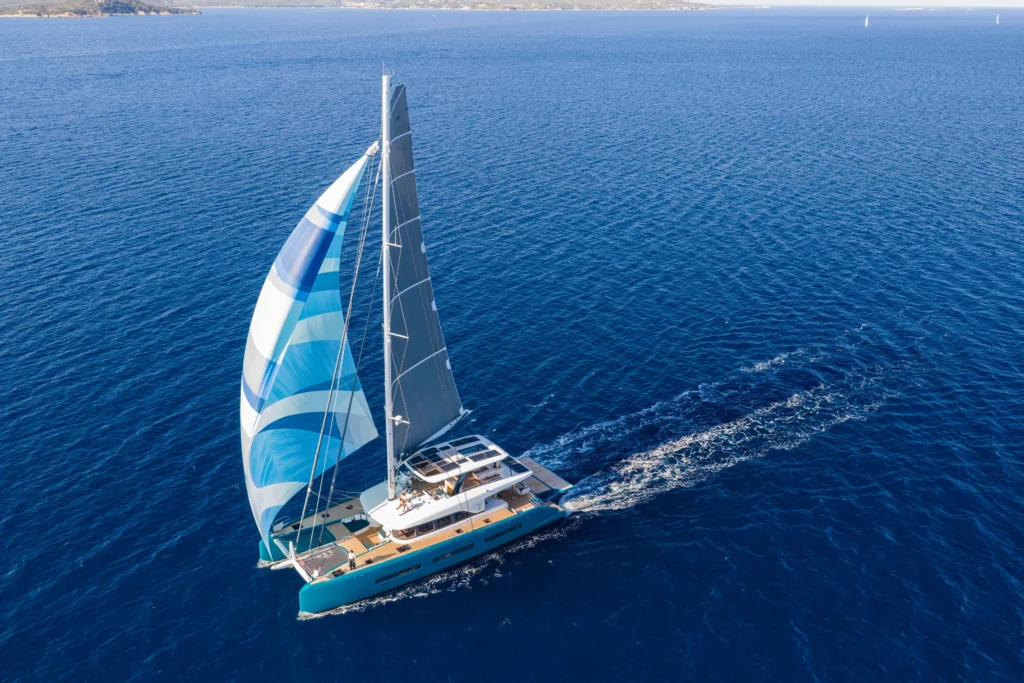
Most people, when they hear that life aboard involves a private cabin and a fully crewed luxury catamaran, assume that packing is not a particularly serious constraint. They are partly right. The cabin is private. The boat is comfortable. There is storage.
But the storage is finite in a way that a hotel room is not, and the nature of the space, and of the life that happens inside it, changes what you actually need in ways that take most people a day or two to understand and then a week or two to fully appreciate. What you pack for a month aboard Naora, and what you leave behind, says something specific about how you are thinking about the experience before you arrive. And what you wish you had packed differently, on the way home, says something about what the experience actually was.
This article is the honest version of the packing conversation. Not a gear list, which is the least interesting version of it. But an account of what the space on a boat does to the question of what you bring, and what it turns out you needed versus what you thought you would.
What the Space Actually Is
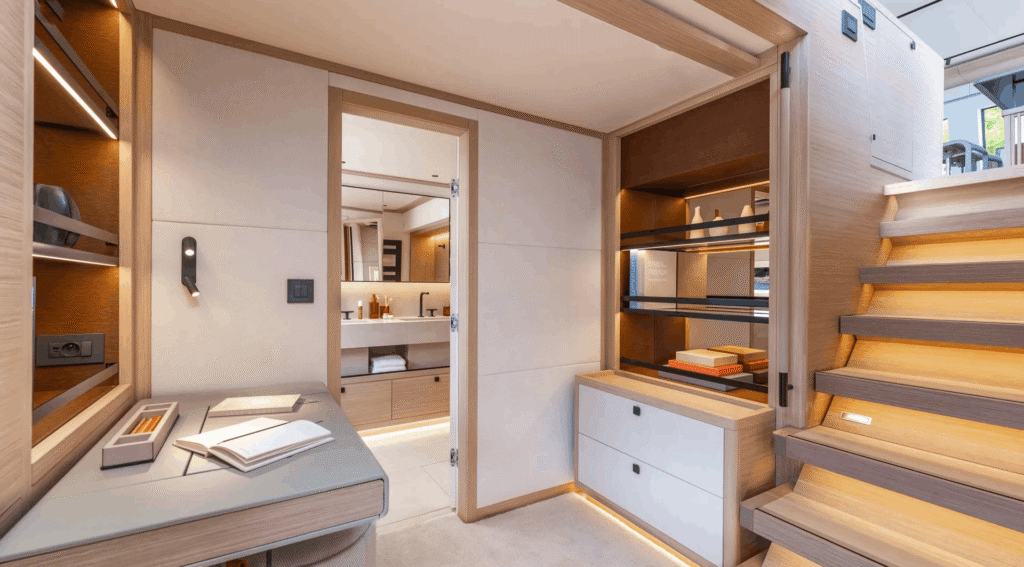
The cabins aboard the Lagoon Eighty2 are private double cabins with en-suite bathrooms. They are genuinely comfortable and genuinely compact. The storage is designed for offshore use: everything has a place, and everything in its place does not move when the boat does. This is a functional design requirement rather than a lifestyle constraint, but it has the effect of making the available storage finite and specific in a way that a wardrobe in a hotel room is not.
You will bring one bag. Possibly two if one of them is soft and compressible. A hard-sided suitcase is possible in port but becomes a problem on passage when it needs to be stowed somewhere that it will not shift. Most experienced sailors travel with one medium-sized soft duffel and a smaller bag for daily items. After one passage, almost everyone who brought more than this understands why.
The other relevant fact about the space is what happens in it. You are not living in the cabin. You are sleeping in it, occasionally changing in it, and storing things in it. The rest of your time is on deck, in the cockpit, in the salon, ashore, in the water, or in the galley. The cabin is where you put things down and where you sleep. It is not where you live. This changes the calculus of what you actually need to have with you.
What You Actually Wear
The clothing question is where most people over-prepare the most dramatically. A month aboard Naora, in the Mediterranean or the tropics, requires less clothing than most people pack for a long weekend in a city. Not because the social standards are lower, but because the social context is completely different.
The daily uniform at sea is simple: a swimsuit, shorts or a light sarong, a t-shirt or linen shirt, and something warmer for the night watch or a cooler passage. That is genuinely most of what you wear for most of the days. Ashore in the evening, one or two pieces that feel slightly more intentional than a swimsuit. For the Circle gatherings and the Long Table evenings, the Naora maritime attire takes care of the question for you.
The items that people consistently bring too much of: formal clothing, shoes of more than two or three pairs, evening wear for occasions that never materialise in the form imagined, and anything that requires special care or that cannot get wet. The items that people consistently wish they had brought more of: high-quality sun protection, good sunglasses, a light merino layer for the night watch, and one excellent pair of water shoes that work both in the water and briefly ashore.
What You Bring That Has Nothing to Do with Clothing
The more interesting packing question is not what to wear. It is what to bring for the hours. A passage from the Canaries to the Caribbean is seventeen to twenty-two days at sea. A week in the Ionian Islands might be anchored and ashore most of the time but with passage days between islands where there is nothing to do except be on the boat. What fills those hours matters more than what you wear during them.
Books are the most valuable cargo most people bring and consistently the one they wish they had brought more of. The reading that happens on a passage is qualitatively different to reading at home, and the books that sit in a bag at home for three months because there is never quite time get finished in four days. One book per week is a reasonable baseline for a passage. Most people bring two or three and run out.
A notebook. Not a device. A physical notebook, with a pen that works in humidity. The writing that happens on a passage, particularly after the 48-hour rule has done its work, benefits from the particular quality of attention that handwriting rather than typing produces. Several Naora members have arrived home with notebooks they did not expect to fill and which have turned out to be among the most useful things they brought.
Music that works without streaming. Download before you leave. The question of what to listen to on a night watch in the middle of the Atlantic, when there is no signal and the stars are out and the boat is moving steadily, is one worth thinking about in advance.
What to Leave Behind
The packing question that most people find hardest to answer honestly is what to leave behind. Not the physical items, though those matter. The other things. The habits and tools and reflexes that go with you everywhere on land and that, on a boat, either do not fit or simply do not apply.
Work. Not entirely, and not necessarily. But the version of work that requires constant availability, that treats every hour of the day as potentially productive in the conventional sense, that checks the inbox reflexively before anything else in the morning. That version of work does not fit on a passage. Not because the boat lacks connectivity, though on offshore legs it does.
But because the quality of what the passage offers is incompatible with that mode of attention, and one of them will win. The members who arrive having made an active decision about this, having genuinely delegated what needed to be delegated and set expectations with whoever needed to know, get the most from the time aboard. The ones who did not are the ones checking their satellite communicator at the Long Table.
The need to be comfortable. Not comfort itself, which the boat provides in considerable measure. But the requirement that every condition be optimal before you can be fully present. The wind picks up on a passage day and the motion becomes more active. The anchorage you planned to stop in is untenable in the actual swell and you sail on to a different one. The fresh produce you expected to find in the last port was not there and dinner is built around what the fishing line produced instead. None of these things require equanimity, but they reward it, and the people who bring the least of the requirement-for-comfort get the most from every version of the day.
| Bring more of | Bring less of | Leave behind entirely |
|---|---|---|
| Books, at least one per week | Formal clothing | Hard-sided luggage |
| A good physical notebook and pen | Shoes beyond two or three pairs | The assumption of constant connectivity |
| One excellent merino layer for night watches | Anything requiring special care | The need for every condition to be optimal |
| Downloaded music and podcasts | Devices beyond one phone and one reader | The sense that time not spent productively is wasted |
| Good water shoes | Anything that cannot get wet | A rigid plan for how each day will go |
What You Come Home With
The interesting version of the packing question is not what goes into the bag at the beginning. It is what comes out of it at the end, and what comes home that was never in the bag at all.
Most people return from a Naora passage with less in their bag than they left with. Things left behind in ports because they turned out not to be needed. Items given away to local communities because carrying them further seemed less interesting than the lightness of not doing so. The bag that arrives home is usually simpler than the one that departed.
What comes home that was never packed is harder to list. A clarity about something that was unclear before. A decision that felt impossible on land and obvious by the third week at sea. A friendship formed in the specific way that only shared physical experience produces, with someone met on the boat who is now part of the life. A recalibrated sense of what actually matters and what was simply loud.
That is the real packing list for a Naora passage. Not the duffel with the linen shirts and the books. The willingness to arrive with less than you think you need and to leave with more than you expected.