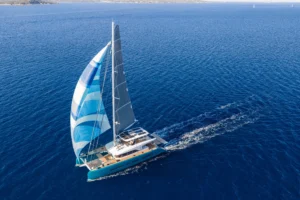
There is a shelf above the chart table on the Eighty2 that holds most of what I consider essential reading for the passages ahead. Not novels, though I read those too when the passage allows. Pilot books. Almanacs. Ocean passage guides. Cruising notes from sailors who came before us through the same waters and wrote down what they found. The accumulated knowledge of the offshore sailing community, printed and bound and stacked in the order of the route.
I read before I sleep. Not always for long. Sometimes for twenty minutes, sometimes for two hours if the passage ahead is demanding and the research is required. But the habit is consistent: the day’s sailing has been done and the night watch has been briefed and the weather has been checked one final time, and then I read. It is not always sailing material. But when it is, it is the specific kind of reading that has shaped how I think about the ocean across 25 years of offshore passages.
The Pilot Books
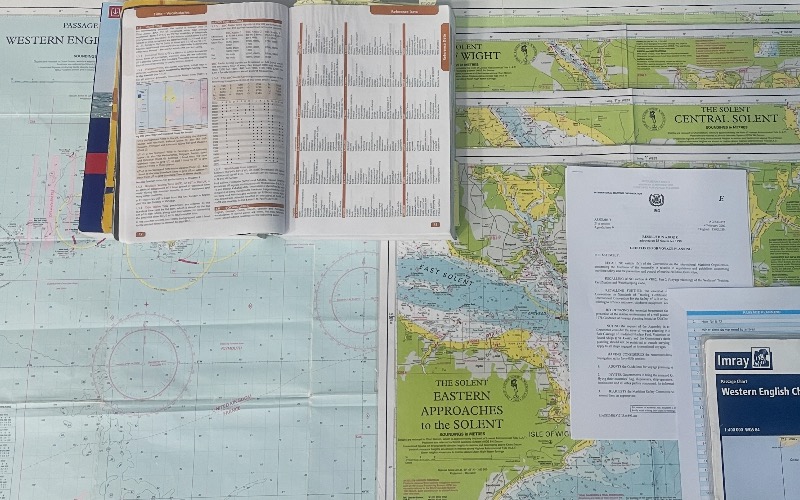
The pilot book is the foundation of offshore passage planning, and the quality of the pilot book determines the quality of the planning. A good pilot describes the coasts and ports and anchorages of a region with the specific detail that charts cannot carry: the prevailing wind direction at different times of year, the current patterns in the channels and straits, the specific hazards that are not marked on the chart because they were not there when the chart was surveyed, the local knowledge that accumulates through generations of sailors working the same waters.
The Admiralty Pilots, the Reed’s, the Imray guides, the specific regional pilots for waters like the Pacific Islands Pilot or the Red Sea Pilot: these are the books that live permanently on the shelf above the chart table. Some of them are marked extensively: pencil notes in the margins from previous passages, pages flagged for specific anchorages, passages underlined because they describe something I want to remember when we arrive. A well-used pilot book is a conversation between the author and the sailor who has been using it, accumulated in the margins across multiple seasons.
The Ocean Passage Guides
Ocean Passages for the World is the book that plans circumnavigations. Published by the UK Hydrographic Office and revised periodically, it describes the recommended routes for ocean passages across the world’s major sea areas, based on the prevailing wind and current patterns, the seasonal weather systems, and the accumulated experience of commercial shipping and offshore sailing across two centuries. It is dry and technical and absolutely essential, and I have read specific sections of it more times than I can count.
The value of Ocean Passages is not primarily in the routes it recommends, which are often well-known to anyone who has studied the relevant ocean. It is in the depth of the explanation: why the recommended route is recommended, what the alternative routes involve, what the seasonal variations mean for departure timing, and what the specific hazards and opportunities of each ocean passage are. Reading it alongside the weather routing software, which shows the current model forecast, produces the combination of historical pattern and current prediction that good passage planning requires.
The Logbooks of Previous Passages
I keep my own logs from every passage I have made and I read them occasionally, not from nostalgia but from instruction. A log from a previous Atlantic crossing tells me things about that specific passage that I will not remember without the record: the exact weather sequence, the routing decisions and why they were made, the systems issues that arose and how they were resolved. Reading a previous log before a similar passage is one of the most efficient preparation tools available because it is entirely specific to the conditions and decisions of someone who has made exactly this passage before: me.
The Naora voyage has its own Logbook, the physical record kept by the Circle that travels with the boat through the five years. I also keep the captain’s log, which is the technical record: daily entries of position, weather, course, speed, and any notable events. Between these two records, the passage exists in a form that can be returned to and learned from in ways that memory alone cannot support. The log is not nostalgia. It is research for the next passage.
The Books That Are Not About Sailing
The reading that is not about sailing is the reading that keeps the mind from becoming only a sailing mind, which is a limitation I have seen in experienced offshore sailors and that I actively try to avoid. The history of the places we visit. The biology of the reefs we dive. The anthropology of the Pacific communities whose hospitality we rely on. The specific accounts of the explorers and navigators who came before us through the same waters, which contextualise the current passage within the larger history of human movement across the ocean.
Bernard Moitessier, who sailed the Southern Ocean in a way that has never been repeated. Eric Tabarly, whose offshore racing changed how Europe thought about performance sailing. Joshua Slocum, whose single-handed circumnavigation in 1895 to 1898 produced the book Sailing Alone Around the World, which is still one of the finest accounts of offshore sailing ever written and which I reread before every significant passage. These men understood the ocean differently to the chart and the weather model, and reading them reminds me that the ocean is older and larger and more indifferent to my planning than any software suggests.