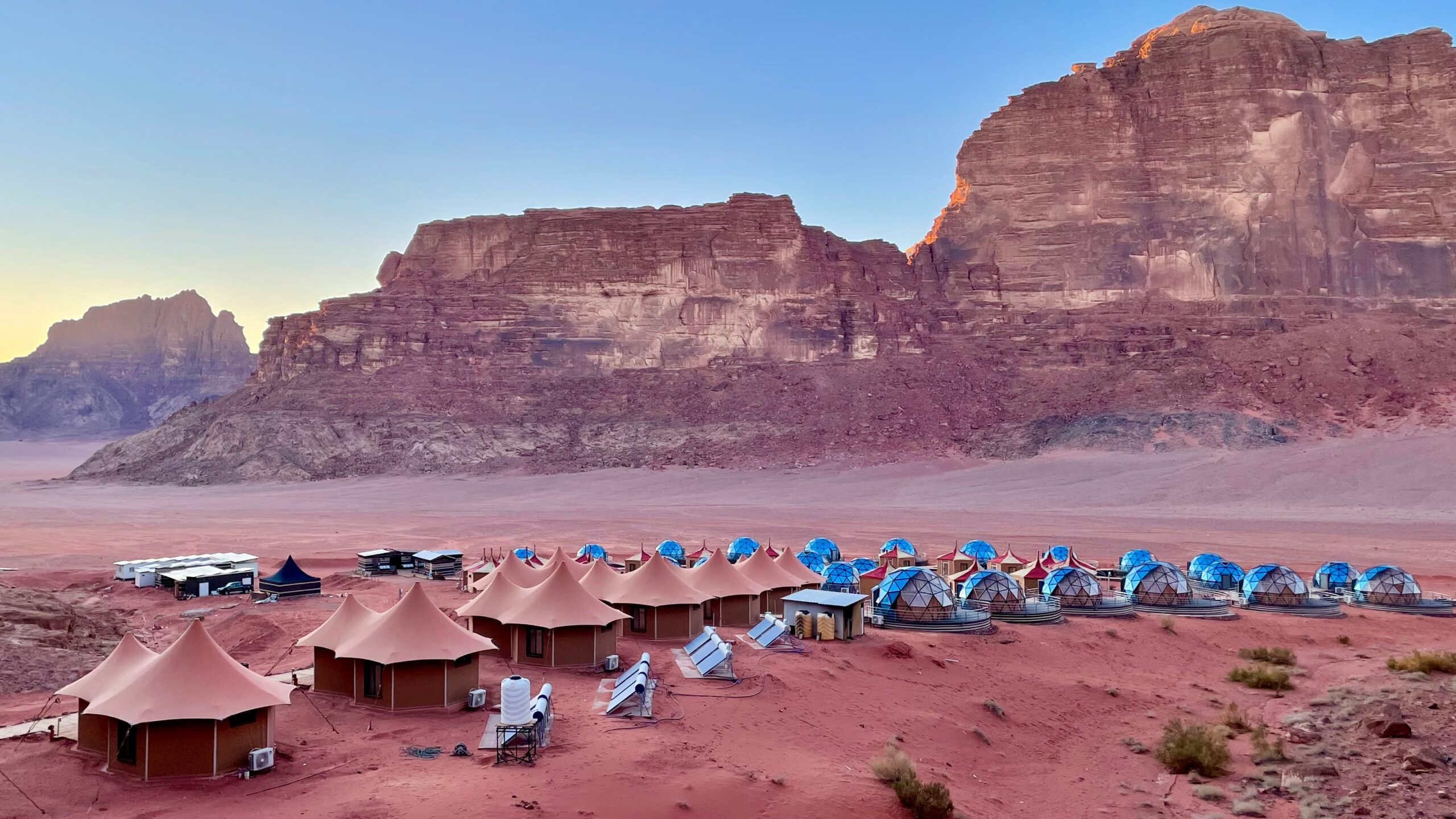
In Wadi Rum, the edge of a sandstone shadow can feel more definite than the edge of a room. Outside it, light comes back from the sand into your face; a few steps inside, the glare eases and your shoulders begin to relax. The air need not be much cooler for the body to notice the absence of direct sun. It is a small distinction, and a useful one. A desert day planned around distance alone misses much of what determines how that day will feel: where shade will fall, when walking will be comfortable, and how much time remains before dark.
Coming here from Aqaba changes the scale of a Red Sea visit. The yacht remains close enough to return to, but the landscape asks for another kind of attention. At sea we read moving surfaces. Here we begin with something that appears motionless, then discover that water, wind and human passage have been working through it for a very long time.
Reaching Wadi Rum From Aqaba
Allow roughly an hour to an hour and a half by road from Aqaba to the Wadi Rum visitor centre, depending on the departure point and road conditions. That is a planning estimate, not a promise of arrival at a camp. The visitor centre is a threshold. Meeting a guide, transferring to a suitable vehicle and travelling farther into the protected landscape all take additional time. Confusing the road journey with the whole transfer is how a generous afternoon becomes a hurried one.
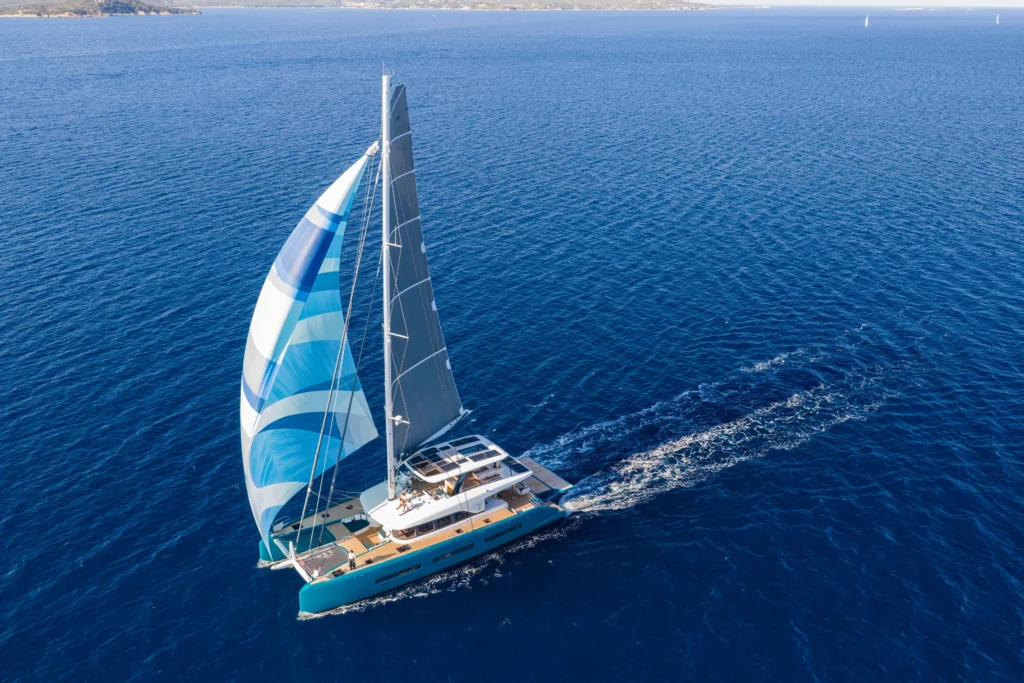
Before any of that, there is the yacht. An Aqaba visit depends on current entry requirements, local restrictions and conditions. Clearance, permission to remain and a suitable berth or permitted anchorage come before plans inland. Discovery is a Lagoon Eighty2 sailing catamaran; a marina must confirm a berth appropriate to her dimensions rather than simply report that it has space. At anchor, permission alone says nothing about shelter, holding ground or the room needed if the wind changes.
Northerly winds commonly funnel along the Gulf of Aqaba. The forecast for the hours we intend to be away matters as much as the conditions when we step ashore. Sven, Naora’s founder and captain, plans every weather window and sails every leg himself. An inland visit belongs within that passage planning, with responsibility aboard, communications and the return arrangement settled before departure.
A vehicle outing of three to four hours can give a useful introduction to the desert, but that duration should not become a demand to fit every named formation into the afternoon. Ask what the proposed route involves: how much driving, how much walking, how much exposed scrambling. For a family, a long shaded pause may be worth more than another stop. The useful agreement with a guide concerns the shape of the day, not merely the number of places visited.
What The Sandstone Actually Records
The sandstone is easier to understand if we stop treating it as a single monumental object. Some of it began as sediment roughly 500 million years ago. That number describes the age of the deposited material, not the age of the cliffs as we see them now, and certainly not the age of a particular arch. The grains, their consolidation into rock, the exposure of that rock and its erosion into its present form belong to different stages of the story.
Look for layers within a face and for angled bands inside those layers. Such structures can preserve the movement of sand before it became stone. Elsewhere, older crystalline granite gives the landscape a different texture. The contrast matters: rocks respond differently to weathering, and the desert’s forms are partly an expression of those differences, not simply the work of wind on an otherwise uniform surface.
Wind carries loose sand and can abrade exposed rock. Water, despite its infrequency, can do substantial work when rain gathers and runs through fractures and channels. Joints guide the weakening of a wall; material falls away; a harder section may remain above an opening. A stone bridge such as Um Fruth is therefore a surviving structure within an ongoing process. Its apparent solidity should not be confused with a reason to climb it.
The distinction between seeing a formation and standing on it is worth keeping. Exposed sandstone can be sandy underfoot, and the descent may ask more of balance than the ascent. Footwear, confidence and the guide’s assessment should determine the decision. Remaining on the ground is often the better way to see the architecture of the opening, including the part hidden from someone concentrating on where to place a foot.
Why Wadi Rum Resembles Mars
The red colour has a material explanation. Iron oxides in and on the sandstone grains contribute to the warm tones; related compounds also help give Mars its familiar reddish appearance. Low sunlight changes the balance again, warming the light while extending shadows across the faces. Colour and relief become unusually legible together. This is why the landscape can seem more sharply constructed near sunset than under the flatter glare of midday.
The resemblance has made Wadi Rum a convincing screen double for Mars. Calling somewhere a planetary analogue, however, requires a narrower meaning than saying that it looks right in a photograph. A useful analogue reproduces a particular feature or problem. Sandy terrain might be relevant to movement across a surface; a certain rock might be relevant to a geological comparison. Neither makes the atmosphere, temperatures or working conditions equivalent. Appearance alone does not establish a scientific testing programme.
For us, the more important limitation of the comparison is human. A camera can frame a wall and a stretch of sand so that the place appears uninhabited. It cannot show, within that frame, all the knowledge that makes moving through the landscape possible: where a track leads, which approach becomes difficult after rain, where shade lasts, who lives nearby.
The temptation is to praise Wadi Rum for looking like another planet. Staying longer makes that description less adequate. The desert becomes more interesting as an inhabited place on this one.
The History Beyond Lawrence
Lawrence remains part of the way many visitors first encounter Wadi Rum. During the Arab Revolt, the capture of Aqaba in 1917 opened a strategically important connection to the sea. The successful approach came from inland rather than through a frontal attack from the water. For someone arriving aboard a yacht, that reversal is worth holding in mind: the port’s significance cannot be understood by looking only out across its bay.
Lawrence was one participant in a much larger Arab campaign. Allowing his name to stand for the whole history obscures the people whose leadership, fighting and knowledge of the terrain made that campaign possible. The same narrowing happens at individual stops. A place called Lawrence’s Spring encourages the visitor to organise everything nearby around one biography, even when the evidence on the rock belongs to a much longer history.
Petroglyphs and inscriptions are different things. Some marks are images worked into the surface; others are writing. They can belong to different periods and require different knowledge to interpret. Older inscriptions around sites associated with Lawrence should not be folded into his story or casually described as his autograph. A good guide should be able to distinguish an established identification from a local association, and leave uncertainty intact where it belongs.
There is a practical consequence to taking these marks seriously. Do not wet them to improve contrast, trace them with chalk or rub the surface for a photograph. Looking in angled light can reveal more than touching. The restraint is modest, but it recognises that the next person should encounter the same surviving surface, not one altered for our convenience.
Moving Through Heat And Shade
Spring and autumn often offer a more forgiving balance between daytime heat and evening cold, but a season is only the beginning of a decision. Wind can lift sand and make an exposed stop unpleasant. A cloudy day can still bring substantial sun exposure. Winter nights can approach 0°C, which gives a very different meaning to an overnight stay from the one suggested by an afternoon photograph of warm red rock.
Clothing should answer both ends of the day. Light coverage protects skin during the walk; a warm layer becomes useful once the sun leaves the ground. Closed shoes are more dependable than boat footwear on loose stone. Water belongs with each person during a walk, not entirely in the vehicle, and the amount carried needs to reflect the heat, effort and distance from resupply. Dry air can remove sweat quickly enough that exertion feels less obvious than it is.
A narrow canyon offers shade, but it is also a drainage route. Rain elsewhere in the catchment can matter even when the sky directly above seems reassuring. The weather assessment therefore has to include the surrounding area, and a local guide’s knowledge does not remove the need to reconsider a route after a warning. A cancelled canyon walk is a sound decision when water may be coming through it.
The guide should also know about mobility limitations before choosing the route, not discover them below a scramble. Inside a vehicle, check the seating and restraints rather than letting the informality of a desert outing lower the standard expected on the road. These are ordinary precautions. Their value is that they leave the attention free for the place.
When the vehicle stops and its engine falls quiet, wait before moving on. Wind may still pass over the ridge while the hollow beside the wall remains sheltered. Sand shifts beneath the heel; a small stone gives a harder, distinct sound. What first seemed like silence separates into several sounds once conversation pauses.
Tea And The Time To Listen
Bedouin hospitality should not be treated as a performance attached to the landscape. A glass of tea is an invitation into a social moment, even when it forms part of a paid guiding day. The professional arrangement deserves clarity and fair treatment; the person offering hospitality deserves more than being reduced to a photograph of that arrangement.
Tea is commonly served sweet, with herbs varying by household and what is available. Ask rather than assuming a single authentic recipe. A small glass can be hot at the rim even when it looks ready to drink. Waiting gives conversation room to begin without forcing it. There is no obligation to extract a story, and no reason to assume that a guide wants to discuss private family life because the visitor has become curious.
Ask before photographing people, particularly children and anyone inside a domestic space. Follow the host’s lead about seating and shoes. These small acts are more useful than trying to memorise an elaborate code of manners. So is accepting that contemporary Bedouin life includes vehicles, phones, education and businesses. Knowledge of the desert does not depend on living outside the present.
If a meal is part of the arrangement, establish that beforehand. Zarb, meat and vegetables cooked in a covered pit using retained heat from a fire, needs preparation and time. The enclosed heat cooks differently from an open grill; the pit is an oven, not simply a picturesque way to present dinner. It is something to ask about, not assume every host will produce at short notice.
Sourcing locally means allowing that time and respecting what is actually available. It also means leaving packaging and leftovers with a proper disposal arrangement rather than imagining that a vast landscape can absorb them without consequence.
Sunset And The Decision To Stay
Staying for sunset is worthwhile when it does not make the return careless. The colour changes before the sun disappears, as one face remains illuminated while another loses its warmth. A stop chosen for the light may be some distance from the place where a road vehicle can collect you. The guide and driver need the same understanding of the meeting point and timing. Darkness should be part of the plan, not a surprise discovered after the photograph.
An overnight stay changes the visit more substantially than another hour of driving among formations. It also introduces different questions. How far is the camp from vehicle tracks? How bright are its exterior lights? What bedding is provided for the season? What are the washing and toilet arrangements? A comfortable answer is one that matches the people going, including anyone who may find cold, unfamiliar footing or interrupted sleep difficult.
A clear night does not automatically mean the darkest sky. Moon phase, dust, cloud and nearby lighting all matter. Give your eyes twenty to thirty minutes away from bright screens and lamps before judging what is visible. Repeatedly checking a phone works against that adjustment. Modest, carefully directed light helps with footing without requiring everyone nearby to begin adapting again.
At Naora, members choose when they join, where along the worldwide route they step aboard and how long they remain. Discovery continues around the world beyond each individual stay. That freedom creates room for different shore days: someone may want the desert night, someone else the familiar quiet of their cabin. Neither choice needs to become the standard for everyone. The limits are the safe operation of the yacht, local arrangements and the next weather window.
What the overnight offers is time after the most photographed part of the day. The tea glass is empty. The ground begins to release its warmth, and a layer that felt unnecessary in the vehicle becomes welcome around the shoulders. Beyond the light near the camp, the sandstone loses its colour and then its detail. Only the outline remains.