I have heard the objection enough times to address it directly. It usually comes from sailors, which is the right kind of person to raise it. Sailors who know what they are talking about, who have spent real time on the water, who have a specific and legitimate set of values about what sailing is and what it demands.
The objection goes something like this: it is a catamaran, it is crewed, there is nothing technical to learn, it is a floating hotel for people who want the aesthetic of sailing without the sailing. Why would a serious sailor choose this over a sailing school, a delivery, or their own offshore passage on a proper monohull?
It is a fair challenge. I want to answer it properly, not defensively, and not by dismissing the values behind it. Those values are real. The sailing I am describing is real. And the argument that Naora offers nothing to the experienced or technically ambitious sailor is, I want to demonstrate, wrong.
The Monohull Argument and What It Gets Right
Let me start by acknowledging what is true in the objection, because there is something true in it and pretending otherwise would be dishonest.
A monohull in a stiff breeze heeled to twenty degrees, requiring active sail trim, constant weather helm management, and the physical engagement of a crew that must brace, adjust, and respond continuously to what the boat is doing: this is technically demanding sailing. It teaches you things.
The relationship between heel angle and speed, the feel of a boat overpowered and the correction required, the specific skill of helming a heavy displacement monohull in confused seas on a long tack: these skills are real, they require practice, and the best way to develop them is to sail a monohull in conditions that demand them.
A sailing school in a fleet of small keelboats in the North Sea, or a delivery passage on a 40-foot sloop from the Cyclydes to the Azores, or a crewed race around the Fastnet: these are genuine technical sailing experiences that develop specific skills that a Naora passage does not develop in the same way. I say this as someone who has done all of them. They are excellent. They are not the point.
The point is that the argument conflates technical sailing skill with sailing knowledge, and the two are different things. Sailing knowledge, real bluewater sailing knowledge, is not primarily about what you can do with a boat in a harbour or a race course or a coastal passage. It is about what you understand about the ocean, about weather systems over thousands of miles, about navigation across featureless water for weeks at a time, about the management of a vessel and a community of people in conditions that the Solent and the Irish Sea and the Bay of Biscay, challenging as they are, do not fully prepare you for.
What the Eighty2 Actually Demands
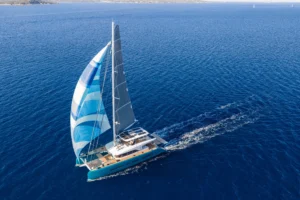
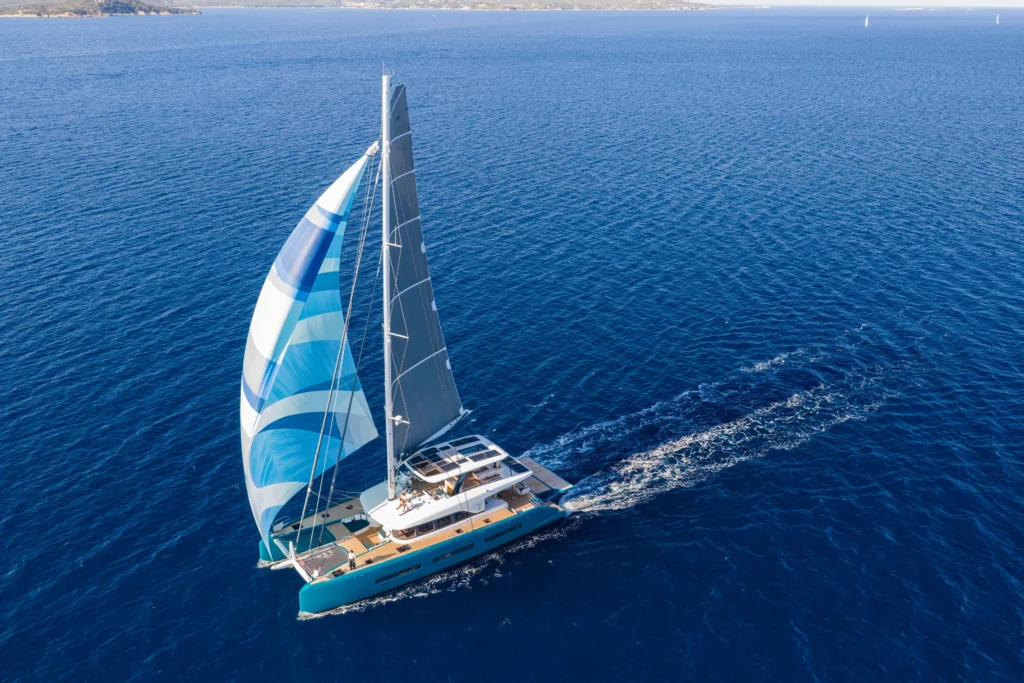
The Lagoon Eighty2 is not a simple boat. It is 24 metres long, displaces 76 tonnes, carries 340 square metres of sail area, and operates in every ocean on earth across a five-year circumnavigation. Managing this vessel competently is a specific and demanding technical challenge that is entirely different from sailing a 40-foot monohull around a coastal circuit, and in several ways more demanding.
The sail area alone is instructive. 340 square metres of sail on a vessel that does not heel to depower is a sail plan that requires continuous active management across a wide range of conditions. A catamaran cannot spill power by heeling: when the wind increases, the response must be reefing or sail reduction, executed on a boat where the loads on the mainsail and the traveller and the sheets are substantially larger than on any monohull of comparable length. The mainsail management on the Eighty2 in building conditions is not passive. It requires judgment, timing, and the physical capability to execute a reef efficiently under load.
The passage planning for a five-year circumnavigation is a technical exercise of a complexity that most sailors, however experienced, have not encountered. Reading weather models for a 2,700-mile Atlantic crossing and making the routing decision that puts the vessel in the best position for the full length of the passage, not just the first three days: this is navigational and meteorological work that goes well beyond coastal passage planning.
The atoll navigation in the Tuamotu, using three independent information sources simultaneously with the bow lookout as the final safety override: this is technical seamanship that no coastal sailing environment produces. The tidal current planning for the passages through the Indonesian straits, where the streams run at six to eight knots and the timing must be exact: this requires a specific kind of tidal and current knowledge that extends well beyond what most bluewater sailors have needed.
The serious sailor who joins Naora and pays attention will observe all of this. Not from the helm of a 26-footer in a Force 6, but from the navigation station of a 24-metre offshore vessel conducting a five-year circumnavigation. The scale is different. The sophistication of the problems is greater. And the opportunity to understand how they are solved, alongside the person who is solving them, is not available anywhere else.
What You Will Learn That You Cannot Learn Any Other Way
This is the argument I want the serious sailor to sit with, because it is the one that most directly addresses the objection.
Ocean passage making at the level of the Naora circumnavigation involves a body of knowledge that is not taught in any sailing school and cannot be acquired by any sequence of shorter coastal passages, however numerous. It is knowledge that accumulates only through extended offshore time across multiple ocean basins, in genuinely varied conditions, with a navigator who has already accumulated it and who can explain, in real time, why each decision is being made.
Weather routing across ocean scales. The difference between a five-day coastal forecast and a three-week passage planning exercise using long-range models is not a difference of degree. It is a difference of kind. The skills required to plan and execute an ocean crossing using GFS and ECMWF model data, professional weather routing services, and the accumulated experience of reading how the models perform in specific ocean conditions: these are not taught in any sailing course available in Europe. They are learned by doing them, alongside someone who has done them many times.
Celestial navigation as a practised skill. We navigate by celestial observation on ocean passages: sun sights at noon, star sights at twilight, the traditional confirmation of GPS position by independent means. For the serious sailor who understands that offshore navigation capability means independence from electronic systems, watching celestial navigation used as a working tool rather than a curiosity is a specific and valuable experience. There is the opportunity to learn it in the context in which it actually applies: in the middle of an ocean, with a sextant, with the horizon as the reference.
Atoll navigation by water colour, satellite imagery, and bow lookout. This is one of the most specific and most transferable navigation skills on the Naora route, and it is one that no textbook and no coastal passage teaches. Reading deep blue against pale turquoise against dark coral at the speed of an approaching atoll pass, with the sun at the right angle and polarised glasses and the responsibility of a 66-tonne vessel behind you: this is a skill that takes time to develop and that we have developed across many seasons. The serious sailor who is alongside him for this process learns more about visual navigation in one Tuamotu entry than in a year of coastal sailing.
Offshore systems management at scale. The Eighty2’s systems are the systems of a serious offshore vessel: watermaker, 300-bar diving compressor, satellite communication, complex electrical systems managing solar, wind generation, and diesel generation simultaneously, twin engines with the specific maintenance requirements of long-distance offshore operation.
Managing these systems across a five-year circumnavigation is a seamanship challenge that goes well beyond what any coastal sailor has encountered. The serious sailor who pays attention to how this is done learns more about practical offshore boat management than any course provides.
The Watch System and Actual Offshore Helming
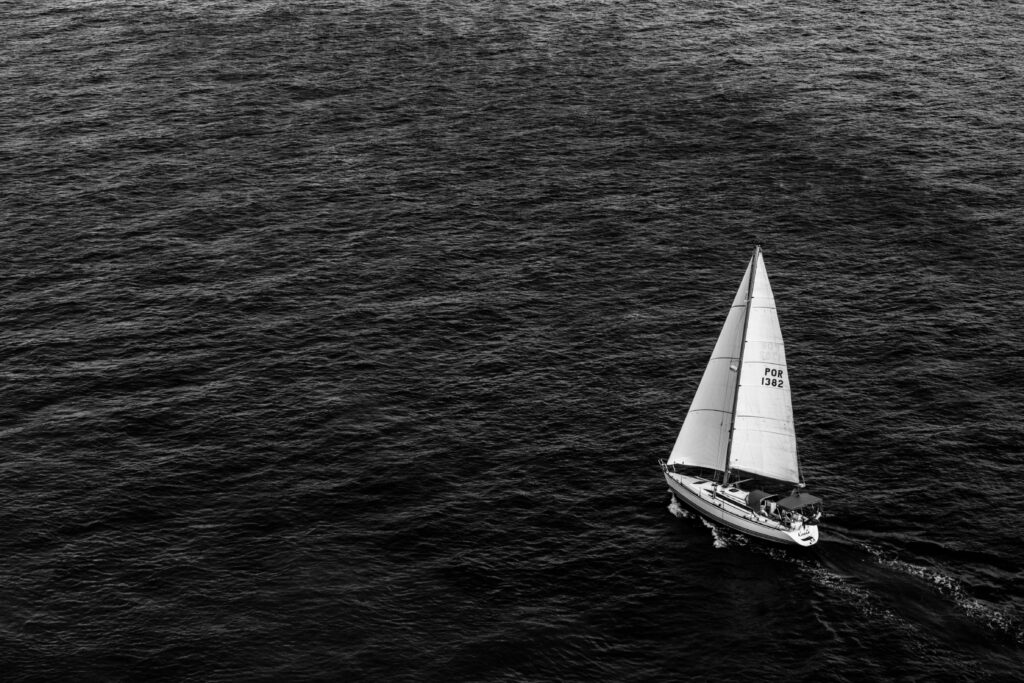
The objection that a crewed vessel offers no helming experience is directly addressable. Members who want to helm the Eighty2 do so. The watch rotation on offshore passages is open to members who want to be part of it. Steering 24 metres and 66 tonnes of catamaran in a trade wind sea state, maintaining course against the swell and the wind, feeling the difference between the autopilot’s response and the helm’s response in varying conditions: this is helming. It is different from helming a 35-foot monohull in a coastal race. It is not lesser. In several respects, including the load management and the situational awareness required at this scale, it is more demanding.
The night watch on a passage puts the member in the situation that the serious sailor specifically values: sole responsibility for the vessel’s safety during the watch period, in open ocean, with the instruments as the only reference and the judgment as the only check. The instruction available from Sven and the crew before and during the watch is the instruction of professionals with combined offshore experience that no sailing school faculty can match. And the ocean crossing at the end of the watch is real: the distance covered is real, the conditions were real, the decisions made were real and had real consequences.
The OCC Qualifying Passage
For the serious sailor who is also an aspiring Ocean Cruising Club member, this is worth noting directly. The OCC qualifying passage requires 1,000 nautical miles non-stop offshore as skipper or certified crew on a vessel of 70 feet or less. The Eighty2, at 23.98 metres, qualifies. The Atlantic crossing from the Canaries to the Caribbean at 2,700 miles qualifies. The Pacific crossing from Panama to the Marquesas at 2,800 miles qualifies. Any of the Naora route’s major ocean passages, participated in as part of the watch rotation as certified crew, qualifies.
The serious sailor who joins Naora for an Atlantic or Pacific crossing and participates in the watch rotation as a working crew member can qualify for OCC membership from that passage. Sven is the Port Officer for the Belgian coast and an OCC member of many years and can confirm that these passage qualify and he will support any Naora member who wishes to apply on the basis of it. The blue and gold flying fish burgee has been earned by people who have made exactly this kind of passage, in exactly this kind of vessel, and the OCC has always understood that the quality of the offshore experience is not determined by the monohull configuration of the vessel that provided it.
The Argument in Summary
The serious sailor who chooses Naora is not abandoning their values. They are taking them somewhere that the Solent and the North Sea and the race circuit cannot take them: to the middle of the Pacific Ocean, where the weather routing decision they made three days ago is now visible in the conditions around the boat, where the atoll pass is being entered using three independent navigation systems, where the celestial fix confirms the GPS position at noon, where the watch rotation places real responsibility in their hands for real hours of ocean passage.
What Naora offers the serious sailor is not a substitute for technical sailing. It is the context in which technical sailing knowledge reaches its full application: the open ocean, at scale, in a vessel capable of going anywhere the wind allows, operated by professionals who have gone there many times and who are genuinely good at sharing what they know.
The monohull argument is an argument about the tool. This is an argument about the ocean. The ocean does not care what the boat is made of. It cares whether you know how to read it, how to navigate it, how to plan across it, and how to respect it. All of those things can be learned, applied, and deepened on the Eighty2. And some of them, specifically the ones that require thousands of miles of ocean rather than hundreds of miles of coast, cannot be learned anywhere else.
| The objection | The reality |
|---|---|
| It is a catamaran, not a real sailing boat | 340m2 of sail on 66 tonnes requires active, demanding sail management across all conditions. The loads are larger than on most monohulls. |
| It is crewed, so there is nothing to do | Watch participation, helming, reef management, anchor deployment, navigation input: all available to members who want them |
| You cannot learn to sail on a boat this size | You can learn ocean passage making, weather routing, atoll navigation, celestial navigation, and offshore systems management: none of which a smaller boat in coastal waters teaches |
| It does not heel, so it is not real sailing | A catamaran that cannot depower by heeling requires reefing discipline and sail trim judgment that a boat that spills power by heeling does not demand |
| The conditions are too comfortable | The Banda Sea in October, the Atlantic in winter, the Pacific squall line at night: the Naora route includes conditions that are as demanding as any passage in European waters |
| It will not qualify me for anything | Any major Naora ocean crossing qualifies as an OCC passage. Sven, as Belgian coast Port Officer, will support the application. |