
There are two logbooks on the Eighty2. The captain’s log and the Circle’s logbook. They are different objects serving different purposes, but they share the quality that distinguishes them from every digital alternative: they are physical, permanent, and irreplaceable. No server failure erases them. No software update makes them unreadable. No backup is required. They exist as ink on paper in a specific location on a specific boat, and they will continue to exist in that form for as long as anyone chooses to take care of them.
I want to explain why both of them exist and what each of them contains, because the logbook is one of the things that makes the Naora voyage specific rather than generic, and understanding it changes how you experience the record it is keeping.
The Captain’s Log
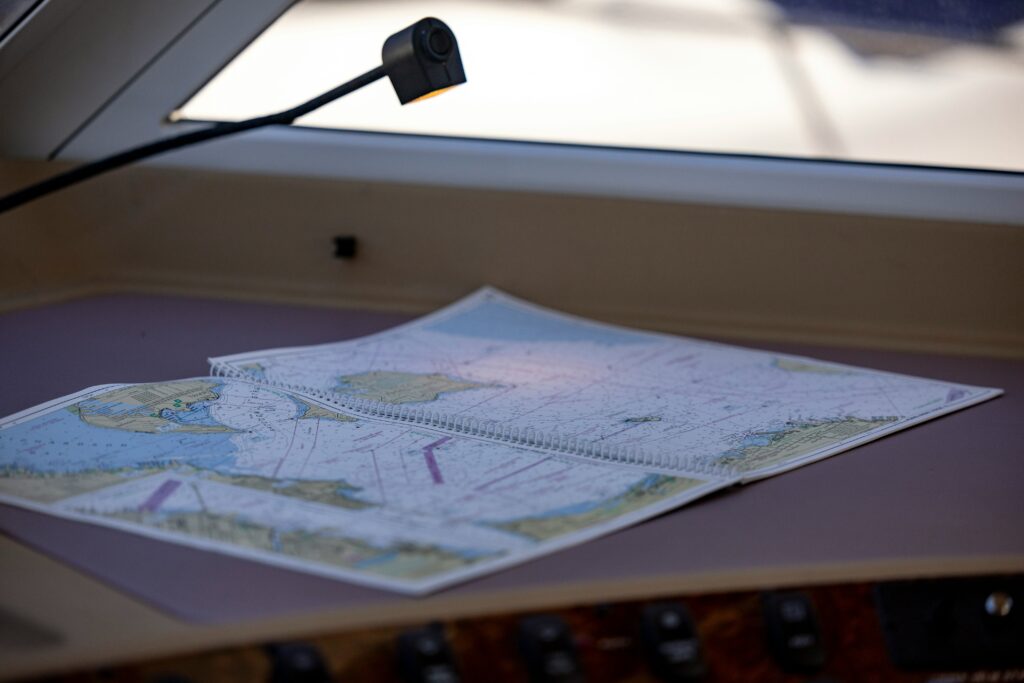
The captain’s log is a technical document. An entry every four hours, timed to the watch rotation: position in latitude and longitude, course over ground, speed over ground, wind speed and direction, barometric pressure and trend, sea state, visibility, any vessels in the AIS picture. Brief notes on anything significant: a system change, a course alteration and the reason for it, a weather development that differed from the forecast. The entry for the equator crossing. The entry for the Date Line. The entry for the first sighting of land after a Pacific crossing.
The captain’s log is a safety document, a legal document, and a navigational resource. If something goes wrong on a passage, the log is the record of what was known and what was done. If a question arises about the boat’s position at a specific time, the log answers it. If I want to understand how the weather developed on a previous passage through a specific area, the log tells me. It is also, read across five years and 45,000 miles, the most precise and complete record of a circumnavigation that most people ever produce: the whole journey in numbers and brief notations, entry by entry, four hours at a time.
The Circle’s Logbook
The Circle’s logbook is a different kind of document. It is not technical. It is communal: the record of who was on the boat at significant moments and what those moments were. Every equator crossing, with the names of the members present and the date and the position. Every first ocean crossing completed by a member who was on the boat for it. The Anchor Moments, where the tradition of the Circle requires a brief note on each new anchorage: who was there, when, and what the specific quality of the place was that justified the note.
The Circle’s logbook also holds the record of the Long Tables: the occasion, the person who opened the conversation, a sentence or two about where it went. Not a transcript, not a summary, but a mark that this conversation happened, in this place, with these people. The record that transforms a passing conversation into a located, dated, witnessed event that belongs to everyone who was there.
Your name will be in the Circle’s logbook if you make an ocean crossing aboard Naora for the first time. The entry is brief: your name, the date, the position, the names of the others present. Sven writes it and signs it and whoever is designated as witness on that passage countersigns it. It takes two minutes. It produces a record that will outlast every photograph taken on the passage and that exists in one specific form in one specific location on one specific boat.
Why Physical
The question of why the logbooks are physical rather than digital is worth answering directly because the answer is not simply tradition or romanticism. It is about the specific quality of a record that cannot be edited after the fact.
A digital record can be altered. Not easily, not without trace in a well-designed system, but it can be. A handwritten logbook entry cannot be altered in a way that is undetectable. The ink is where it is. The handwriting is what it is. The date was written when it was written. This quality, which maritime law has recognised since the earliest formal requirements for ship’s logs, is the quality that makes the physical record the definitive one: it is what happened, written at the time it happened, by the person who was there. Not what the system shows happened. What happened.
This matters for the captain’s log in the legal and safety sense. It matters for the Circle’s logbook in a different and perhaps more important sense: the record of your name at the equator, in your specific crossing on your specific day, is unedited and uneditable. It is a fact, physically fixed in a book that travels with the voyage from Bodrum to the return to the Mediterranean. This is the kind of permanence that a photograph, however beautiful, does not have. The photograph can be lost, the file corrupted, the account deleted. The logbook entry cannot be undone.