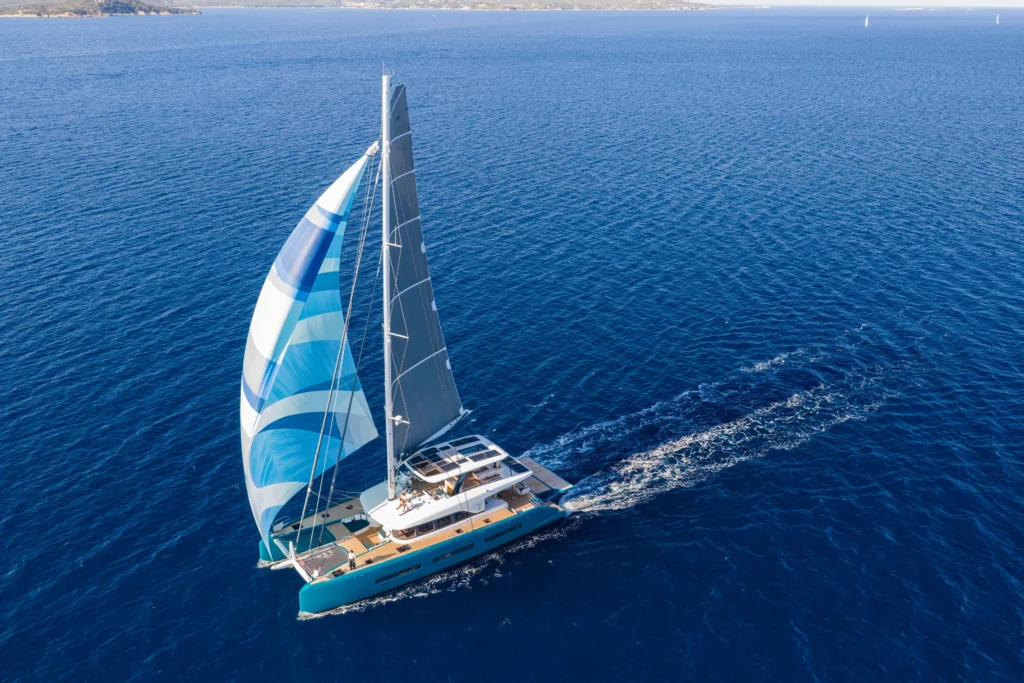
Every boat has a best seat. On the Eighty2, it is the flybridge: the elevated helm station above the salon, reached by a short ladder from the afterdeck, with 360-degree views of the water and the horizon and whatever the sky is doing. The sails are visible from here in their full extent. The bow wave is visible ahead. The wake is visible behind. The anchorage, when the boat is at rest, is visible in every direction without obstruction.
It is where Sven is when the boat is sailing and where members who want to understand what the boat is doing find themselves gravitating naturally within the first day. It is also the place that most rewards simply being in rather than doing anything specific from: the cushions, the shade from the bimini, the wind that is slightly stronger at height than on the afterdeck below, and the specific quality of watching the sea from above the surface rather than from it.
The Flybridge Under Sail
Under sail, the flybridge is the navigation and helm centre of the boat: the chart plotter, the instrument panel, the VHF radio, the controls for the autopilot and the sail systems, all centred around the helm position that gives the helmsman the clearest possible view forward and to both sides. When Sven is sailing the boat manually rather than on autopilot, he is at the flybridge helm. When a crew member is on watch, they are at the flybridge. When a member wants to take the helm for an hour on a trade wind passage, the flybridge is where they stand and where the instruments that tell them what the boat is doing are.
The view from the flybridge helm under sail is the finest view on the boat. The mainsail fills the upper field of vision ahead and to the left, the genoa extends forward and to the right, and between and around them the sea and the horizon are visible in a way that the afterdeck below does not fully provide. The motion is the same motion as the rest of the boat but felt differently from height: the swell passes beneath in a way that is more visible than felt, and the boat’s acceleration on a wave face and the deceleration behind it are visible as changes in the bow wave rather than primarily as physical sensation.
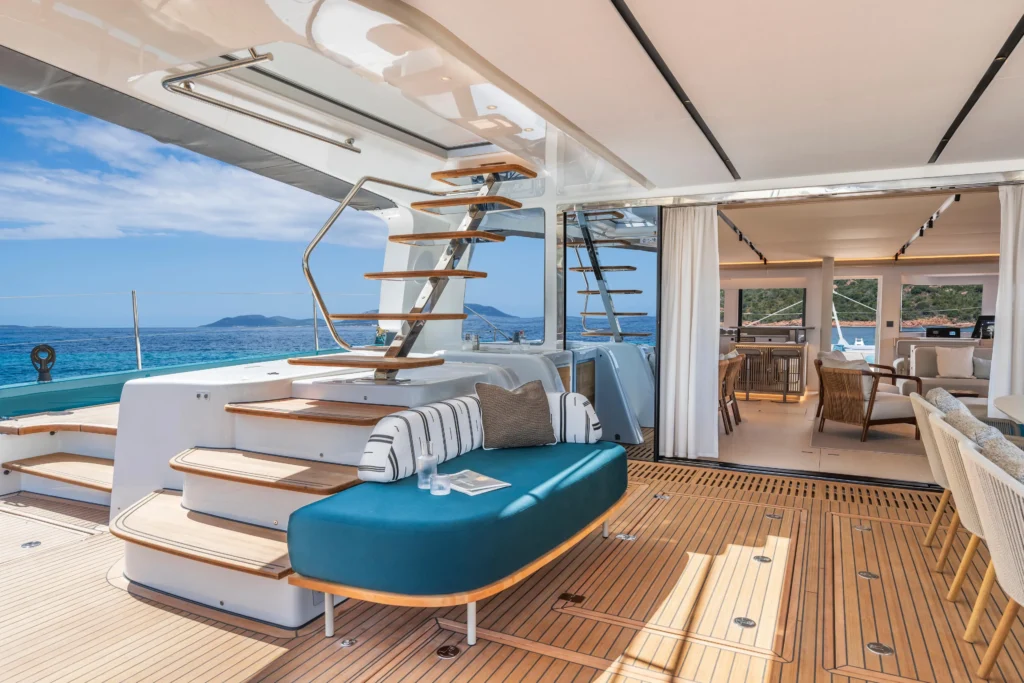
The Flybridge at Anchor
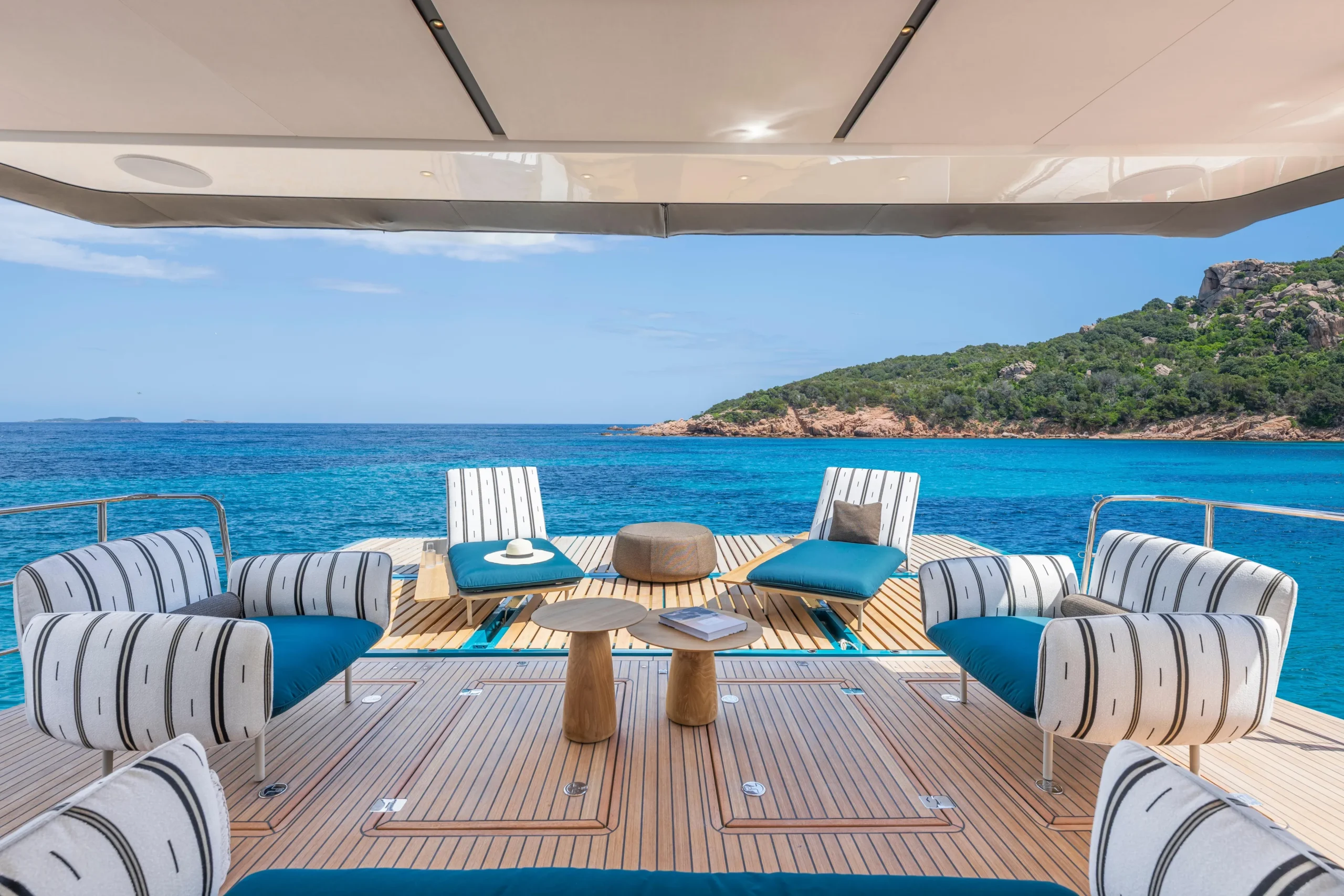
At anchor, the flybridge changes character. The instruments are still there but nobody is watching them with urgency. The helm is locked. What the flybridge becomes at anchor is the finest reading and watching and doing-nothing position on the boat: elevated enough to see over the boom and the bimini and the tender on the stern, shaded by the bimini, cushioned by the helm seat and the side benches, with the entire anchorage visible from a single position without needing to move.
The flybridge at anchor is also, importantly, slightly separate from the afterdeck’s social activity. When the group is gathered at the afterdeck table for the aperitif, the person on the flybridge is present but at one remove: visible, audible if the conversation is animated, but not in the circle. This is a useful social position on a boat where the communal spaces are genuinely shared and genuine solitude requires the cabin. The flybridge offers an intermediate state: company without full engagement, the option to re-enter the conversation at any moment and the equal option to remain in the elevated and pleasant distance until the dinner gathers everyone at the table.
The Flybridge at Night
The night flybridge, on a passage with clear skies, is one of the finest positions available to the human eye for watching the sky. Elevated above the deck lights, with the boat’s own light pollution minimised, the stars in the southern hemisphere especially are extraordinary from the flybridge on a moonless night in the trade wind belt. The Milky Way, which in the Northern European urban environment is a suggestion rather than a presence, is here a structure: dense and specific and bright enough to read by if the reading material were large enough.
The watch crew spends the night watch on the flybridge. Members who join the watch for a period stand on the flybridge alongside the crew. The specific experience of the flybridge at night, the instruments glowing faintly below eye level, the stars overhead, the bow wave occasionally luminescent with bioluminescence below, the horizon present in every direction as the slightly lighter darkness where the sky meets the sea: this is what the night watch offers that no other position on the boat provides. It is the best seat. At night, in the open ocean, it is the best seat available anywhere.