
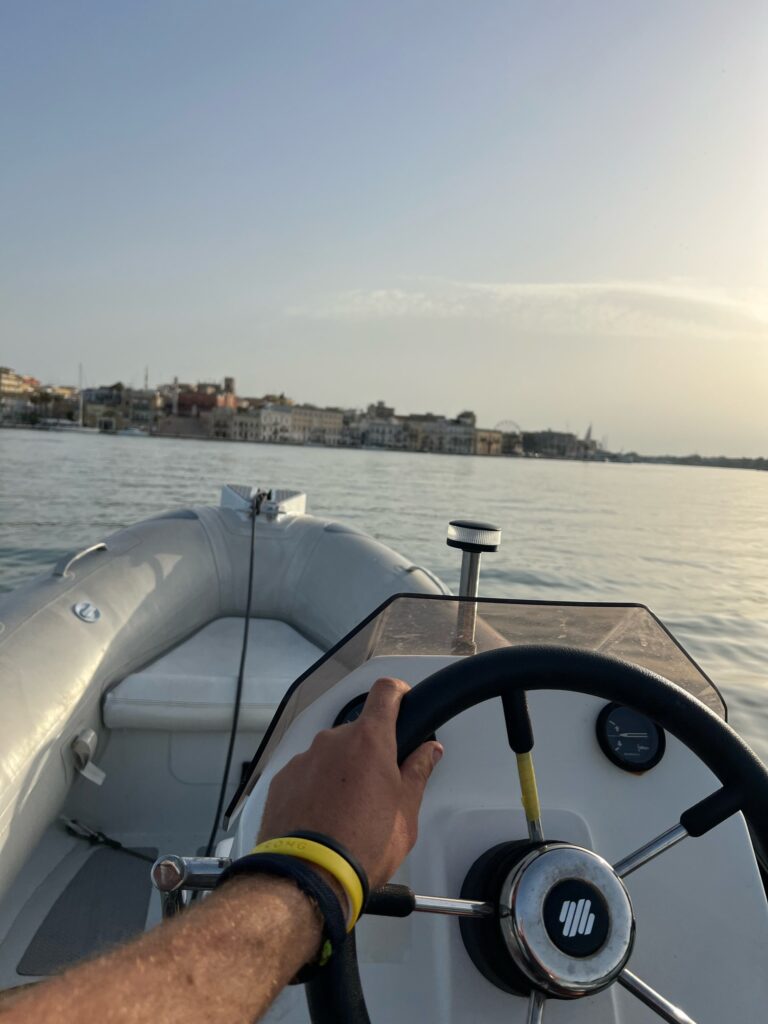
The dinghy ride from the boat to the shore is the shortest journey that produces the most specific feeling of transition. Not a commute, not a transfer: a crossing between two worlds that coexist in the same anchorage but that are genuinely different in what they are and what they require from the person moving between them. Two or three minutes in the rubber tender, the outboard pushing quietly, the boat behind growing smaller and the shore ahead growing larger, and for those two or three minutes belonging fully to neither.
I have made this crossing thousands of times across the sailing life and it has not become routine in the way that most repeated actions become routine. The specific quality of the in-between, the boat behind and the land ahead and the water between them, is renewed by every anchorage the boat enters because every anchorage produces a different version of both sides of the crossing.
The boat is always the same boat. The shore is always different: the village that was not visible from the anchorage becomes visible from the water level of the dinghy, the sounds of the land that the boat’s environment had reduced to background become specific and loud as the dinghy approaches the beach, the smells of the shore, the cooking and the vegetation and the specific organic warmth of land that the open water does not produce, arrive before the bow of the dinghy grounds on the beach.
What the Crossing Reveals
The dinghy crossing reveals the anchorage in a way that neither the boat’s perspective nor the shore’s perspective provides. From the boat at anchor, the shore is a backdrop: the hills above the bay, the village if there is one, the beach between them. From the shore, the boat is the visitor: the foreign hull at anchor in the local water, belonging here only temporarily.
From the dinghy in the crossing, both perspectives are available simultaneously and neither is dominant, and the specific quality of being genuinely between the two, moving from one to the other and attached to neither for the duration of the crossing, is a quality of perception that the sailing life provides and that I have found to be one of its most specifically useful gifts.
What I notice in the two or three minutes of the dinghy crossing is what I cannot notice from either the boat or the shore: the relationship between the two, how this anchorage sits in its bay, how the village above it relates to the water below it, what the scale of the boat looks like from the water level between the two scales of shore and sea. The dinghy crossing is the perspective that neither end of the journey provides, and the observations it produces are the observations that arrive in the specific window of transition rather than in the stability of arrival or departure.
Coming Back
The return crossing is different from the departure crossing. The departure is the crossing toward the unknown: the village that has not yet been entered, the market that has not yet been visited, the path above the bay that might lead somewhere worth walking to. The return is the crossing toward the known: the boat that is exactly where it was left, the cabin that is still the cabin, the community of the boat that has been doing its own things ashore or aboard during the hours the individual was away.
The specific quality of the return to the boat at dusk, after a day on shore in the village or the market or the hills above the bay, is the quality of returning to a home that moves. Not a fixed address that stays where you left it but a floating one that has been gently moving at its anchor across the hours of your absence, turning with the tide and the wind, and that presents itself at a slightly different angle each time the dinghy approaches it from the same direction. This is not instability. It is the specific character of the home that the sailing life provides: present, familiar, yours, and never quite identical to how you left it.