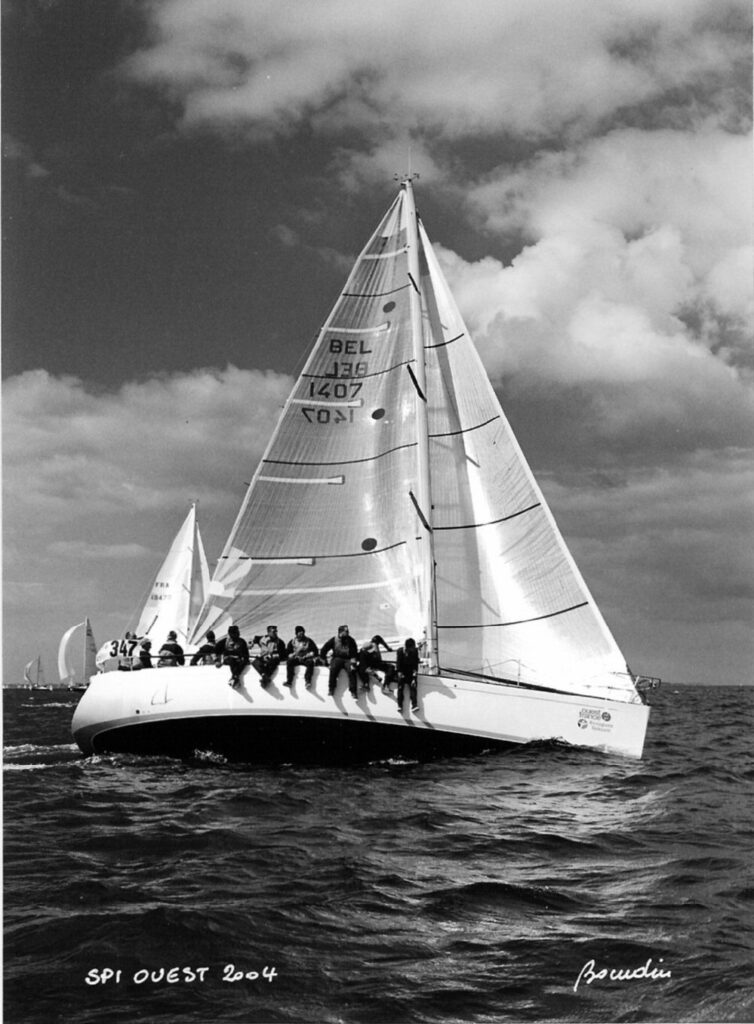
I want to say first that we were going fast. This is important context for what follows. We were at the front of the pack in the Spi Ouest France, one of the great offshore races of the European circuit, running the Breton coast in the specific conditions that the Bay of Biscay produces when it decides to be generous: the Atlantic swell from the west, the breeze in the right corner, the boat moving at the specific pace that makes the crew quiet in the way that crews go quiet when the boat is doing exactly what it is supposed to do and nobody wants to say anything that might change it. We were fast. We were where we wanted to be. The race was going well.
And then the helicopter arrived.
The Helicopter
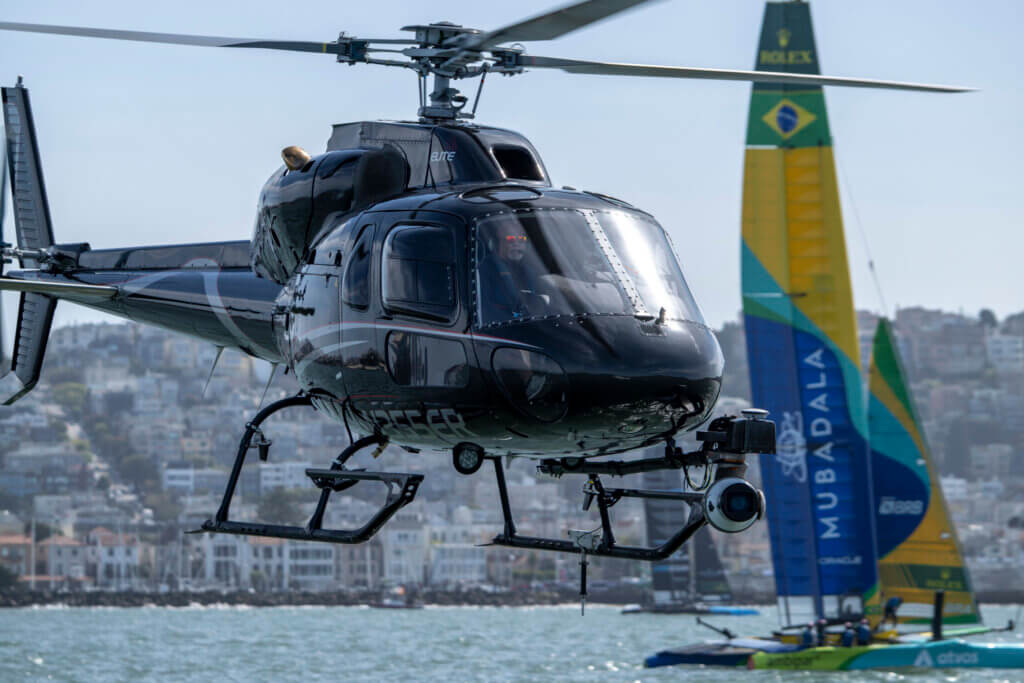
The Spi Ouest television coverage uses helicopters to film the fleet. The helicopters work the front of the pack because the front of the pack is where the interesting racing happens and where the images that make compelling television are most available. When you are at the front of the pack, the helicopter finds you. When the helicopter finds you, you hear it before you see it, the specific bass note of the rotors arriving over the wave noise and the rigging noise as the machine comes down to the altitude where the camera can fill the frame with the boat.
A racing crew’s correct response to a helicopter is no response at all. The helicopter is not part of the race. It does not affect the result, it does not change the wind, it does not alter the tactical situation. The correct posture is to continue doing exactly what you were doing before the helicopter arrived, with the specific indifference of people who are so focused on the race that the presence of a television camera overhead registers as background noise rather than as an event.
This is the correct response. It is also, in practice, extremely difficult to maintain when a helicopter is hovering thirty metres above your head and the camera operator is pointing the lens directly at the boat and you are at the front of the Spi Ouest going fast in good breeze on the Breton coast.
Sven and the Helicopter
Sven, to his credit and to the crew’s considerable amusement, did not maintain the indifference. What he maintained was the specific quality of someone who has been presented with something genuinely fascinating and who is constitutionally incapable of pretending otherwise. The helicopter came down to filming altitude and Sven, who was at the navigation station and who was at that moment supposed to be tracking the competition and reading the pressure band coming in from the west and calling the shifts that were going to determine whether we held our position or surrendered it, looked up.
Not a glance. A proper look. The look of someone who has noticed something extraordinary and who is taking the time to observe it correctly, which is exactly the quality that makes Sven a good navigator in every other context and which was, in this specific context, making him a temporarily distracted one. He watched the helicopter with the specific focused attention that he normally applied to the instruments and the horizon and the competition, and the helicopter, to its credit, did not seem to mind: it stayed, it circled, it came back for another pass, and Sven watched all of it with the expression of a man who was having a very good time and who had temporarily set aside the fact that we were racing.
The Team That Kept the Boat Going
This is where I want to be clear about something, because the story of Sven and the helicopter is also the story of the crew that was on the boat with him, and the crew’s contribution to this specific chapter of the Spi Ouest story deserves its full acknowledgment.
While Sven was engaged in his personal documentation of the helicopter’s filming technique, the boat continued to go fast. This was not an accident. The helmsman held the pressure. The trimmers watched the sail shape with the specific attention that the front of the pack in a good breeze demands. The tactician, whose job was to cover what Sven was temporarily not covering from the navigation station, absorbed the additional workload with the specific quality of a crew member who has been on enough boats to understand that the navigator occasionally needs a moment and that the appropriate response is to provide that moment without comment or complaint.
The boat did not slow down. The position in the fleet did not suffer. The race continued to go well despite the fact that our navigator was, for a specific and memorable period of it, more interested in the helicopter than in the competition.
This is what a good team does: it maintains the function when one of its members is briefly elsewhere, without drama, without the performance of complaint, without the specific dysfunction of the crew that requires everyone to be at full capacity simultaneously in order to operate at all.
The Spi Ouest team that held the boat at the front of the pack while Sven watched the helicopter was the demonstration, in miniature and in circumstances that were more amusing than dramatic, of exactly the quality that the Naora crew will need across five years of offshore sailing: the ability to cover, to adapt, to maintain the function when the situation requires it without waiting for the person who is usually responsible for the function to return from wherever they briefly went.
What the Helicopter Left
When the helicopter eventually moved on to the next boat, Sven returned to the navigation station with the specific quality of someone who has had a very good experience and who is not entirely sure how long it lasted. He looked at the instruments. He looked at the competition. He made a call on the pressure band from the west that was, as usual, correct. The boat continued to go fast. The race continued to go well. Nothing had changed except that everyone on the boat now had a story that would be told at harbour bars for the remainder of the season and that, twenty-two years later, I am still telling.
The helicopter came back one more time before the finish. Sven watched it again. The crew watched Sven watch it. The boat kept moving. Nobody said anything, because nobody needed to: the specific shared understanding of a crew that has been through something together and that finds the something genuinely funny rather than merely inconvenient was present in the silence that the helicopter’s second visit produced. We held our position in the pack.
We finished well. And somewhere in a television production company’s archive there is footage of the Spi Ouest front pack that contains, if you look for the boat with the navigator who is looking up instead of forward, a very accurate portrait of the man who is going to captain a five-year circumnavigation departing Bodrum in May 2027.
He was watching the helicopter. He was also going very fast. Both things were true simultaneously. This is, in my experience, an accurate description of Sven in most situations.