I have spent a significant part of my professional life facilitating conversations. Bringing people together across cultural and organisational distances, creating the conditions in which something honest can emerge between people who do not know each other well enough to be honest on their own. It is work I believe in and that I am reasonably good at, and the tools I have developed for it over twenty years of practice are genuinely effective in most contexts.
The sea is better at it than I am.
I say this not to diminish the value of what professional facilitation produces, which is real and important in the contexts it serves. I say it because I have observed, repeatedly and without exception, that the quality of conversation that emerges between people who have been at sea together for more than 48 hours exceeds the quality of conversation that the most carefully designed facilitated process produces on land. Not in every dimension, not for every purpose, not at every moment. But in the specific dimension that I care about most: the willingness to say what is actually true rather than what the social situation appears to require.
What the Sea Does to Conversation
The sea removes the audience. This is the most important single thing it does to conversation, and it is something that no facilitated process on land can fully replicate because even the most carefully constructed off-site or retreat exists within a social field that connects back to the office and the hierarchy and the reputation that the participants are managing continuously whether they are consciously aware of it or not.
At sea, specifically on an offshore passage, this social field contracts to the boat. The people you are talking to are the only people who will hear what you say. There is no back channel, no follow-up email chain, no conversation that will be reported to someone who was not present. What is said on the boat stays on the boat in a way that is structural rather than promised: the physical separation from the wider social world makes the privacy real rather than asserted.
The other thing the sea does is remove the time pressure that most conversations on land are conducted under. There is no meeting after this one. There is no next agenda item. There is the afternoon, and the watch change at four, and the meal after that, and the evening. If a conversation starts in the morning and takes all day, the day is available. This changes what people are willing to explore. The topics that require sustained attention, that cannot be resolved in the twenty minutes between the previous meeting and the next one, become available. The thinking that needs to unfold rather than be delivered finds the space it needs.
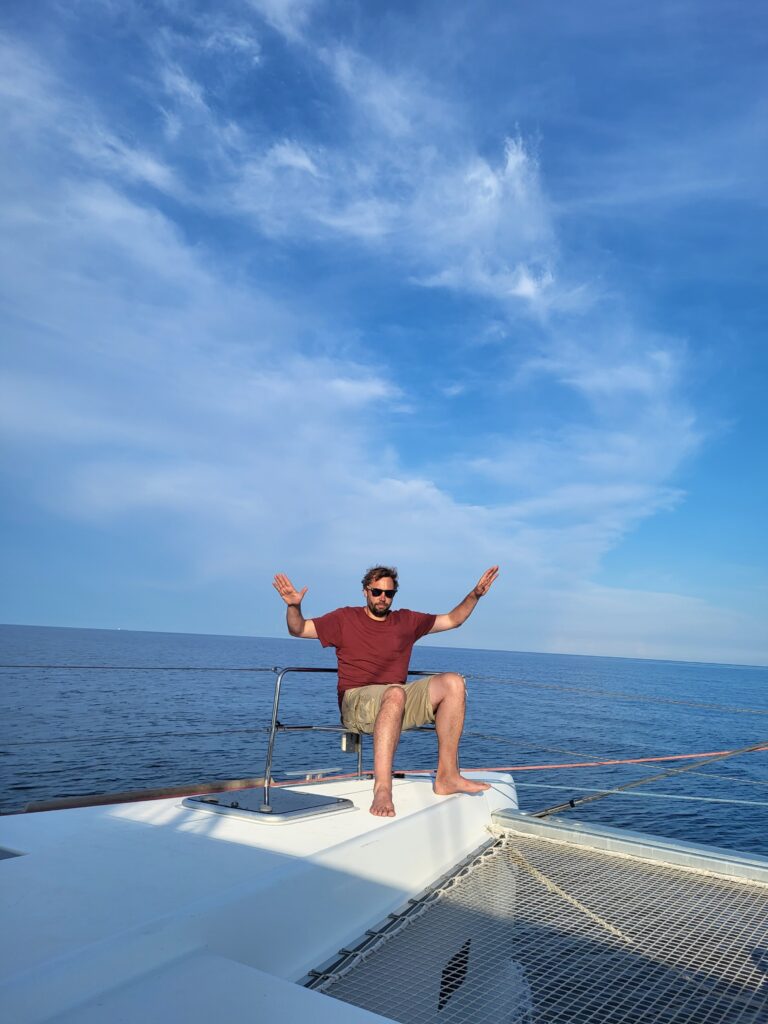
The Conversation That Happens
The specific conversations that the sea produces are not predictable, which is part of what makes them valuable. They are not the conversations that were planned, and they are often not the conversations that the participants expected to be having. A conversation that begins with a question about the navigation and becomes a conversation about what someone is actually doing with their professional life. A conversation that starts as a discussion of the fishing and arrives, two hours later, at something fundamental about what the person values and has been treating as secondary.
I have had conversations at sea with people I had known professionally for years and discovered things about them that the professional context had made invisible. Not secrets, not revelations, but the specific substance of who someone is when they are not being who they are for an audience. The question they are actually thinking about. The doubt they have been carrying. The thing they are genuinely proud of that they have never mentioned because the professional context did not invite it.
This is what the Long Table is designed to formalise, and what the passage produces informally: the conditions in which people say what they actually think rather than what the situation requires. The sea creates these condition more reliably and more completely than any process I have designed. I have learned from it. I continue to learn from it every passage. And I think the Naora community, which gathers people who are good at conversation and places them in conditions that make conversation good, will produce exchanges that neither the participants nor we could have anticipated. That is, in the end, what the whole thing is for.