At the lion’s paws on Sigiriya Rock, the scale becomes personal. The surviving paws dwarf the people passing between them, while a metal staircase carries the eye upwards against the exposed stone. There is air beyond the handrail and a long view behind you. This is a useful place to pause, before the desire to reach the summit takes over from everything else. Look at the masonry. Look at the next flight. Make sure the person beside you still wants to climb. A palace built to command attention can easily distract us from the small decisions that make visiting it worthwhile.
Taking Time Inland From Galle
For Naora, Sigiriya belongs to the inland possibilities of a Sri Lankan landfall during the Indian Ocean part of the world route. Galle is the coastal starting point, but the interior deserves its own time. Sigiriya is not a comfortable three-hour excursion north from the harbour. For planning, we would allow roughly six to eight hours by road, depending on the route, traffic and stops, then confirm that estimate locally. That is a substantial travelling day before anyone has climbed a step.
An overnight stay near the site changes the visit more than an ambitious departure time from the coast. It allows breakfast without urgency, a climb before the strongest heat where opening arrangements permit, and enough attention left for the gardens afterwards. Trying to compress the outward drive, the ascent and the return into one day spends most of the available energy on transport. The first thing we would protect is the time ashore.
Leaving Discovery, our Lagoon Eighty2, overnight also requires a proper arrangement aboard. The yacht must be securely berthed or otherwise safely attended, local formalities completed, and the crew’s responsibilities clear. An appealing inland plan is not a reason to assume that a harbour stay will look after itself. Sven, Naora’s founder and captain, plans every weather window and sails every leg himself; the return from the interior has to leave him room to prepare the next departure, rather than arriving against its deadline.
Members choose when and where along the worldwide route they join, and how long they remain aboard. That freedom can make room for a longer understanding of Sri Lanka, but it does not remove road distances or the weather. We would rather give Sigiriya a proper interval than make its summit the hurried proof that we had been inland.
The History Written Into Sigiriya Rock
The rock rises about 180 metres above the surrounding plain. That figure matters less as a measure of altitude than as a measure of separation: the summit is close enough to see from the gardens, yet difficult enough to reach that everything required for life above had to be considered. Food, building materials, labour and water all belonged to the palace before the view did.
The familiar description of Sigiriya as volcanic is misleading. It is an isolated mass of ancient crystalline bedrock, exposed as the surrounding material was worn away. Its steepness was inherited from geology, then adapted by builders. They did not create a mountain. They worked out how to occupy one.
Kassapa I ruled from 477 to 495. The traditional account of his rise centres on the death of his father, Dhatusena, his seizure of the throne and the eventual return of his brother Moggallana, who defeated him. It is a compelling family history, and it makes the summit palace easy to read as an expression of fear. But fear is an interpretation, not something preserved in the foundations. A defended royal residence could also proclaim legitimacy, organise ceremony and make power visible across a landscape.
Below the rock, the deliberate arrangement of pools, paths and terraces makes a purely defensive explanation feel incomplete. A fugitive needs protection. A ruler also needs an audience. Sigiriya offered both separation and display, and much of its interest lies in that tension.
The royal occupation was only part of the site’s life. Buddhist monastic use preceded it and continued afterwards. In the boulder gardens, rock shelters and cut drip ledges belong to a longer history of making this landscape habitable. Those shallow grooves above a shelter diverted rain away from its entrance. They are easy to overlook beside a palace, yet they answer the same practical question: how do people remain comfortable beneath stone in a country with heavy rain?
The Water Gardens Below The Palace
We would begin at ground level and resist treating the gardens as an approach corridor. Their geometry is part of the architecture. Long sightlines draw the visitor towards the rock, while pools and planted spaces establish an order that the irregular stone above seems to interrupt. The climb is visible almost from the beginning. So is the evidence that the people who built here understood far more than how to build upwards.
The water gardens use differences in level, channels, conduits and carefully formed outlets. The principle behind their fountains is straightforward, although executing it across a royal garden was not. Water supplied from a higher level develops pressure as it descends through a confined system. Released through a small opening below that supply level, it can rise as a jet. No mechanical pump is required for that effect, but the levels, supply and condition of the passages matter.
Some of Sigiriya’s fountains can still operate when rainfall provides sufficient water. That qualification is important. A dry outlet does not necessarily represent failed engineering, and a photograph of a flowing fountain is not a promise about the day of a visit. The garden depends on water being available. Understanding that dependence is more interesting than expecting it to perform on demand.
Sri Lanka’s dry zone is not a landscape without rain. The interior commonly receives substantial rainfall from October into January, through the later intermonsoon period and the northeast monsoon. These are broad seasonal tendencies, not a forecast for a particular climb. Galle’s southwest coastal weather is not a reliable shorthand for conditions here, so the inland forecast deserves a separate check.
What interests us most is the relationship between beauty and maintenance. A clear channel, a functioning outlet and a retained pool are modest things individually. Together they make a place possible. After living aboard a yacht, it is difficult to look at a palace without noticing the systems beneath its apparent ease.
Climbing Sigiriya Rock With Care
The usual ascent involves roughly 1,200 steps, though the number depends on what is counted along the approach. It is a useful warning against judging the visit by the rock’s height alone. The effort comes in repeated flights, changing surfaces, heat and sections where exposure matters more than fitness. Someone comfortable walking a long distance may dislike the open metal stairs. Someone who enjoys heights may still struggle in humid weather.
Our planning allowance would be three to four hours for the gardens, ascent, summit and descent, with more time for a detailed visit. This is room to move comfortably, not a target. A queue on a narrow section, a slower member of the party or a spell of rain can change the rhythm. Early entry, when available, is useful chiefly because of the heat. It does not confer ownership of the site or guarantee an empty staircase.
On the exposed flights, the body becomes very aware of small things: a shirt damp against the lower back, the warmth of a handrail, the sound of shoes on metal rather than stone. In still conditions, the next patch of shade can seem more important than the summit. There is no value in pretending otherwise. Pause somewhere that does not obstruct the route, drink before discomfort becomes the organising fact of the morning, and keep hands available rather than carrying loose belongings.
Footwear needs a secure grip on uneven stone and metal. Water and sun protection should be carried, not assumed to be available higher up. For children, the practical question is their steadiness on exposed stairs and their ability to follow an adult’s direction when tired. For anyone uneasy with heights, turning back is a reasonable decision. The gardens are a substantial visit in their own right.
Wet steps, thunderstorms and local wasp activity can alter access. Closures and instructions from site staff take precedence over the intended route. Wasps should not be disturbed for a photograph or a closer look. On the descent, tired legs deserve the same attention as the climb. Reaching the top has not finished the physical work.
The Paintings And The Mirror Wall
The surviving paintings occupy a sheltered recess in the rock face. Their position helps explain their survival, but exposure, moisture and human attention still make them vulnerable. Photography is not permitted in the fresco gallery. The useful response is to put the camera away before entering, rather than spend the encounter negotiating with the restriction.
The painted female figures are often called apsaras, or celestial beings. Their identity is not settled, and other interpretations connect them with the royal court or religious imagery. It is better to hold that uncertainty than attach a confident label to every face. Look instead at what is actually present: flowers, jewellery, the modelling of a shoulder, the controlled outline of a hand. The work has specificity even where its meaning remains open.
Nearby, the Mirror Wall takes its name from the highly polished plaster surface it once presented. Its later inscriptions include verses left by visitors, many responding to the paintings. They complicate the idea that everyone in the past approached the site with the same purpose. Some people came and looked closely enough to want to answer what they saw.
Those old inscriptions are now part of what must be protected. They do not grant permission to add another. Do not touch the painted or inscribed surfaces, lean against them or mistake proximity for access. A good local guide can be particularly valuable here, distinguishing surviving evidence from reconstruction and allowing an unanswered question to remain unanswered. We do not need every detail resolved for the encounter to feel complete.
Making Space For Dambulla
Dambulla is a natural companion to Sigiriya, lying south of it, but proximity on a map is not sufficient reason to append another demanding visit. The cave temples involve their own uphill approach, and arriving depleted after the rock can turn a place of worship into something to get through. We would decide the order around heat, energy and the time available, rather than insist that both belong to the same day.
The five principal cave shrines contain Buddha images and extensive painted surfaces shaped by successive periods of patronage and renewal. They offer a useful counterpoint to Sigiriya’s exposed royal terraces. Here the enclosing rock is part of the experience: the eye adjusts to a dimmer interior, the ceiling bends above the paintings, and voices naturally become smaller.
Dambulla remains a place of worship. Shoulders and knees should be covered, and shoes removed before entering the shrine area. The heat of exposed paving matters when arranging that transition, especially with children or anyone whose feet are sensitive. Carrying suitable clothing is easier than trying to improvise respect at the entrance.
Leave room for worshippers and keep photographs, where permitted, from making sacred images into props. There is no need to manufacture an encounter with a monk or interrupt someone praying to make a visit feel personal. Sometimes the most attentive way to enter a place is to accept that its important activity has nothing to do with us.
Reading The Summit
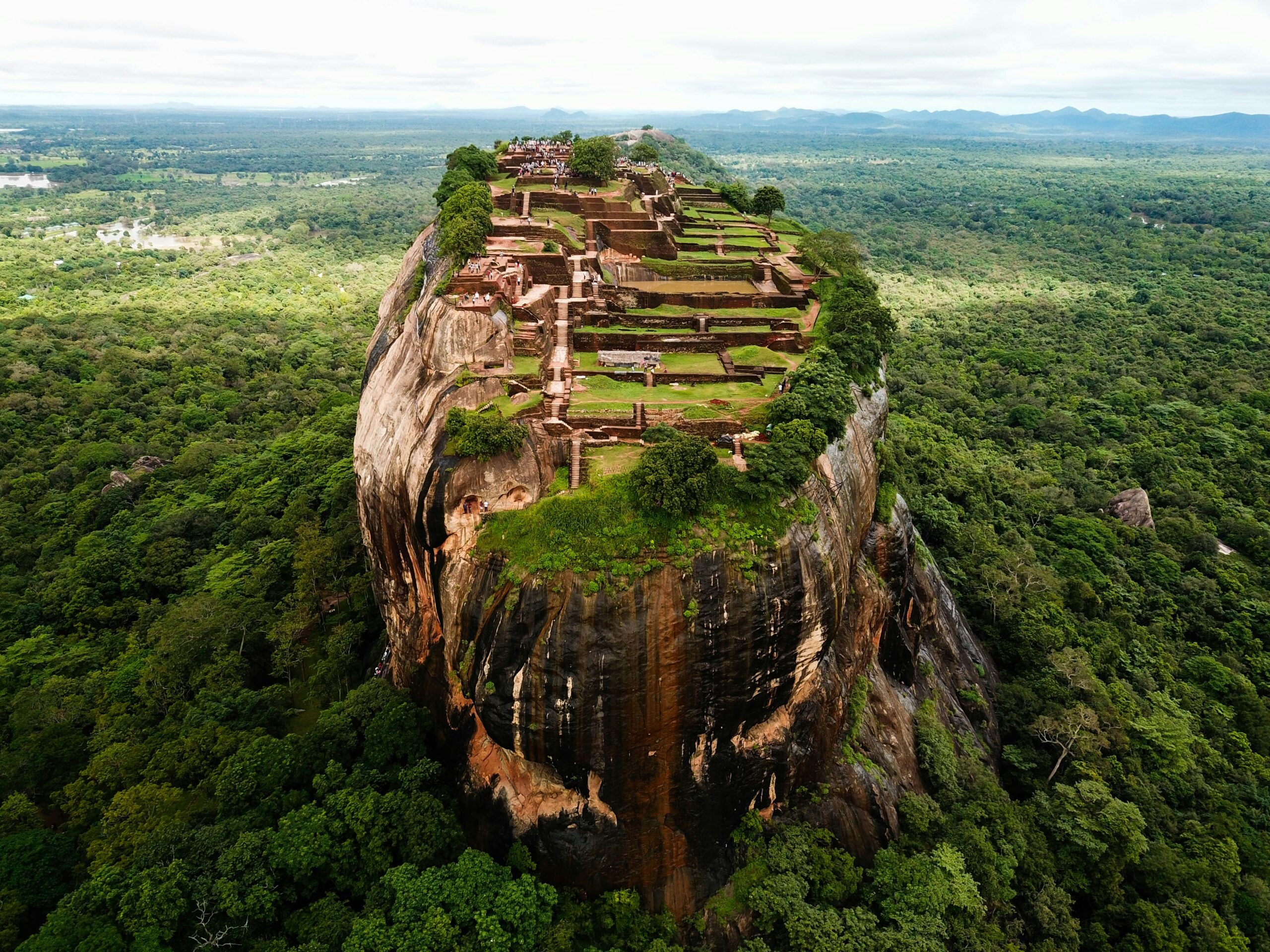
At Sigiriya’s summit, much of the palace must be understood from foundations, terraces, stairways and water storage rather than standing rooms. The missing architecture matters. Roofs would have offered shade; walls would have controlled movement and framed views. The open platform experienced today is not the same physical environment as an inhabited royal residence.
Nor is the surrounding landscape simply an untouched jungle plain. Woodland, cultivated ground, settlements and reservoirs belong to the view. What can seem like an expanse of nature from above contains the long work of living in this region. Kassapa’s view cannot be recovered exactly by standing where a throne room is thought to have been. Vegetation changes, land use changes, and the summit itself has lost much of what once shaped the act of looking.
Stand still long enough and another distinction becomes apparent. The breeze can make the heat feel less insistent while the sun remains strong on an unshaded shoulder. The gardens below become legible as a plan, but the people within them become difficult to distinguish. Height clarifies some things and removes others.
A palace above the plain depended on lives and labour that the view makes almost invisible. Water had to be retained, food supplied, buildings repaired and paths kept usable. The remains allow us to admire the design without forgetting those obligations. Beside the summit’s surviving pools, the grand account of kings and brothers gives way to something quieter: stone shaped to hold water, waiting for rain.