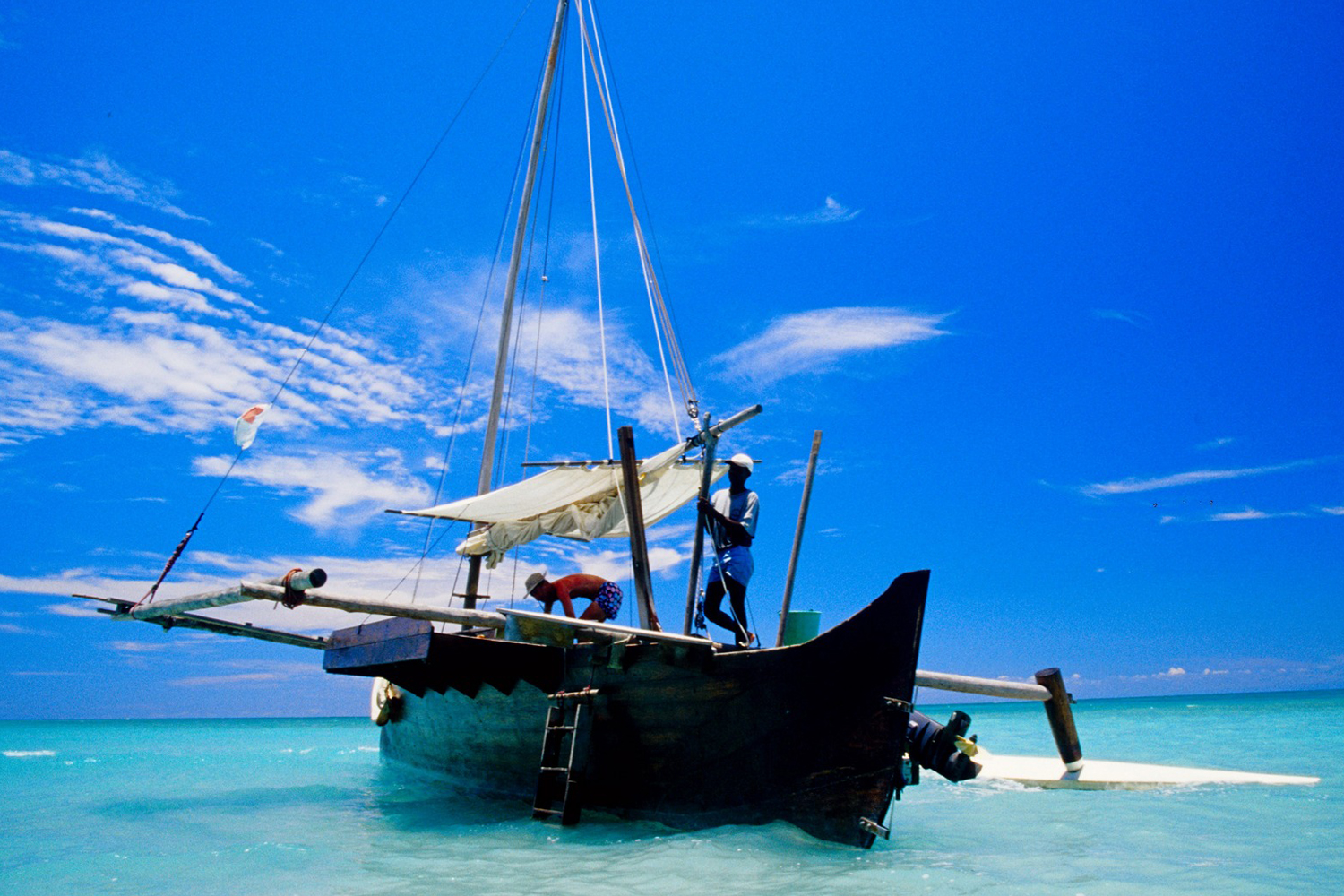
A dhow’s sail can be drawing cleanly while its progress along the shore is scarcely visible. Full cloth is evidence of wind, not proof that the hull is winning against the current. Watching East African dhows from another vessel begins with that distinction, between movement through the water and movement towards a landing place, and between a beautiful sail and the practical work it is doing.
For Naora’s East African chapter, the encounter deserves more than admiration. A working vessel may be carrying goods, returning from fishing or moving between shore communities. We cannot establish its purpose from the shape of its sail, and we should not turn its crew into characters in our own voyage. What we can establish is whether our courses are converging, which vessel has room to manoeuvre and what the collision regulations require.
The difficult part is that consideration and predictability are not always the same thing. An unexpected turn intended as a courtesy can make another helm’s decision harder. Respect begins earlier, while there is still enough water and time to make our intentions plain.
Reading The Sails Of East African Dhows
Dhow is a broad name rather than a single design. Hull forms, working arrangements and rigs vary. The familiar long, sloping yard may carry a triangular lateen sail or a four-sided settee sail, whose forward corner appears cut away. Those differences belong to living boatbuilding traditions, but they also matter immediately: the sail, yard and running rigging determine how the crew can change direction and how much handling that change requires.
A long yard is a substantial object to control. Depending on the rig and the intended manoeuvre, changing tack may involve easing the sheet, managing the yard and moving sailcloth around the mast. Some arrangements can sail with the sail pressed against the mast on one tack, accepting a less efficient shape. Others call for more rearrangement. There is no universal dhow tack whose timing we can safely predict from a distance.
What we watch is the sequence. A sheet being eased, the leading edge of the sail beginning to shake, a bow turning towards the wind and crew moving to handling positions are evidence of something developing. They are not a promise of the next heading. A boat that loses speed during the turn may also lose some steering response, while the current continues carrying the whole vessel sideways.
Nor does a traditional rig establish how the boat is being propelled. A dhow may use sail, machinery or both. The same distinction applies to us: if Discovery is being propelled by machinery, she is a power-driven vessel under the collision regulations, even with sails drawing. Appearance does not decide the rule.
There is skill worth noticing here, particularly in how little movement an experienced crew sometimes needs. But watching closely should make us less intrusive, not bring us nearer for a better look.
Wind And Tide Set The Working Day
Across the equatorial part of the East African coast, northeasterly monsoon winds generally prevail from roughly November to March, with southeasterlies during much of April to October. The transitions vary, and these broad seasons do not describe every afternoon. Coastal orientation, headlands, squalls and the daily exchange between land and sea breezes can all change the wind a small vessel actually receives.
The seasonal pattern helps explain the long relationship between sailing craft and coastal trade. It does not make the working day effortless. A favourable wind along an exposed stretch can become an awkward angle at the final approach. A short distance directly to windward may require repeated tacks, each consuming water and momentum. An engine, where fitted and usable, changes the choices without removing the cost of fuel or the constraints of depth.
Consider an illustrative case, not a measurement from our route: a boat making four knots through the water against a two-knot current advances over the ground at only two knots. For a fixed distance, that doubles the time compared with still water. The wake can look purposeful throughout. If the usable depth at the landing is also falling, the consequence of delay is larger than a later arrival.
Tide height and tidal stream are related, but their turning points do not necessarily coincide. High water does not reliably mean slack current, particularly around channels and connected bodies of shallow water. Local predictions need to be read for the actual place, and then checked against what the water is doing. A line of disturbed water, drifting material or flow past a fixed marker can contradict the easy assumption that the current has already turned.
This is why a crew may wait when the breeze appears favourable, or leave while the shore still looks inconveniently far away. Their useful window may depend on water beneath the hull as much as wind above it.
Sea Room Is More Than Open Water
The broad blue space beside a working boat is not necessarily available to it. A shoal can leave ample room on the surface and very little beneath. A loaded hull may draw more than its silhouette suggests. Leeway, the sideways movement caused by wind, can carry a vessel towards a bank even while its bow appears to point safely along the channel.
We therefore read the chart and the other vessel together. Which side offers navigable depth? Where will the current carry a boat that slows? Does an approaching tack leave room to regain speed? These are working questions, not invitations to assume that an unfamiliar craft handles badly. Its crew may understand the water far better than we do, while still having fewer practical options at that moment.
Discovery is our 2025 Lagoon Eighty2 sailing catamaran. Her manoeuvring possibilities do not entitle us to occupy every convenient patch of water. Before altering course to give room, we need to check that our own new track is safe and that it will not simply transfer the problem to another vessel. Turning away from one bow can put us across another.
Speed matters beyond collision risk. A passing wake can disturb a loaded boat or people transferring goods at the water’s edge. Slowing at the last moment does not retrieve the wake already travelling outwards. The useful reduction happens before the close approach, with enough steering control retained for the conditions, and with a look astern to see what our hulls are actually leaving behind.
The aim is not to make a display of yielding. It is to avoid using another crew’s remaining margin as our own passing space.
Keeping A Lookout Beyond The Screen
Looking into low afternoon sun, bright water can erase a low hull before it erases the sail. From shade, the eyes recover some contrast; binoculars help separate the dark line of a gunwale from the glare. Then they have to come down again. A close view of one vessel is a narrow view of the coast, and the next boat may be approaching outside that small circle of attention.
Electronic information is useful without being complete. A wooden hull with low freeboard may give a weak or intermittent radar return, depending on its construction, equipment, aspect and the sea state. An absent AIS target means only that we are not receiving a target. It does not mean there is no vessel. Neither display removes the need to look and listen.
A steady compass bearing to an approaching vessel, accompanied by decreasing range, is a serious collision warning. The important word is compass: a boat remaining beside the same window frame is a less reliable test if our own heading is changing. Even an appreciable bearing change does not, by itself, prove a safe passing distance, particularly at close range or when a tow is involved.
The arithmetic explains why early attention feels so different from late attention. At an illustrative closing speed of twelve knots, one Nm disappears in five minutes. That is the combined rate at which the gap closes, not necessarily either vessel’s own speed. Time spent deciding whether a distant sail matters is already part of the encounter.
A watch handover must carry that developing picture, not merely the heading and destination. The sail whose course is still uncertain, the boat partly lost in glare and the narrowing water ahead belong in the conversation.
Collision Rules Around East African Dhows
In an ordinary open-water encounter between vessels in sight of one another, a power-driven vessel keeps out of the way of a sailing vessel. This is the starting point, not the whole decision. Overtaking, narrow channels and vessels with particular operational restrictions introduce other obligations. The first task is to identify the situation accurately, rather than apply the comforting but incomplete idea that sail always has priority.
An overtaking vessel keeps clear, including a sailing vessel overtaking a power-driven one. The formal overtaking sector begins more than 22.5 degrees abaft the other vessel’s beam, placing the approach within its stern sector rather than alongside or ahead. If there is doubt about whether we are overtaking, we treat ourselves as the overtaking vessel. That duty continues until finally past and clear.
When both vessels are sailing, opposite tacks mean the vessel with the wind on its port side keeps clear of the vessel with the wind on its starboard side. On the same tack, the windward vessel keeps clear of the leeward vessel. A port-tack vessel that sees another sailing vessel to windward and cannot determine its tack must keep clear. These arrangements give two crews a shared expectation without requiring a conversation.
In a narrow channel, a sailing vessel must not impede a vessel that can safely navigate only within that channel. A broad expanse of shallow water outside the channel does not cancel that restriction. Equally, a working boat is not automatically a vessel restricted in its ability to manoeuvre in the regulatory sense. That status concerns particular kinds of work, not simply a heavy load, a demanding rig or inconvenient wind.
Fishing needs similar care. A boat used for fishing does not receive the fishing-vessel provisions merely because of its occupation. The relevant condition is fishing with gear that restricts manoeuvrability. A vessel travelling home with its gear aboard is a different encounter from one actively working restrictive gear.
There is a necessary counterpoint to the instinct to make way for every working sail. The stand-on vessel initially maintains course and speed so that the give-way vessel has something predictable to act around. It may act when it becomes apparent that the other vessel is not taking appropriate action, and must act when collision can no longer be avoided by the give-way vessel’s action alone. Standing on is a responsibility to remain attentive, not permission to wait for an impact.
Making A Manoeuvre Another Helm Can Read
Good avoiding action has a visible shape. It is taken early, is substantial enough to be readily apparent and leaves a safe passing distance. A succession of small alterations may change the calculation on our display while communicating almost nothing to the person watching from the dhow. That helm should not have to guess whether we have seen them.
Where the rules and available water make it appropriate, a clear alteration to pass astern can be easier to understand than an attempt to slip across the bow. It is not a universal instruction. Depth, other traffic, the dhow’s likely manoeuvre and the current may make another action safer. Reducing speed can create time, but it also changes steering response and the balance between forward motion and sideways set.
We need to think beyond the first alteration. If the dhow is approaching the edge of usable water, it may soon have to tack. A passing plan that works only if it holds its present course indefinitely is a poor plan. The answer is not to invent a turn on its behalf, but to leave enough separation for the plausible changes without abandoning our own obligations.
Communication can help, but it should not become the weak point in an otherwise clear manoeuvre. We cannot assume that a working boat is monitoring VHF, that a call has identified the right vessel or that a hand gesture has the meaning we intended. When vessels are in sight and there is doubt about another’s intentions or the sufficiency of its avoiding action, at least five short, rapid blasts are the prescribed warning. A wave is not a substitute.
After acting, we keep checking. The other vessel’s bearing, the separation and our new track all need attention until the encounter is over. Returning immediately to the previous course can undo the room just created. The useful manoeuvre is the one whose outcome is verified, not merely the one whose beginning felt decisive.
An Anchorage Can Still Be A Workplace
The obligation does not end when we stop sailing. A sheltered patch of water may be part of an approach to a landing, a place where vessels wait for depth or the turning space needed before a sail is lowered. An anchorage can look empty between movements without being unused. Watching the pattern of arrivals before settling into it is part of understanding the place.
At rest, the sounds become easier to distinguish: cloth shaking as a sheet is eased, a yard shifting against its fittings, voices carrying across water without the masking noise of our own passage. Those sounds can also announce a boat slowing or preparing to turn. Quiet aboard should sharpen the lookout, particularly if the tide will swing Discovery towards water that was clear when the anchor went down.
The same restraint belongs ashore. We do not need to know what a crew earns or carries to recognise that unloading takes precedence over our curiosity. Questions can wait until hands are free. Photographs of people deserve permission, and permission to photograph a boat is not an invitation to climb aboard or interrupt its handling. An explanation offered in an unhurried moment will usually tell us more than a close pass ever could.
It is tempting to call a sailing workboat timeless. The word conceals its present tense: repairs to make, materials to choose, an engine perhaps worth using, a tide that will not wait. Its crew is making contemporary decisions with inherited knowledge.
The coast is already occupied by those decisions when we arrive. Somewhere a landing needs to be reached while there is still water enough. Our passage should leave that possibility intact.