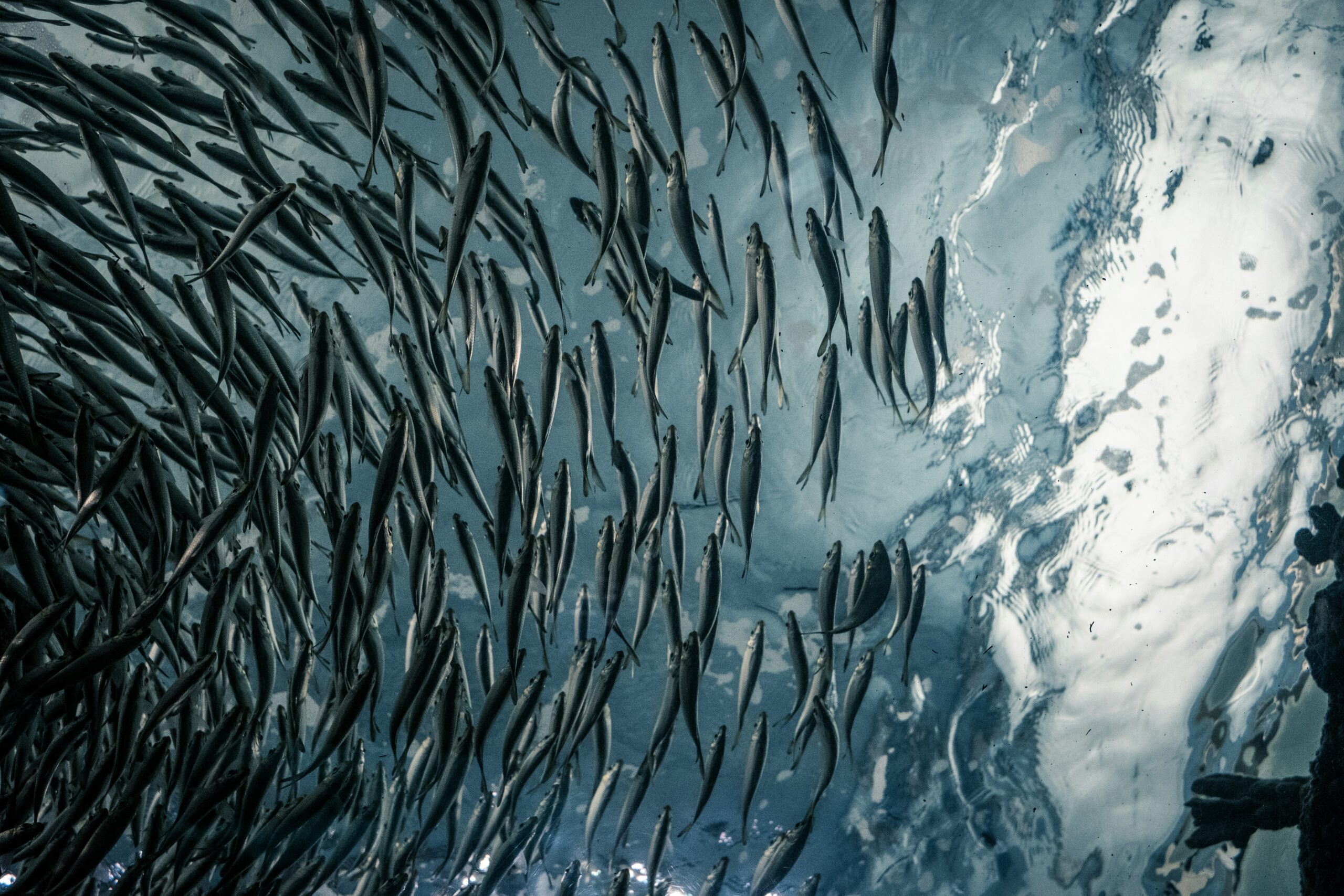
From below, the silver becomes a wall. The sardines turn together, their flanks catch the light, and what looked like open water becomes something almost solid before changing shape again. That is the image I return to when I think about the KwaZulu-Natal sardine run. Not a count of animals, or the size of the biggest predator, but the speed with which thousands of separate lives can appear to make one decision.
I have been in the water during the run twice. Those encounters changed my sense of scale, but they did not make the event feel predictable. A photograph gives the baitball an apparent permanence that it never has in the water. The fish are moving, the predators are responding, and the place where a swimmer seemed well positioned can cease to be a sensible place almost immediately. What matters is being able to read the change, including the change that means we should leave.
The Water Behind The KwaZulu-Natal Sardine Run
The broad season to consider is May to July, the approach to and arrival of the austral winter. That is a planning window, not a timetable. The movement can be weak, late, fragmented or difficult to see from the surface, and the presence of sardines somewhere along the coast does not mean that a feeding aggregation will be accessible on the day we happen to be there.
The fish moving north represent part of the sardine population associated with the southern shelf and Agulhas Bank, not the entire population travelling as one enormous shoal. This distinction matters. The run is a succession of movements and encounters spread through changing water, rather than a single procession whose front can be located and followed indefinitely.
Sardines are associated with cooler water, and temperatures below about 21°C are a useful broad guide to the habitat that can allow their northward movement. That figure is not an entry requirement written into the sea. A surface reading cannot reveal the whole water column, and a cool patch does not prove that fish are present. Its practical value is to direct attention: temperature helps explain where suitable habitat might exist, after which observations have to establish what is actually happening.
It is also misleading to picture the Benguela Current simply turning a corner and delivering a cold stream along KwaZulu-Natal. The warm Agulhas Current flows predominantly southwestward offshore. Seasonal cooling and local shelf processes, including upwelling, help create cooler coastal water beside it. The sardines can move north within that changing inshore habitat. Northbound fish do not imply a northbound current.
For passage planning, this means looking beyond the calendar. Recent fish sightings, the development of coastal temperatures and the weather between the boat and those sightings all matter. Yesterday’s position is information, not a destination.
How A Shoal Becomes A Baitball
A shoal and a baitball are not quite the same thing. Shoaling offers individual fish protection through numbers and coordinated movement. A baitball is that defence under concentrated pressure, with the fish compressed into a smaller volume as their escape routes are restricted. The beautiful silver sphere is an emergency response.
Common dolphins are important participants in this compression. By working around and beneath a shoal, they can drive fish together and towards the surface, where escape upwards is no longer possible. Other predators take advantage. Cape gannets enter from above, sharks move through and around the aggregation, and a Bryde’s whale may feed through a mass of fish that seemed, a moment earlier, to occupy all the available water.
These animals are not performing a coordinated display for our benefit. Their opportunities overlap, and their movements can change the shape of the shoal in different ways. Nor does every encounter contain the complete cast. Dolphins and feeding birds do not guarantee a whale; a disturbed surface does not guarantee sardines, since other schooling fish can also attract predators.
An adult Bryde’s whale can exceed 12 metres in length. The useful meaning of that number is physical: an animal that large feeding through a moving shoal needs space that a swimmer cannot negotiate with it. The sensible response is not to calculate how close might be possible, but to avoid occupying its feeding path.
There is no dependable duration to build an entry around. Some aggregations disperse before the equipment is ready. Others remain coherent longer, or break apart and reform. A baitball dissolving is not necessarily an encounter lost. It may mean that enough of the fish found a way out.
Reading The Birds Before Reading The Water
From a boat, birds often make the otherwise invisible distribution of fish legible. A gannet travelling purposefully is a clue. Several birds beginning to circle deserve more attention. Repeated plunge dives indicate feeding activity, but still leave questions about the prey, its depth and how quickly the whole encounter is travelling. The distinction between birds searching and birds feeding saves a great deal of unnecessary pursuit.
I would want time to watch the pattern before moving closer. Are dolphins continuing along the coast, with birds following them, or repeatedly working the same patch? Is the activity spreading or tightening? Are there already boats manoeuvring around it? A position on a screen cannot answer these questions. They require someone looking out, following the sequence rather than reacting to its most dramatic instant.
The underwater view can make that sequence harder to understand even as it makes the encounter more immediate. The light breaks across the sardines, a gannet’s entry leaves a white disturbance through the blue, and the eye follows whichever movement is nearest. A swimmer sees a portion of the event. The person watching from the boat may have the better understanding of where it is going.
That is one reason surface observation is a substantial experience in its own right. From above, the relationship between birds, dolphins and the moving shoal can become clearer than it is through a mask. Nobody should feel that staying aboard means they have failed to see the run properly.
The Decision To Enter The Water
The hardest judgement is often made before anyone gets wet. Visibility, swell, current, the behaviour of the animals, nearby vessel traffic and the capability of the people entering all belong in the same decision. A strong swimmer with little experience of open-water pickup presents a different situation from someone accustomed to drifting offshore. Confidence alone does not settle it.
The original temptation is to say that the sharks are interested in the sardines, not in us. That is an observation about what they are feeding on, not a safety assurance. Bronze whaler and dusky sharks can be part of these aggregations, and feeding behaviour can change quickly. Whales and plunge-diving birds introduce their own hazards. Remaining outside the compressed fish and out of obvious feeding paths reduces interference, but it does not turn an unpredictable encounter into a controlled one.
Any entry needs a dedicated surface lookout, a clearly understood recall signal and a workable recovery plan. The driver must retain sight of the people in the water rather than become another spectator. If visibility or animal behaviour prevents the group from maintaining its agreed position, the encounter should end. If the fish begin gathering around swimmers for cover, that is a reason to withdraw, not an opportunity to remain at the centre of the photograph.
Even modest drift deserves respect. In a current of one knot, a person moves 0.5 Nm in half an hour relative to the seabed. That is an illustration, not a prediction for this coast, where conditions vary greatly. It explains why a comfortable swim can still require active boat support, and why the tide table alone cannot describe the movement of water offshore.
Waiting has a bodily cost too. A wetsuit that felt warm on deck can feel quite different once water reaches the neck, and repeated entries can leave someone cold, tired or seasick without any single swim seeming demanding. I would rather hear that early than have someone remain quiet because the rest of the group is excited. The return to the boat is part of the encounter, not an administrative detail after it.
The Coast Has Its Own Conditions
The Agulhas Current gives this coast a passage-planning problem that cannot be separated from the wildlife. Strong southwesterly wind blowing against the southwestward flow can produce steep, dangerous seas. Wind strength alone therefore tells an incomplete story. Direction, duration, swell and the boat’s position relative to the current are part of what makes a forecast acceptable or unacceptable.
The tempting response is to assume that moving inshore always solves the problem. It does not. Shallower water, breaking swell, restricted sea room and the shape of the coast introduce other constraints. A sheltered-looking strip seen from offshore is not automatically somewhere to wait, anchor or recover swimmers. Those decisions need proper chart assessment and current local knowledge.
Finding feeding activity and reaching it safely are separate achievements. So are reaching it and being able to recover people afterwards. The wind may be manageable for the larger yacht while making a tender journey wet and tiring. A swell that looks orderly from the deck can be much less forgiving beside a small boat, where climbing aboard requires timing, strength and a stable handhold.
For us, this is where patience has an operational meaning. It can mean remaining farther away, observing without entering, or accepting that the day’s conditions do not support the encounter at all. Local expertise belongs in that assessment, together with the relevant permissions and wildlife rules. Familiarity with offshore sailing is valuable, but it does not replace knowledge of this particular coast.
A sighting does not improve a weather window. That is worth remembering precisely when the sighting is exceptional.
Planning For The KwaZulu-Natal Sardine Run
Naora puts these decisions inside a much longer undertaking. The Naora Global Expedition is a private sailing expedition around the world, covering roughly 49,000 Nm over five years. Discovery, the Lagoon Eighty2 sailing catamaran, is the yacht carrying that continuous voyage. At this scale, time spent waiting in one region has a relationship with weather and seasons farther along the route. We cannot treat every destination as an isolated appointment.
Sven, Naora’s founder and captain, plans every weather window and sails every leg himself. Considering the sardine season within that work means weighing the possibility of an encounter against the coastal passage, the conditions for stopping and the requirements of the onward voyage. It does not justify promising a baitball to someone arriving during a particular week.
Members of Naora’s private circle choose when they join, where along the worldwide route they step aboard and how long they stay. Some have a short interval available; others can give the sea considerably more time. The yacht keeps sailing around the world as people step in and out. That freedom concerns how we take part in the expedition. The movements of the fish remain beyond it.
Discovery gives us a place to prepare carefully and recover comfortably, but the yacht’s scale is not a reason to bring her into the middle of feeding wildlife. Any closer observation would need its own assessment of suitable boat support and local expertise. A tender is a means of access, not permission to enter.
The value of keeping the voyage larger than a single encounter is that an unsuccessful search does not empty the day of meaning. The water still has something to show us, even when it does not show us what we hoped for.
A Coast That Lives With The Fish
It would be easy to write about the run as though it belonged entirely to divers. Along KwaZulu-Natal, sardines reaching the beaches also mean work, food and trade. Beach-seine crews watch for fish that can be reached from shore. A shoal close enough to net changes the activity on the beach and the movement of fish through the local market. The event has a human life beyond the offshore image.
Arriving by yacht should make us more attentive to that life, not less. Working nets need room. People handling a catch are working, not providing a scene for visitors. Before buying fish, we need to understand how it was caught and handled, and what local restrictions apply. Sourcing locally only means something if the decision is informed.
If legally landed sardines reach the galley in good condition, the first task is to keep them cold. Their oily flesh deteriorates quickly when handled carelessly. Close to cooking, scaling and gutting them, then drying the skin, gives a better result than putting wet fish straight into a pan. A hot surface, a little oil and restraint with the turning let the skin colour without tearing the flesh apart. Lemon can wait until the fish is on the plate.
There is something grounding about returning attention to the sardine itself. We remember the dolphins, the birds and the whale because their movements are so visible. Yet the small fish is the reason they are there, and each flash in the wall is an animal trying to survive.
When I think back to being in that water, it is the changing shape that remains. For a moment the shoal appears solid enough to touch. Then it turns, and there is open water where the silver had been.