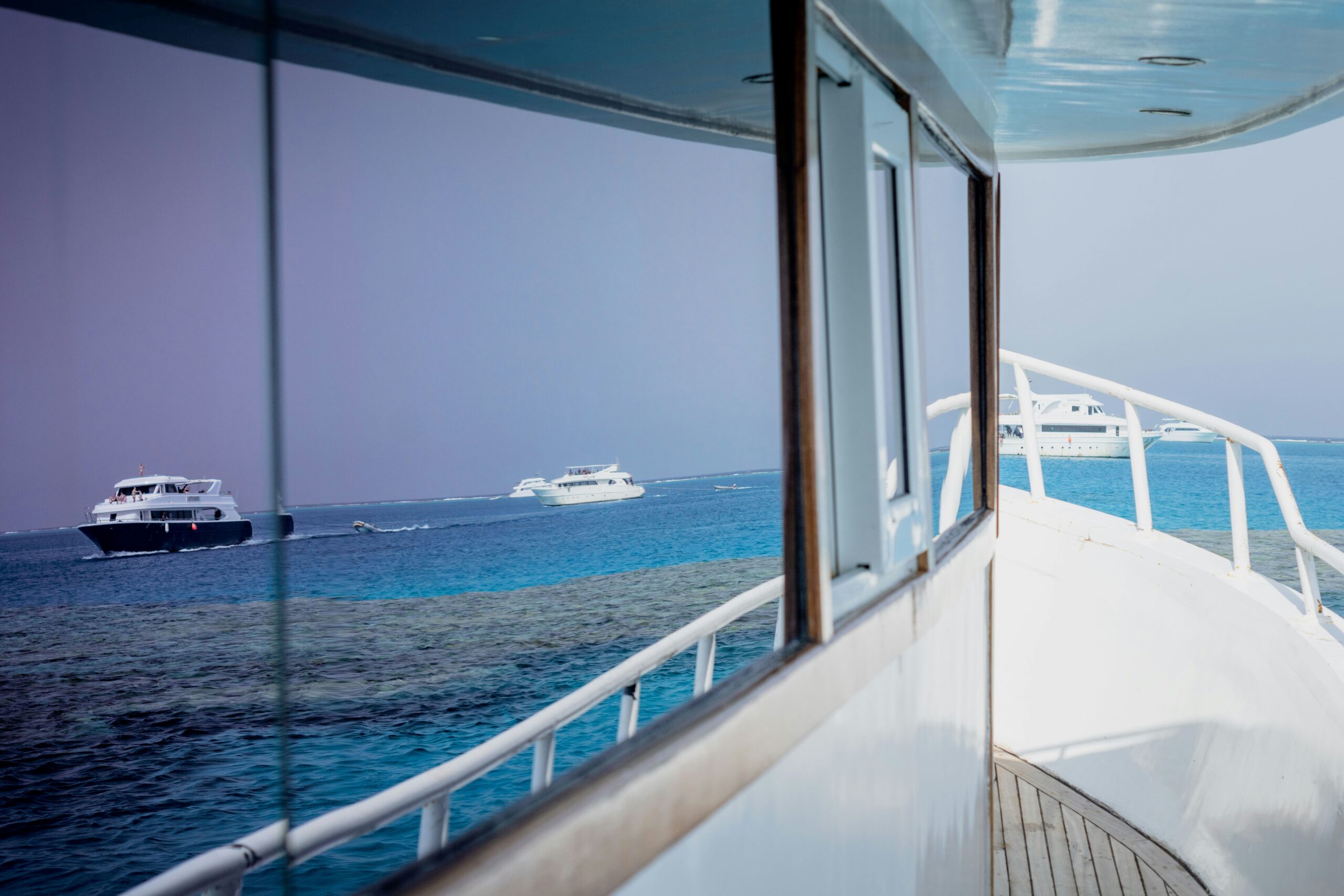
With a low sun ahead, the pale edge of a reef can disappear into reflected light while the coastline remains perfectly sharp. The land seems close and legible. The water between the yacht and the land is another matter. For us, sailing the Red Sea begins with respecting that difference, and with refusing to let a beautiful prospect make a navigational decision.
The same discipline applies to the larger passage. A favourable wind does not establish security. A destination on a route plan does not establish permission to enter. None of this diminishes the Red Sea. It is how we leave room to appreciate it without asking the people aboard to carry the consequences of an optimistic assumption.
Sailing The Red Sea Starts With Direction
A northerly wind comes from the north. It therefore generally favours a southbound yacht and opposes a northbound one. This needs stating plainly because reversing that relationship reverses the whole argument about the passage. Equally, entering through Bab-el-Mandeb from the Gulf of Aden means entering at the southern end. Continuing towards Suez from there is a northbound passage.
The Red Sea extends roughly 1,200 Nm along its main axis. That is enough distance for a useful breeze at departure to become an entirely different proposition farther along the route. In the northern Red Sea, northerly and northwesterly winds predominate through much of the year. The southern basin has a stronger seasonal reversal, with southerly and southeasterly winds commonly developing during the cooler period, broadly October to April. The transition is not a line painted across the water, and its timing varies.
A northbound winter passage may therefore begin with assistance in the south and meet persistent headwinds farther north. A southbound passage can enjoy the northern wind before encountering less helpful conditions towards the southern entrance. There is no universally correct direction independent of season, destination and the weather actually developing.
Nor is wind direction the whole comfort forecast. Short, closely spaced waves can make progress tiring even when their height sounds unremarkable. On a catamaran, repeated impacts beneath the bridgedeck are a reason to reconsider speed and angle, not something to accept because the yacht is large. An apparently slower course can protect sleep, reduce fatigue and leave everyone in better condition for the next approach. We plan for the sea state as well as the arrow on the wind forecast.
The Route Is A Plan Before It Is A Passage
Naora’s opening geography is distinct from a later approach through the Gulf of Aden. The prelude brings Discovery east from Palma de Mallorca to Valletta, then to Alexandria, into the Red Sea and onwards to AMAALA in Saudi Arabia. That opening passage is planned across January to April. It precedes the Naora Global Expedition, the private sailing expedition around the world spanning 2027 to 2031.
Those facts should not be stretched into a guaranteed Red Sea timetable for 2027 or 2028. A proposed leg, a suitable weather period and permission to proceed are separate things. Sven, Naora’s founder and captain, plans every weather window and sails every leg himself. The person assessing the conditions is also the person who will live with the decision at sea.
The places associated with the wider Red Sea passage also deserve to be placed correctly. Djibouti and the Gulf of Tadjoura lie outside the Red Sea proper, on its southern approach. The Dahlak Archipelago lies off Eritrea. The Brothers Islands are offshore in Egyptian waters. Aqaba sits at the head of its own long gulf, requiring a deliberate diversion rather than a casual stop on the way to Suez. Naming these places together does not make them a confirmed sequence of accessible landfalls.
At the northern end, the Suez Canal is roughly 100 Nm long. Its length is useful for understanding the scale of the transit, but it does not produce a dependable arrival time by itself. Movement arrangements, waiting, paperwork and the vessel’s instructions all matter. A canal passage requires functioning propulsion, cooling and steering, sufficient fuel and an attentive crew. The operational commitment begins before the yacht enters the canal, not when someone starts the clock.
Safety When Sailing The Red Sea
Weather risk and security risk require different decisions. Reefing can reduce sail load. Altering course can reduce uncomfortable motion. Neither action makes a regional threat acceptable. The attacks on shipping that began in late 2023 are a reason to be particularly careful about any assurance extending into a future sailing season. A private yacht cannot assume that being different from a commercial ship makes it unaffected.
A responsible assessment has to consider the intended passage, the yacht, the people aboard, current threats, insurance conditions and the practical options if access changes. It needs revisiting as departure approaches and whenever circumstances change. An annual review would not be enough on its own. Nor would an uneventful passage reported by another vessel establish what is appropriate for Discovery.
The important planning question is how much choice remains after departure. Can the yacht reach a genuinely usable alternative? Is entry permitted there? Can people leave if that becomes necessary? Fuel endurance and communications matter, but so do the less visible constraints of borders, transport and medical support. A harbour symbol on a chart is not proof that a harbour can serve as a refuge.
Naora’s long horizon allows a route to be reconsidered, but flexibility is useful only when we are willing to use it. Waiting may need to happen well away from the affected area. A leg may need to change or be omitted. There is a real cost in lost plans and disappointed expectations, and we should acknowledge it without suggesting that disappointment is comparable to an avoidable exposure. No particular island is owed a visit.
Reef Water Changes The Way We Navigate
Clear water gives the impression that everything beneath the yacht is available to the eye. In practice, glare, cloud shadow, surface disturbance and the angle of the sun can make the same patch of seabed look quite different within minutes. Dark water may indicate depth, coral or vegetation. A colour is evidence to interpret, not a depth measurement.
For an unfamiliar reef approach, useful daylight belongs in the passage plan from the beginning. We work backwards from the conditions needed at arrival, allowing for slower progress rather than treating the most optimistic speed as a commitment. If the light deteriorates, the fact that the entrance is close does not make continuing the better choice. The alternative needs to have been considered while there was still room to take it.
Electronic navigation and visual pilotage support one another. The chart helps establish the intended approach and its limits. A lookout checks what the water actually presents. The depth sounder confirms the water beneath its transducer, but cannot be treated as a forward warning of every abrupt reef edge. On a wide yacht, the clearance needed belongs to the whole vessel, not to the thin track drawn on a screen.
Anchoring requires another change of scale. We need suitable bottom, permission to use it and room for the yacht and its rode through a change of wind. The depth used to judge scope includes the height of the attachment point above the water, with allowance for any expected rise in water level. An inviting patch can still be unusable if the chain would sweep across coral. A mooring, where available and permitted, also needs to be suitable for the vessel rather than merely convenient.
Near Bab-el-Mandeb, constricted geography makes wind, current and traffic part of one planning problem. A helpful seasonal wind does not settle the timing of an individual transit. Water movement and the sea state can change the yacht’s progress and handling, particularly where wind opposes current. The strait should be approached as a passage requiring its own assessment, not as a small gap between two larger sailing regions.
The Brothers Islands Require Their Own Decision
The Brothers Islands are a compelling reason to care about this sea, but their offshore position is fundamental to the experience. They are not a sheltered swimming stop that happens to have good diving. Steep reef walls, deep surrounding water and potentially strong currents mean the conditions for reaching the islands and the conditions for entering the water must be assessed separately.
At a reef edge, the physical change can be immediate. Close detail gives way to blue water without an obvious bottom. Bubbles rise past the side of the mask, and the sound of each breath becomes more noticeable than anything above the surface. It is easy to look outwards. The discipline is to keep noticing the reef, the other divers and the direction in which the water is carrying the group.
A current felt at the surface may differ from the flow at depth. A comfortable descent therefore says little about the eventual pickup. A drift dive needs an agreed recovery plan, a surface team able to follow the dive appropriately and clear procedures for separation. Carrying a surface marker buoy is only part of that system. Someone must know how and when it will be used, and someone must be in a position to see it.
Buoyancy deserves attention too. In the northern Red Sea, salinity can be around 40 grams of dissolved salts per kilogram of seawater, compared with roughly 35 in the open ocean. The practical consequence is greater buoyancy, so a familiar weight configuration from another sea may need reassessment. That calls for a proper weighting check with the equipment being used, not casually adding lead before a demanding dive.
Current access rules, suitable local dive knowledge and a credible response to a diving emergency all belong in the decision. So does the experience of the people hoping to enter the water. Clear visibility does not cancel current or distance from help. Any shark encounter remains an encounter with a wild animal, not an appointment. We do not bait, pursue or turn a sighting into a reason to abandon the agreed dive. Sometimes the sound decision is to remain aboard, with the reef still there beneath us.
What Remoteness Asks Of Life Aboard
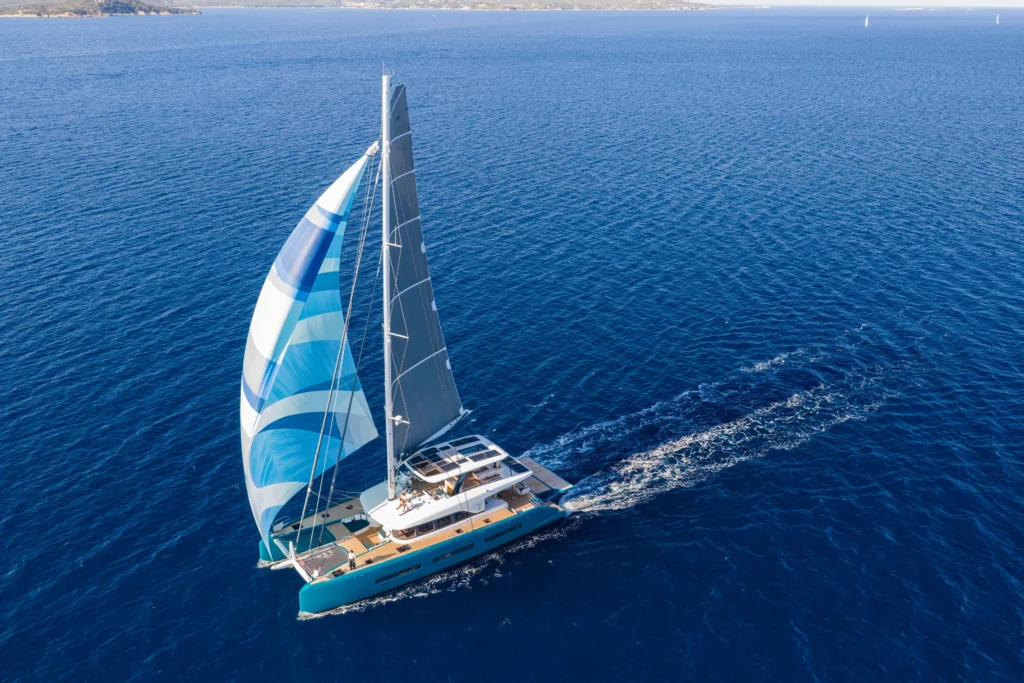
Discovery, the Lagoon Eighty2 sailing the world route, gives us space to make a long passage habitable. Her water production and independent energy systems support life away from shore. They do not remove the need to manage consumption, maintain equipment or carry reserves. A machine that can produce water is still a machine that may need attention. Remoteness makes that distinction practical rather than philosophical.
In hot conditions, shade, drinking water and the timing of activity matter before anyone feels unwell. A cool cabin can make it easy to underestimate the exposure of a tender ride or an afternoon ashore. Tiredness, headache and irritability deserve attention rather than being dismissed as the ordinary consequences of travel. Passage comfort is partly the quiet work of preventing small demands from accumulating.
The galley carries some of that responsibility. Food needs to remain appealing when heat or motion reduces appetite. Refrigeration capacity, safe storage and the order in which provisions are used matter more than an ambitious menu. Locally caught fish is not automatically a sensible purchase simply because it is fresh. Species, lawful origin, handling and the ability to keep it cold all belong in the decision. Sourcing locally should support a place, not excuse us from asking practical questions.
There is a particular pleasure in the quieter meal that preparation allows. After time in salt water, skin feels tight around the mouth and wrists. A glass set down in the shade beads with condensation. Conversation can become less hurried when nobody is calculating an immediate departure. These are modest sensations, but they are often what people hope to recover when they give a week or longer to the sea.
Going ashore requires the same attentiveness in another form. The Dahlak Archipelago is not empty because visiting yachts may be few. Waters can be fishing grounds, islands can have restrictions, and apparently quiet shorelines belong to people whose routines do not revolve around our arrival. Permission comes before landing. Photographs of people require consent. Dress and conduct follow local expectations. Time spent understanding those things is part of the visit, not an administrative delay before it.
The Time That Makes The Passage Worthwhile
What makes the Red Sea worth considering is the relationship between its apparent spareness and the attention it rewards. A coast that looks almost without detail from offshore becomes a place of working routes, reef passages and human decisions. Underwater, clarity reveals extraordinary structure without making that structure invulnerable. Remoteness is not evidence that a reef is untouched or healthy. It is a reason to look carefully and make fewer assumptions.
Within Naora, members choose when they join, where along the world route they step aboard and how long they stay. That freedom works best when a person’s time aboard is matched honestly to the character of the passage. Someone with a fixed departure commitment should not be asked to depend on an uncertain clearance or a narrow weather opportunity. The yacht continues around the world, but the needs of the person joining it still matter at the scale of a single day.
For a family, friends or a private party aboard Discovery, the reward need not be a completed list of Red Sea destinations. It may be enough time at one permissible, well-chosen anchorage to stop looking towards the next one. No waiting is worthwhile merely because it is slow. But once the practical decisions have been made with care, a quiet afternoon can remain a quiet afternoon. The shore does not need to become anything more than the shore.