In a Bodrum anchorage, flat water beside a headland does not necessarily mean a quiet night. A small swell can still turn the corner, lifting the stern while the wind holds the bow elsewhere. From shore, the yacht may look almost motionless. Aboard, the teaspoon taps against the cup. For us, sailing from Bodrum to Barbados begins with these small differences between what a stretch of water appears to offer and what it will actually ask of the people aboard.
The 2027 plan places Bodrum in May and the Atlantic departure from Las Palmas in a November window. Between them lie the Dodecanese, the passage west through the Mediterranean, Sicily, the Balearics, Gibraltar and the Canary Islands. These are months of sailing, not a delivery passage with an ocean crossing attached. Each part deserves its own attention. The Atlantic will eventually change the scale of the decisions, but it does not make the earlier ones less interesting.
Sailing From Bodrum To Barbados Begins With Shelter
In the Turkish Aegean, the first useful question about an anchorage is what it will become when the wind changes. Shelter is directional. A bay that is comfortable in one breeze can offer very little protection when the wind moves into its opening, and the land that blocks the wind does not always block the swell.
The northerly summer wind system of the Aegean, commonly called the Meltemi, gives the region a recognisable seasonal pattern. It does not give every island the same weather. Hills accelerate air, channels concentrate it, and gusts can descend from a ridge into water that looked sheltered on the chart. May also belongs to a different part of the seasonal transition from high summer. We would not use a summer expectation as a substitute for the forecast on the day.
Before settling for the night, we need to understand the bottom as well as the surface. Clear water can help distinguish sand from weed, but appearance alone does not prove holding. Where anchoring is permitted, a suitable sand patch offers both a practical advantage and a way to avoid damaging seagrass. There must also be room for the yacht and her neighbours to swing if the breeze turns.
Anchor scope is easy to misunderstand. A scope of 5:1 means five times the vertical distance from the bow roller to the seabed, not five times an uncorrected depth reading. That explains the calculation, not the right answer for every night. Forecast load, holding ground, water-level changes and swinging room determine what is appropriate. If sufficient scope will not fit, the answer is another anchorage, not a more optimistic interpretation of this one.
The Mediterranean Deserves Its Own Time
Moving from the Dodecanese towards Sicily and the Balearics changes more than the language spoken ashore. The exposure of the coast changes, the available shelter changes, and a forecast that looks manageable in open water may produce a very different sea where the wind has been blowing along a confined stretch for hours.
A short, steep sea can be more tiring than a much larger, longer ocean swell. Wave height alone does not describe comfort. The interval between crests and the angle at which the yacht meets them help determine whether lunch stays on the table and whether someone can sleep. A slightly different course or a later departure can matter more than a faster passage.
This is one reason we resist treating the Mediterranean as preparation for something more important. There is work worth doing here at the pace of the place: learning which side of an island offers shelter, taking time over provisions, understanding when a harbour becomes busy and when a town closes for the afternoon. Going ashore means entering somebody else’s ordinary day.
The galley follows that change of scale. With regular opportunities to provision, delicate produce can be bought in quantities that will actually be eaten while it is good. Local sourcing still requires judgement. Ripeness, storage space and the next likely shopping opportunity matter more than filling a basket because everything looks beautiful. Leaving room in the fridge can be a better decision than buying another crate.
Gibraltar Changes The Questions
At Gibraltar, the Mediterranean does not simply widen into the Atlantic. It exchanges water with it through a constriction only about 8 Nm across at its narrowest point. For a yacht, that means commercial traffic, changing current and wind compressed into a relatively small area. A clear view of the opposite coast should not be mistaken for an uncomplicated passage.
The broad circulation is worth understanding. Atlantic water generally enters the Mediterranean near the surface, while denser, saltier Mediterranean water flows outward at depth. Evaporation helps sustain that exchange. The deep outward flow is no help to a sailing yacht leaving at the surface, and the general inward flow is only the background to the tidal streams and local effects that matter on the day.
A westbound passage therefore needs more than a favourable wind arrow. The easterly Levante can assist westward progress, but wind blowing against an incoming current can build a steep, uncomfortable sea. The westerly Poniente brings a different problem for a yacht heading out. Wind direction, strength, current and sea state have to be read together.
We also need to know what waits beyond the strait. A tolerable departure followed by deteriorating conditions outside is not a useful window. The passage plan must include the approach, the transit, the next stretch of exposed water and the options if progress is slower than expected.
Traffic adds another layer of discipline. Electronic information helps establish a ship’s course and speed, but it does not replace a visual lookout or the rules governing traffic lanes. The aim is to make our movements legible to others, with decisions taken early enough that nobody has to guess what we intend.
The Canary Islands And The November Window
The Canary Islands are where the planning horizon lengthens. Before an Atlantic departure, the question is no longer simply whether the next harbour can be reached comfortably. It is whether the yacht, the people and the weather pattern are ready for a passage whose later conditions cannot yet be forecast in detail.
November is an intended seasonal window, not a guarantee that the northeast trade winds will be established on the chosen morning. Their strength and reach depend on the position and behaviour of the subtropical high and on other weather systems across the basin. November also remains within the Atlantic hurricane season. A calendar cannot make the departure decision.
The islands themselves complicate the first part of the passage. High land creates wind shadows and acceleration zones. A quiet patch in the lee can be followed by substantially stronger wind, so the conditions beside the departure port are not necessarily representative of the conditions offshore. Sail choices should anticipate the transition rather than react to it late.
Las Palmas and Barbados are separated by roughly 2,600 Nm on the shortest geographical line. The sailed track will generally be longer because a yacht follows usable weather rather than a line drawn for minimum distance. The twenty-two days allowed in the plan are a working estimate, not an arrival commitment. They are neither a target to beat nor a reason to carry more sail than the conditions warrant.
No departure forecast can describe that entire passage reliably. Weather routing continues at sea, using new information alongside what the sky, pressure, wind and swell are actually doing around the yacht.
Preparing For The Days Without A Harbour
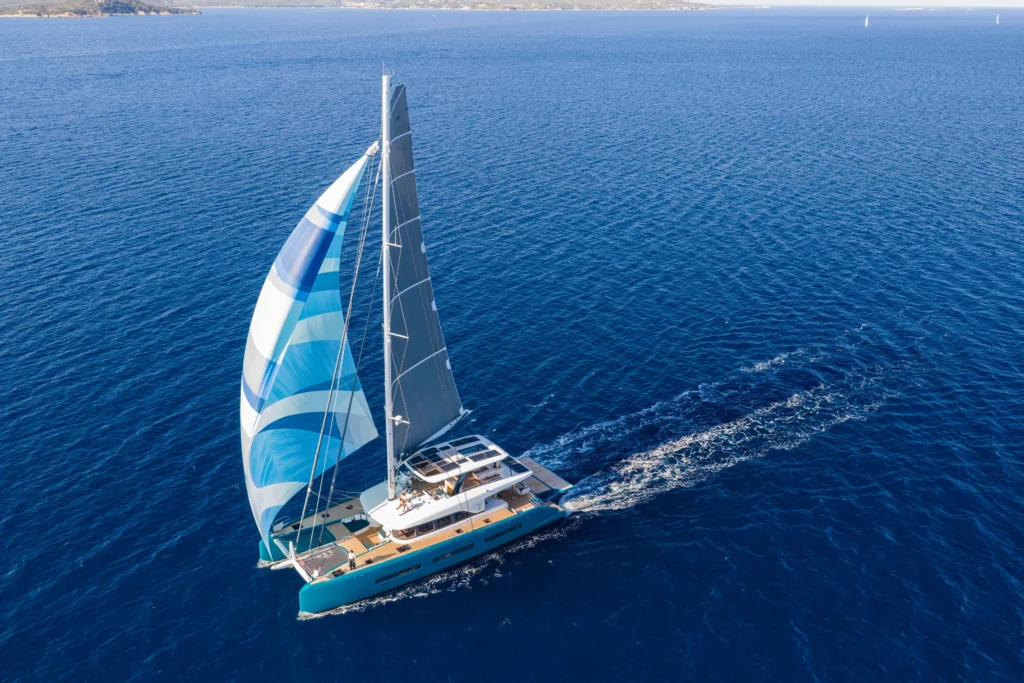
Discovery, the Lagoon Eighty2 sailing the Naora Global Expedition, gives us space to live well over distance. That space does not remove the need for offshore discipline. A quiet cabin depends on machinery remaining dependable, a good meal depends on storage and restraint, and an untroubled afternoon depends on work done before departure.
Sven, Naora’s founder and captain, plans every weather window and sails every leg himself. That continuity matters because small observations accumulate: a line beginning to polish where it passes through a lead, a pump taking longer to complete a familiar task, a steering sound that has changed. A checklist should make room for those observations, not reduce preparation to confirming that equipment switches on.
The useful test of a system is whether it performs under the conditions in which it will be needed. Steering, reefing arrangements, navigation lights, communications and emergency equipment need attention before leaving the reach of straightforward assistance. Spares are valuable only if they fit, can be found and can be installed with the tools aboard.
Water production brings independence, but it should not turn the water in the tanks into an afterthought. If production stops, stored drinking water becomes a finite reserve. Knowing the usable quantity and how consumption would change is part of preparation, even when everything is working normally.
Food involves equally plain arithmetic. At three meals a day, a twenty-two-day crossing represents sixty-six meals per person before any allowance for delay. A hoped-for fish cannot be counted among them. Fresh produce needs an order of use, more durable ingredients need somewhere suitable to live, and the reserve needs to be food people will willingly eat.
There is kindness in making the first passage meals simple. Bodies are adjusting, sleep may be unsettled, and the cook is moving too. A familiar meal, prepared without prolonged work over a hot stove, can do more for the first evening than an elaborate dinner. Stowing a heavy pan so it cannot move is part of the same care.
When The Coast No Longer Sets The Day
On a settled trade-wind night, the yacht can seem quieter from the cockpit than she does from a berth. Outside there is the wash along the hulls and the dark shape of the sails. Below, water passes close to the ear, a cupboard gives a small answering click, and the body learns which movements belong to the boat’s ordinary stride. Sleep becomes less a matter of silence than of familiarity.
That familiarity must not become inattention. A squall may announce itself as a darkening patch to windward, a change in the feel of the air or a return on the radar. None of those signs is guaranteed, and no single instrument sees everything. A proper watch combines observation with the information available, then acts while there is still room to act calmly.
Downwind sailing can conceal how much wind is present because the yacht is moving with it. The breeze felt on deck is the apparent wind, not simply the true wind across the sea. A catamaran can also remain comparatively level as rig loads rise. Comfort is therefore a poor reason to postpone reducing sail. Reefing decisions belong to the conditions, the sail plan and the yacht’s operating guidance, not to how reassuring the saloon feels.
The watch system must protect sleep as deliberately as it protects the course. A captain needs rest, handovers need clarity, and fatigue cannot be solved indefinitely with coffee. Guests should know what is expected of them before departure, without being made responsible for filling gaps in the crew’s arrangements.
For the person off watch, the freedom is substantial but ordinary. A book can remain open through an afternoon. Conversation can stop without anybody needing to repair the silence. The working rhythm underneath that ease is what makes it possible.
Sailing From Bodrum To Barbados In Your Own Time
Following this arc does not require one person to remain aboard from the Aegean to the Caribbean. Through Naora’s private circle, people choose when they join, where along the world route they step aboard and how long they stay. Discovery can also be privately hired for a carefully designed voyage within that route. The expedition continues when a particular stay ends.
Those choices have practical boundaries. Joining and leaving require a suitable port, the necessary formalities and enough flexibility for weather. Someone with a fixed obligation ashore should not build their return around the earliest plausible arrival of an ocean passage. An Atlantic crossing asks for the whole passage and a margin around it. A Mediterranean stay can offer a different relationship with time.
Neither choice is a lesser way of understanding the sea. A week spent noticing how an Aegean anchorage changes can be complete in itself. Weeks offshore reveal something else: how slowly a horizon changes, how much care goes into keeping daily life ordinary, how distinctly land begins to matter when it has been absent.
Barbados does not end those responsibilities. The final approach still requires current charts, attention to swell and light, the proper arrival formalities and enough alertness after many days at sea. If the approach calls for daylight, the desire to get ashore does not make darkness acceptable.
Only once Discovery is secure does the passage release its hold. There is no need to make the first hours ashore prove anything. After so much moving water, the stillness beneath the feet is enough.