The sheltered water can be almost unmarked while the gap beyond the headland is white. In the cockpit, a loose shirt barely moves. Farther out, small breaking crests keep appearing in the same strip of sea, too distant to hear but persistent enough to deserve attention. This is where reefing a catamaran begins, with the difference between the wind touching the boat and the wind waiting along its course. The instrument at the masthead can measure only the air that has reached it.
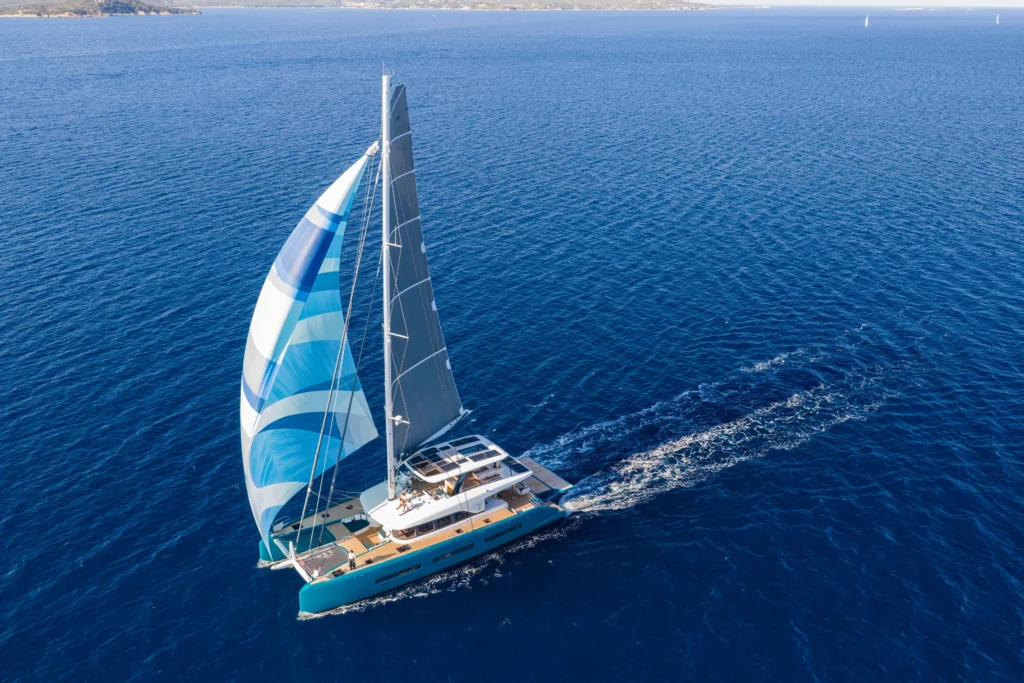
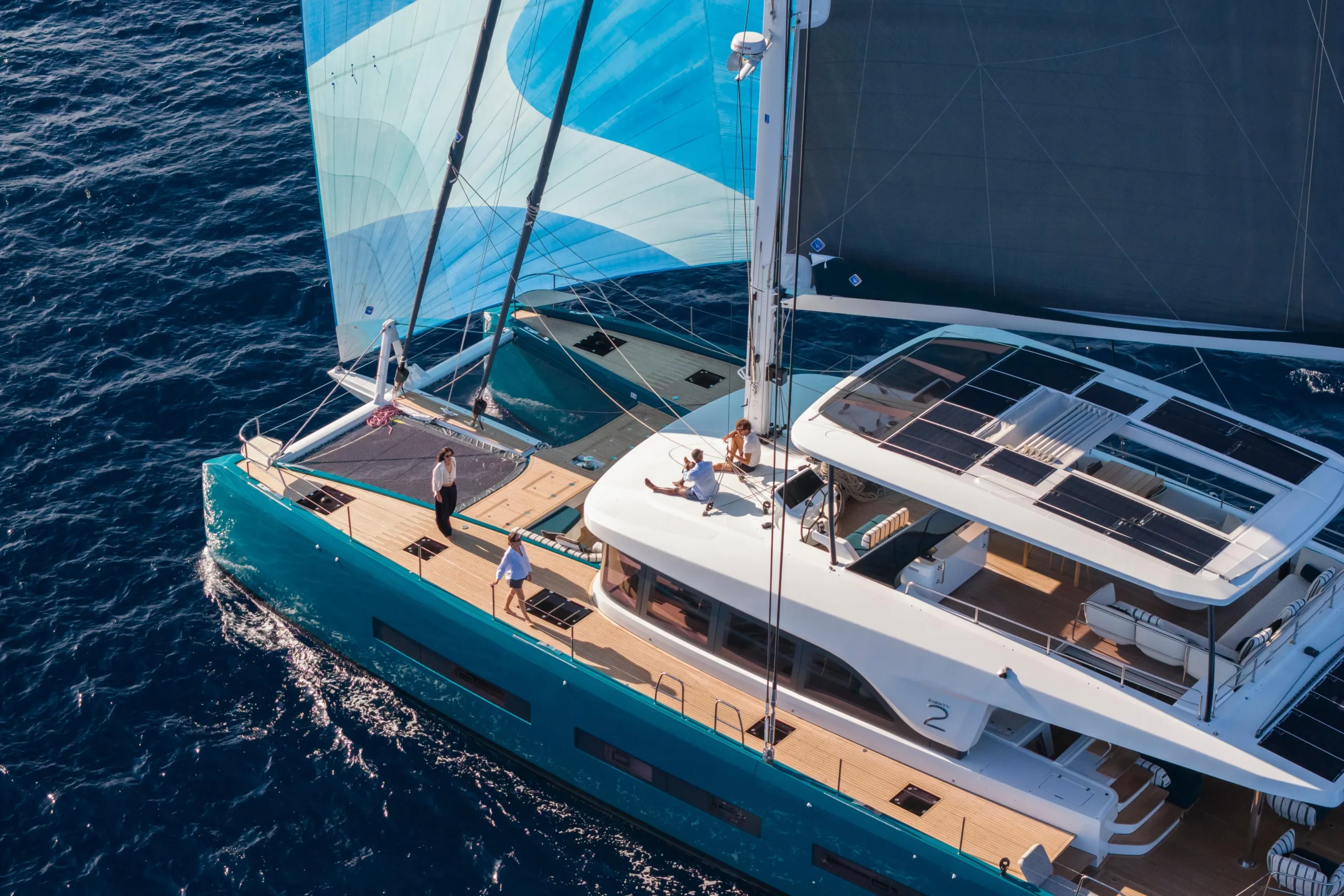
For our Cyclades sailing aboard Discovery, the 2025 Lagoon Eighty2 sailing catamaran at the centre of the Naora Global Expedition, that distinction governs the departure. We choose sail for the exposed water ahead, rather than proving how much the yacht can carry in shelter. The apparent caution of a shortened mainsail in a quiet bay becomes much easier to understand after the headland falls astern.
How The Summer Meltemi Develops
The meltemi is the persistent summer northerly of the Aegean, generally most established in July and August. Its larger engine is a pressure difference, broadly between higher pressure over southeastern Europe and lower pressure towards Turkey and the eastern Mediterranean. Local heating and island terrain modify that flow, but they do not create the whole system. This matters because the meltemi cannot safely be treated as a sea breeze that will switch off when the land cools.
An afternoon increase is common, and an earlier departure can sometimes offer better conditions. Neither is a promise. A strong pressure gradient can keep the wind blowing through the night and into the following morning, with several days of sustained conditions. Clear skies do not contradict that forecast. The light can be beautiful, the horizon sharply defined, and the passage still unsuitable for the course we intended to sail.
We read the marine forecast and warnings alongside the weather model, paying attention to timing, gusts and the expected sea state rather than taking one coloured wind field as the answer. Beaufort force 6 corresponds to 22 to 27 knots, force 7 to 28 to 33 knots. Those ranges are not ceilings on individual gusts. Nor do they describe the waves completely: duration, fetch and the direction of the passage determine how much work the hulls will have to do.
A wind that has been blowing since yesterday can have a substantial sea waiting beyond an island even when the anchorage is flat. An early start does not erase that accumulated water movement. The departure decision has to account for both the wind now and the sea it has already made.
Island Acceleration and Gusts On The Lee Side
The spaces between Cycladic islands do not receive an even distribution of the forecast wind. Air is diverted around high ground, channelled through some gaps and accelerated around exposed shoulders. The effect depends on the wind direction, the height and shape of the land, and the stability of the air above it. Calling every acceleration a funnel effect is convenient, but it misses how different two neighbouring passages can be.
The lee side adds another complication. An island may remove much of the wave action while allowing strong air to descend its slopes or spill around its edges. Behind steep ground, there can be turbulence, sharp changes of direction and gusts separated by convincing lulls. We can therefore have sheltered water without sheltered wind. The absence of waves is especially persuasive from a catamaran cockpit, where a broad, level deck reinforces the impression that the whole situation is settled.
On the chart, we examine the shoulders of the island, the orientation of the gap and the terrain above the lee shore. Outside, we look for repeated streaks of disturbed water, patches of spray lifting from crests and a sudden change in surface texture beyond a point. None of these supplies a reliable wind speed. Together, they can show where the smooth water ends and where the next sail-handling job would become more difficult.
The useful rule is to treat the end of shelter as a change in conditions, not merely a waypoint. The reef should be established before that boundary where there is safe room to do so. If the sheltered water is too confined for the manoeuvre, we need a different departure method or a different departure time.
Reefing a Catamaran Without Relying on Heel
A cruising catamaran develops substantial initial stability from the distance between its hulls. That stability is valuable, but it changes the information coming back to the person sailing. Increasing wind can put much greater loads into the sails, rig and structure while producing relatively little additional heel. The deck remains reassuringly close to horizontal. The load has not disappeared because the glass stays upright.
A monohull’s heel is not a calibrated load indicator either, but it often gives a conspicuous physical warning that the sail plan needs attention. On a catamaran, waiting for that same warning is a poor habit. We look instead at wind strength and angle, the sail-reduction guidance for the yacht, sea state, steering behaviour and the way gusts are being converted into motion. Unusual heel should never be the event that starts the discussion.
The arithmetic explains why anticipation matters. With sail shape and angle otherwise unchanged, aerodynamic force varies approximately with the square of apparent wind speed. A rise from 20 to 30 knots therefore represents roughly 2.25 times the force, not merely half as much again. This is an illustration of the physics, not a prediction of a particular fitting’s load. A real yacht is moving, pitching and changing the airflow continually.
Reefing reduces the area exposed to that flow and lowers the mainsail’s centre of effort. It gives us margin before the gust arrives. Easing a sheet can reduce load immediately, but carrying excessive sail and repeatedly spilling wind is not an equivalent passage plan. It requires continuous correction precisely when traffic, waves or navigation may also need attention.
Choosing Sail Area For The Next Exposed Reach
The starting point is the reduction guidance for the yacht and its sails, including whether its wind figures refer to true or apparent wind. A generic instruction to take the first reef at a particular number of knots cannot account for different rigs, displacement, loading or sea conditions. We choose the configuration for the expected exposed conditions, with room for credible gusts. The first reduction is not a compulsory stopping place if the next reach calls for less sail.
We also consider the course after departure. In a simplified example, running directly downwind at 8 knots in 25 knots of true wind produces about 17 knots of apparent wind. Turn onto a beam reach at the same speed and the apparent wind becomes about 26 knots, coming from forward of the beam. The weather has not strengthened. The boat’s movement relative to the air has changed what the sails receive.
This is one reason a comfortable downwind stretch behind an island can mislead us before a turn into a channel. We plan the sail area for the new angle before making the turn. The headsail belongs in that decision as well: its area must remain appropriate to the reduced main and the yacht’s approved sail combinations. A deeply rolled headsail may lose useful shape, so more turns on the furler are not an unlimited substitute for the right sail.
Sven, Naora’s founder and captain, plans every weather window and sails every leg himself. The decision includes the option of staying where we are. A smaller sail plan does not make an unfavourable passage favourable if the waves, visibility at the destination or available shelter remain wrong. Reefing is preparation for a suitable departure, not permission to force one.
Reefing a Catamaran Before Leaving Shelter
Before leaving shelter does not mean hoisting a large mainsail while still anchored among other boats. We can prepare the lines, identify the intended reduction and brief the manoeuvre while stationary. Raising or reducing sail then requires adequate depth, room to hold the necessary heading and a clear escape from nearby boats and shore. Sometimes that means moving under engine within protected water first. If there is no safe working space, the plan must change.
The crew need to know who is steering, who is handling each control and who is watching the sail and the line leads. One person should not be expected to watch a powered winch and an obscured fitting simultaneously. Lifejackets are on, people remain clear of the boom’s possible sweep, and a stop instruction must be understood without discussion. A quiet anchorage is the place to settle those details.
The mechanical sequence depends on the installed reefing arrangement. On a conventional slab-reefed mainsail, the essential work is to support the boom, unload the sail, lower it to the selected reef and transfer the working loads to the new tack and clew. Halyard and reef-line tension are then established in the specified sequence. The reduced sail needs a properly tensioned luff and foot, rather than a loose pocket of cloth whose movement shocks the fittings every time the boat pitches.
The smaller intermediate reef ties, where fitted, gather spare cloth. They are not substitutes for the load-bearing tack and clew attachments and must not be made to carry the sailing load. A furling installation requires its own boom angle and tension sequence; the principle of unloading the sail does not make the handling procedures interchangeable. The correct method belongs to the actual equipment, not to whatever system someone last sailed.
A powered winch makes restraint particularly important. Unexpected resistance is a reason to stop and look, not to apply more power. A loaded batten car, trapped line or snagged sail can turn a routine reduction into damage very quickly. From the helm, we listen for the change from cloth moving freely to a hard, irregular crack, and watch that the sail is actually travelling as the control line moves.
Once the reduction is set, we load the sail progressively and inspect the working attachments, line leads and shape from a safe position. The headsail is adjusted as required, loose lines are secured, and the steering is checked under the new balance. The manoeuvre is finished when the configuration has been verified under load, not when the winch stops.
Managing Gusts After The Headland
Outside the lee, the change can arrive first on the skin. Air that felt warm against the sheltered deck becomes a continuous pressure across the face, and the first spray cools the forearms before it dries into salt. The sail fills more firmly. With the reduction already in place, we can watch how the yacht answers instead of dividing our attention between an unfinished reef and the first exposed waves.
We keep looking upwind. A moving band of fine, dark ripples can mark stronger air approaching, although a cloud shadow can imitate the colour without the surface disturbance. Texture, movement and the behaviour of nearby crests help distinguish them. The point is not to estimate a precise gust speed by eye. It is to recognise an approaching increase early enough to have the relevant sail controls ready.
There is no universal instruction to turn a catamaran one way whenever a gust strikes. Heading towards the wind may initially increase apparent wind before the sail luffs; bearing away can change both the sail load and the relationship to the waves. The appropriate response depends on the point of sail, available water and the yacht’s handling guidance. We reduce load with the appropriate controls and keep the course deliberate, rather than making a large reflex turn towards danger.
The autopilot does not decide whether we have too much sail. Repeated corrections, a yacht surging hard into the next wave or a sail that needs constant easing all deserve attention. After the first stronger gusts, we reassess the configuration and check for movement or chafe at the working lines. An early reef creates margin. It does not remove the need to keep observing.
How Reduced Sail Changes The Motion
A reef does not flatten the sea. The same wave train still reaches the bows, and heading and speed still need adjustment to avoid driving unnecessarily hard into it. What can change is the yacht’s response between waves. Instead of a gust accelerating the boat into the next encounter, the smaller sail plan can produce a steadier pull. The difference is felt in the knees and hips before anyone finds a useful word for it.
There may be less speed in the lulls. We accept that cost rather than immediately restoring sail, especially when another exposed gap lies ahead. The temporary softness behind the next island is not evidence that the earlier decision was excessive. Shaking out a reef and putting it back a short time later adds handling, wear and another opportunity for a line to catch or a manoeuvre to be interrupted.
In the cockpit, the sounds separate again. There is water against the hulls, the steady movement of air through the rig, a voice from inside that no longer has to compete with repeated flogging. At the helm we are still watching the next patch of sea. But someone can carry a thought through to the end of a sentence without stopping to brace for each acceleration.
The folded chart stays where it was put. A hand rests around a warm cup rather than gripping the edge of the table. Beyond the shade, the water is still white in places, and the island is slowly becoming smaller.