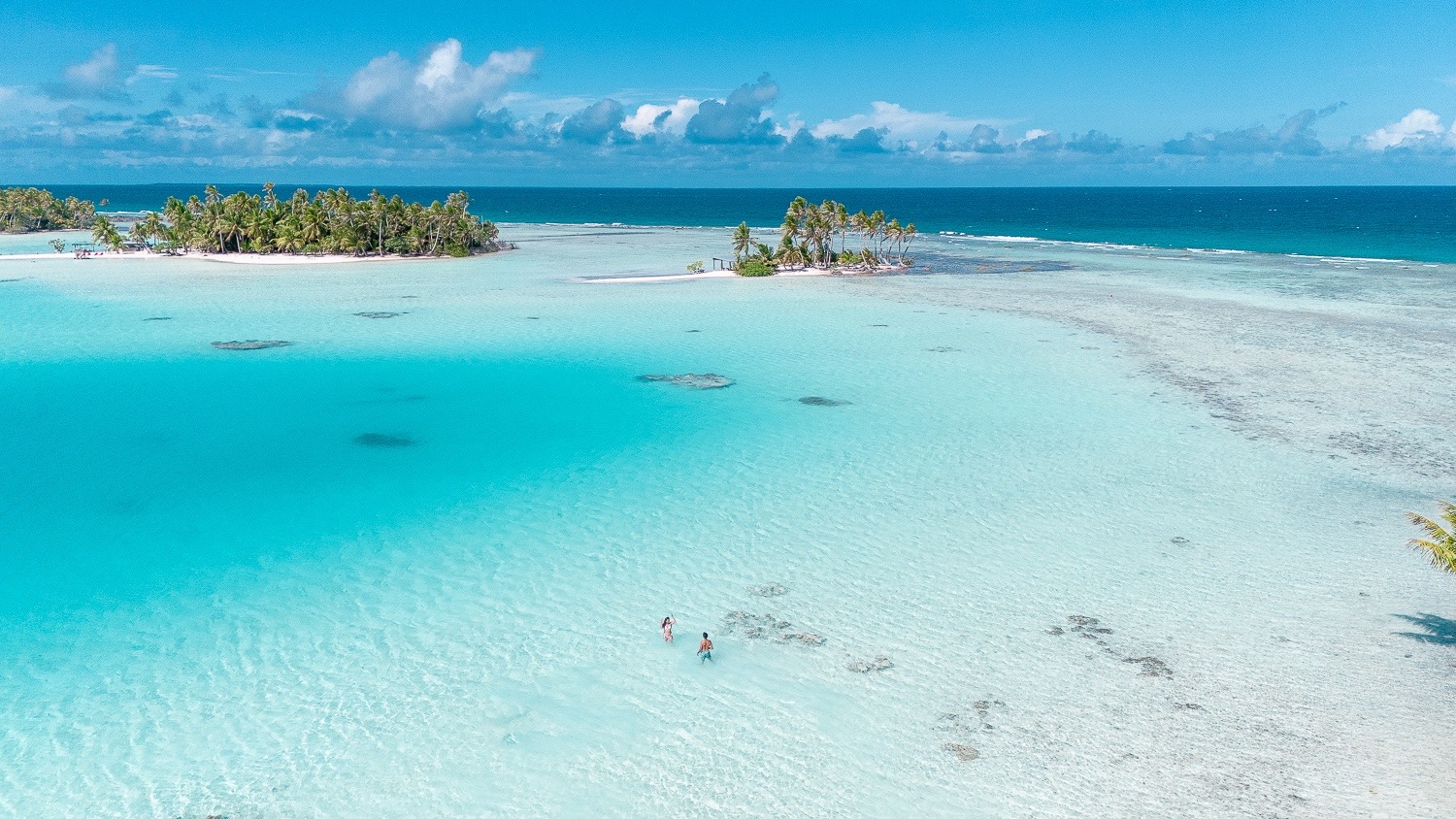
From a dinghy, the pale bottom at Rangiroa Blue Lagoon can look close enough to touch. Sunlight comes back through the water and under the brim of a hat; a darker patch interrupts the sand, and the eye keeps returning to it. Coral, perhaps. A change in depth, perhaps. Before there is anything to photograph, there is something to read.
The attraction is easy to understand: shallow blue water held inside the much larger lagoon of an atoll, with reef and low islands making another boundary between you and the ocean. Getting there deserves more thought than the photograph suggests. The sheltered water at the destination tells us little about the crossing, and a dinghy that can enter a shallow opening is not necessarily the right boat for every stage of the outing. For us, the pleasure begins with making those distinctions properly.
The Lagoon Within A Living Reef
Rangiroa extends roughly 40 Nm along its long axis. That is the useful meaning of its size for someone arriving by yacht: there is enough water inside the reef for the wind to build a sea. Being inside an atoll does not mean being in a small, protected harbour. The same reef that breaks the ocean swell can enclose a lagoon with a considerable stretch of open water.
The Blue Lagoon lies towards the western side of this larger enclosure. Its boundaries are reef, shallow banks and motu, the Tahitian word for islets. It is not a sealed pool with a single patch of land in the middle. Water moves through the reef system, shorelines change with water level, and the places where a small boat can pass depend on more than its width.
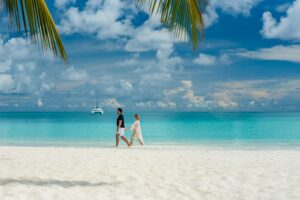
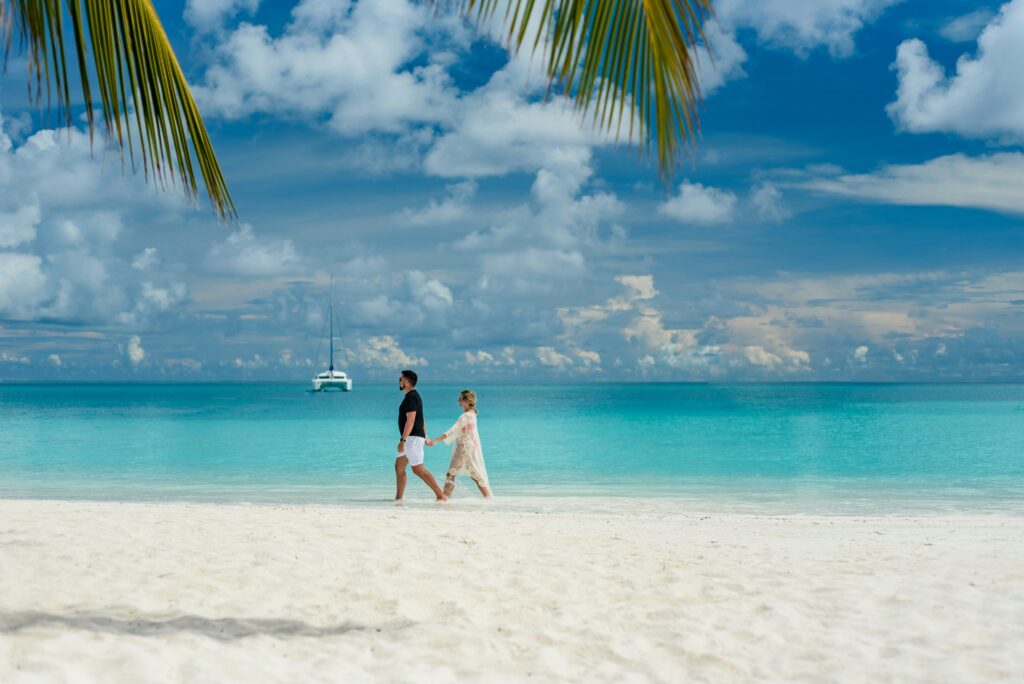
Pale carbonate sand contributes much of the brightness. Sunlight reaches the bottom and returns through the water, while depth, cloud and the nature of the seabed alter the colour. Two or three metres of clear water over pale sand can look intensely blue. That does not establish the depth of the approach, where coral or a sand ridge may lie much closer to the surface.
The inner shelter reduces fetch, the distance over which wind can build waves. It does not abolish wind or current. This matters because the experience can genuinely be quiet while the journey back is becoming uncomfortable. Both conditions can exist at once.
Planning The Crossing From Discovery
An anchorage in the northern lagoon near Avatoru or Tiputa may be the starting point, but those names alone do not settle the plan. We need the actual position, the wind direction, the likely return conditions and a route that accounts for coral hazards. The northern ocean passes and the shallow approaches to the Blue Lagoon are separate pieces of pilotage. One cannot stand in for the other.
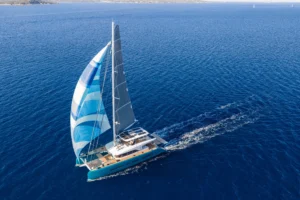
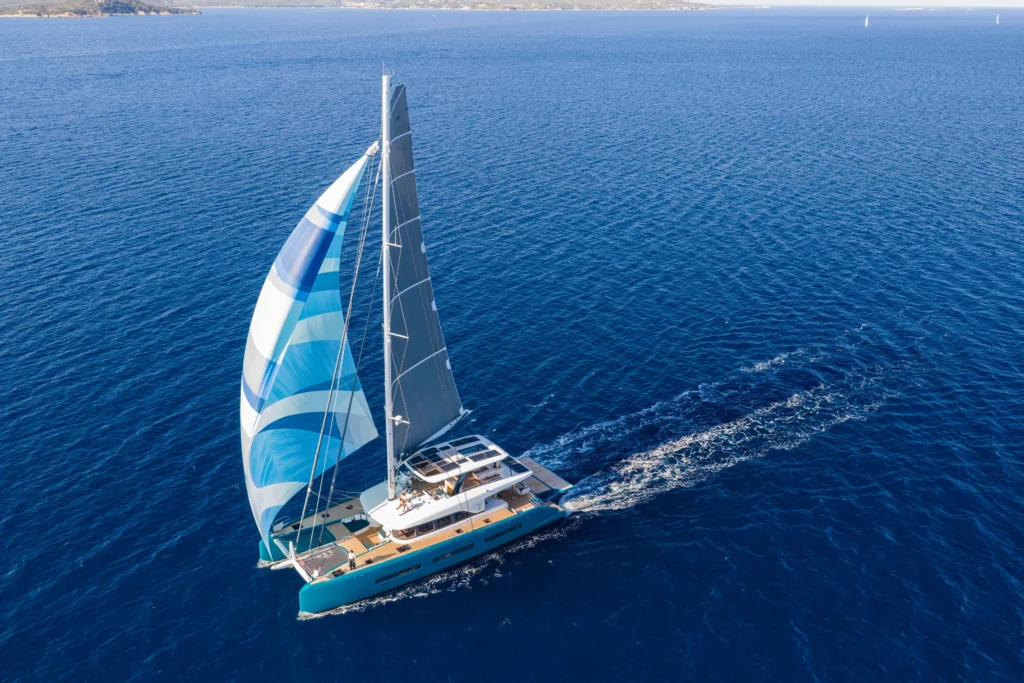
Discovery, the Lagoon Eighty2 sailing the Naora world route, gives us a comfortable base. Her presence does not remove the question of which boat should make the crossing. Moving the yacht towards a suitable nearer anchorage, using an appropriately equipped local boat, or making a tender journey are different decisions, each with its own constraints. None should be assumed before the weather and local information have been considered.
May to October generally brings drier conditions in the Tuamotu, but the southeast trade winds can be firm rather than gentle. Stronger southerly weather can also disturb an otherwise settled pattern. November to April is generally warmer and wetter, with greater concern about squalls and tropical disturbances. These are seasonal tendencies, not a forecast for the day we want to swim.
Before discussing an arrival time, we measure the actual route around the hazards. At a comfortable 10 knots, each 10 Nm needs an hour; at 5 knots in chop, the same stretch takes two. The return may be slower than the outward run because the wind has strengthened or the heading puts the waves ahead. Fuel and daylight have to cover that less convenient version.
Sven, Naora’s founder and captain, plans every weather window and sails every leg himself. The smaller decisions belong to the same discipline. A lunch outing should not depend on maintaining an uncomfortable speed, and nobody should have to endure repeated impacts simply because the destination looked close on a map.
Reading The Rangiroa Blue Lagoon Approach
Slack water is a condition to establish, not a time to assume. High water, low water and the weakest current are related, but they are not interchangeable. Atolls complicate that relationship because waves can push water across the outer reef into the lagoon, while wind can redistribute water within it. The flow through an opening responds to differences in water level on either side.
A tide prediction is therefore one part of the picture. It cannot, by itself, tell us what a shallow opening far across the lagoon is doing. Recent wind and swell matter. So does local knowledge of the particular approach. The useful conversation is specific: which opening is usable, what the water is doing there now, and what may be different when we leave.
The quietest current is not necessarily the deepest water. A dinghy might have adequate clearance while the flow is too strong for a controlled transit, or find weak current with too little water over the shallowest part. We need both clearance and control, with room to stop or turn away before committing.
Light is another working condition. With useful sun behind the observer, changes in the bottom are generally easier to distinguish. Low sun ahead can turn the surface into a sheet of glare. A passing cloud can flatten distinctions that were obvious a moment earlier. Polarised glasses help, but they do not make an uncertain route certain.
This is close observation at a controlled speed, not simply following a line on a screen. The sounder reports what is beneath its transducer, not what lies ahead of the bow. If the route stops being readable, the answer is to pause or withdraw while that remains straightforward. Raising an outboard and hoping to skim across doubtful reef is not a substitute for adequate water.
On the return, the morning’s successful entry is useful information, not permission. Water level, current and visibility all need to be read again.
The Dinghy Is Still A Boat
A tender makes distance feel informal. People sit close together, the shore remains visible, and the things going aboard look like the contents of a beach bag. That familiarity can disguise a substantial small-boat passage. The exposed crossing deserves its own fuel calculation, safety equipment and communication plan.
We load for the people and conditions, not merely for the seating available. Lifejackets need to fit and be worn for the crossing. The engine stop cord belongs attached to the driver. Bags must be secured where they will not obstruct movement or shift with each wave. A shaded seat aboard Discovery tells us little about how someone will feel after prolonged sun and spray in an open boat.
Drinking water, protection from the sun and a way to stay comfortable when wet are practical provisions. So is enough reserve fuel for a slower return or a necessary change of route. Communication needs to work over the intended area; carrying a handheld radio does not establish that someone can hear it. The people remaining aboard should know the route, the expected return and what will happen if contact is missed.
The landing has to be thought through as carefully as the crossing. We need somewhere appropriate to secure the boat without damaging coral or vegetation, and we need to know that changing water level will not leave it stranded. An attractive palm is not automatically a mooring point. Getting back into the dinghy should remain easy for the least agile person aboard, not only for the person driving it.
Swimming Without Rearranging The Reef
The sheltered shallows offer a different kind of water time from Rangiroa’s ocean passes. There is no reason to bring the expectations of a pass dive into a quiet pool, or to assume that clear water means there is no current. Before anyone swims, we look at where the water is moving, where it leaves the pool and how each swimmer will get back aboard or ashore.
The first moments in a mask are often enough to change the scale of the place. A broad pale patch becomes individual ripples of sand. Small fish that were invisible from the boat hold close to shelter. Your breathing sounds large beside these slight movements. Staying still makes more of this visible than swimming continuously from one patch of colour to the next.
Shallow water calls for more care with fins, not less. There may be little clearance between a swimmer and living coral, especially when turning or stopping. We choose open water with enough room, keep equipment from trailing and avoid standing on the reef. If someone needs to stand, the place must be confirmed bare sand rather than a pale surface assumed to be harmless.
Juvenile blacktip reef sharks may use these shallows. They are not a scheduled encounter, and their presence is no invitation to feed, pursue or touch them. We leave their route open. Food scraps stay out of the water, both because feeding changes behaviour and because a swimming place should not become associated with a meal.
A shallow lagoon can make the sun easy to underestimate. Covering skin reduces exposure without requiring anyone to interrupt every quiet moment to think about it. The best swim is not necessarily the longest one.
Ashore At Rangiroa Blue Lagoon
Landing somewhere beautiful does not make it ours for the afternoon. A motu may be privately owned or used by local families, and a quiet shore is not evidence that nobody has an interest in it. We establish permission and any conditions before setting out lunch. Local knowledge belongs to people who live here, rather than being a free accessory to the scenery.
The shore may be shared with other visitors. Rangiroa’s Blue Lagoon is known and visited, and there is no honesty in promising an empty landscape. Privacy here comes partly from our own conduct: keeping the group together without occupying every stretch of shade, leaving access clear, and not making other people part of our photographs without asking.
This is the part worth leaving time for: the engine stopped, water tapping against the dinghy, salt drying on a forearm while someone opens the lunch box. Coarse coral grains shift under a shoe. In strong reflected light, the underside of a hat can feel almost as bright as the sky. Shade and a cool drink become quite sufficient comforts. Nobody needs an elaborate arrangement to improve them.
The meal does, however, need careful handling. A closed insulated box kept out of the sun matters more than a beautiful platter. Food should come out in portions rather than sit exposed while everyone swims. Locally bought fruit makes sense when it is available and good; anything brought ashore leaves with us again, including peel and scraps.
If poisson cru is part of lunch, its simplicity should not disguise the care it needs. Fish, lime and coconut milk make a dish closely associated with French Polynesia, but lime changes the texture of fish without reliably making raw fish safe. Suitable sourcing and uninterrupted cold storage still matter. If those cannot be assured, we choose something else. A dish belongs to a place through its ingredients and technique, not because we insist on serving it under unsuitable conditions.
Leaving Room For The Return
The departure decision is best made before anyone becomes attached to staying. We need sufficient light to read the reef, a manageable crossing and fuel held in reserve. If the breeze starts building sooner than expected, lunch can be shorter. If the approach is doubtful, lunch can happen aboard. These are ordinary adjustments, not diminished versions of the day.
There is a particular kindness in making them early. People can enjoy the water when they are not being hurried through the final minutes or asked to tolerate conditions that were foreseeable. Good preparation keeps the captain’s calculations from becoming everyone else’s discomfort.
Rangiroa belongs within the French Polynesian part of the Naora Global Expedition, the private voyage around the world running from 2027 to 2031. Members choose when they join, where along the route they step aboard and how long they stay. Discovery continues sailing beyond any individual visit. That continuity gives a small outing its proper scale: important enough to plan carefully, but never something to force because it has been imagined in advance.
We cannot always exchange a windy day for a calm one within someone’s time aboard. We can be honest about that before the dinghy leaves, and keep the day open enough for the place to be itself. The Blue Lagoon needs neither a guaranteed landing nor a solitary island story to hold our attention.
There is room for lunch, for a quiet swim, for watching the changing edge between pale sand and blue water. Beyond it, the larger lagoon carries the wind.