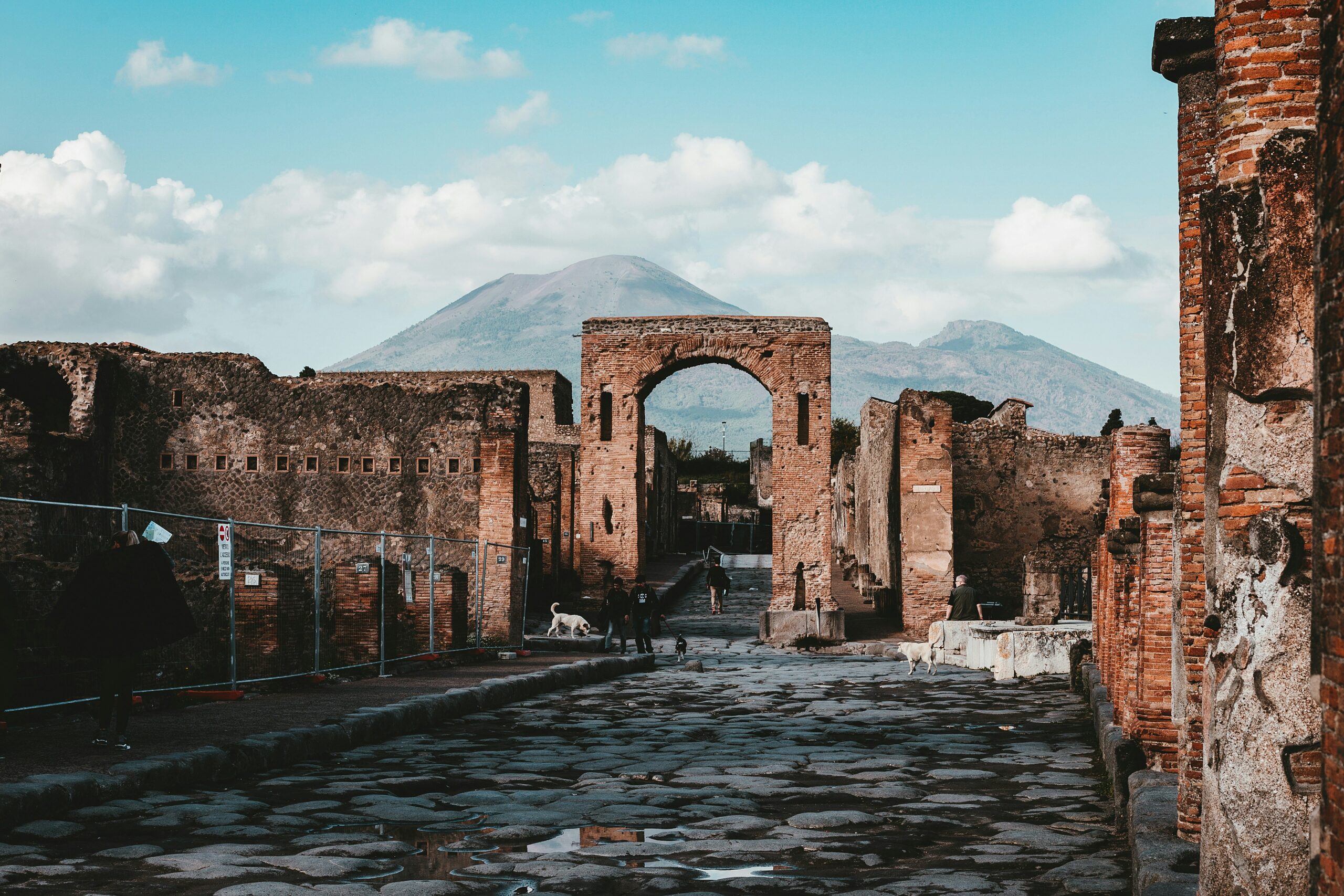
The stepping stones rise above the road, with gaps between them where cart wheels could pass. Before we have read a date or understood a building, the street asks us to think about water, feet and traffic. Visiting Pompeii from the Bay of Naples, we want to leave enough time for this kind of detail, the practical arrangement that makes an ancient place briefly intelligible as somewhere people had to get through an ordinary day.
Vesuvius supplies the outline above the bay and the explanation for much of what survived. It is tempting to let the volcano explain everything. But Pompeii becomes more absorbing when the eruption stops being the only event we can imagine there, and the ruined streets begin to suggest all the mornings when nothing exceptional happened.
Visiting Pompeii From The Water
For a visit from Discovery, our Lagoon Eighty2, the first decision is where the yacht can lie securely while people are ashore. The Bay of Naples is a large body of water with different exposures, shore facilities and traffic patterns. An attractive view of Vesuvius is not an anchoring plan.
We need to understand the bottom and the available swinging room, then judge the shelter against the weather expected throughout our absence. Flat water at breakfast does not establish that an anchorage will remain comfortable until evening. In settled warm weather, an afternoon sea breeze can roughen an exposed landing; ferry wash can complicate a tender transfer even when the wind is light. The return deserves the same attention as the departure.
A marina berth may be the more sensible choice for a substantial day ashore. At Pozzuoli, that would mean confirming a berth suitable for Discovery’s length, beam and draught, rather than assuming that a marina marked on the chart can accommodate her. A shore plan is also incomplete until responsibility aboard and communication with those ashore are settled. Looking at Roman houses does not suspend the work of looking after a yacht.
The road transfer follows from that decision. There is no single reliable taxi time from an entire bay, and a departure from Pozzuoli is a different proposition from a landing farther along the coast. Traffic, the chosen entrance and the return arrangements all matter. We would rather allow an honest margin than give someone a precise-looking arrival time that depends on everything going conveniently.
What The Eruption Preserved
In AD 79, Pompeii was buried through successive phases of an eruption, not covered instantaneously by one uniform blanket of ash. Falling pumice accumulated on buildings and overloaded roofs. Later pyroclastic currents, fast-moving mixtures of hot gas, ash and rock, brought further destruction. The depth and character of the deposits varied across the city. That sequence helps explain why some structures survived while others collapsed, and why the archaeological record cannot be read as one perfectly frozen instant.
The city was already changing before the eruption. A severe earthquake in AD 62 had damaged buildings, and repair and alteration remained part of Pompeian life. Some of the unfinished work visible in the remains belongs to a community rebuilding and adapting, although not every repair can be assigned to that earthquake. These were occupied streets with maintenance problems, ambitions and interruptions of their own.
Organised excavation began in 1748. The Pompeii we encounter therefore carries another long history: what was uncovered, what was removed, what was recorded, what deteriorated after exposure and what has since been conserved. Protective roofs and repaired masonry are part of keeping the surviving fabric standing. An excavated wall has exchanged the protection of burial for rain, sunlight and the wear of visitors.
Pompeii is a ruin, but one in which relationships survive unusually well. A counter remains beside a pavement. A doorway still connects a street to a household. The value lies in those connections, not in pretending that nothing has changed.
The Street As A Working System
On a hot day, the paving makes its own demands. Reflected light narrows the eyes, uneven stones shorten the stride, and a strip of shade beside a wall becomes somewhere worth pausing. Looking down is unavoidable. It is also useful. The street contains information that disappears when we walk through it only to reach the next important building.
Raised footways and stepping stones helped pedestrians negotiate roads that also carried runoff and waste. At some crossings, the spaces between the stones accommodated wheels. The arrangement makes sense when movement and drainage are considered together. A dry street can conceal its purpose; imagining water moving along it restores part of the explanation.
Public fountains belong to the same reading of the city. They show that water supply was a shared urban provision, not something to be assumed inside every home. A fountain’s position mattered to the effort of fetching water and to the ordinary encounters that happened around it. The impressive object is also a piece of infrastructure.
Along the Via dell’Abbondanza, commercial frontages and entrances bring work close to domestic life. Painted electoral appeals add another layer. These should be distinguished from scratched graffiti: a public endorsement of a candidate and an informal inscription are different uses of a wall. Neither should be treated merely as decoration. People wanted their preferences seen, their names remembered, their neighbours persuaded. That does not mean everyone passing could vote, but it does mean the street was a place where influence was exercised.
Bread And The Work Behind It
The bakeries make the city particularly easy to understand because their surviving equipment explains a process. In the rotary mills, a movable stone worked around a fixed one, reducing grain in the gap between them. Animal or human muscle supplied the power. The oven belongs to the end of that sequence, after grinding, mixing and kneading. What looks like a collection of heavy stone objects becomes a workplace once we follow the grain through it.
That workplace was demanding. The effort of turning a mill was repetitive, and the labour behind Roman prosperity included enslaved people. It is possible to admire the ingenuity of the equipment without making the conditions around it picturesque. Bread reached a counter because someone had done the work.
The food counters, often called thermopolia, offer another kind of familiarity. Their round openings held large ceramic vessels set into the masonry. Prepared food and drink could be sold here, but an opening alone does not tell us exactly what its vessel contained. Calling every counter an ancient fast-food restaurant is a useful first comparison, provided we do not mistake the comparison for a complete explanation.
Cooking required fuel, space, equipment and time, then as now. Buying food could answer practical needs as well as appetite. A substantial private kitchen was not universal. Once that is understood, the counter becomes more than an appealing photograph: it belongs to a network of people who milled, baked, carried, sold and ate, usually without leaving much record of themselves.
The House Around An Open Sky
It is worth leaving the broad public spaces for a house whose layout can still be followed. In a typical atrium arrangement, an opening in the roof admitted light and rain above a shallow basin. Water collected there could feed a cistern below. The basin was therefore more than an ornamental centrepiece. Light, weather and storage were being brought into the organisation of the household.
The body understands some of this before the mind supplies the architectural terms. Where shade survives beside a bright court, the eyes take a moment to adjust. A doorway frames a smaller portion of the garden than the garden itself. Columns interrupt the view and reveal it again as we move. These are useful reminders that a house is experienced in sequence, not as the flattened plan we see on a sign.
But the missing roofs and upper rooms matter. A sunlit ruin can make an ancient interior seem much more open than it was. Rooms that now appear exposed may once have been enclosed, crowded or dim. The generous surviving houses also represent only part of Pompeian society. Their proportions cannot stand in for everyone’s domestic life.
The gardens require similar care. Planting holes and root cavities can help recover evidence of earlier layouts, but a replanted garden is a reconstruction informed by archaeology, not vegetation that has survived unchanged since the eruption. Its value is in making space understandable again. We can enjoy that clarity while keeping the distinction intact.
What The Casts Can Tell Us
The casts need a different pace. The technique introduced in 1863 used voids left in consolidated volcanic deposits as soft tissues decayed. Plaster poured into suitable cavities could recover the external form of a body and sometimes impressions of clothing. Skeletal remains may be enclosed within the resulting cast. These are neither imagined sculptures nor simply intact bodies covered in plaster.
Understanding the process changes the encounter. What we are looking at is an absence made visible through excavation, sometimes still containing human remains. The precision can be difficult to absorb because it brings the individual body so much closer than a broken wall does.
It does not, however, give us a complete private story. A posture cannot reliably tell us a person’s final thought. Two people found near one another do not automatically establish a particular family relationship. Many inhabitants escaped; those who died cannot all be described as people who simply chose not to leave. Circumstances and opportunities differed, and much remains beyond recovery.
We do not need to fill those gaps to feel the loss. Restraint is part of taking the people seriously. With children, explaining what the casts are before approaching them allows a parent to judge what is appropriate, rather than discovering the emotional weight of the display halfway through it. A child need not see them for the visit to have mattered. The street, the mill and the rainwater basin already offer a substantial encounter with other lives.
Visiting Pompeii At A Human Pace
The ancient city extended over roughly 66 hectares. That scale makes a full circuit a poor default ambition, particularly in heat: walking farther does not necessarily mean understanding more. We would normally allow roughly three to four hours for a selective first visit, as a planning estimate rather than a prescribed duration. Interest, mobility, weather and the houses open that day can all change it. A shorter, attentive visit is preferable to an exhausted final hour.
An early arrival is useful for cooler conditions in warm weather, but it is not a promise of empty streets. Opening hours and access arrangements should be checked for the actual day, and individual houses may be closed for conservation or operational reasons. The route through the site should remain adjustable. There is little sense in marching past an absorbing room to keep an appointment with a building that turns out to be inaccessible.
Footwear needs to grip and remain comfortable on uneven paving. Drinking water and sun protection belong in the day bag, not back aboard. The ancient fountains explain a water system; they should not be assumed to be drinking-water points. If someone has limited mobility, the accessible route needs consideration before arrival, because a line on the site plan does not communicate the effort of a raised crossing.
The archaeological museum in Naples offers a complementary experience. Many objects from Pompeii, including mosaics, painted decoration and household pieces, can be considered there at a scale and in conditions different from the streets where they originated. The site explains relationships between spaces; the museum allows closer attention to things once used within them. We would not automatically compress both into one long day. Each deserves enough attention that the second does not become something merely completed.
Discovery follows the Naora Global Expedition around the world, while members choose when and where they join and how long they stay. That freedom also has a quieter expression within a day. A visit to Pompeii need not become the programme for everyone aboard, and those who go need not share an identical appetite for history. The arrangements should make room for those differences without leaving anyone uncertain about the return.
A threshold is a small thing to remember from a city. Someone once crossed it at the end of an ordinary day.