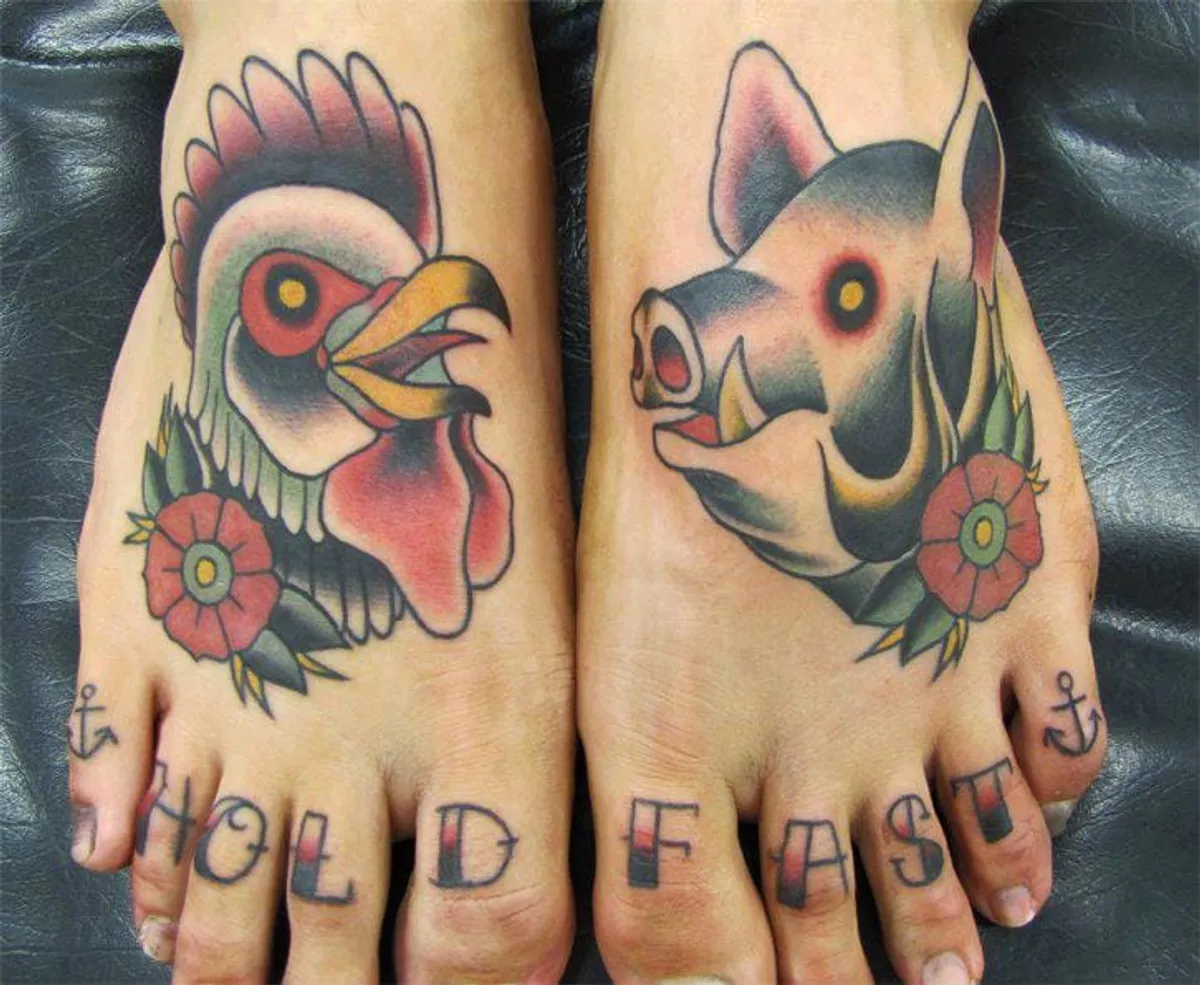
The pig and the rooster are not obvious candidates for maritime protection symbols. They are farmyard animals with no particular relationship to the sea, no navigational capability, no special tolerance for salt water or Atlantic storms. And yet for generations of deep water sailors, tattooing a pig on one foot and a rooster on the other was the specific protective measure against drowning that the offshore sailing tradition had developed and that the sailors who used it took as seriously as any piece of safety equipment aboard.
The logic was specific and it was grounded in observation rather than in superstition in the dismissive sense. Wooden crates floated. When a merchant vessel went down in the era of sail, the livestock that was carried in wooden crates, the pigs and the chickens that provided fresh meat and eggs for the crew on long passages, frequently survived the wreck by floating ashore on the same crates that had housed them.
The sailors who watched their shipmates drown while the pig in its wooden crate bobbed safely toward the beach drew a conclusion that was entirely rational given the available evidence: the pig survived because something specific about the pig, or the pig’s relationship with the sea, or the pig’s connection to the powers that determined who drowned and who did not, protected it from the fate of the men who went into the water.
The Logic of the Tattoo
The tattoo was the transfer of the protection from the animal to the sailor. By carrying the image of the pig and the rooster on his feet, the sailor was, in the specific symbolic logic of the maritime tattoo tradition, claiming for himself the quality that had allowed those animals to survive the wreck that had killed the men.
The feet specifically: the closest part of the body to the water, the first part to enter it when a man went overboard, the part that the superstition identified as requiring the most specific protection against the drowning that the sea produced in the men who fell into it without a wooden crate to keep them at the surface.
This is the logic that the outsider calls superstition and that the insider calls preparation. The sailor who tattooed the pig and the rooster on his feet was not being irrational. He was applying the available technology of protection to the available evidence of what survived and what did not, in the specific context of a life where the difference between survival and drowning was decided by factors that were not fully within the sailor’s control and where every available means of improving the odds was worth using.
The Broader Tattoo Tradition
The maritime tattoo tradition is one of the oldest continuous tattoo traditions in the world, and it is unusual among tattoo traditions in that its symbols were earned rather than chosen. The swallow at 5,000 miles. The full-rigged ship for rounding Cape Horn. The crossed anchors of the bo’sun. The golden dragon for crossing the International Date Line.
Each symbol was the mark of a specific achievement in the specific context of the offshore sailing life, and the accumulation of symbols on a sailor’s body was the accumulation of the specific experiences that the offshore life produced, worn permanently in the form that the offshore tradition had developed for carrying the record of those experiences.
The pig and the rooster are among the oldest of these symbols, and they are among the most honest: they do not claim a navigational achievement or a geographic threshold. They claim only the desire not to drown, which is the most fundamental desire of every person who has ever spent a night watch in the North Atlantic in a Force 8 and who has understood, specifically and physically, what the water below the hull would mean if the hull were suddenly absent. The pig and the rooster are the mark of the sailor who knew what the sea was capable of and who used every available means to survive it. This is not superstition. This is seamanship.