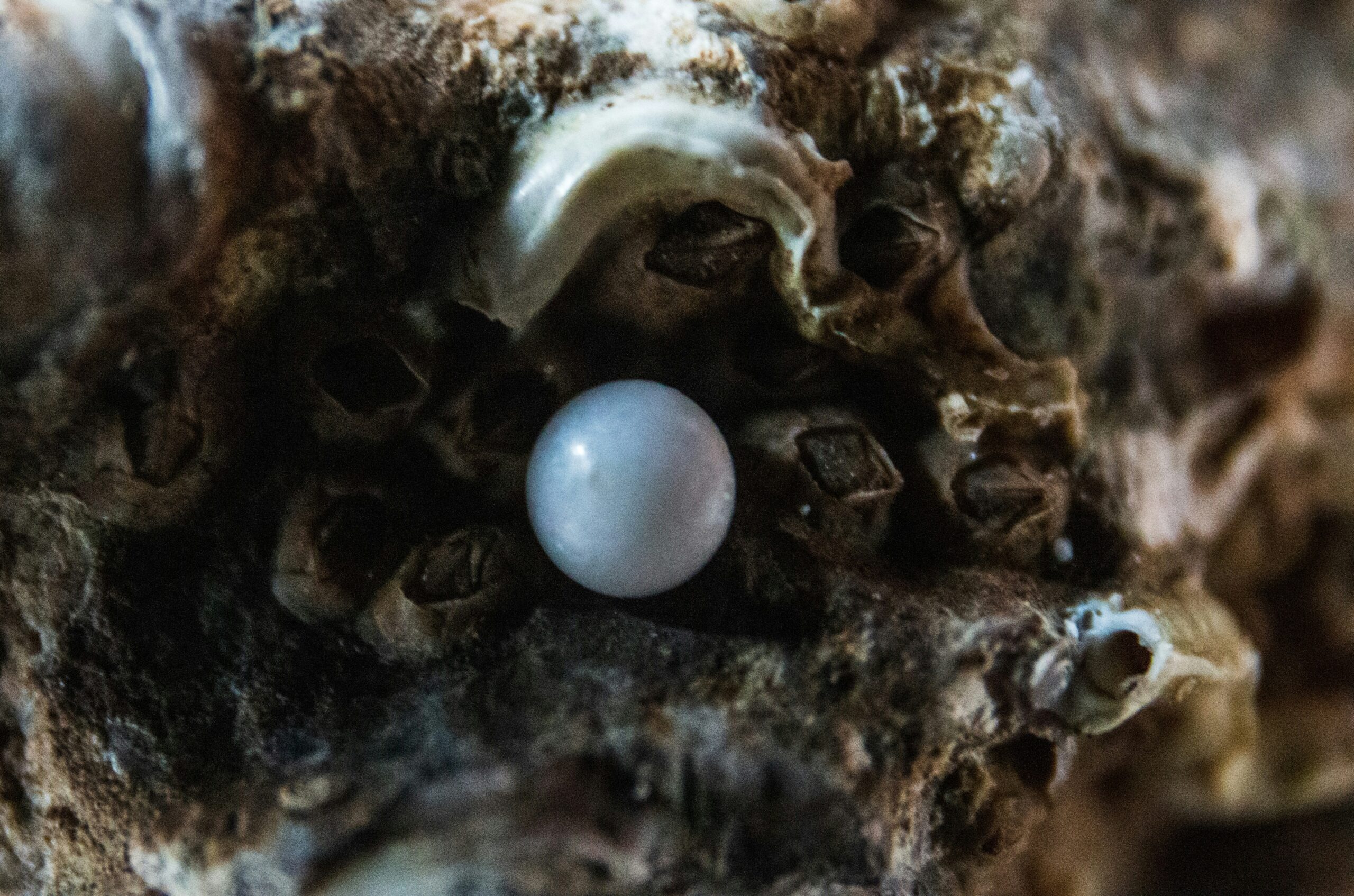
I would rather be shown how a pearl oyster is cleaned than have one opened specially for my arrival. Pearl farming in French Polynesia involves a long period in which nothing resembling jewellery is visible, and that is the part I want to understand: keeping a living animal healthy while a pearl develops out of sight. A harvest can reveal the result. The cleaning, handling and maintenance explain how it became possible.
As we look ahead to the French Polynesian chapter of the Naora Global Expedition, this distinction has a practical consequence aboard Discovery, our Lagoon Eighty2 sailing catamaran. Farm installations may occupy water that looks open from a distance. Before there can be any thought of visiting, there has to be an understanding of what is suspended there, how the equipment is held in place and where a yacht can pass without disturbing it. The lagoon has a working arrangement that its surface does not fully describe.
How Pearl Farming In French Polynesia Begins
The oyster associated with French Polynesia’s dark cultured pearls is Pinctada margaritifera, the black-lipped pearl oyster. It is a living filter feeder, drawing food from particles carried in the water. The pearl is only one part of its biology, and certainly not the reason the animal exists. That matters because farming begins with the conditions an oyster needs, rather than with the colour or shape someone hopes eventually to sell.
Much of the production cycle begins with collecting wild spat, the tiny juveniles that settle after a free-swimming larval stage. Collectors offer surfaces on which those larvae can attach. The young oysters are subsequently sorted and moved into suitable grow-out arrangements, which may include protective mesh pockets or baskets. A collector is therefore not discarded material hanging in the lagoon. It can be the beginning of a crop whose value will remain uncertain for years.
Oysters are often around two to three years old when suitable for a first graft, although growth and readiness vary with conditions. That interval represents repeated handling, checks and cleaning before there is even a cultured pearl growing inside. Size alone does not settle readiness. The animal’s condition matters, because an oyster weakened before the operation is a poor candidate for the demands that follow.
Food arrives with the water, rather than in sacks delivered to the farm. Flow brings plankton and oxygen, but stronger movement also loads ropes and moorings. Water that looks exceptionally clear to someone choosing a snorkelling spot is not necessarily the most productive water for an oyster. My preference for seeing farther beneath the surface is a visitor’s preference. The farmer has to consider what the water carries, how consistently it arrives and what the animals can use.
The Graft And The Wait For Nacre
A cultured pearl does not ordinarily begin with a grain of sand. A skilled grafter places a rounded shell bead into the recipient oyster’s gonad, together with a small piece of mantle tissue from a donor oyster. The mantle is the tissue involved in making the shell. Donors are selected partly for the qualities visible in their inner shell, including colour and lustre.
The tissue graft may be only about 2 to 3 millimetres across. Its importance is much larger than its size suggests: cells from that tissue form a pearl sac around the bead and secrete nacre. The bead provides a foundation, but the living tissue makes the material we recognise as pearl. Cultured does not mean imitation. It means that people have initiated and managed a biological process.
Nacre consists largely of calcium carbonate arranged in fine layers with organic material between them. The way those layers are formed contributes to the pearl’s optical qualities. A polished bead inserted into an oyster is not already a finished pearl, and simply leaving it there does not guarantee a good result. The oyster can reject the nucleus, fail to recover well or produce a pearl whose surface and shape differ from the grower’s hopes.
After grafting, a growing period of roughly 18 to 24 months is common, with the actual timing depending on the farm’s practice and the developing pearl. This is additional time, after the oyster has already been raised to grafting condition. It helps explain why an apparently small accident involving a line or a basket can damage much more than equipment. The loss may include years of tending an animal that had not yet produced anything saleable.
The grafter’s work is concentrated and delicate, but it is not the whole craft. Recovery checks, suitable suspension, cleaning and careful handling continue afterwards. Some healthy oysters that produce suitable pearls can be grafted again, usually with a larger nucleus. That decision depends on the animal and the result of the previous harvest. There is no automatic sequence in which every oyster yields a succession of larger, better pearls.
How Pearl Farming In French Polynesia Uses Lagoon Space
A farm can have horizontal lines supported by floats, with oysters suspended beneath in different arrangements. Moorings hold that system in position. Some supporting components are at the surface; others are submerged. The depth, spacing and equipment vary between sites and stages of production, so there is no single diagram that a visiting yacht can safely impose on every cluster of buoys.
The important distinction is between the visible markers and the installation’s full extent. A float may support a line running towards another float, while a mooring line leads down and away towards its anchor. The apparently empty water between markers may contain precisely the equipment that connects them. A gap wide enough for a hull is not evidence of a navigable lane, and a line below the surface can still be within reach of a propeller or rudder.
Cleaning explains another part of the layout. Algae and encrusting organisms accumulate on shells and equipment, adding weight and potentially interfering with water flow and the oysters’ feeding. If we are able to watch this work, the first impression will be very different from a polished pearl: a wet, rough shell, growth attached to its surface, water draining from the gear. In hot air, efficient handling and a timely return to the lagoon matter more than arranging a better view for a visitor.
Maintenance also means watching chafe, attachment points and floats that no longer provide the support they should. Equipment must be accessible to the people tending it, sometimes with working boats coming alongside or lifting sections. A stretch of water left clear may be needed for that manoeuvre. I would want to understand the route between the growing lines and the work area before deciding that an unoccupied space was somewhere to leave our tender.
Navigating Around Pearl Farm Lines
For the yacht’s approach, current charts and local information have different jobs. A chart can identify an aquaculture area and the surrounding depths and hazards. It should not be treated as a survey of every rope presently in the water. Local confirmation of the farm’s extent and the intended passage is especially valuable where installations have changed, markers are difficult to distinguish or the route runs close to working gear.
On an approach with low sun ahead, a bright strip of reflection can conceal a small float while the far shore remains perfectly visible. Polarised lenses may help with glare, but they cannot reveal every submerged line. A lookout needs time to distinguish an object from the broken reflections around it, and the person handling the yacht needs room to act on what is seen. Slowing early is useful; arriving slowly at an uncertain gap still leaves the uncertainty unresolved.
Depth is only part of the problem. A sounder showing ample water beneath the hull does not establish clearance from suspended equipment. Discovery’s passage needs room for the whole yacht, including both hulls and the underwater appendages, with an allowance for the wind and current pushing her away from the intended track. A farm worker’s small boat passing close to a line is not a demonstration of a route suitable for us.
Anchoring requires a separate assessment. The place where the anchor lands is only the beginning of the footprint. Chain lies along the bottom and can move as the yacht swings; the yacht itself needs space as the wind changes. A clear patch beside farm equipment can therefore be unsuitable even when its depth and holding ground appear attractive. The intended anchoring area, swing room and retrieval path all need to remain clear of the installation. There is no universal distance from a buoy that proves this.
If the layout cannot be established, keeping clear is the useful decision. Continuing to investigate from progressively closer range can leave fewer options than staying outside while information is obtained. Nor should a suspected snag be tested by trying to power through it. Propeller rotation can draw in more line and turn a local problem into damage across the installation. Securing the boat and arranging controlled assistance come before any attempt to free equipment.
Arranging A Pearl Farm Visit
I would try to make contact before taking the tender towards a farm, rather than arrive beside someone at work and make them solve our access. The useful request is specific: whether visitors can be received, when that would cause least disruption, which approach to use and where a tender may stop. Some farms have arrangements for visitors. Others do not, and the presence of a work platform or landing stage tells us nothing definite about either.
A farm buoy is not a convenient visitor mooring. Tying to it can put an unplanned load on equipment supporting oysters, even if the float looks substantial. An operator may instead direct us to a separate landing or mooring arrangement. That instruction needs to reach the person handling the tender clearly, before engine noise and the final approach make a conversation difficult. There is little courtesy in asking permission while already drifting onto the line.
My interest in what is underwater would also need a boundary. Permission to visit a work area would not mean permission to swim through the farm. Suspended ropes, pockets and attachment points create places where a fin, strap or loose line can catch. Workers may also be moving boats or lifting equipment. I would leave the mask aboard unless entering the water had been expressly discussed and there was a suitable plan, rather than treat clear water as an invitation to inspect the crop.
A visitor demonstration can be valuable, and there is no reason to dismiss it because it has been arranged. It can make skilled work legible and support another part of a farm’s income. The distinction I care about is honesty about what we are seeing. A demonstration is a demonstration, a harvest has its own timing, and nobody needs to interrupt delicate work to produce a revelation for us. Watching quietly from the place offered can teach more than moving closer.
What A Cultured Pearl Can Tell Us
The term black pearl can obscure a surprising range of colour. French Polynesian cultured pearls may appear silver-grey, dark grey or carry green and other overtones; they are not uniformly black. Donor tissue influences colour, but it does not give a farmer a simple way to order a particular shade. The living process produces variation, which becomes obvious when pearls are placed beside one another rather than photographed separately.
Many pearls encountered in the trade fall roughly within an 8 to 14 millimetre diameter range, though smaller and larger examples exist. Diameter is easy to measure and easy to discuss. It is also incomplete information, because the measurement includes the nucleus inside. A larger external diameter does not, by itself, establish a thicker nacre coating or a better pearl. The quality of the surface and the way it returns light deserve their own attention.
Roundness is another visible characteristic, not the whole judgement. Pearls can be oval, irregular or marked by rings formed during growth. An irregular outline does not make a pearl artificial, just as a round outline does not tell us everything about its quality. Lustre, surface condition, colour and nacre quality contribute to the assessment. Grading language also needs explanation rather than an assumption that every seller uses a letter or descriptive term identically.
If I were choosing a pearl, I would ask where it was grown, what was known about its production and whether it had received any treatment. Those are more useful questions than asking for a story based only on its colour. They also keep the work attached to the object. A seller may be able to explain the farm and the harvest, or may know only part of the chain. A clear limit to that knowledge is better than an elaborate account nobody can substantiate.
Pearl Farms And Lagoon Health
There is a reasonable attraction to an animal that feeds from what the lagoon already carries. Pearl farming generally does not require prepared feed to be delivered to the oysters. But that should not become a claim that any number of oysters, in any arrangement, must improve the water. Filtration takes particles out of suspension, and waste material can settle beneath growing areas. Stocking density and water exchange affect what the lagoon can accommodate.
Equipment creates its own responsibilities. Ropes, collectors, mesh and floats need maintenance, replacement and eventual recovery. An installation can be productive while still needing better management of worn material. Equally, the presence of working gear does not make a lagoon damaged simply because it interrupts a visitor’s view. I would want to know how a farm handles its equipment and its growing conditions before reaching either conclusion.
The livelihood is broader than the moment when a pearl appears in an opened shell. Collecting juveniles, raising them, grafting, cleaning, maintaining gear, sorting pearls and bringing them to buyers require different kinds of attention. A farm may combine several of these tasks or depend on other people for part of the work. The polished object makes those stages easy to compress into a single story. The years spent reaching it resist that compression.
I would be content to leave without seeing a harvest. There is enough to understand in a line of oysters being lowered back to the depth where they will go on feeding.