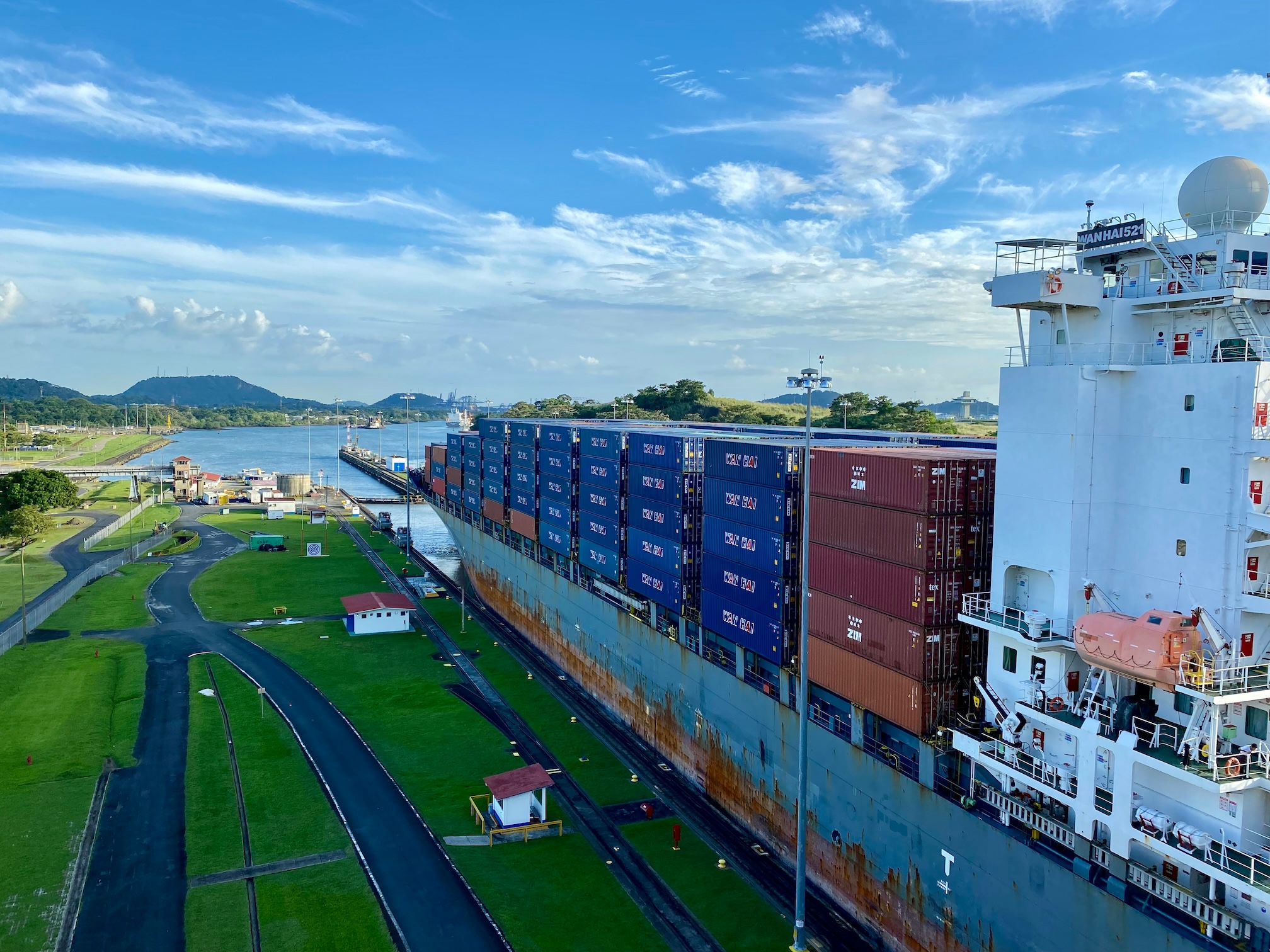
I would check the tank levels before calculating what Panama Canal freshwater will do to Discovery’s draft. The change in water density is real, and it belongs in the transit plan, but there is little value in calculating a small correction precisely if the weight already aboard is only loosely understood.
A yacht entering freshwater settles slightly deeper without taking anything on board. The people, provisions and equipment can remain exactly where they were. Nothing has become heavier. The water outside the hull has changed, and the hull must find a different floating position to support the same weight.
For the Panama transit within the 2027 to 2031 Naora Global Expedition, I will need a draft that describes Discovery, our Lagoon Eighty2, as she is loaded then. Neither the yacht’s specification nor a lesson in buoyancy can supply that number alone. The useful work is bringing them together without pretending that the smallest effect is necessarily the most important.
Why Panama Canal Freshwater Changes Draft
The Panama Canal carries vessels through locks and an elevated freshwater lake system between the oceans. The yacht therefore encounters more than a change in surface level. She also moves through water whose salinity, and consequently density, differs from the sea outside.
These are separate effects. Raising the water level in a lock raises the surface and the floating yacht together. It does not, by itself, increase her draft. Draft changes when the relationship between the yacht’s weight, the density of the surrounding water and the volume of immersed hull changes.
A floating yacht displaces a weight of water equal to her own weight. Salt water is denser than freshwater, so a smaller volume of it can support the same yacht. In freshwater, more hull must enter the water until the additional displaced volume makes up the difference. That is the entire mechanism. It does not require a leak, a change in tank contents or anything unusual happening aboard.
For an illustrative calculation, seawater is commonly represented by a density of about 1,025 kilograms per cubic metre and freshwater by about 1,000. These are rounded reference values, not measurements for a particular day in Panama. Temperature matters, and water near the locks and entrances can be mixed rather than belonging neatly to either category.
Using those reference values, the same yacht needs to displace about 2.5 per cent more volume in freshwater. The important word is volume. It does not follow that her draft increases by 2.5 per cent. That tempting shortcut leaves out the shape of the hull, which is precisely what determines how far she must settle.
How Hull Shape Turns Volume Into Draft
The relevant area is the waterplane, the horizontal area enclosed by the hull where it meets the surface. As a yacht settles a little, that area determines how much extra volume goes underwater for each increment of immersion. A broad waterplane gains volume quickly. A smaller one requires a greater downward movement to displace the same additional water.
On a catamaran, the calculation includes the waterplane areas of both hulls. It does not include the open water between them merely because a deck spans the gap above. Using the yacht’s overall length and beam as though she were a rectangular floating platform would produce the wrong answer.
Consider a deliberately hypothetical yacht weighing 100 tonnes. With the rounded densities above, she needs roughly 2.4 cubic metres of additional immersed volume when moving from seawater to freshwater. If her combined waterplane area is 60 square metres, that additional volume corresponds to about 4 cm of extra mean immersion. This is an example of the calculation, not a draft prediction or a set of dimensions for Discovery.
The approximation works by dividing the extra volume by the waterplane area, treating that area as effectively constant over a small change. Real hull sections are not vertical boxes. Their waterplane area changes with immersion, and the balance of buoyancy can change as well. Proper hydrostatic information describes those relationships rather than assuming them away.
I find the scale useful. It turns an abstract density difference into something visible on a ruler, while also showing why a model name cannot tell me the correction. I need the yacht’s loaded displacement and the appropriate hull information. Even then, an estimate of mean immersion is not a promise that bow and stern will move down by exactly the same amount.
Loading And Trim Change The Calculation
The water inside the yacht can matter as much as the water outside it, but for an entirely different reason. Freshwater in a tank adds weight. Freshwater around the hull provides less buoyancy per unit volume than seawater. Confusing those two mechanisms makes an otherwise straightforward subject unnecessarily mysterious.
A useful provisioning conversion is that 1,000 litres of freshwater weigh approximately one tonne. That is substantial weight even though it arrives through a hose rather than in boxes carried across the deck. Fuel must also be accounted for, using its appropriate density rather than treating every litre of liquid as a kilogram.
For a departure loading assessment, I would bring together tank contents, stores, equipment and people, using the yacht’s loading information rather than working backwards from an optimistic draft. A tank indicator is useful only to the extent that its reading is understood. An uncertain gauge does not become a precise weight because someone enters its reading into a spreadsheet.
Where the weight sits matters too. A load placed well aft can increase stern draft more than mean draft suggests. Uneven loading between the hulls can produce a transverse difference. Moving water between tanks changes its distribution without removing its weight from the yacht. Neither a smaller total load nor a tidy average guarantees that the deepest point has risen by the amount expected.
The limiting draft must describe the lowest relevant part of the yacht in her actual attitude, including her fixed underwater appendages. That relationship comes from the yacht’s own drawings and loading information. It should not be guessed from the most convenient patch of hull to observe.
I would not reduce sensible water or fuel reserves merely to improve a draft figure that already sits comfortably within the clearance plan. Reserves have work to do beyond the canal. Nor would I shift heavy stores casually to make the waterline look more even. Loading limits, secure stowage and the effect on trim come first. A small gain in immersion is a poor exchange for a new problem elsewhere.
What A Waterline Can Tell Me
A painted stripe can make a small change look obvious, or conceal it completely. It is not necessarily a calibrated draft mark. Paint may follow a design waterline rather than the yacht’s present loading condition, and a stain on the hull records more than a single moment of flotation.
In bright light, the reflection beneath a white hull can swallow the exact point where water meets paint. A ripple climbs the side, falls away and leaves a wet edge above the actual surface. Watching that edge for a moment is enough to understand why a casual glance cannot establish a correction of a few centimetres. The eye is useful, but it needs a known reference and reasonably settled water.
A meaningful comparison would use suitable fixed reference points or calibrated marks, where fitted, and observations at more than one position. Forward and aft readings help reveal trim. Comparing both hulls helps reveal an uneven floating attitude. The loading condition and surrounding water need to be recorded with the observation, otherwise a later difference may have several possible explanations.
A suitable density measurement can refine a calculation, but colour cannot. Brown water may contain suspended sediment; clear water is not necessarily fresh. Where different waters are mixing, a single surface sample may also be a poor description of the water around the immersed hull. I would only ask a measurement to answer a question it is capable of answering.
For an initial allowance, treating the relevant freshwater section as freshwater is more defensible than assuming that residual salt will preserve the yacht’s sea draft. The refinement should follow the importance of the decision. If clearance depends on a precision I cannot establish reliably, the answer is to reconsider the movement, not to add another decimal place.
If a sound waterline observation and the estimated loading condition disagree, I would look for the cause. The reference point, tank estimate, trim or assumed density may be wrong. Averaging two incompatible answers would hide the disagreement rather than resolve it.
Panama Canal Freshwater And The Clearance Plan
Underwater clearance begins with the available depth and the yacht’s actual operating draft. But those figures must describe the same place, time and reference. A charted depth is related to a defined level. A lake level or tide height cannot simply be added to it until that relationship is understood.
For Panama, the relevant water levels, transit requirements and any operating restrictions belong to the passage date. They are not permanent properties of the route. I can plan the method now; the working figures must be checked nearer the transit. The same applies to the draft information supplied for Discovery. It needs to reflect the loaded yacht and any required density convention, rather than an unexplained number lifted from a specification.
There is an important counterpoint here. A small density correction can matter greatly to a heavily laden vessel operating close to a limiting draft. For a yacht with generous clearance, it may have no effect on the decision to proceed. I do not want to borrow the constraints of a large ship merely because Discovery will use the same canal. Knowing an effect exists does not make it the controlling risk.
Clearance also changes when the yacht moves. Squat is the change in a vessel’s immersion and trim caused by the flow around her underway, particularly in shallow or confined water. Its size depends on speed through the water, hull form, depth and the degree of confinement. A generic correction taken from another kind of vessel is not a reliable substitute for understanding those conditions. Wake and pitching can also bring an underwater point closer to the bottom than the static draft suggests.
The depth sounder introduces another reference that must be understood. Depending on its configuration, the displayed depth may be below the transducer, below the waterline or below a selected keel reference. Subtracting the full draft from a display already corrected to show clearance would count part of the calculation twice. Assuming a transducer reading is clearance could make the opposite mistake. I want the offset understood before the number becomes important.
The practical result is a clearance margin that accounts for loading, density, motion, water level and the reliability of the depth information without counting the same allowance twice. That margin must cover the route actually to be used, including approaches and assigned waiting positions. Deep water in the middle of a channel says nothing useful about a shortcut outside it.
Why Lock Handling Needs More Attention
The freshwater correction is a quiet change. Lock handling may be much more immediate. I expect the larger share of attention during the transit to belong to position, communications, traffic and the required line arrangements, with the draft assessment already settled rather than still being debated on deck.
A wet line has weight before it carries any significant load. As tension comes on, its curve straightens and the space around it changes character. In the heat, with machinery audible nearby and instructions arriving over the radio, that is a poor moment to discover that a lead is obstructed or that someone is standing inside a bight. Keeping people clear of loaded lines is physical work, not a sentence completed during a briefing.
The actual transit arrangement determines how Discovery will be positioned and handled. As the water level changes, line handling must accommodate the changing geometry. A line allowed to restrain a vessel against the rising or falling surface can impose serious loads. The important preparation is knowing who controls each working line, how instructions will be passed and which areas must remain clear.
Water movement from lock operations and nearby vessels can move a yacht much more noticeably than the density change alters her draft. Correct fendering, suitable line leads and controlled manoeuvring therefore deserve attention in proportion to their consequences. The small calculation remains useful because it has already been incorporated into the plan. It should not compete with the work happening at the rail.
This is where I draw a distinction between being thorough and being distracted. A detail earns its place through the decision it improves. Once it has done that work, the captain must still look up.
The Return To Salt Water
As the yacht returns to saltier water, the density effect reverses. At unchanged weight she needs less immersed volume and will float slightly higher. The qualification matters: unchanged weight. Fuel consumed, freshwater produced or used, and any changes to stores can alter the comparison. A different waterline on the Pacific side cannot automatically be assigned entirely to salinity.
I would carry the transit loading record forward rather than treat it as paperwork finished at the last lock. The stores aboard in Panama are part of the preparation for the Pacific passages ahead. Knowing the starting condition makes later tank readings and loading changes more useful. It also avoids the habit of allowing the published draft to become the default again simply because the confined water is behind us.
The human scale of the density change still appeals to me. Someone sitting on deck may feel nothing at all as it happens. The cup beside them has the same weight, the cabin remains familiar, and the yacht is supported a little differently by the water beneath her. I want the planning to be good enough that noticing this can remain a pleasure rather than a concern.
In still water, the surface finds its own mark on the hull.