Night sailing is not a different activity to day sailing with the lights turned off. It is a different activity: the instruments play a different role, the visual lookout works differently, the threat picture is different, the body is different, and the specific skills required are specific to the conditions of darkness in a way that makes preparation and practice necessary rather than optional.
Sailors who have done little offshore sailing often approach their first night passage with vague apprehension. Sailors who have done a lot of it know that the apprehension is appropriate for someone who has not yet developed the skills, and that the skills are learnable and the darkness becomes, eventually, one of the finest times to be on watch.
Night Vision
The human eye adapts to darkness through the production of rhodopsin in the rod cells of the retina, a process that takes approximately twenty to thirty minutes to reach full effectiveness. In full darkness, the dark-adapted eye is capable of detecting objects and horizon features at ranges that the unadapted eye cannot. The problem for the watch crew is that any exposure to white light during the adaptation period resets the process: a single unshielded phone screen or an unmasked cabin light reaching the helm position can destroy thirty minutes of dark adaptation in seconds.
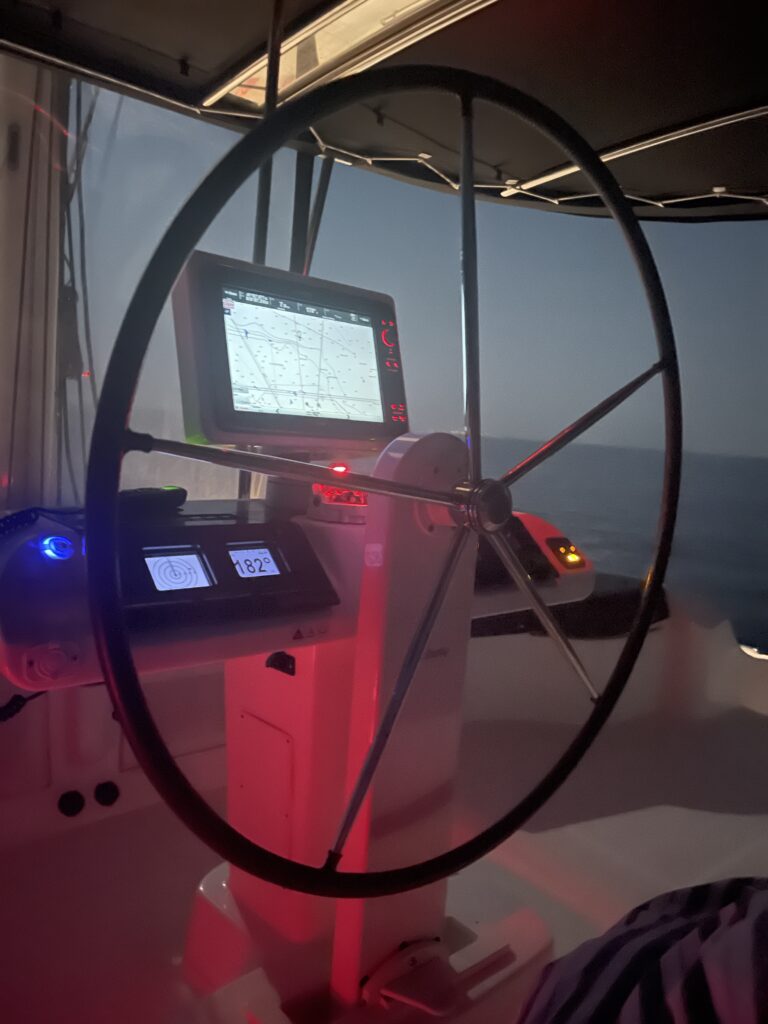
The solution is red light for all navigation station functions and a culture of shielding white lights from the helm position. Red light does not significantly affect rhodopsin production and allows the watch crew to read the chart or the instrument faces without sacrificing night vision. The instruments themselves are dimmed to the minimum level at which they are still readable.
The phone, if it must be used on watch, is set to the lowest brightness setting and shielded from the forward direction. These are not inconvenient precautions. They are the minimum required to maintain the visual capability that the dark watch demands.
AIS and the Traffic Picture
The Automatic Identification System transmits and receives the position, course, speed, and identity of vessels equipped with AIS transponders. In the open ocean and in the shipping lanes, the AIS display provides a picture of the surrounding traffic that the visual lookout alone cannot provide in darkness: the bearing and range of every AIS-equipped vessel within range, and the closest point of approach calculation that tells the watch crew whether each vessel is a collision risk or a passing ship that requires monitoring but not action.
The limitation of AIS is that it shows only AIS-equipped vessels. The fishing boat without AIS, the unlit log in the water, the small vessel running without lights: none of these appear on the AIS display and all of them require the visual lookout that the watch crew maintains even when the AIS picture is clear. The offshore night watch is not an instrument watch alone. It is an instrument watch combined with the visual lookout of dark-adapted eyes scanning the horizon regularly and specifically rather than casually and occasionally.
The Horizon at Night
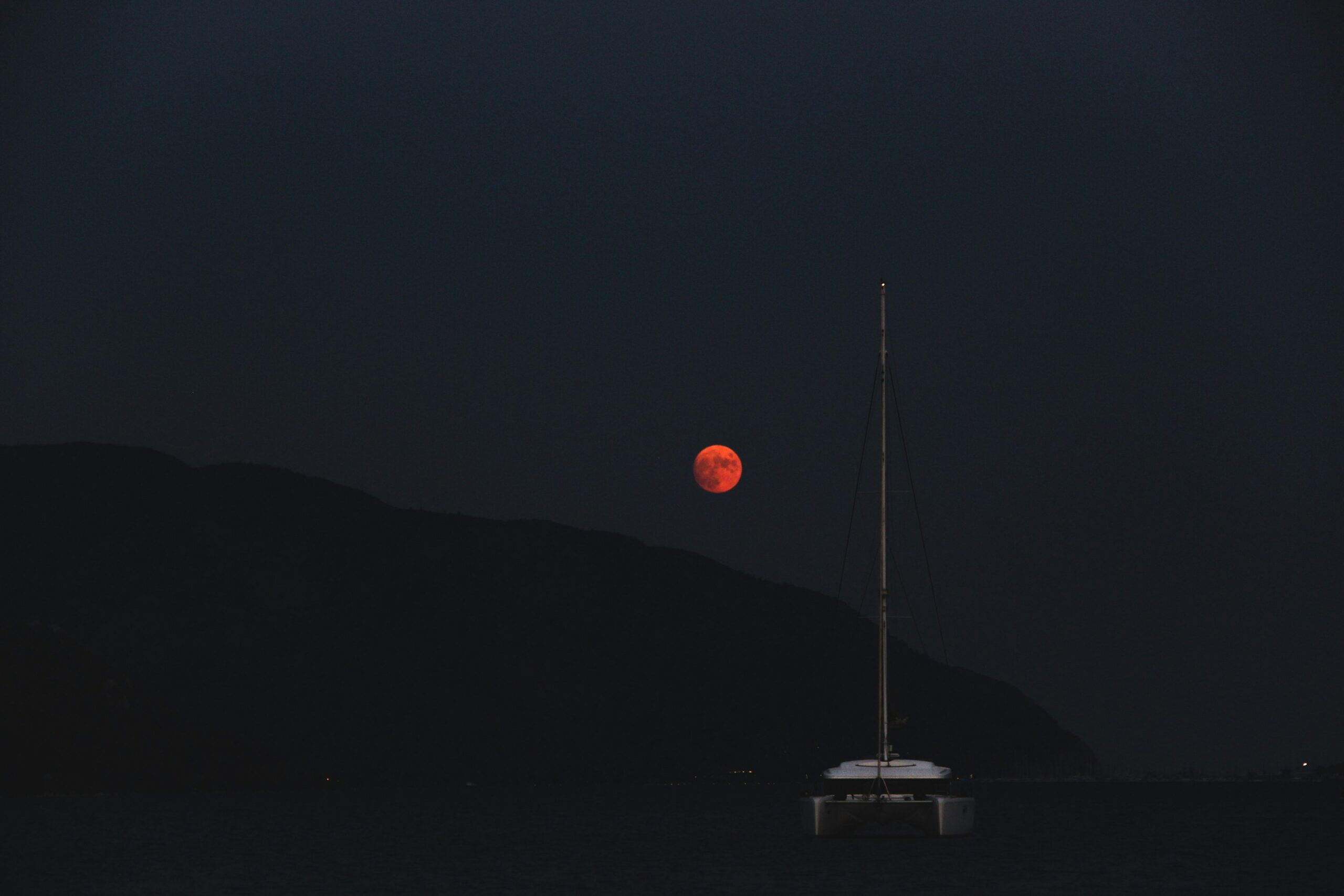
The horizon at night is not the sharp line that it is on a clear day. It is a transition between the darker darkness of the sea and the lighter darkness of the sky, and its visibility depends on the moon phase, the sky conditions, and the dark adaptation of the eye. On a clear moonless night, the Milky Way illuminates the horizon with enough light to make it visible at range. On an overcast moonless night, the horizon may be invisible and the watch relies entirely on the instruments for course and attitude information.
The technique for scanning a dark horizon is not the same as the technique for scanning a daylit one. The dark-adapted eye is more sensitive in its peripheral vision than in its central vision, which means that objects at the limits of visibility are often more clearly seen by looking slightly to the side of them rather than directly at them: the peripheral rod cells pick up the light that the central cone cells cannot. This technique, eccentric viewing, is one of the first things I teach to watch crew who are new to offshore night sailing, because it immediately and significantly improves the detection range for dim lights and shapes on a dark horizon.