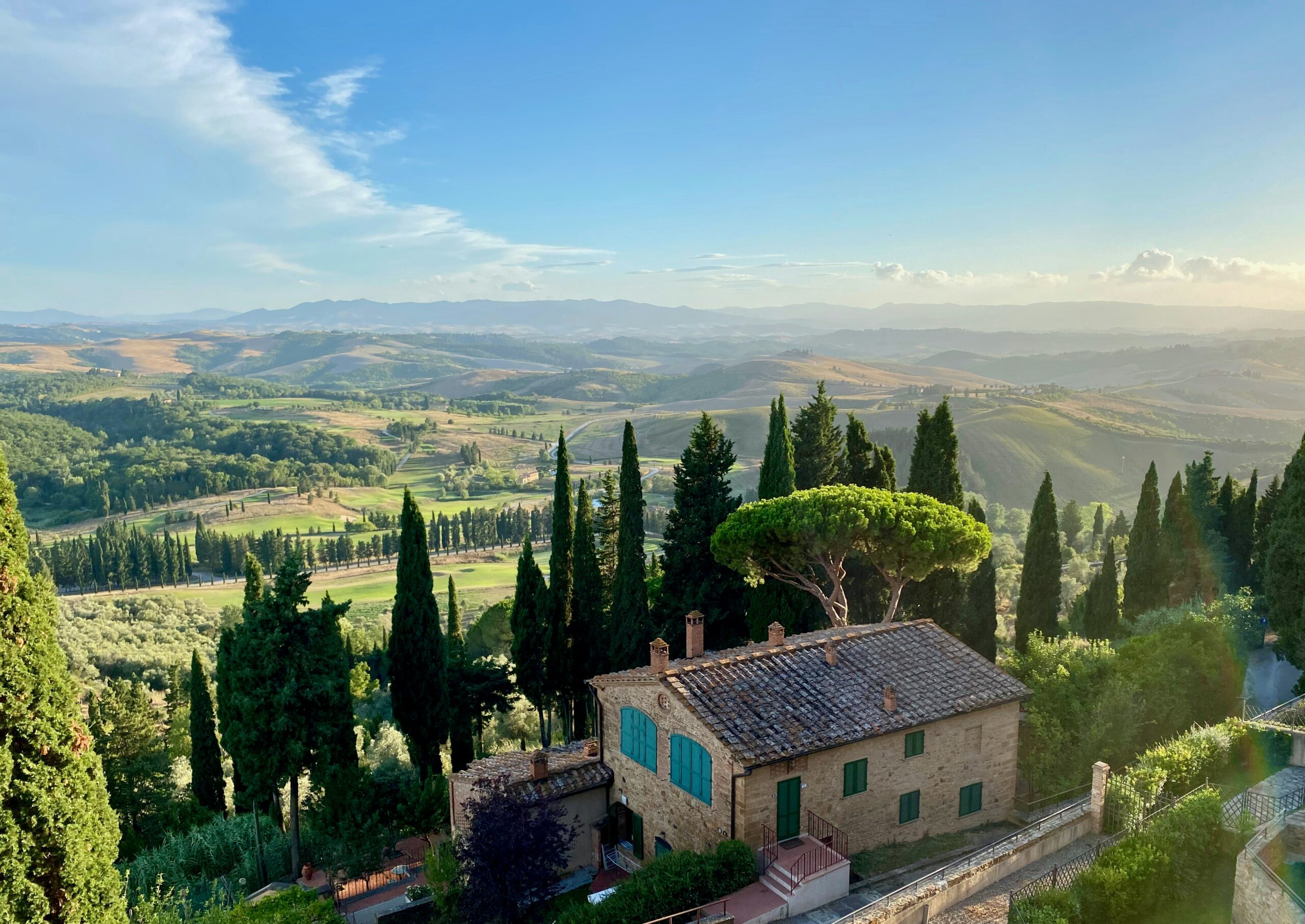
A shutter that has stiffened since the last visit can occupy the first morning at a house in Tuscany. So can opening every window, finding the coffee, and carrying a chair into the part of the terrace that catches the sun. For anyone considering a second home alternative, these small acts deserve attention. Some are work. Some are precisely what makes the house feel like home.
We would not dismiss that attachment in order to make a case for the sea. A house and a place aboard a yacht answer different needs, even when both begin with the same wish: to have somewhere beyond ordinary life that you can return to without beginning again.
What A Second Home Alternative Must Preserve
The strongest argument for Tuscany is repetition. Returning to the same countryside allows you to notice what a first visit cannot reveal: which rooms remain comfortable in afternoon heat, which road needs more time after rain, which part of the year you actually prefer once you have experienced it without the flattering light of a summer holiday.
That knowledge accumulates slowly. The olive harvest generally belongs to autumn, often October and November, rather than a dependable September scene. Its timing changes with variety, elevation, weather and the grower’s decisions about ripeness. A house makes it possible to be there for the season as it happens, including the damp days and the work, rather than arriving only for its most agreeable image.
Imagine coming inside from a hot terrace and feeling the cooler floor through bare feet. The shutters reduce the room to narrow lines of light. Outside, someone is moving a chair across stone. There is no need to identify a departure port or check the next passage. The house is doing something valuable simply by remaining where it is.
For a family, that permanence can hold traditions and possessions as well as people. A book stays unfinished on a shelf. Children know where things belong. The inconvenience of maintaining a building may be inseparable from the pleasure of making it your own.
Any honest comparison must preserve this advantage. Movement does not automatically improve a life. Sometimes the freedom a person needs is permission to return to exactly the same place.
The Comparison Needs More Than Annual Costs
It is tempting to put property ownership and participation in Naora into adjacent columns and declare them equivalent. We would be careful with that conclusion. Without the details of a particular property, its financing, its condition and the way it is used, an annual comparison is more suggestion than calculation.
A useful property account separates cash leaving the bank from economic cost. Mortgage principal reduces debt; interest is the financing expense. Maintenance keeps the building usable, while a major improvement may add value, though not necessarily as much as it costs. Insurance, local charges, management and the work required between visits belong in the account too.
Capital deserves its own line of thought. Money held in a house cannot simultaneously be used elsewhere, but that opportunity cost should not be confused with a bill or counted twice alongside borrowing costs. Ownership also leaves an asset that may eventually be sold. Participation in a sailing expedition provides access and experience, not title to a house or to the yacht. They are different arrangements, not interchangeable investments.
Rental income complicates the comparison further. Gross receipts are not the amount retained after management, cleaning, repairs and other obligations. Nor is letting the house for its most desirable weeks neutral if those are the weeks the family would otherwise use it.
There is another account worth keeping: attention. Record the decisions the property asks of you during a year, not only the days spent there. Then distinguish the ones you enjoy from the ones you would gladly hand over. That distinction often reveals more than a supposed cost per night. Someone who loves tending an olive grove is not trying to eliminate the same responsibilities as someone who wants to arrive, put down a bag and read.
The Familiar Part Can Travel
Naora places continuity somewhere other than an address. Discovery, the 2025 Lagoon Eighty2 sailing catamaran carrying the expedition, remains the physical centre while the coastline changes. The layout, the movement between cabin and deck, and the practical habits of living aboard can become familiar without requiring the view to remain fixed.
This is the part of the comparison that interests us most. Travel often asks people to learn a new room, a new set of arrangements and a new way of getting through the day each time they move. Returning to the same yacht can reduce that work. Familiarity becomes something you take into an unfamiliar place.
At anchor, the morning has small sounds of its own: water against the hull, a cup placed on a table, a hatch opening somewhere nearby. Reflected light shifts with the surface outside. Even in shelter, a passing wake may ask you to steady your coffee. These are modest reminders that a yacht is a home-shaped space afloat, not a house transported intact onto the sea.
The differences matter. Possessions have to be stowed. Fresh water production depends on machinery, power and maintenance. A comfortable cabin does not remove the need to secure a door before a passage. The working parts of the yacht remain present, even when guests need have little involvement in them.
Nor is membership the same as possessing the whole place. Naora’s private circle involves shared life aboard. Private hire of Discovery is a separate arrangement for a family or private party, designed around a real part of the expedition route. Someone comparing either with a second home should be clear about how much shared company they welcome and how much space they need to themselves.
A Second Home Alternative Has A Moving Calendar
The Naora Global Expedition is planned across five years, from 2027 to 2031, covering roughly 49,000 Nm. Those figures describe a continuing voyage, not a collection of destinations available on demand. The yacht keeps moving when a member goes home, and the next opportunity to return belongs to a later part of its progress around the world.
The plan contains 166 legs and more than 187 destinations. A leg is a section of the route, not necessarily a single destination or a uniform kind of holiday. The Bodrum loops and the Cyclades offer a different relationship to shore from an Atlantic crossing. A canal transit brings another set of demands. Those distinctions are more useful than counting countries.
Across ten regions, from the Mediterranean through the Atlantic, Caribbean, Panama, French Polynesia, Pacific, Asia, Indian Ocean, Africa and the Red Sea, the route follows the tradewinds and parts of the Coconut Milk Run. This is a sequence unfolding over years. It should never be understood as every region being available within one membership year.
Seasonal movement has a practical reason. In the Aegean, the summer northerly wind known as the meltemi can persist for days. Its effect depends on direction of travel, the length of exposed water ahead and the way islands and headlands accelerate the flow. A short line on the chart can be a tiring passage if it leads into steep seas.
That is why we distinguish a preferred plan from a departure decision. A sheltered bay may justify staying longer; an exposed transfer may deserve postponement. A coastal week allows different adjustments from a committed offshore passage.
The house in Tuscany lets you return whenever your calendar permits, subject to the ordinary practicalities of travel. Naora asks you to find the meeting point between your calendar and the yacht’s. The reward is movement, but the condition is accepting that the world route has a direction and the sea has a say.
The Work Behind An Unhurried Day
A quiet breakfast at anchor begins with decisions made before breakfast. The appealing water colour and the distance to shore are only part of choosing where to stop. We need to understand the bottom, the available depth, the room to swing and the exposure if the wind changes during the night.
Clean sand may offer suitable holding, but its appearance from the surface is not enough. Seagrass should be avoided, both to protect the habitat and because an anchor caught in vegetation may seem secure without being properly buried. The anchor must be set and its holding assessed, not simply lowered into an attractive patch of water.
Depth also needs interpretation. A sounder may report water below its transducer or a corrected depth, depending on its settings. That is not automatically the clearance beneath the yacht’s lowest point. The calculation must allow for the vessel, changes in water level, movement and an appropriate margin. The room required around the boat includes the deployed rode and the yacht’s length, not merely the position of the anchor on a screen.
These details belong in a comparison with a second home because they explain where the responsibility goes. It does not disappear when a guest steps aboard. It sits with the captain and crew, supported by checks, maintenance and decisions that may occasionally disappoint a preference for a particular bay.
Sven, Naora’s founder and captain, plans every weather window and sails every leg himself. That continuity connects the long route with the day’s judgement. The person responsible for the passage also has to consider what the anchorage will be like after dark and what conditions may greet the next departure.
A guest should not have to supervise this work. They should understand enough of it to recognise why a change of plan can be evidence of care rather than a failure to deliver.
Coming And Going Along The Route
The freedom at the centre of Naora is the ability to choose when to join, where along the worldwide route to step aboard and how long to remain. It may be one week or many. That freedom becomes useful when it is matched to the actual shape of someone’s life, rather than described as unlimited movement.
A sensible starting point is the date by which you genuinely need to be home. Work backwards from that, considering the kind of leg, the transport connections and the scope for weather to alter an arrival. A flight booked tightly against an offshore landfall puts pressure in the wrong place. The sea cannot provide a reliable margin simply because the onward ticket requires one.
Joining and leaving also require practical access. A promising point on the chart is not automatically a suitable transfer location. Port facilities, local formalities, transport ashore and the conditions for moving people and luggage all matter. On an ocean passage, there may be no meaningful way to shorten the stay once the yacht has departed.
For families, these distinctions are more important than the breadth of the route. Sheltered coastal sailing and a long passage ask different things of sleep, appetite, mobility and confidence around water. Before choosing, it helps to describe the least comfortable person’s needs plainly. Shade, secure movement around the yacht and an easy return from shore can matter more than reaching another anchorage.
The same honesty applies to work. Connectivity depends on equipment, coverage and operating conditions; it should not be treated as an uninterrupted utility. Someone with an immovable commitment needs a plan that does not depend entirely on being able to take a call at sea.
A second home allows considerable control over the environment and the date of return. Naora offers a different control: choosing the part of a continuing expedition that suits you, then letting the voyage carry on without requiring your presence. Neither arrangement removes obligations. They place them differently.
Returning Without Owning The View
There is a danger in presenting the moving life as an accumulation of places. A larger map does not necessarily produce a deeper experience. If every landfall becomes something to complete before the next, the yacht has only exchanged one hurried rhythm for another.
The better lesson comes from the house in Tuscany. Repetition teaches attention. On the world route, that attention has to be practised deliberately: taking time ashore, buying provisions locally where practical, learning what a place asks of visitors, and leaving room in the day for something other than departure. Not every opportunity needs to become an activity.
We cannot promise the rootedness of owning the same house for decades. The expedition moves on. What can remain continuous is the yacht, the responsibility for her, and the way we approach each place. The familiar framework gives the unfamiliar coast time to register.
For some people, the house will be the right answer. Its repairs, cupboards, neighbours and seasons are part of the attachment, not defects to be solved. Others will find that they want less permanence in the landscape and more continuity in the way they travel. Some will want room for both.
At the end of the afternoon, a chair on a Tuscan terrace does not need to go anywhere. Neither does someone sitting on deck in a well-chosen anchorage. For that hour, the value of either place may be the same: nothing needs to be added.