On a moving yacht, the surface of the coffee tilts before the cup slides. A hand beside the saucer, the soft contact of crockery, sunlight moving across the table as the heading changes: breakfast belongs to the passage even when nobody is discussing sailing. A round the world business class ticket is designed to make much of the travelling recede into the background. A sailing passage cannot offer that separation. The movement remains part of the morning, sometimes pleasantly, sometimes inconveniently, always physically.
The two ways around the world can touch the same broad geography. The Mediterranean, the Caribbean, the Pacific and the Indian Ocean appear in both kinds of planning, although an airport network and a sailing route do not connect identical places. The useful comparison begins beyond the map. It concerns how much of the distance we want to experience, how much uncertainty we can accommodate, and what we expect the hours between destinations to be for.
What Round The World Business Class Makes Possible
There is a considerable achievement in going to sleep above one part of the world and waking near another. Aviation makes distant relationships practical. It allows a parent to return home, a colleague to be present for an important decision, or a traveller to spend a limited stretch of leave in places that would otherwise be beyond reach. A comfortable cabin can reduce the strain of that movement. None of this becomes less valuable because we choose to sail.
A round the world ticket also gives a complex itinerary a framework. Depending on the fare, that framework can include rules about direction, permitted stops, mileage, participating airlines and how changes are handled. Those details deserve attention before purchase. Business class describes a cabin category, not an identical seat or service on every aircraft, and a protected air connection is a different proposition from a flight booked separately after a sea passage.
For someone whose main purpose is to spend time ashore in several distant places, flying can be the more sensible choice. It preserves more of the calendar for those places. Long intervals of ocean need not become an obligation merely because they lie between destinations someone wants to know.
What flying cannot provide is continuous experience of the water underneath. That is a limitation of the medium, not a failure of the service. Equally, sailing cannot reproduce the compression of distance that makes an ambitious itinerary possible within ordinary working and family commitments. We should be honest about both before attaching meaning to either.
One Yacht Carries The Route Forward
The Naora Global Expedition is planned across five years, from 2027 to 2031, covering roughly 49,000 Nm. That distance is the scale of the yacht’s undertaking, not a requirement placed on each person aboard. Members choose when they join, where along the worldwide route they step aboard, and how long they stay. Their part can be one week or many. Discovery continues around the world when they return home.
The planned 166 legs and more than 187 destinations describe a route with different kinds of time in it. A leg among the Greek islands is not interchangeable with an Atlantic crossing. A canal transit brings a different set of constraints from a stay among Polynesian atolls. Counting destinations alone conceals these differences, much as counting airports says little about what happens after leaving the terminal.
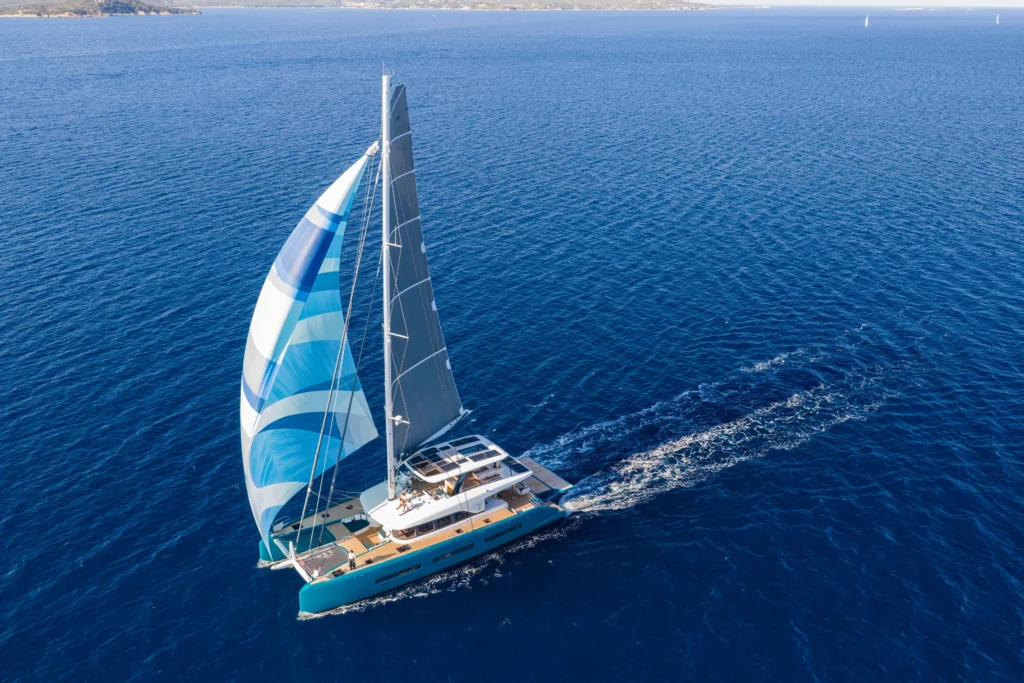
Discovery, the 2025 Lagoon Eighty2 sailing catamaran, carries the continuity. Her equipment does not begin a fresh history whenever the people aboard change. Maintenance, stores, wear and decisions made on the previous passage remain relevant to the next one. A minor fault left unresolved is not made smaller by crossing into another region.
Sven is Naora’s founder and captain. He plans every weather window and sails every leg himself. That continuity matters operationally: the person deciding on the next departure also knows how the yacht behaved on the last passage. It connects the route drawn in advance with the condition of the boat and the conditions outside the harbour. The map does not make that connection for us.
The Departure Belongs To The Weather
An airline and a sailing yacht both take weather seriously. The difference is not professional concern but exposure and options. A yacht remains within a weather system for much longer, and its comfortable progress depends on more than the direction of the wind. We need to consider wave direction and period, currents, the evolution of the forecast and what conditions may await at the landfall.
For westbound Atlantic sailing, the northern winter generally offers a useful seasonal setting for seeking the northeast trades farther south than the stormier North Atlantic. That is a starting point for planning, not permission to depart. Seasonal tropical cyclone risk helps shape the larger calendar; the actual departure still needs its own assessment. A favourable prevailing wind does not rule out a difficult swell or an inconvenient change several days ahead.
Current makes the difference between movement through the water and progress over the ground particularly clear. An opposing current of one knot, if sustained for a full day on the same track, takes 24 Nm away from the progress the yacht would otherwise make. This is an illustration, not a prediction for a Naora leg. Its significance is practical: an apparently modest current can alter an arrival estimate without any change in the boat’s speed through the water.
Nor does a stronger wind necessarily improve the passage. A short, steep sea can make cooking, sleeping and moving around harder while increasing loads on the yacht. Reducing sail early can be the better decision even when it sacrifices speed. The aim is useful progress with manageable loads and people able to rest, rather than the highest number briefly visible on an instrument.
This is why we would rather protect a margin in the itinerary than spend it before leaving. A flight home should not become an argument for carrying too much sail or arriving at an unfamiliar entrance in unsuitable conditions. When choosing a passage, the time after the expected arrival deserves as much thought as the time aboard.
Where Round The World Business Class And Naora Part Company
The deeper distinction is what happens when travelling lasts long enough to become ordinary life. On an aircraft, most of the domestic work of the journey is organised around a relatively brief interval: settle in, eat, sleep if possible, prepare to arrive. Offshore, those activities repeat until they no longer feel like arrangements for transport. They become the day itself.
When propulsion stops and the yacht continues under sail, the missing vibration can be noticeable through the feet before it registers as quiet. Water still strikes the hulls. A fitting may creak under load. Air moves through the space where conversation has paused. It is not silence, and describing it as silence would miss what is interesting: the individual sounds become distinguishable when the mechanical layer falls away.
There is effort in this life too. A wide catamaran platform does not make the ocean flat. Some conditions disturb sleep. Some people feel seasick. Moving safely can require a handhold and a moment’s patience. These are matters to discuss before choosing a long passage, not details to conceal beneath photographs of calm water. A shorter coastal leg is a legitimate choice, not a lesser version of the expedition.
The ease aboard also has a working foundation. Onboard water production reduces dependence on shore supplies, but it still requires power, maintenance and attention to consumption. Refrigeration makes fresh provisions possible, but storage space and the order in which food is used still matter. Independent systems extend our options; they do not remove the need for reserves or places where repairs can be made.
Guests do not need to spend their days thinking about these systems. The crew does. That division allows an afternoon to remain unstructured without the operation of the yacht becoming casual. The apparent freedom of the day rests on work that has already been considered.
The Ocean Does Not End At The Shore
A landfall is not complete when land becomes visible. In an aircraft, much of the transition from the travelling environment to the destination happens through an established terminal. A yacht has to resolve the approach, the entrance, the anchorage or berth, and the required formalities before the people aboard can properly turn their attention ashore.
Polynesian atolls make the distinction particularly clear. An opening in the reef may look like the obvious way into sheltered water, but the pass can carry a strong flow. Water driven over the reef by ocean swell may raise the lagoon and then drain through that opening. Wind and lagoon shape also influence what happens there. The current cannot safely be understood from the apparent calm outside alone.
Slack water in a pass need not coincide with the high or low water shown by a tide prediction. The practical lesson is to separate tidal height from current, assess the particular entrance, and compare the expected conditions with what is actually visible. If the picture does not agree, waiting offshore or changing the plan can be the correct outcome. Reaching the destination is not the same as having a suitable opportunity to enter it.
Once inside, arriving by sea gives us no special claim on the place. Clearance requirements remain. So do local restrictions, property, fishing rights and the ordinary courtesy of asking before taking photographs of people. A sheltered anchorage is part of somebody’s home waters, not an empty setting prepared for our arrival.
More time can help us notice these things, but slowness does not automatically produce understanding. That takes attention. Buying locally means learning what is available and useful, rather than expecting every market to reproduce the stores left behind. Staying longer should make us more observant about our presence, not more entitled to it.
The Week Has To Fit The Person
The freedom offered by Naora lies in choosing a part of a continuing expedition. It does not require arranging a life around an entire circumnavigation. Someone can join through the private circle for a Mediterranean leg, leave when their commitments require it, and return in another region. The route belongs to the yacht; the length of an individual’s involvement belongs to them.
There is an important boundary to that freedom. Choosing how long to sail happens within the practical shape of the route. An offshore passage cannot offer a convenient departure point halfway across an ocean. The decision to join includes accepting the interval until a suitable landfall. That deserves plain discussion before departure, especially for anyone with a fixed obligation immediately afterwards.
A week in the Dodecanese or Cyclades has different implications from a Pacific passage. Coastal sailing may allow more opportunities to go ashore and adjust the daily rhythm, although wind can still change the plan. An ocean crossing asks for a larger uninterrupted part of the calendar. Neither choice says anything about a person’s courage, seriousness or capacity to appreciate the sea.
Work needs the same clarity. Connectivity is useful when it is available, but we cannot promise an uninterrupted connection throughout a worldwide sailing route. A conversation whose failure would have serious consequences should be planned somewhere with a tested connection and a credible alternative. It is better to choose a leg compatible with one’s responsibilities than to spend it hoping those responsibilities will temporarily disappear.
For a family, the deciding detail may be tolerance for motion, the ease of moving around, or the amount of time everyone wants ashore. For another private party it may be the ability to share meals without a sequence of departures breaking up the conversation. These are more useful starting points than asking how much geography can be fitted into the available days. They describe the life people actually want to have together.
What The Map Leaves Out
There is no need to turn this comparison into a contest between virtuous slowness and careless speed. A sailing yacht uses energy, requires maintenance and supplies, and often depends on flights to bring people to and from the route. Moving with care and sourcing locally are working intentions, not evidence by themselves of a smaller environmental footprint. We should not make a numerical comparison without the accounting to support it.
Air travel and Naora may therefore belong in the same person’s life, even in the same stretch of travel. The flight makes it possible to reach the yacht without spending months away. The yacht makes it possible to give a portion of those saved days back to the distance. There is no contradiction in needing both.
What matters is recognising the experience being chosen. At sea, arrival has an approach long enough to inhabit. A coast becomes distinguishable before it becomes accessible. Its outline gathers detail slowly, while there is still breakfast to clear and the boat to attend to. For a while, it is simply land ahead, with water still between us.