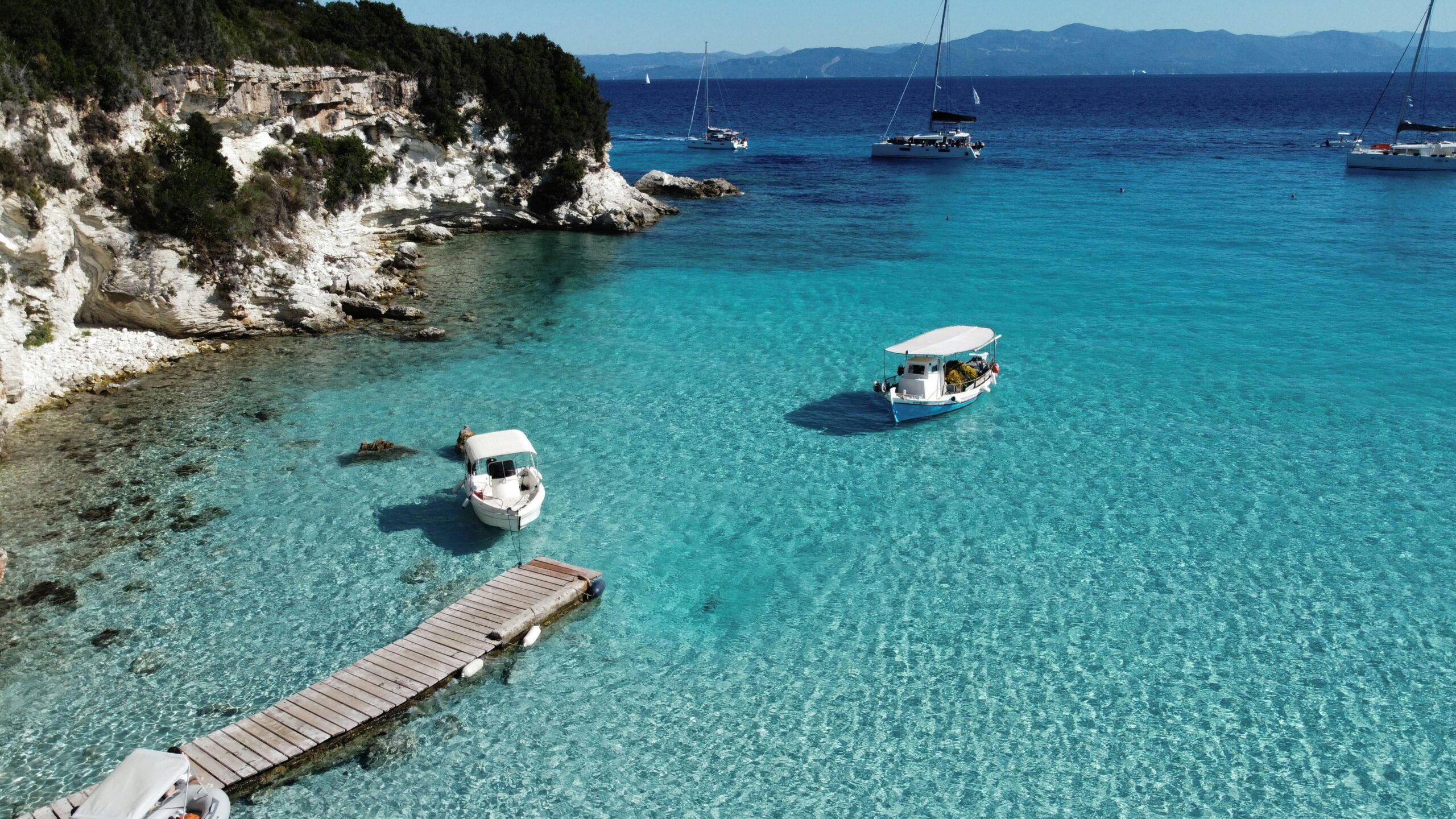
An anchorage in the Cyclades can be quiet enough to hear a spoon touch a coffee cup while whitecaps are building beyond the headland. The sheltered water beside the hull does not describe the passage ahead. On a luxury yacht charter, as on a week with Naora, a good captain reads both. The boat may be beautiful, breakfast unhurried and the next island plainly visible, but none of those things settles the decision to leave.
This is where an honest comparison should begin. A well-run charter can give a family or a group of friends a deeply satisfying week at sea, with capable people doing the work that allows everyone else to relax. We do not need to diminish that experience to explain our own. What Naora adds is continuity: a private expedition whose responsibilities, relationships and route extend beyond the time any particular guest spends aboard.
What A Luxury Yacht Charter Already Does Well
The same water feels the same against your skin. A sheltered Greek bay does not become more beautiful because the yacht anchored in it has an ocean crossing ahead. Good food, a comfortable cabin, privacy and a thoughtful crew are not qualities that belong to one way of travelling.
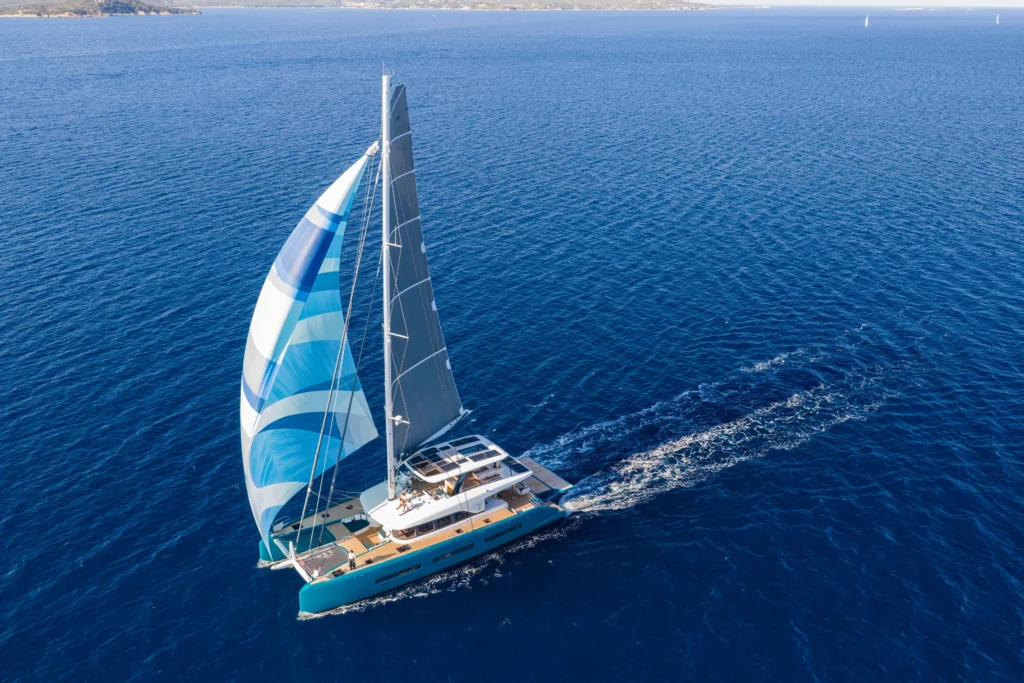
Discovery, the 2025 Lagoon Eighty2 sailing catamaran that carries Naora, gives us the space in which to build our life aboard. But the yacht alone is not the explanation. Comparing broadly equivalent boats means looking beyond accommodation to the decisions that shape the day, the expectations people bring with them and what happens when those expectations meet the weather.
A charter devoted to one party can be particularly good at concentrating on that party’s wishes. An established local crew may know a coastline more intimately than a yacht arriving during a world voyage. Returning to a familiar cruising ground also has its pleasures: less orientation, favourite places revisited, children recognising the shape of an island before anyone names it.
Naora is a different arrangement, not a correction to those pleasures. The question is how much of a continuing life at sea someone wants their holiday to contain. A week can be complete in itself. It can also be a short stay within something that remains in motion.
What The Cyclades Ask Of A Week
In the Cyclades, the summer meltemi makes the distinction between a desired itinerary and a workable one particularly clear. This northerly wind can persist, accelerate through gaps between islands and produce strong gusts near steep terrain. A calm patch in the lee is evidence of shelter at that moment, not evidence that the next channel will be comfortable.
Beaufort force 6 corresponds to sustained winds of 22 to 27 knots. The human meaning depends heavily on direction. Sailing with that wind and its sea is a different proposition from pushing into them. Gusts may be stronger, and short, steep waves can make a modest distance tiring, especially for someone still finding their balance aboard.
A simple planning calculation helps: 30 Nm at an assumed average of 6 knots takes five hours underway. That excludes getting out of an anchorage and settling into the next one. If the sea requires a lower speed or a different course, the day grows longer. An island that looks close on a chart can occupy most of the useful daylight.
The destination also has to work after arrival. We need to think about the wind overnight, the swell that may wrap around a headland, the room to swing and the seabed beneath the anchor. Where permitted, a clear patch of suitable sand is preferable to dropping into seagrass. The anchor must be set and its hold checked. An anchor alarm can warn of movement; it cannot make unsuitable ground hold.
The Caribbean requires a different seasonal conversation. The Atlantic hurricane season runs from June through November. That does not make every day within it stormy, or every day outside it safe, but it prevents us from treating a Caribbean summer as the equivalent of a Greek summer. Regional weather, shelter and onward routing have to be considered together.
No booking arrangement changes these realities. The useful comparison is how clearly they are discussed before boarding, and how willingly everyone accepts a different day when the original plan no longer makes sense.
Where The Luxury Yacht Charter Comparison Changes
The Naora Global Expedition is planned across five years, from 2027 to 2031, covering roughly 49,000 Nm. Those figures matter less as scale than as a statement of responsibility. A defect noticed during a quiet island week belongs to the same yacht that must later make a long passage. Maintenance cannot be treated as somebody else’s problem after the guests leave.
Sven is both Naora’s founder and its captain. He plans every weather window and sails every leg himself. The person making the route decision therefore remains with its consequences. Sailing every leg does not mean standing every watch. Rest, delegation and clear handovers belong to the same responsibility as knowing when to shorten sail.
Continuity becomes useful when knowledge is recorded rather than merely remembered. A pump beginning to cycle more frequently needs investigation, not familiarity. A repair needs a clear record of what was changed and what still requires attention. An unusual noise should not become normal simply because people have learned to live with it. These are small matters until a yacht is far from the parts and skills needed to resolve them.
Nor does a continuing expedition mean an unchanging crew roster for the entire voyage. People need rest and relief. What must survive a handover is the working knowledge of the vessel, with enough clarity that the next person does not have to rediscover an unresolved fault.
For a guest, this work should mostly remain in the background. Its value is felt when a concern receives a plain answer and a change of plan is explained before it becomes confusing. We would rather make the reason for staying understandable than turn departure into a performance of confidence. A longer voyage only earns its distinction through the quality of those ordinary decisions.
The People Around The Table
A private charter often begins with people who already know one another. Naora’s private circle allows people to join a shared voyage without having to assemble the whole party themselves. That creates possibility, but it also creates a responsibility to discuss how people actually want to live aboard.
Compatibility is more practical than a shared job title or an enthusiasm for travel. Someone may love sailing and need long stretches of silence. Someone else may want company over breakfast but an early night. Comfort with motion, expectations around meals and willingness to accept a weather delay affect the atmosphere far more directly than an impressive biography.
The conversation before joining matters because a yacht brings ordinary habits close together. Privacy needs to remain available without an explanation. An empty chair at dinner need not become a concern, and a morning spent reading should not be treated as a missed opportunity.
There is a particular quiet after an evening swim, when a dry shirt catches on salt at the shoulders and the deck is still warm under bare feet. For a Greek-island supper, ripe tomatoes, olive oil, bread and fish need little decoration. The galley judgement is in buying produce that is ready to eat, using the softer fruit first and keeping fish properly chilled until preparation. Local sourcing becomes meaningful through those choices, rather than through the length of a menu.
A continuing circle leaves room for acquaintance to develop without forcing it into the first evening. Some people may sail together again elsewhere on the route. Others will share only this week. Neither outcome needs to be turned into a promise of lifelong friendship. A comfortable silence across a table is already something worth protecting.
The Work Behind A Remote Anchorage
Further along the world route, Polynesian atolls and Indian Ocean island groups change the practical meaning of distance. Remoteness is not proof that nobody else can reach a place. Capable privately hired yachts make ambitious passages too. The difference is that Naora connects these regions within one continuing expedition rather than treating each as a separate undertaking.
What distance adds operationally is fewer convenient alternatives. Discovery has onboard water production and independent energy systems, but independence is never the same as freedom from maintenance. Water production depends on functioning equipment and available power. Filters, pumps, spares and stored reserves remain part of the calculation. The ability to make water is not a reason to stop caring how much is used.
The same restraint applies to going ashore. An anchorage can be secure while the landing is difficult. Swell breaking on a beach may make a tender transfer inappropriate even when the water around the yacht looks manageable. The return deserves as much thought as the outward trip, especially if the wind is expected to strengthen.
At an atoll pass, a tide prediction alone does not describe the current. Water driven across the reef by waves can also feed the flow through the opening. Observing the water, checking local information and allowing the option not to enter are part of competent pilotage. Familiarity with Discovery does not confer familiarity with every reef.
Diving follows the same logic. Equipment aboard makes a dive possible, not automatically suitable. Current, entry and exit, the experience of the people entering the water and surface support all matter. A calm lagoon is not a guarantee of gentle conditions outside it. Sometimes the best decision is to snorkel in shelter or leave the water alone. The reef does not owe the itinerary a dive.
Choosing Your Time On The Route
Naora’s freedom lies in choosing when to join, where along the world route to step aboard and how long to stay. Someone can spend a week in the Greek islands and leave while Discovery continues. Someone else may choose a longer chapter. Nobody has to organise their life around completing the whole expedition for their time aboard to have meaning.
That freedom needs a precise boundary. A worldwide route is not a promise to board from any shore at any hour. Suitable ports, formalities, safe transfers and the passage ahead determine workable joining points. The yacht keeps sailing around the world, but the meeting between a person’s calendar and the yacht’s movement still requires care.
A fixed return date should influence the kind of leg chosen. A family travelling within a school holiday may be better served by a coastal chapter with sensible access ashore than by an ocean passage whose arrival remains weather-dependent. The experienced planning decision happens before the flight is booked, not when the forecast deteriorates near the end of the stay.
Discovery can also be privately hired for a family, friends or a discreet company gathering, with the voyage designed around a real part of the Naora route. The private circle is therefore not an obligation to share every voyage with people you have yet to meet. Having the yacht to one party allows meals, shared time and privacy to follow that party more closely, within the limits of safe operation.
This is the addition to the familiar charter week: a choice of how to belong to a continuing voyage. It is not necessary to stay longer to take it seriously. What matters is choosing a stretch of water whose demands fit the time and attention available.
Learning To Stay Where You Are
There is a risk in any world route that the next place becomes more important than the present one. An island can be reduced to the stop before a crossing, a meal to provisions consumed, a quiet afternoon to time that might have been used to move further. A long expedition needs to resist that habit deliberately.
Staying can be active work. It gives us time to understand where landing is welcome, where boats obstruct somebody’s working waterfront and which food is genuinely available locally rather than brought in to satisfy a visiting menu. Respect begins with noticing that the shore has a life unrelated to our arrival.
It also changes how we use an anchorage. Remaining in a suitable place can avoid an unnecessary engine run and another disturbance of the seabed, provided the location permits the stay and the forecast still supports it. Care is often a modest decision repeated, not a grand claim about the whole voyage.
The world route gives a week a wider context, but it should not make that week restless. There is still bread to cut, shade moving across the deck and a coast worth looking at without deciding what comes next. Beyond the headland, the wind can go on blowing. There is enough here for the afternoon.