The cup stays in your hand a little longer when the yacht is moving. You feel the next lift through your feet, wait for it to pass, then set the coffee somewhere it cannot slide. A Croatia sailing holiday can contain mornings like this too. The difference on an Atlantic crossing is that the motion belongs to the whole day ahead, and to the night after it, rather than to a passage you expect to finish before dinner.
The swimming pool and ocean comparison is tempting, but it gives the coast a safety it has never promised. Croatia has demanding weather, exposed passages and anchorages that cease to be comfortable when the wind changes. The Atlantic has long intervals of manageable sailing. What separates them is not a dependable division between gentle water and serious water. It is the distance from an alternative, and the length of time for which the yacht must remain a good place to live.
What A Croatia Sailing Holiday Makes Possible
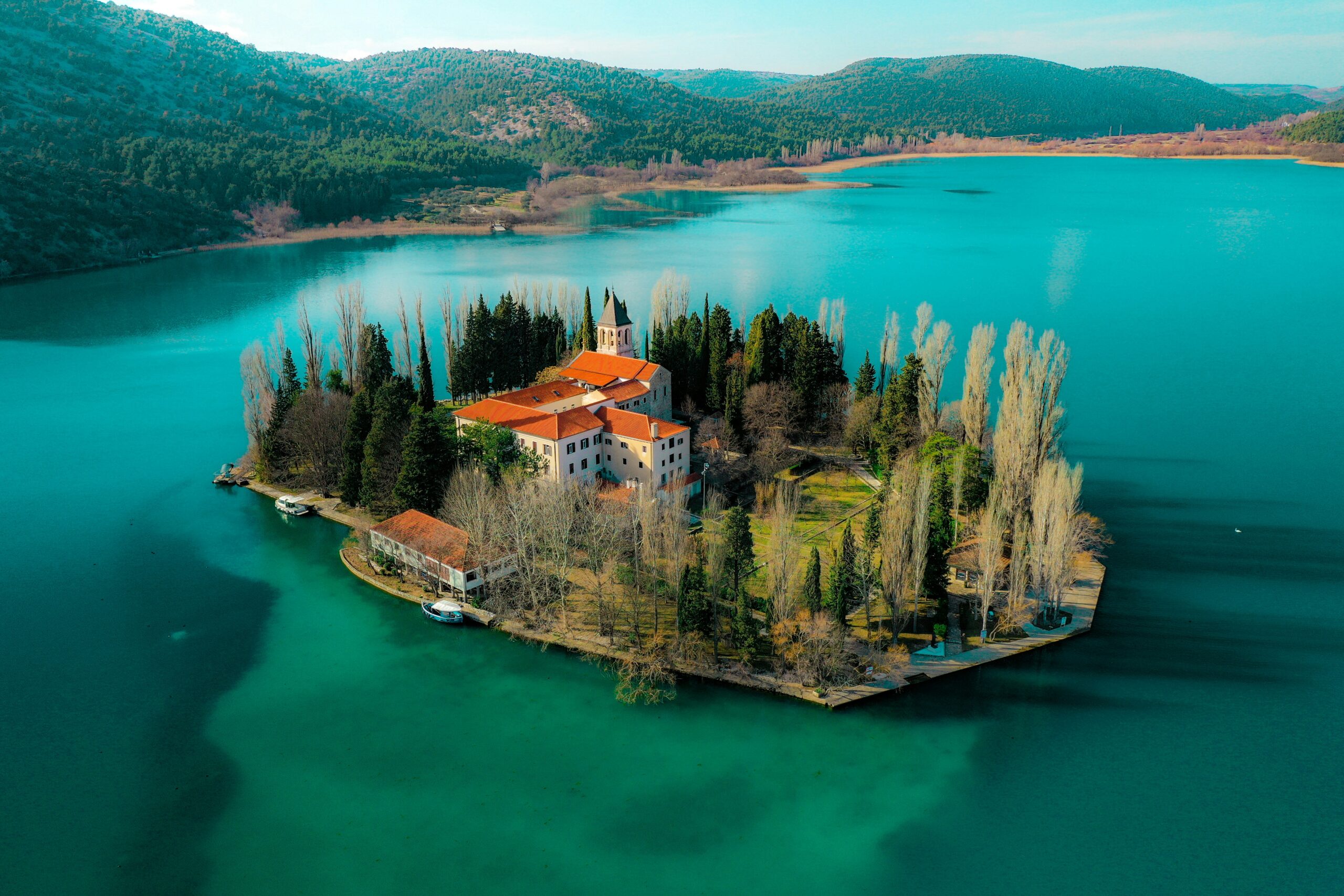
Along the Dalmatian coast, sailing can remain in conversation with the shore. The Kornati archipelago and islands such as Hvar, Brač and Vis give a voyage successive points of contact with land, though not every bay provides shelter from every direction. You can spend a morning moving between islands and still have an afternoon that belongs to swimming, a walk or a meal ashore. The pleasure is partly this ability to change the texture of the day without abandoning the voyage.
That freedom depends on work done before the anchor goes down. We would look at the expected wind through the night, not merely the breeze on arrival, then at the seabed, the room to swing and the route out if conditions deteriorate. Clear water helps identify sand and vegetation, but a pale patch alone does not establish good holding. Sand can be thin over rock. An anchor must be set and its holding checked under controlled load, with enough space to discover a problem without drifting towards another boat.
Where anchoring is permitted, keeping clear of seagrass is part of that decision, not an environmental afterthought. Chain moving across the bottom can damage living habitat even when the anchor itself lands in sand. Local restrictions and mooring arrangements matter, particularly in protected waters. The practical reward for getting these details right is modest and considerable: a meal that need not be interrupted, children able to settle, and a night that does not require repeated negotiations with a dragging anchor.
The Weather Is Not A Measure Of Courage
The Croatian summer has a familiar fair-weather pattern in the maestral, a generally northwesterly sea breeze that often strengthens during the afternoon. It can make an early departure sensible for anyone who prefers easier motion, but it is a pattern, not a timetable. Cloud cover and larger weather systems alter it. A plan made from yesterday’s pleasant afternoon, without looking at the next forecast, confuses familiarity with information.
The bora asks a different kind of attention. This northeasterly wind can descend from the coastal mountains in powerful, uneven gusts, with marked differences between nearby stretches of water. A bay that looks sheltered behind high ground may still receive descending gusts. The jugo, generally from the southeast, can build a more sustained sea over a long fetch. Shelter must therefore be considered against both wind direction and the direction from which waves arrive. The two do not always change together.
This is why a nearby harbour is not the same thing as an available refuge. Its entrance may be uncomfortable or unsafe in the conditions that made you seek it. Islands can accelerate airflow through gaps, and a short, steep coastal sea can be harder on a tired person than a longer ocean swell. On the Atlantic, the northeasterly trades of the northern winter provide a useful seasonal framework, but squalls and interruptions still belong in the plan. Neither coast nor ocean rewards a captain for proving that the original itinerary can be kept.
An Atlantic Crossing Changes The Cost Of Delay
For Las Palmas to Barbados, think of twenty-two days as an indicative passage length, never a fixed arrival date. Departure conditions, the route actually sailed, current, sea state and the amount of sail that can sensibly be carried all affect the result. A forecast helps us make the next decision. It does not describe every day of an ocean crossing with equal confidence, and the route must remain open to revision as new information arrives.
The arithmetic makes small differences tangible. An average reduction of 1 knot in speed over the ground means 24 Nm less distance covered each day. Sustained over three weeks, that difference becomes 504 Nm. This is an illustration, not a performance estimate for Discovery, but it explains why an offshore arrival cannot be treated like a flight landing time. A modest change in average progress accumulates into a substantial stretch of sea.
The useful response is not to push the yacht harder to recover a calendar. It is to leave margin in provisions, essential supplies and commitments ashore. It is also to distinguish speed through the water from progress over the ground. Current can change one without changing the other, while an apparently fast course may take the yacht away from the direction that matters. Routing means comparing these effects, including the motion and sail handling each option will require.
On the coast, waiting may cost an afternoon in the next harbour. Offshore, an early decision about sail area or route can influence several days of comfort and work. Sven, Naora’s founder and captain, plans every weather window and sails every leg himself. That continuity matters because the decision is made by the person who must live with its consequences aboard, not handed over as a promise for someone else to keep.
The Work That Continues Through The Night
A coastal voyage can end its sailing day with the yacht securely berthed or anchored, although neither removes the need to monitor conditions. Offshore, movement continues while most people sleep. Someone must remain responsible for the lookout, the course, the weather and the state of the boat. The quietness of a night passage is therefore supported by a structure that is deliberately repetitive. Rest has to be planned as carefully as the watches themselves.
A useful watch handover carries forward what has changed and what may change next: nearby traffic, developing cloud, the current sail configuration, any equipment concern and the circumstances in which the captain should be called. An electronic target is useful information, not proof that every vessel has been detected. Visual lookout remains essential. Equally, a small sound that seems unimportant at the beginning of a passage deserves investigation if it might be chafe, a loose fitting or a pump running more often than expected.
At night, the cabin light feels bright even when it has been turned low. Outside, your eyes need time to recover the horizon. Water passes the hull with a sound that makes speed physical again, and a dark cloud ahead deserves more attention than the stars behind it. This is where reducing sail early can preserve both comfort and working room. Downwind, the breeze felt on deck can understate the true wind because the boat is travelling with it. A change of course can bring a sharper apparent wind, precisely when sail handling is already adding to the workload.
Guests should know before departure what participation is appropriate and what remains the crew’s responsibility. Interest is welcome; assumed competence is not. Learning aboard should begin with clear instructions and supervision, not with discovering in the dark that someone expected you to know.
Comfort Has To Work While The Boat Moves
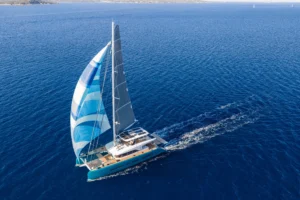
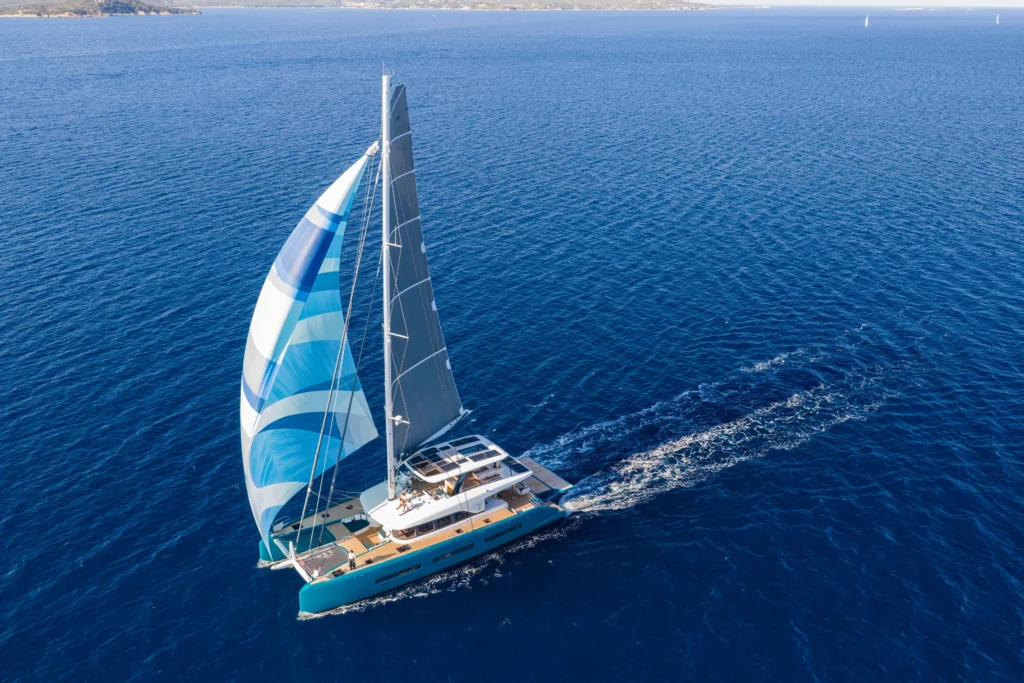
Discovery, our 2025 Lagoon Eighty2 sailing catamaran, is the yacht sailing the Naora Global Expedition. Her space matters, particularly when people want different things from the same afternoon, but space does not remove motion. A catamaran can reduce the sustained heel associated with a monohull under sail while still pitching, rolling and experiencing impacts beneath the bridgedeck in some sea states. Comfort depends on course, speed and wave direction as well as hull form. We would rather explain that plainly than let a photograph make the promise.
The difference becomes clear in ordinary tasks. A cupboard must be secured after use, not left for someone else to notice. Hot food needs a safe route from galley to table. A shower taken while the yacht moves calls for different balance from one taken at anchor. These are small adjustments, but they are repeated throughout a passage. Order is not fussiness offshore. It prevents a tired person from meeting a preventable problem at the wrong moment.
Sleep and seasickness deserve the same practical attention. Anyone concerned about motion sickness should discuss suitable options with a clinician before departure, including possible drowsiness and interactions with other medicines. The first days should leave room for adjustment rather than demand immediate enthusiasm. Smaller meals, fresh air where it is safe to sit, and freedom from unnecessary obligations can make the beginning gentler. No one should have to conceal discomfort to avoid disappointing the person they came with.
Water production and independent energy systems extend the yacht’s reach, but they are systems to maintain, not evidence that resources have become limitless. Power demand, freshwater reserves and equipment condition remain part of daily management. Connectivity requires similar honesty. A coastal stay may offer opportunities to go ashore for an important call; an ocean crossing does not provide that fallback. Work that cannot tolerate interruption needs a plan that does not depend on an uninterrupted connection from the yacht.
Choosing A Croatia Sailing Holiday Or A Crossing
A useful distinction is the ability to stop moving. On a coastal voyage, conditions permitting, the next day can become a day at anchor. Someone recovering from poor sleep can have a quieter morning. A family can trade distance for time in the water. On an Atlantic crossing, the yacht keeps making passage, and rest has to happen within that movement. This is not a hierarchy of travel. It is a material difference that should be understood by everyone coming aboard, especially when one person is more enthusiastic about the crossing than another.
We would want a conversation about sleep, movement and medical needs before a conversation about the romance of landfall. Previous enjoyment of a week among Croatian islands is useful experience, but it cannot establish how someone will feel after successive nights at sea. Equally, uncertainty does not mean a person is unsuited to offshore sailing. It means the preparation should be honest, and that a shorter experience of sailing through the night can be informative before committing to a whole ocean passage.
Naora itself is not exclusively offshore. The Naora Global Expedition is planned across roughly 49,000 Nm from 2027 to 2031, with coastal chapters as well as ocean crossings. Through the private circle, people choose when they join, where along the world route they step aboard and how long they stay. Discovery can also be privately hired for a carefully designed voyage. The expedition continues beyond each person’s time aboard. That freedom works at the scale of choosing the right section of the route; it does not mean an ocean passage offers an unscheduled place to step ashore halfway through.
The Approach To Barbados
Arrival has work of its own. As Barbados comes within reach, attention must move from the broad ocean picture to the detail of landfall: the current chart, the approach, traffic, available light and the entry formalities. After a long passage, relief can arrive before the yacht is secure. That is a moment to slow the decisions down. A tired crew does not become less tired because the coast is visible, and making landfall is not the same as having completed the approach.
The first sheltered meal can feel different simply because the body no longer has to make the same continuous corrections. A plate stays where it was set. A conversation can continue without someone leaving to take over the watch. The sensations are ordinary, which is part of their value. There is no need to claim that everyone has been transformed, or that arriving by sea gives anyone a greater right to the place than arriving by air. Barbados remains a place with its own life, not the reward at the end of ours.
Croatia offers the pleasure of returning to shore repeatedly and getting to know it through those returns. A crossing asks us to live without that option for a while. At the end, the quiet may belong as much to the release of sustained attention as to the anchorage itself. There is time to let the coffee cool.