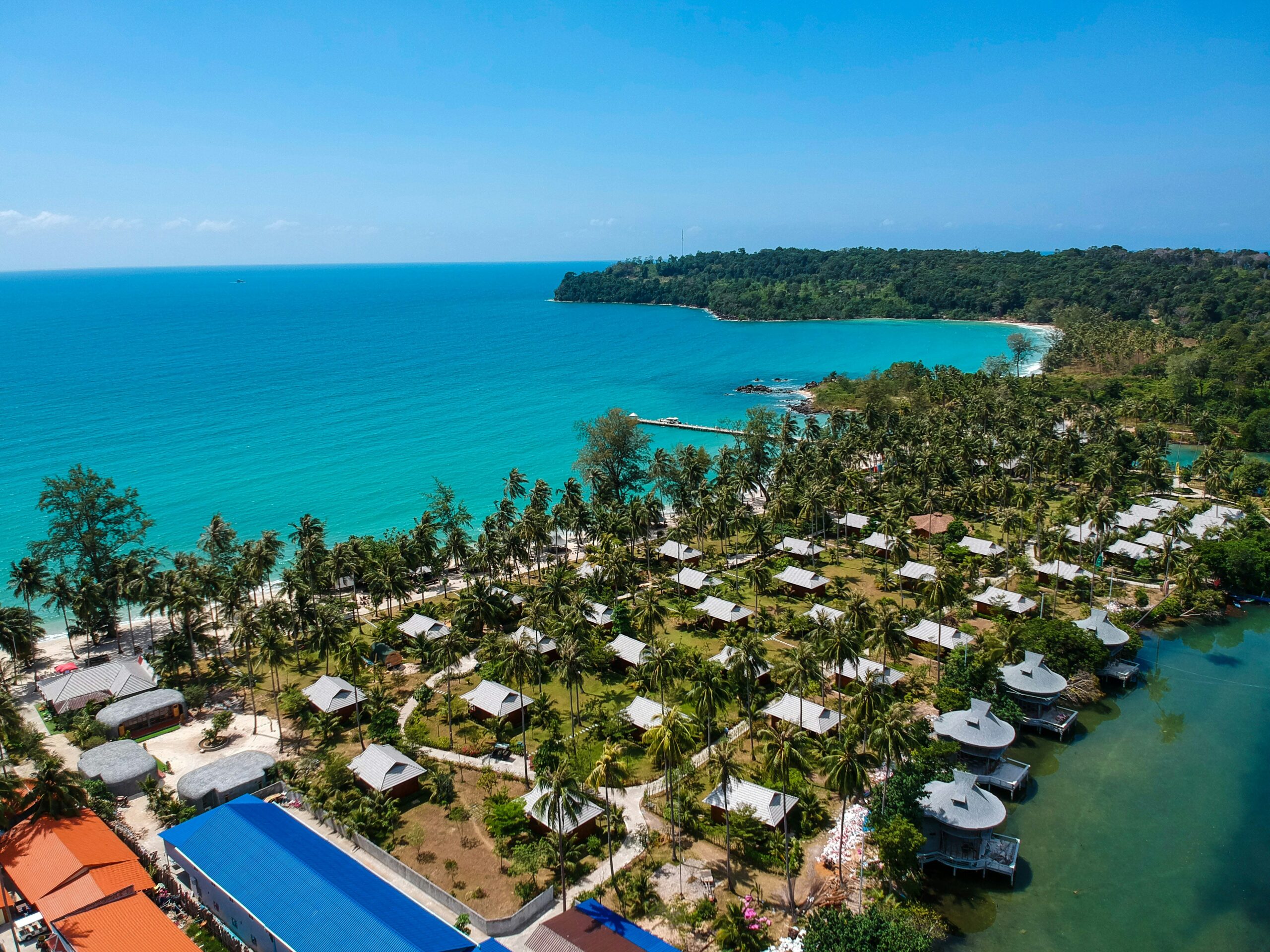
From a breakfast table, a bay can look entirely calm while the water beyond the headland is already streaked white. The cup is warm, the surface nearby barely moves, and nothing in the immediate scene suggests a reason to change the day. For someone comparing a Club Med all-inclusive holiday with time aboard Naora, that difference between the visible morning and the conditions beyond it matters more than a list of activities. At sea, someone must be thinking about the water you cannot yet see.
The attraction of an inclusive holiday is understandable: fewer arrangements to negotiate, fewer small decisions interrupting the hours you came to recover. But the word describes a commercial scope, not a common experience. A beach resort and a yacht following a continuous world route can both make life feel easier. They do so through different kinds of work, and they ask different things of the people spending time there.
What Club Med All-Inclusive Makes Easier
Club Med began in 1950 and helped establish the modern all-inclusive holiday. That long history matters because the model addresses an enduring need rather than a passing preference. People want to arrive somewhere pleasant and find that the ordinary machinery of a holiday, meals, activities, places to sit, things for different generations to do, has already been thought through.
Accommodation, meals, drinks and a programme of activities generally form the core of the offer, but the precise boundaries depend on the resort and the arrangements selected. Childcare deserves particular attention: age bands, operating hours and any additional arrangements matter more to a family than the broad statement that children are welcome. The same is true of specialist instruction, excursions and treatments. The label is useful only when its edges are clear.
Scale can provide genuine freedom. A family does not have to agree on a single way to spend the morning. One person can stay by the water while another takes part in an organised activity, with lunch remaining a dependable meeting point. A fixed base also makes repetition easy. The route back to the room becomes familiar, a child recognises the same place at breakfast, and nobody needs to consider what the accommodation will be doing overnight.
These are substantial advantages. For someone who spends much of life coordinating other people, the relief may lie precisely in having a broad range of choices within a stable setting. There is no reason to treat that preference as less curious or less adventurous than wanting to sail.
Club Med All-Inclusive And The Limits Of A Label
The mistake is to carry the resort meaning of all-inclusive aboard a yacht and assume that the same words describe the same responsibilities. A room beside the sea and a cabin moving through it are not interchangeable settings for a menu of services. Movement changes the work behind almost everything, from keeping food cold to deciding when it is sensible to enter the water.
For a Naora voyage, the agreed scope needs the same clarity as any carefully arranged stay. Meals aboard and meals ashore are separate questions. So are equipment and instruction, a shore transfer and onward travel, participation in an activity and the qualifications needed to undertake it safely. Personal travel, specialist arrangements and any additional expenses need to be understood in writing. The phrase itself cannot settle them.
We should also distinguish hospitality from the operation of the vessel. Weather routing, maintenance and watchkeeping are not recreational additions that make an inclusion list look longer. They are responsibilities without which the voyage cannot take place. An opportunity to understand a night watch is valuable, but it is different from being expected to provide essential crew cover. Those expectations must be clear before anyone joins.
Most importantly, inclusion cannot mean guaranteed access to the sea in every condition. A dive that is within the agreed arrangements may still be wrong for the current, the visibility or the people present that morning. The professional response is to change the plan and explain why. No description of a holiday should make that decision feel like a failure to deliver.
The Work Behind A Quiet Anchorage
A sheltered breakfast is the result of more than finding an attractive piece of coast. Before anchoring, the relevant questions include depth, seabed, room to swing, underwater hazards, nearby boats and the direction from which wind and swell may arrive later. The view matters after those questions have satisfactory answers.
Holding ground is the material in which the anchor must set. Suitable sand can offer good holding, but a chart symbol is not a guarantee that every patch beneath the boat is identical. Weed can prevent an anchor from reaching the ground properly, while living seagrass and coral also demand protection from anchoring damage. Local restrictions, charts and what can actually be established on arrival all belong in the decision.
Depth alone does not determine how much anchor rode to deploy. Scope describes the relationship between the length deployed and the vertical distance from the bow roller to the seabed, allowing for the highest water level expected while the boat remains there. More length also means more swinging room. A setting that works in an empty bay may be unsuitable once other vessels occupy it, or if a wind shift would bring the boat towards a hazard.
Along the Bodrum loops and through the Dodecanese, summer northerly winds are part of the planning context. Wind can accelerate around headlands and through gaps, while the sheltered side of an island can conceal the sea state outside. Swell may also enter an anchorage from a direction different from the local wind. A calm departure point does not establish that the next stretch will be comfortable.
Sven, Naora’s founder and captain, plans every weather window and sails every leg himself. That continuity keeps the decisions with someone who knows both the vessel and what has come before. On Discovery, our Lagoon Eighty2 sailing catamaran, the judgement may be to leave earlier, choose a different shelter or remain where we are. The comfort of a large catamaran does not remove the need to make those decisions. Good shelter is often the most consequential comfort aboard.
Water Time Depends On The Water
At a resort, a watersports centre can give the day a recognisable structure, although its activities remain subject to weather and operating limits. From a yacht, the place itself changes. Each new anchorage brings a different relationship between the boat, the shore, the bottom and the moving water.
Clear water can be deceptive. Visibility tells you what you can see, not how easily you can return. A current of 1 knot moves water roughly 31 metres in a minute. That is not a measurement from a particular Naora anchorage; it is a useful sense of scale. A surface that looks almost motionless from deck can still carry someone a considerable distance during an unhurried look at the seabed.
Before anyone enters, the entry and recovery arrangements matter as much as the attraction below. The route back aboard must remain workable, vessel movements must be controlled, and someone must understand where the swimmers are. Snorkelling, freediving and scuba require different competencies and supervision. Equipment does not replace training, buddy procedures or a plan for changing conditions.
This is where an activity comparison needs restraint. A resort should not be reduced to a pool, and a voyage should not be represented as unlimited diving. The useful distinction is how each setting supports the activities that suit the people present. At sea, there also needs to be an easy way to decline. Watching from the shade should require no more justification than wanting to spend the morning in the water.
Meals Follow The Shore And The Passage
The resort kitchen and the yacht galley solve different provisioning problems. A large resort can offer breadth and support several ways of eating at once. A yacht has finite storage, refrigeration and working space, with the next reliable supply point sometimes separated from the present one by a passage. Variety remains possible, but it has to be planned through time.
For a sailing galley, the important distinction is often between what should be eaten soon and what will remain useful later. Delicate leaves and ripe fruit have a different role from squash, dried pulses and grains. Fresh herbs need careful storage. Raw fish needs a controlled cold chain, appropriate handling and separation from ready-to-eat food. Freshness is desirable, but it is not a substitute for food safety.
Local sourcing works best when the menu responds to what is good and responsibly available, rather than requiring a market to reproduce a menu decided elsewhere. It also means understanding the limits of the next stop. An arrival delayed by weather should not leave the galley dependent on finding an open shop immediately. Thoughtful reserves create the freedom to wait.
On a moving boat, warm food in a bowl has a particular usefulness. Steam reaches the face before the first spoonful; one hand steadies the meal while the body makes its small adjustments to the deck. The food can be simple without feeling secondary. When conditions demand attention, something nourishing that is easy to serve and eat may be a better choice than a dish needing several delicate finishes.
At anchor, there is room for a different pace. The table can follow the appetite of the people aboard and the ingredients the shore has offered. That intimacy is one of the pleasures of a private voyage, but it comes from communication and preparation. Dietary needs belong in the planning, not in a late discovery when the yacht is already under way.
Privacy And The Shape Of A Day
A small yacht community offers privacy from the wider world, but it does not make everyone aboard invisible to one another. Shared spaces are genuinely shared. People notice who likes an early breakfast, who needs quiet after lunch and who wants to keep talking when the plates have been cleared. At its best, that familiarity becomes considerate rather than demanding.
A resort gives people more ways to disperse independently. A yacht gathers them into a more connected day, even when nobody is expected to do the same thing. Neither arrangement guarantees harmony. The useful question is how much shared rhythm a family or group actually wants, and how comfortably its members can give one another space within it.
Discovery can be privately hired for a family or a private party, which changes whose preferences shape the voyage. Meals, time ashore and the balance between activity and rest can be discussed around that group. The sea still has a say. Having the yacht to yourselves does not make a difficult landing easier or remove the consequences of a late departure.
With children, warmth and clear boundaries belong together. Age-appropriate participation can make weather, navigation and everyday care of the boat absorbing, but an activity list is not a supervision plan. Adults need a shared understanding of water access, movement on deck and who is responsible at any given moment. A child’s confidence in the water does not remove those responsibilities.
Privacy also includes freedom from participation. Some people need to make a call; others have deliberately left work ashore. Connectivity cannot be promised everywhere along an ocean route. A quiet hour should not require an explanation, and a shared meal should not become a compulsory performance of sociability.
A Place Within A Continuing Voyage
The Naora Global Expedition is planned across five years, from 2027 to 2031, with roughly 49,000 Nm of sailing. That distance describes the undertaking behind the experience, not a quota for a guest to complete. The yacht continues around the world while people join and leave where the voyage fits their lives.
Its 166 planned legs provide different kinds of time aboard. A coastal chapter and an Atlantic crossing do not offer the same relationship with land, even if both contain swimming, meals and long stretches without an appointment. On a passage, there may be no sensible intermediate place to step ashore. Along a coast, the greater number of possible stops still has to be weighed against shelter, access and the conditions expected next.
Guests joining through Naora’s private circle choose when they join, where along the worldwide route they step aboard and how long they stay. That freedom operates within real geography and sound passage planning. Arrival and departure arrangements need to allow for the fact that weather can change a sailing day. The freedom is to find your place within a continuing expedition, rather than to make the expedition behave like transport on demand.
The route follows the tradewinds and parts of the Coconut Milk Run, carrying Discovery through regions with different seasons, customs and practical limits. For us, moving with care means allowing those differences to affect the voyage. A shore is a place where people live, not an extension of the yacht’s facilities. Sourcing locally, respecting protected habitats and taking time to understand a place are part of arriving well.
A resort can give a family the pleasure of returning to the same stretch of beach until it feels familiar. A voyage can offer that pleasure too. There is no obligation to turn every morning into another departure simply because the boat is capable of one. Sometimes the anchorage remains right, the book stays open on the table, and there is time to look at the same shore again.