A whole dried nutmeg gives surprisingly little away until it meets the grater. Then the scent arrives, warm and resinous, while fine brown flecks collect beneath it. It is a useful starting point for yacht dining in the Banda Sea: an ingredient whose connection to the surrounding shores matters more than any elaborate arrangement on the plate. Used carefully, it can make a simple sauce more interesting. Used heavily, it can obscure everything else.
The same restraint belongs in the comparison between a Michelin-starred chef’s table and dinner aboard. An accomplished restaurant can give an evening extraordinary concentration. A galley must sustain people through the ordinary hours as well as the memorable ones. For the Banda Sea chapter of Naora, with provisioning in Ambon and meals shaped by what follows at sea, the interesting question is what good cooking requires when the kitchen travels with the people it feeds.
The Comparison A Restaurant Deserves
A serious tasting menu is a considerable undertaking. The sequence of dishes has to make sense, ingredients must arrive in the right condition, and several people may contribute to a plate that spends only moments between the kitchen and the table. Much of the pleasure comes from accepting another person’s complete idea of an evening. There is nothing trivial about that achievement.
Comparing the restaurant bill with the cost of a day aboard would conceal more than it reveals. Accommodation, passage making, crew responsibilities and food belong to different arrangements, and there is no honest shortcut from those differences to a claim of better value. Nor does an anchorage confer culinary distinction by itself. A beautiful shore cannot rescue fish that has been poorly handled or a meal that arrives after everyone has become tired and hungry.
The worthwhile comparison concerns attention. At a restaurant, attention can be concentrated on one service. Aboard, it has to reach breakfast, lunch and dinner, the person who needs something gentle after an unsettled night, and the crew member who must eat before taking responsibility for the boat. Three meals a day require a different kind of consistency from one remarkable evening. Technique still matters. Its purpose is broader, and often less visible.
What Yacht Dining Requires Before Departure
Discovery, the 2025 Lagoon Eighty2 sailing the Naora Global Expedition, carries its kitchen into conditions that a restaurant does not have to accommodate. Storage travels with us. The next delivery cannot be assumed. Refrigeration depends on functioning machinery and an electrical supply that has other work to do. A full provisioning locker is useful only if its contents remain accessible, identifiable and suitable for the meals ahead.
We therefore think about provisions in time as well as quantity. Delicate leaves and ripe fruit need an early place in the menu. More durable produce can wait. Frozen ingredients and dry stores provide a meal when landing ashore becomes impractical or the fresh choice disappoints. These reserves should be ingredients someone actually wants to cook, rather than an emergency collection whose only virtue is longevity. A good lentil dish deserves its place without having to be justified by bad weather.
For chilled perishables, 4°C or colder is a useful operating target. Frozen stores belong at minus 18°C or colder. Those figures mean that refrigeration needs checking rather than merely listening to: a running compressor does not prove that food is being held correctly. Cabinets also need room for cold air to circulate. Filling every gap can undermine the storage capacity we thought we had gained.
The less visible cost of a meal is the work that protects it. Containers need labels, raw ingredients need separation from food ready to eat, and older stock needs to remain in view. Fresh fish benefits from storage close to the temperature of melting ice, with meltwater able to drain away. These details rarely enter a conversation over dinner. Their absence would eventually enter it in a much less welcome form.
Buying Fish In Ambon
Ambon’s fish market offers the possibility of a meal connected directly to these waters. It does not remove the need for judgement. A fish lying on a counter has already passed through a chain of decisions: how it was caught, how long it remained warm, what happened on the boat, and how it reached the stall. The purchase is the point at which the galley accepts that history.
Firm flesh, intact skin, clear eyes where appropriate to the species, and a clean smell are useful observations. They are not a certificate of safe handling. Ice, shade and the seller’s account of the landing matter too. We need to know what the fish is, not merely accept a broad market name when identification affects safety or responsible selection. If the answers remain uncertain, another ingredient is a better decision than an argument with the uncertainty.
The return to Discovery belongs to the purchase. Insulated containers and sufficient ice should be ready before buying, and fish should not accompany a leisurely circuit of other errands in tropical heat. Packaging also needs to keep raw juices away from produce that will be eaten without cooking. The apparent simplicity of market fish for lunch rests on arranging the least picturesque part of the morning properly.
Buying locally asks for restraint as well as enthusiasm. The largest fish is not automatically the best choice, and a low asking price is not an invitation to buy more than can be stored and eaten well. Asking the seller how a fish is usually prepared can be more valuable than arriving with a fixed recipe. Local knowledge can suggest a cut or method we would otherwise overlook. It deserves attention, rather than being treated as atmosphere around the transaction.
The Catch Is Never The Provisioning Plan
A trolling line can change dinner. It should not be responsible for making dinner possible. Fish may not strike, conditions may make handling a catch unsafe, or the species may be unsuitable to retain. The meal still needs to exist in the stores. That separation allows fishing to remain selective: there is no hungry table waiting to turn a doubtful decision into a necessary one.
Before keeping a fish, the relevant permissions and restrictions need to be understood, the species identified, and the means of handling and chilling it ready. There must also be room for it. Catching more than the galley can use responsibly is not abundance in any useful sense. Where a fish is retained, prompt humane dispatch and appropriate cleaning and chilling are part of the same decision, not tasks to improvise after the excitement.
Some hazards are particularly easy to misunderstand because they are invisible. In susceptible fish, including tuna and mackerel, poor temperature control can allow histamine to form. Cooking or freezing afterwards does not reliably remove it. Good appearance and smell cannot be relied upon to reveal the problem. The important intervention happens early, through handling and cooling, rather than through a clever treatment in the galley.
The same caution applies to raw preparations. Lime juice changes the texture of fish; it is not a dependable way to eliminate parasites or harmful bacteria. Raw service requires suitable fish and controlled handling, including validated parasite-control freezing where required. A fish brought aboard recently is not automatically appropriate to serve raw. There is no loss of refinement in choosing to cook it.
Cooking With The Banda Sea
The weather enters the menu before anyone turns on the stove. The southeast monsoon generally influences the Banda Sea from about May to September, while northwesterly monsoon conditions are more usual from roughly December to March. These are broad seasonal patterns, not forecasts. Exposure, local squalls and the sea state on the actual day determine what movement the galley must work with and what an anchorage can reasonably offer.
Sven is Naora’s founder and captain, planning every weather window and sailing every leg himself. The galley has to understand the consequences of those decisions. If conditions favour an earlier departure, a meal that requires prolonged last-minute work becomes a poor choice. If the anchorage no longer offers suitable shelter, dinner must accommodate moving the boat. Holding a table to its proposed hour is never a reason to delay a necessary maritime decision.
The catamaran platform helps with life aboard, but it does not abolish motion. Hot liquid still moves inside a pan, knives still need a secure working position, and a person carrying a dish still needs a clear route. Where possible, preparation that involves heavy pots, extensive chopping or complicated assembly belongs before the boat becomes lively. Preparing early also means cooling and storing food properly, not leaving finished dishes warm until they are wanted.
There is considerable culinary freedom inside these limits. A coconut-based sauce can be brought to the right consistency before the fish goes in, allowing the fish to cook without being broken up by prolonged stirring. Aromatics can be developed patiently while the galley is settled. Citrus added towards the end retains more of its fresh scent. None of this needs a complicated plate. It needs someone who knows which part can wait and which part must happen close to eating.
Heat and appetite matter too. A rich succession of courses may be exactly right for an evening ashore and entirely wrong after an active day in humid air. Fish, rice, vegetables and something sharp can offer enough contrast without making dinner an endurance exercise. The successful menu answers to the body that arrives at the table, rather than requiring that body to honour the menu.
Nutmeg Belongs To A Place
Nutmeg gives this part of the Banda Sea its particular connection between food and shore. The fruit yields two spices: nutmeg from the kernel within the seed’s hard shell, and mace from the lacy covering around that shell. Fresh mace is strikingly red before drying changes its colour. Their flavours are related but distinct, and understanding that difference makes a familiar spice jar seem less anonymous.
In cooking, the most useful lesson is restraint. Whole nutmeg grated close to serving retains an aromatic liveliness that a long-open container of ground spice often lacks. A small amount can deepen a coconut sauce or lend warmth to something creamy. It does not need to announce itself. Mace brings a different, often more delicate aromatic character, and should be tasted on its own terms rather than treated as an interchangeable second name.
The nutmeg-growing shore also deserves more than a role behind the dinner table. The spice trade here carries a history of coercion and violence as well as commerce. Plantations are working places, and the people tending them are not part of the yacht’s scenery. Going ashore properly means respecting access, asking before photographing people or their work, and allowing time to hear something beyond the story we expected to find.
For us, sourcing locally has value when it creates that clearer understanding. It does not make every purchase automatically responsible, and it is not a reason to demand an ingredient outside its availability. Sometimes the respectful menu is the one that changes. The absence of a particular spice or fish can tell the truth about a place more faithfully than an impressive dish assembled to suggest otherwise.
What Yacht Dining Gives Back To The Day
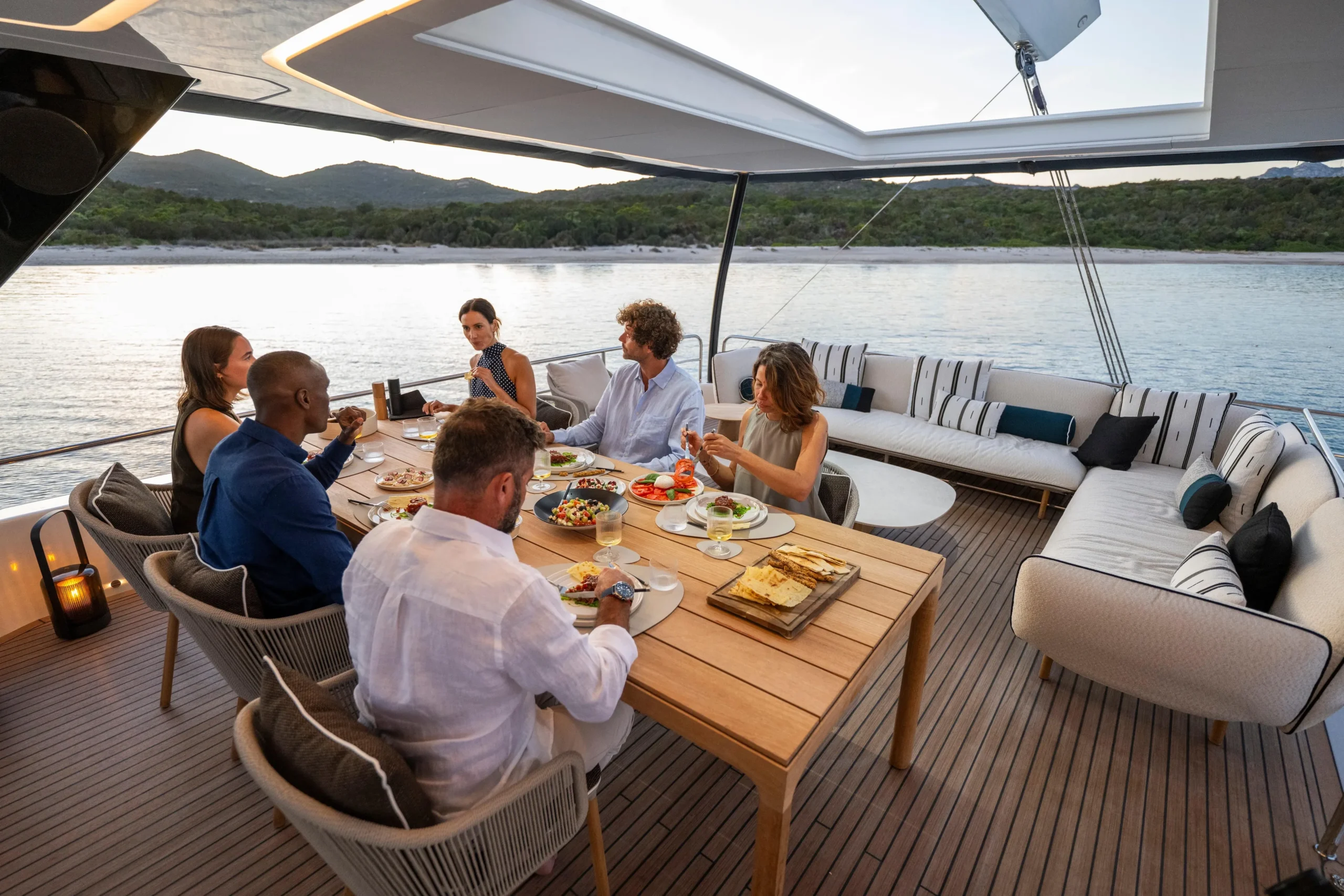
After a swim, salt can remain tight on the skin even when the towel is dry. In the warmth of an anchorage, the first pleasure may be a glass of cool water and somewhere to sit without having to explain the day. Then comes the scent from a bowl being set down, steam carrying ginger or citrus into the evening air. That is the scale of experience we want dinner to accommodate. It needs no claim of superiority to a restaurant.
There is work behind that apparent informality. Food allergies and dietary needs have to be understood before provisioning, including the practical question of preventing cross-contact in a shared galley. Preferences deserve attention without turning every meal into a negotiation. A younger guest may need to eat earlier. Someone returning hungry from the water may need food before the longer dinner. Feeding people well includes noticing when the proposed rhythm does not suit them.
The Naora Global Expedition is a private sailing expedition around the world, planned across five years from 2027 to 2031. Members choose when and where along that route they join, and how long they remain aboard. The galley therefore serves both continuity and change. It must welcome someone at the beginning of their time on Discovery while keeping daily life dependable for people who have already settled into it. A favourite breakfast can matter as much as an unfamiliar ingredient.
A Michelin-starred table can reward surrendering an evening to the kitchen. Here, we would rather the kitchen give the evening back to the people aboard. There should be room to ask about the fish, to talk about what was seen in the water, or to say very little. A serving spoon can rest against the side of the bowl. Someone can take another helping without interrupting the conversation.
That is a good use of a galley.