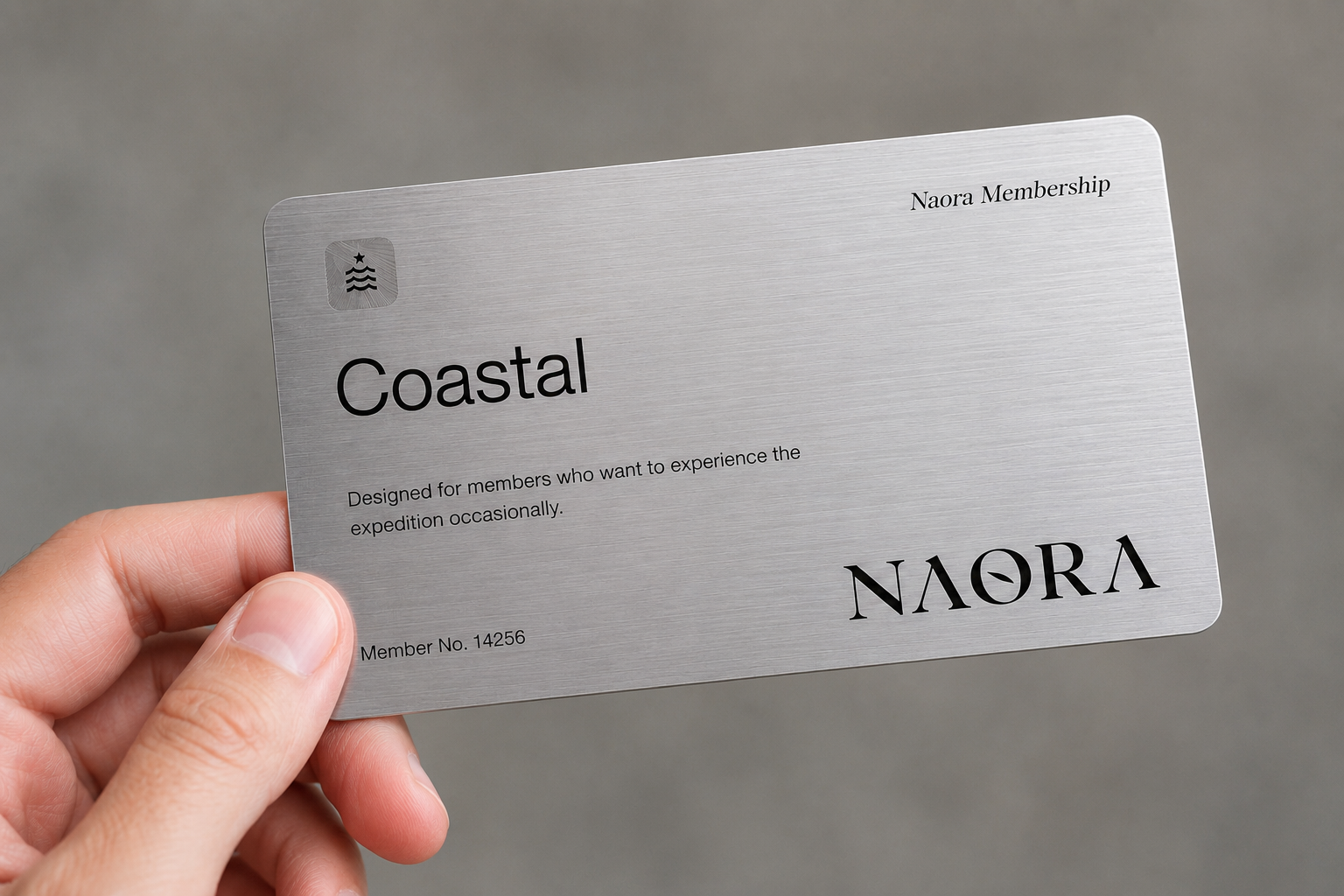
On the route map, a week in the Cyclades sits within a much longer line. In a family calendar, the same week has commitments on either side, people to consider and arrangements that cannot simply move with the wind. The Naora membership fee belongs to the interval between those two views of the voyage: the expedition we are sailing and the life from which someone will join it.
That interval can be substantial. Someone may know they want to sail with us long before they know which passage will fit. Another person may have a particular part of the route in mind but still need time to understand what being aboard will ask of them. Neither should have to confuse becoming a member with immediately choosing a berth.
The distinction begins with a precise point in time. Circle access starts when the membership payment is processed. It does not wait for departure, and it is not necessarily a promise about tomorrow. The processing date is the date that matters.
What The Naora Membership Fee Starts
Membership follows a personal conversation about expectations and the way Naora moves through the world. Once the membership payment is processed, the Circle app becomes accessible, registration for the digital sessions opens, onshore events become bookable, the partner network becomes accessible and personal guidance from the Naora team begins. These are things a member can use while their sailing date is still some distance away.
There is an important difference between access beginning immediately and everything happening immediately. The digital sessions have their own programme, scheduled every two months. Onshore gatherings have their own dates and places. Activation allows a member to take part in that programme; it does not mean that a session or gathering takes place on the day they join.
The sessions bring specialists, thinkers and people with experience of building and leading businesses into conversation with the Circle. Their usefulness should lie in the substance of the exchange, not in the prominence of a name. A good conversation leaves someone with a distinction they had not made before, or a question that is more useful than the answer they originally wanted.
The membership fee covers the membership year from the point of processing, rather than a year beginning with the first passage. That matters when considering a distant sailing date. The intervening months are part of the membership itself. They are time in which the app, programme, network and guidance are already accessible, not months held aside until the yacht comes into view.
The Time Before The First Passage
We should be careful about what the word community promises. Access can begin on a particular day. Familiarity cannot be switched on with it. Paying a fee does not create friendship, establish confidence between strangers or guarantee that a conversation will matter. Those things depend on attention, conduct and time.
What the Circle can provide is the opportunity for contact before anyone is sharing the motion and close quarters of a yacht. A digital conversation allows people to hear how someone thinks, how they respond to disagreement and whether they leave room for another person to finish. None of that requires a dramatic introduction. Often the useful thing is simply discovering that a question can be asked without performing expertise.
The two-month rhythm gives those conversations space between them. It is not a daily stream that must be followed to avoid falling behind. There is room for an idea to encounter ordinary life, to prove useful or turn out to need qualification, before the next session arrives.
For us, the months before sailing also have a practical value. A member can begin distinguishing an attraction to a destination from an appetite for the passage that reaches it. Those are related, but they are not identical. Wanting to see a Polynesian atoll does not, by itself, say how someone feels about an extended stretch offshore.
That is a useful thing to discover on land, with time to think. There is no virtue in allowing anticipation to become an obligation to enjoy a kind of sailing that was never right for you.
What The Naora Membership Fee Does Not Reserve
The membership fee does not reserve a berth on a particular leg. It is not the annual participation fee, and it does not go into the escrow account. Its purpose is the Circle membership and the access that begins when that payment is processed.
The annual participation fee is the separate payment that secures the specific berth on the specific leg and goes into escrow. In this structure, the offshore payment sits sixty days before departure. For someone joining earlier, Circle access does not wait until that point to begin.
The distinction is straightforward, but it should never be left implicit. A person may have an active membership without having secured a particular place aboard. Membership activation also provides access to route availability and bookings through the private member platform. Being able to examine those options and enter the booking process is different from having a confirmed berth.
Escrow deserves equally plain language. It concerns how money is held and released under agreed conditions. The word alone does not explain cancellation rights, refund terms or what happens if a voyage changes. Those details belong in the written agreement and need to be understood before the offshore payment is made. No financial arrangement removes the captain’s responsibility to respond to conditions at sea.
We keep the two payments separate because they serve different purposes and begin doing their work at different times. Someone considering membership should be able to identify what becomes accessible now, what still requires a separate commitment and which payment is subject to the escrow arrangement. That understanding should come before flights, leave arrangements or the assumption that a particular cabin is theirs.
Reading The Route Before Choosing A Leg
The Naora Global Expedition is a private sailing expedition around the world, covering roughly 49,000 Nm across 166 legs over five years, from 2027 to 2031. Those figures describe the scale of the yacht’s undertaking, not the commitment required of each person who joins it. Discovery keeps sailing while members step in and out where the route fits their lives.
The distance includes ocean passages as well as coastal sailing. The number of legs creates many possible points of connection, but it does not make those legs interchangeable. The five-year span allows a relationship with the expedition to continue through periods when a member is ashore and occupied with other things.
This is where personal guidance becomes more useful than another attractive photograph. A leg needs to be read for its likely rhythm: how much time is spent moving, whether sailing continues through the night, how much flexibility the weather may require and what reaching the next joining point involves. A destination name cannot answer those questions.
Nor can distance alone. A shorter stretch into wind and steep seas can be more tiring than a longer passage with the wind at a comfortable angle. Wave period matters as well as wave height. Closely spaced waves give the boat less time between encounters, changing the motion someone feels while reading, resting or moving through the cabin. These are considerations, not forecasts for an individual leg.
Sven, Naora’s founder and captain, plans every weather window and sails every leg himself. The route follows the tradewinds and parts of the Coconut Milk Run, but a seasonal pattern is a planning basis, not permission to disregard the weather on the day. Understanding that before choosing a passage is part of choosing well.
Personal Guidance Begins With Ordinary Details
The most useful early conversations are often about things that would never appear in a destination description. How someone sleeps away from home. Whether they have experienced seasickness. How comfortably they move on an unfamiliar surface. Whether a family wants most of its time together or needs periods apart. An essential work call or an immovable return date can matter more to the choice of leg than a preference between two coastlines.
These details do not make someone a difficult guest. They make the planning more honest. A previous uncomfortable passage is useful information, not something to minimise out of politeness. Equally, enjoying a calm afternoon aboard another yacht does not yet tell someone how they will feel during sustained motion offshore.
The morning someone imagines may be an anchored one: bare feet finding the cool deck before the sun reaches it, the warmth of a cup held in both hands, water making a small, irregular sound against the hull. On passage, that same cup needs a secure place, the horizon may rise and fall beyond the window, and walking across the saloon calls for an available hand. Both belong to life aboard. They ask different things of the body.
Guidance should help make that difference understandable without turning it into a test of character. Choosing a gentler introduction is a sensible decision. So is recognising that a particular period of work leaves too little room for the uncertainty of an offshore passage. Connectivity should never be treated as uninterrupted, and the sea cannot be scheduled around an essential call.
The value of beginning these conversations before departure is the room it gives everyone to make adjustments without haste. Sometimes the right outcome is a different part of the route, or a different length of stay.
Access Without An Obligation To Perform
A private circle can become tiring if membership starts to feel like another role to maintain. People already have families, colleagues, longstanding friendships and responsibilities that will not become less important because they intend to sail. We do not need to interpret constant visibility as the measure of a meaningful relationship with Naora.
Someone may find the digital sessions useful while rarely being near an onshore gathering. Another may value a conversation with the team more than a group exchange. The programme provides different ways of participating. Its worth cannot be reduced to the number of times a name appears on a screen.
The partner network needs the same restraint in how we describe it. Access is not a promise of a transaction, a particular introduction or a commercial result. A network is useful when the connection is relevant and both sides have a reason to engage. Treating every member as a possible customer would change the character of the Circle very quickly.
Privacy, meanwhile, is a matter of behaviour rather than headcount. A small group can still be indiscreet. The better habit is to ask before sharing a photograph, not repeat someone else’s personal circumstances as an interesting story and recognise that a contact made in one setting is not automatic permission to approach in another.
That standard matters before anyone boards the yacht. A member should be able to contribute without making their private life public, and to listen without having to account for their silence. Space is partly physical. It is also the freedom not to explain yourself more than the situation requires.
When The Circle Meets The Yacht
Discovery, the Lagoon Eighty2 sailing the world route, gives the Circle a physical centre without requiring everyone to be there at once. Members choose when they join, where along the route they step aboard and how long they stay, within the practical arrangements of the voyage. One week and a much longer stay can each be a considered choice. Neither needs to stand for a person’s seriousness about the sea.
The yacht’s continuity is important. When someone returns to shore, the expedition does not become a completed trip kept in a folder of photographs. It continues into another region, another season and another set of decisions. The Circle is the part of membership that remains accessible during the membership year even when the member’s own days are being lived elsewhere.
Eventually, for the member whose passage has been arranged, there is the physical arrival. Picture the pause at the boarding point: the weight of a bag coming off a shoulder, brightness reflected from the water, a hand finding the rail before the feet follow. The movement is small, but it makes the difference between looking at a yacht and being on one unmistakable.
Knowing people beforehand may make that moment less socially unfamiliar. It does not replace the safety briefing or the practical orientation aboard. Familiarity with the Circle is not familiarity with the vessel. Where to put a hand, how to move when the boat is under way and when to wait for the crew’s instruction still deserve fresh attention.
If the time before sailing has done something worthwhile, it should be easier to say that something is unclear. There should be no need to arrive appearing more experienced than you are. The small question asked quietly at the rail deserves a complete answer.