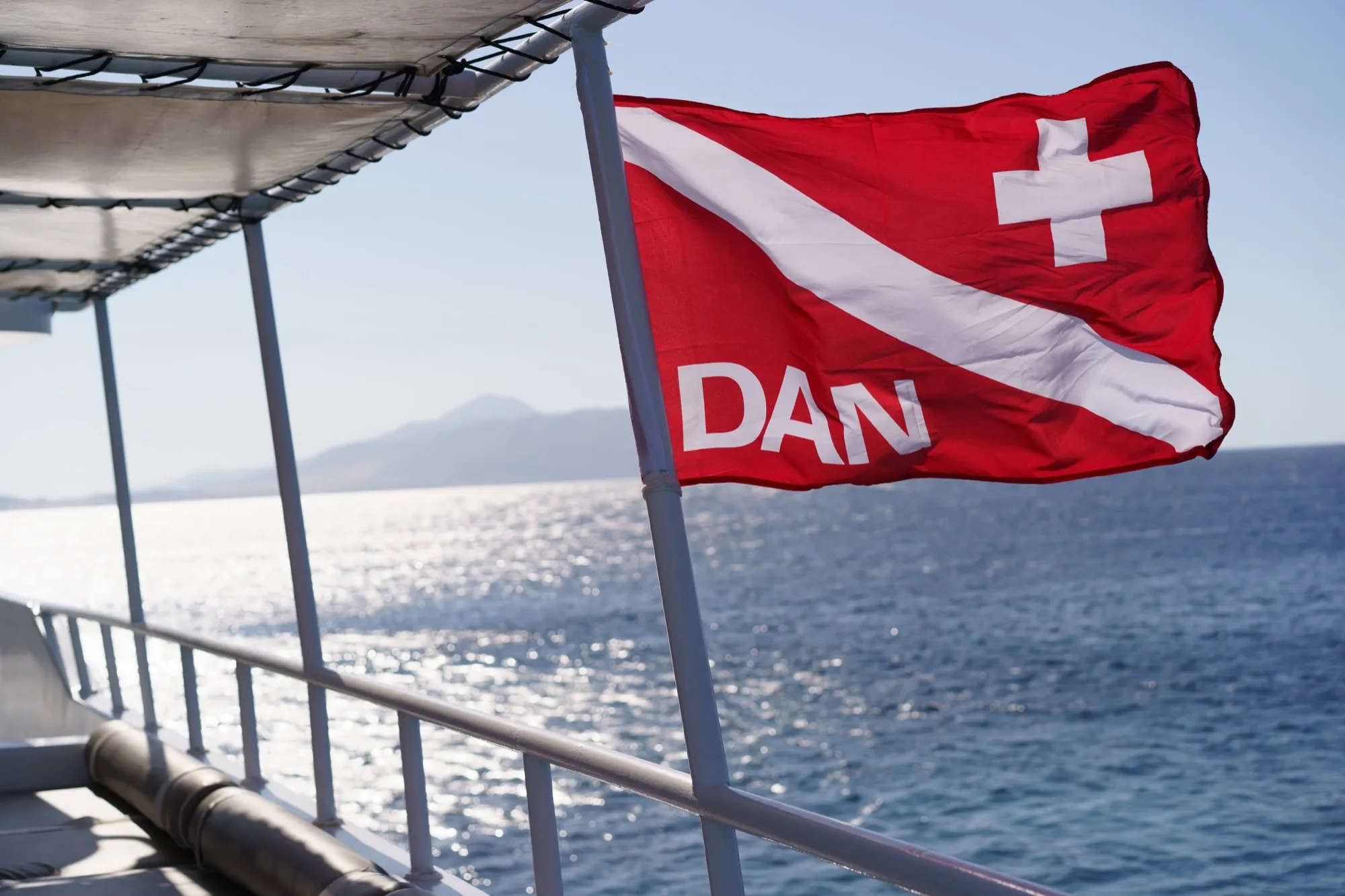
The expiry date on a diving insurance certificate is a small line with considerable weight. When we discuss DAN Silver Sport before someone boards Discovery, that line matters more than the logo above it. So do the insured activities, the geographical scope and the conditions attached to emergency assistance. A membership card is a beginning. It is not, by itself, confirmation that the person holding it has the cover their voyage requires.
These are things to settle before there are fins beside your feet and sunlight breaking into moving fragments beneath the stern. At that moment, attention belongs elsewhere: to the briefing, the current, the person beside you and the way back aboard. The administrative work earns its place by being finished early enough to leave that attention undivided.
What DAN Silver Sport Needs To Cover
DAN Silver Sport refers here to DAN Europe’s Sport Silver plan, our minimum recommended level for the Naora diving programme. Appropriate, active diving insurance needs to be confirmed before participation. That recommendation is not a claim that the same product is available to every resident of every country, or that its wording will remain unchanged throughout the expedition. The relevant document is the insurance contract issued to the individual coming aboard.
There is an important distinction between belonging to an assistance organisation and holding an insurance policy that will respond to a particular accident. Membership, access to advice and insured financial benefits are related, but they are not interchangeable. We need to understand the cover behind the card: who is insured, for which activities, during which dates and subject to which conditions.
Sport Silver’s provisions for recreational scuba diving and freediving make it relevant to life aboard. Spearfishing still deserves a separate check rather than an assumption that anything done on a held breath falls within the same wording. Training, professional activity and competition can also be treated differently. A quiet recreational descent and a formally organised performance attempt may look similar from the surface while being very different insurance questions.
The same care applies to depth. Whatever a policy says about maximum depth, it does not extend a diver’s qualification, establish fitness to dive or make a site suitable. The dive limit must remain within training, competence, equipment, local rules and the conditions on the day. Insurance is the financial and assistance provision behind the activity, not permission to make the activity more demanding.
Ordinary travel insurance should be read with equal attention. Some policies include diving within defined limits; others exclude particular activities or restrict depth and supervision. The useful distinction is not between a reassuring name and an unfamiliar one. It is between cover whose terms match the intended diving and cover whose terms have never been examined.
Distance Changes The Meaning Of Cover
Discovery, our 2025 Lagoon Eighty2 sailing catamaran, will follow a world route of roughly 49,000 Nm over five years, from 2027 to 2031. Those figures describe continuity rather than a single guest’s absence from home. Members choose when they join, where along the route they step aboard and how long they stay. Their insurance must fit their own part of that moving voyage.
A diving accident near established medical infrastructure and the same accident beside a remote Polynesian atoll create different practical problems. The injury may be similar. The time and means required to reach appropriate care may not be. In the Red Sea, Asian archipelagos or Indian Ocean island groups, proximity to land alone tells us very little about access to diving medicine.
A chamber marked on a map is not a complete evacuation plan. It may not be operational, staffed or able to accept a patient. The most appropriate destination may be a hospital capable of initial stabilisation before any onward transfer. Those decisions belong with medical professionals working from current information, not with a distance measurement to the nearest chamber symbol.
Emergency medical transportation, search and rescue, and repatriation are also distinct benefits. Cover for treatment does not automatically establish cover for every stage of getting there. Nor does a benefit mentioning aircraft mean an aircraft can reach the yacht immediately. Weather, operating range, landing facilities and the patient’s condition still govern what is possible.
This is where a policy’s wording becomes physical. A limit or exclusion that seemed abstract at home can affect who arranges transport, which costs require authorisation and what happens after initial treatment. We want those distinctions understood while everyone is well, with time to ask a precise question and obtain a written answer.
Freediving Needs Its Own Attention
The absence of a cylinder can make freediving appear to belong with swimming rather than diving. The body does not recognise that administrative convenience. Breath-hold diving brings pressure changes, oxygen depletion and the possibility of injury without any breathing apparatus being involved. Ear and sinus barotrauma, lung injury and hypoxic blackout require explicit attention in both the safety plan and the insurance check.
The final part of an ascent deserves particular respect. From around 10 metres to the surface, ambient pressure roughly halves. As pressure falls, the oxygen pressure in the lungs can fall sharply too, which helps explain why a freediver can lose consciousness near the surface or shortly after reaching it. Being almost back is not the same as being safely recovered.
A buddy therefore needs a defined job, suitable training and undivided attention. Two people underwater looking for fish are not providing each other with effective surface supervision. Nor is a person watching intermittently from the deck an adequate substitute for an attentive in-water safety partner. Supervision must continue through surfacing and recovery, not end when a head appears above the water.
Hyperventilation is another point worth making plainly. It can suppress the urge to breathe by lowering carbon dioxide without making an extended breath hold safe. We do not treat it as a useful way to stay down longer. Equalisation also belongs to prevention: pressure should be managed early and gently, and discomfort is a reason to stop a descent rather than a challenge to push through.
For someone carrying a camera or speargun, attention has an additional competitor. The subject moves, the opportunity seems brief, and the intended limit can become negotiable in the mind. The safety arrangement has to account for that distraction before entering the water. Insurance cannot perform the buddy’s work, and neither experience nor a familiar reef removes the need for it.
The First Response Cannot Wait
After a dive, the boat can seem unusually loud. Water drains from a suit onto the deck, a buckle taps against something hard, and an ordinary conversation finds its volume again after the muffled world below. Someone sitting quietly with a towel around their shoulders may simply be tired. They may also be deciding whether a strange sensation is worth mentioning.
We want that sensation mentioned. Unusual pain, tingling, weakness, dizziness or breathlessness after diving should not be dismissed as exertion without assessment. Symptoms do not have to look dramatic to deserve urgent attention. A dive computer showing an apparently acceptable profile does not rule out decompression illness, and someone feeling embarrassed about disrupting the afternoon should not be left to make that judgement alone.
The immediate priorities are the casualty and access to medical help, not a claims form. An unresponsive person who is not breathing normally needs immediate resuscitation. Suspected diving illness requires prompt medical assessment, with emergency oxygen administered by someone trained to use it when available. Improvement after oxygen does not establish that the problem has resolved. Returning a symptomatic diver underwater to try to treat them is not an improvised option aboard a recreational yacht.
DAN’s emergency assistance operates 24 hours a day and provides access to specialist diving medical advice. That support belongs alongside the relevant local emergency response, not in place of an urgent rescue call when one is needed. A medical conversation can help determine what should happen next while the people aboard continue immediate care.
The information passed ashore needs to be usable: the yacht’s position, reliable contact details, the diver’s condition, when symptoms began, the dive profile, breathing gases and recent diving history. A computer record is valuable, but so is a plain account of what changed. Keeping those facts together reduces the burden on a casualty who may be frightened, uncomfortable or unable to explain clearly.
What An Evacuation Actually Requires
There are two conversations during an insured emergency. One concerns the care a person needs. The other concerns arranging and authorising the services that the policy will pay for. They should support each other, but they are not identical. Immediate lifesaving action must not wait for financial approval, while assistance providers should be involved as early as practicable in arranging covered treatment and transport.
The yacht’s part in that response begins before the dive. Emergency oxygen is a finite supply. Its useful duration depends on the quantity available, the delivery system and the casualty’s needs. Remote diving preparation therefore has to relate the oxygen provision to a realistic delay before further medical support, rather than treating the presence of a cylinder as a complete answer.
Communications require the same practical scrutiny. A number saved on a phone is useful only if there is a working means of reaching it. The response plan needs an understood primary method, an alternative where practicable, and enough information available offline to begin the conversation without searching an inbox. We cannot promise uninterrupted connectivity at sea, so preparation must acknowledge the possibility of a failed connection.
Local services have their own operational limits and other people to care for. Arriving by private yacht does not create priority over those realities. Clear information, early coordination and a realistic account of the boat’s capabilities are more useful than urgency expressed as insistence.
DAN Silver Sport Before Boarding
The pre-boarding check should establish that the named person is insured for the intended activities throughout the relevant dates and locations. A certificate or membership confirmation helps identify the cover, but the schedule and policy wording explain what it means. Important documents should be saved for offline access rather than left behind a login that depends on a connection.
Residence and eligibility matter. DAN organisations serve different regions, and a familiar product name is not enough to establish that someone can properly buy a particular policy. Age conditions, medical declarations and exclusions also need individual attention. A higher tier is not automatically the answer to a mismatch between the person’s circumstances and the contract.
Duration is especially relevant to Naora because people may stay longer than an ordinary holiday. An annual policy does not necessarily mean that every benefit applies without a limit on the length of an individual trip. Non-diving medical benefits may have different conditions from diving benefits. Someone joining for an extended passage needs to distinguish those provisions rather than reading the annual expiry date as the answer to every question.
Medical fitness is a separate matter again. An insurance certificate does not clear someone to dive after an illness, a change in medication or a new diagnosis. Those questions belong with a clinician competent in diving medicine. Relevant information should be shared privately with the people responsible for safe participation, not discussed across the dinner table or left until equipment is being fitted.
The emergency contact details and policy identifier need to be accessible to the person who might have to make the call. That does not require personal medical documents to circulate around the yacht. It requires a deliberate arrangement that respects privacy while allowing help to begin if the insured person cannot speak for themselves. Discretion works best when it has been thought through in advance.
The Last Dive Belongs In The Passage Plan
The final dive before leaving Discovery can feel like a small decision. The equipment is familiar, the water is clear, and there is still time before the flight. But the relevant interval begins when the diver surfaces, not when the yacht reaches port or the bags are packed. A departure plan that ignores that distinction can turn an unhurried morning into an unnecessary calculation.
For symptom-free recreational divers, commonly used minimum surface intervals before flying are 12 hours after a single no-decompression dive and 18 hours after multiple dives in a day or diving over several days. These are minimum planning intervals, not guarantees against decompression illness. Dives involving required decompression need a longer interval and specific advice. An ascent to altitude ashore also belongs in the discussion.
Suspected diving illness changes the question completely. A person with symptoms needs medical assessment, not reassurance that enough hours will have passed by departure. The conditions of any necessary air transport should be determined with medical guidance. Advice intended for a well diver taking a scheduled flight cannot simply be applied to a casualty being evacuated.
For us, the practical response is to make the last diving day part of the onward travel conversation early. A flight change, an extra dive or a longer stay aboard should prompt another look at both the plan and the cover. There is no need to fill every possible hour underwater merely because the opportunity is there.
Sometimes the better last morning is spent dry, with the equipment rinsed and a cup resting securely beside you. The reef may still be visible through the water. It does not need another descent to make the morning complete.