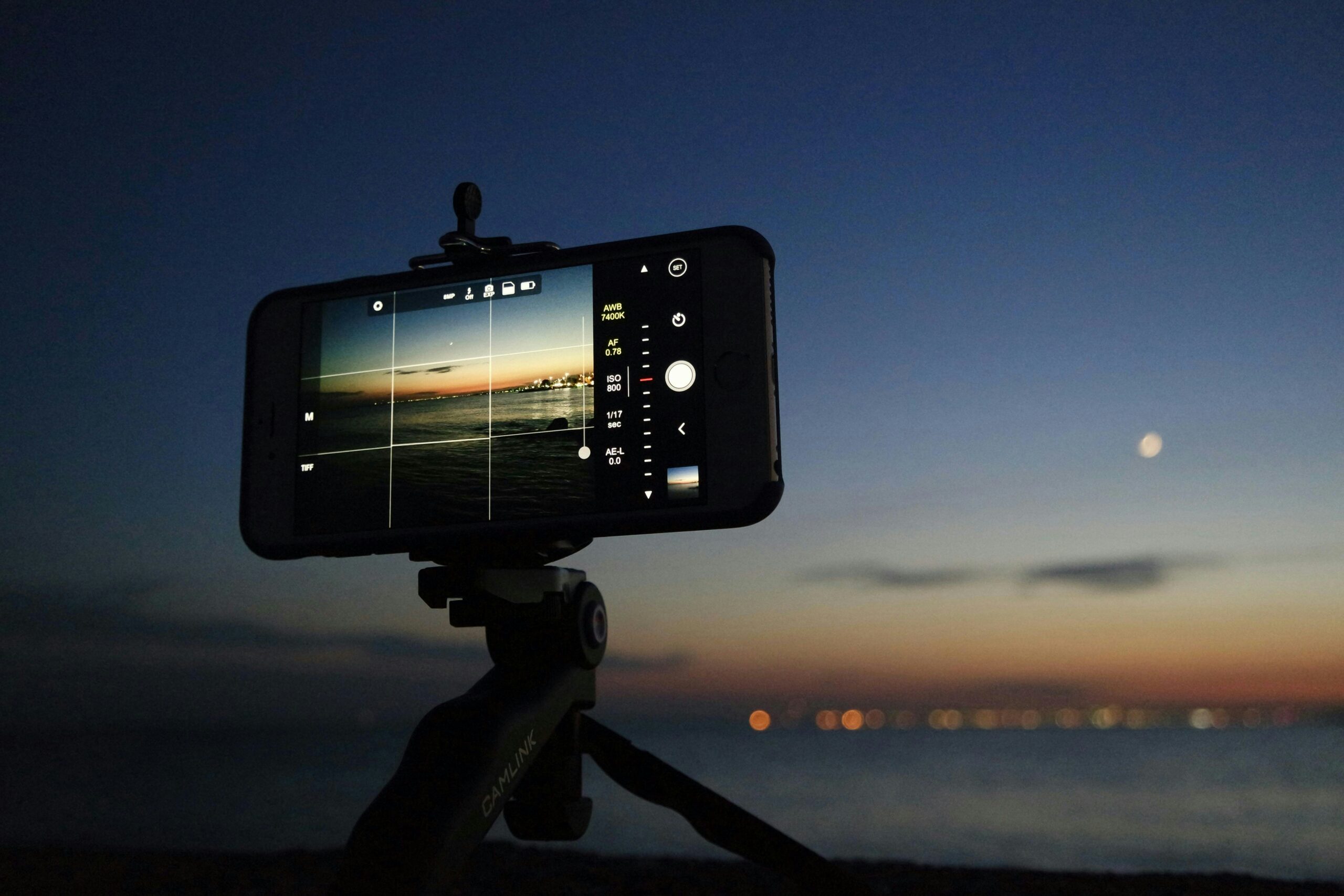
A bright camera screen in a dark cockpit makes it harder to see the sea. That small conflict is a useful place to begin thinking about offshore sailing content: the picture can improve while the watchkeeper’s view deteriorates. We would rather lose the picture.
From a cockpit at night, much of the boat reaches you through sound and touch. Water moves along the hull before its surface becomes distinguishable. Air comes around the shelter of the helm and across your face. A change in the sound of a sail can draw attention before there is much to see. Put a bright screen into that setting and the eye turns towards it, away from the faint information that matters.
This is the difficulty with showing offshore life. Recording it can interfere with the very thing worth recording. As we prepare for the Naora Global Expedition, planned across five years from 2027 to 2031, I think the most useful question is how to make that life understandable without asking it to become a performance.
What Offshore Sailing Content Leaves Out
There is already thoughtful sailing work being made. A clear explanation of a repair can save another sailor hours. A well-filmed passage can convey something of the scale of an ocean. The problem is not that these forms lack value. It is that an audience can watch a great deal of both and still have little sense of what happens between the repair and the landfall.
The missing material is often the connection between events. A sail reduction looks straightforward when the explanation starts with someone pulling a line. It becomes more revealing when we understand what prompted it: the approaching night, a changing forecast, the behaviour of the boat, the wish to make the next watch less demanding. The manoeuvre takes a short time. The judgement begins earlier.
The same is true of a quiet afternoon. Without context, it may look as though nothing needs doing. With context, the reader understands that someone has already checked the weather, considered traffic, dealt with a small defect and arranged the work so that another person can rest. Ease has a history. A documentary that removes that history leaves the wrong impression of how a yacht is run.
I would like someone who has never sailed offshore to finish a piece knowing why the day took the shape it did. They need not learn every term. They should be able to recognise a decision, understand its consequence and notice the care that made an uneventful passage possible. That is more valuable than being told that everyone aboard had an extraordinary time.
The Watch Comes Before The Camera
An Atlantic watch handover offers a good example because its outward appearance is so modest. Two people speak quietly. One stays and one goes below. Yet the exchange has to transfer a working picture of the yacht and the water around it, rather than merely report that everything seems fine.
The incoming watchkeeper needs to understand the course being steered, the sail configuration, the wind trend, nearby traffic and anything that is not behaving normally. A vessel seen intermittently on the horizon deserves more useful description than a gesture into the dark. A changed alarm setting or a piece of equipment being watched should not remain knowledge held only by the person about to sleep.
There is also a difference between repeating information and taking over responsibility. The arriving watchkeeper needs time to look outside, understand what the instruments are showing and reconcile the two. If something is unclear, the outgoing person stays until it is clear. An attractive shot of a solitary figure at the helm tells us less about offshore competence than that unhurried transfer.
Filming must fit around it. Questions can wait. Lighting cannot be added merely because faces are difficult to expose. Dark adaptation takes time to recover after bright light, and looking into an illuminated display can make a faint light outside harder to distinguish. A camera operator who asks someone to repeat the handover for a cleaner recording has already misunderstood its purpose.
Sven, Naora’s founder and captain, plans every weather window and sails every leg himself. Any account of life aboard should preserve the distinction between his operational judgement and the wish to explain it to an audience. If the explanation has to be recorded later, it should be recorded later. The reason for a decision can survive a delay. Attention divided at the wrong moment cannot always be recovered so easily.
The Conditions Behind The Picture
A camera is not a reliable measure of sea state. Lens choice, camera height, stabilisation and the direction of the shot all affect how motion appears. A low view across the water can make modest waves look imposing. A wide view from a stable position can make an uncomfortable sea look surprisingly flat. Neither image necessarily tells a lie, but neither is enough by itself.
Useful context starts with distinctions that are easy to lose in an edit. Was the wind figure a gust or a sustained reading? Was it true wind or the apparent wind experienced aboard the moving yacht? Was the swell travelling with the wind waves, or crossing them? A comfortable motion in one arrangement does not imply the same comfort in another, even when the wind speed is similar.
The numbers become worthwhile when they explain a choice. With sail area, angle and other conditions unchanged, an increase in apparent wind from 20 to 30 knots produces roughly 2.25 times the aerodynamic load. That is an illustration of the physics, not a reefing threshold for Discovery. It explains why an increase that sounds modest in conversation can matter considerably aboard.
An honest account would show that sail decisions depend on more than a single reading. Sea state, gusts, the yacht’s loading, the equipment limits and what is expected next all enter the judgement. Reducing sail before the conditions become difficult may produce less dramatic footage than doing it late. It also leaves people with more capacity to deal with something unexpected.
The useful story is the margin kept, not the spectacle avoided. That takes a little longer to explain than a wave breaking across the frame.
The Work Inside An Ordinary Morning
Imagine the galley on a passage morning, rather than at the moment a finished breakfast reaches the table. A cupboard latch clicks shut. The kettle is restrained before attention moves elsewhere. Someone pauses with a cup in hand as the hull meets the next wave, then continues when the movement passes. Warm air carries the smell of coffee, while the worktop remains clearer than it might in a kitchen ashore.
These are ordinary physical adjustments, not evidence that life aboard is an obstacle course. They show how familiarity changes behaviour. A loose object gets secured before it can travel. A hot pan is not left where a sudden movement can turn it into a problem. Preparing ingredients before applying heat reduces the number of tasks competing for attention when the yacht is moving.
A useful account of provisioning would follow that same practical logic. Local produce has to be inspected, stowed so that delicate items are not crushed, and used in an order that reflects its condition. Food that will deteriorate first belongs early in the meal plan. A beautiful market purchase is only the beginning of the story; making good use of it several days later is where the galley’s judgement becomes visible.
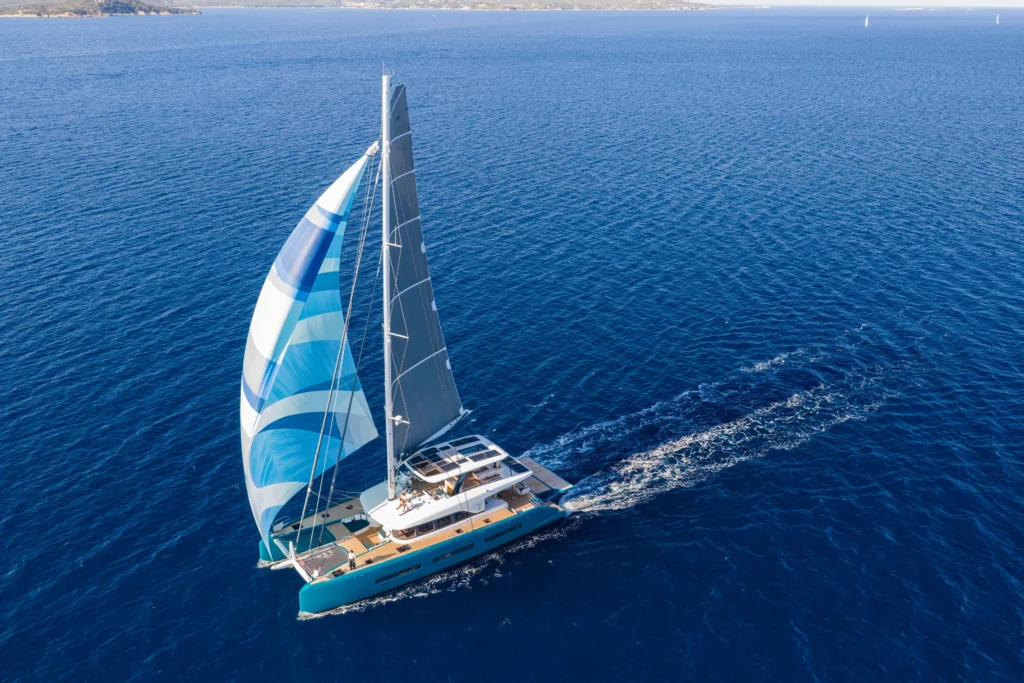
Discovery, the Lagoon Eighty2 sailing the Naora route, has onboard water production and independent energy systems. Those capabilities make longer stays away from shore infrastructure possible, but independence still requires maintenance, monitoring and sensible use. Water production draws power. Refrigeration needs power. A quiet meal is supported by systems whose work does not usually appear in the photograph.
Across roughly 49,000 Nm, those relationships matter more than any single display of self-sufficiency. Small faults deserve attention before distance makes them difficult to resolve. Consumables have to be considered before the next place to obtain them becomes remote. Showing some of this work gives the viewer a more generous understanding of comfort: it is something people keep making for one another.
Offshore Sailing Content Needs An Honest Clock
The pressure to publish immediately can be a poor companion to a passage. Offshore connectivity varies, and an upload competes with other demands on the connection and on the person preparing it. Footage also needs reviewing, identifying and storing securely. None of those tasks becomes more important because an audience has grown accustomed to receiving something every evening.
For Naora, a useful publishing rhythm should follow the voyage rather than govern it. A delayed account can be more truthful than an immediate fragment because there has been time to understand what happened. Waiting also allows an account to explain the result of a decision, rather than presenting the decision itself as proof that it was right.
Chronology deserves particular care. If a forecast shown on screen was received after a course change, it cannot be used to suggest that it informed that change. If an explanation was recorded at anchor, it should not be presented as speech captured during a manoeuvre. The viewer needs to know what was understood at the time and what became clear afterwards.
Weather offers a simple editorial discipline. Keep the issue time and valid period of a forecast with the material it helps explain. Distinguish a forecast from an observation. Say when a figure is an estimate. These details need not dominate the finished piece, but keeping them prevents a neat story from replacing the actual sequence of judgement.
The same care belongs in sound. A soundtrack can make a calm watch feel ominous or turn concentration into apparent conflict. Sometimes the most informative sound is the unaltered rhythm of water and rigging. Sometimes there was no usable recording at all. Silence is preferable to manufacturing evidence of a mood that nobody aboard experienced.
The People Aboard Are Not The Programme
The most intimate material is not automatically the most valuable material. A conversation can matter deeply to the people having it without belonging in a public account. In fact, knowing that it will remain unrecorded may be part of what allows the conversation to happen.
That matters on a private voyage. Someone may be happy to appear swimming or helping with a sail and still want their meals, family time or work kept out of view. Permission to be filmed on one occasion is not general permission to publish everything a camera happens to collect. A private audience is still an audience, and material shared within a circle still needs the care that private lives deserve.
There are practical consequences. A screen in the background can expose a message. A document on a table can reveal a name. A location caption can disclose someone’s movements even if their face never appears. Reviewing a frame for these details is as much a part of responsible editing as checking its colour or sound.
Children require particular restraint. So do moments of fatigue, illness or distress. The fact that a difficult moment would make a compelling scene does not create an obligation to show it. An explanation given later, by someone who genuinely wishes to give it, may be enough. Sometimes nothing needs to be published.
This is not a loss of documentary depth. Depth can come from attention rather than access: understanding why a plan changed, following a repair through to completion, noticing how responsibilities are shared. A guest should be able to read, sleep, be quiet or decline a camera without becoming an absence the story tries to overcome. Privacy is part of the life we are trying to describe.
What A Continuing Voyage Can Reveal
The opportunity in Naora is continuity. The route plan contains 166 legs, which means repeated opportunities to return to the same questions under different conditions. How does provisioning change as the distance between reliable supplies increases? What does the yacht need after a sustained passage? Which routines remain useful as people join and leave?
The Atlantic passage, Polynesian atolls and Asian archipelagos should not become interchangeable backgrounds for the same onboard story. Each changes what deserves attention. Offshore, weather and endurance can organise the day. Near land, pilotage, local requirements and the responsibility to enter a place respectfully become more immediate. Returning to familiar tasks in unfamiliar surroundings lets an audience see adaptation rather than merely scenery.
Members choose when they join, where along the worldwide route they step aboard and how long they stay, with arrangements grounded in the route and conditions. Some experience a short chapter; others remain for a longer passage. Discovery continues sailing as the people aboard change. That gives the journal a subject larger than any one guest’s holiday: the life of a yacht, its crew and its small circle over time.
Duration alone will not make that account worthwhile. The value will depend on what we notice, what we explain accurately and what we are willing to leave unrecorded. The ordinary day deserves patient attention, but it does not owe us every part of itself.
Somewhere below the cockpit, a person can sleep because another person is keeping watch. The camera adds nothing to that arrangement. It is there to help us understand it.