In the dark, water passing the hull is easier to hear than to see. On an Atlantic crossing, that sound continues beneath everything else: a quiet conversation, the closing of a cabin door, the small domestic business of making something warm to drink. The boat moves under your feet while your hand finds a secure place for the cup. Before the ocean becomes a thought, it becomes an adjustment of the body.
From an aircraft, the same water occupies the space between departure and arrival. There is nothing lesser about that use of an ocean. A flight makes distance manageable, brings people together and preserves time for other things. A sailing passage asks us to spend the time instead.
The distinction matters because the Atlantic does not automatically improve anyone who crosses it slowly. It offers something more specific: enough repeated contact with weather, distance and the needs of a moving household that these stop being abstractions. We begin to understand what it takes to live there.
The Time An Atlantic Crossing Takes
The passage from Las Palmas in the Canaries to Barbados is on the order of 2,700 Nm, with the distance actually sailed depending on the chosen track. Weather routing may favour a longer line through useful wind over a shorter one through a weak or unsettled area. The shortest line on the chart is a geographical fact. The most sensible line for the boat is a decision.
Twenty-two days gives a useful sense of the commitment, but it should not be mistaken for an arrival guarantee. At an average of five knots, a yacht covers 120 Nm in a full day. That simple arithmetic puts a crossing of this scale at roughly the duration we are considering. It is an illustration, not a speed forecast for Discovery. A passage average includes the slower hours, the changes of sail, the uncomfortable sea that makes restraint sensible, and any time spent taking a less direct course.
For the people aboard, the practical consequence comes before departure. Leave room around the arrival. A flight home booked immediately after an optimistic landfall estimate quietly introduces pressure into decisions that should remain independent of it. The captain should never have to weigh a better weather choice against someone else’s immovable appointment.
There is also a difference between days at sea and the time a crossing occupies in a life. Preparation, a possible departure delay, arrival formalities and recovery all belong to it. The honest conversation begins with that larger space in the calendar, not with a neat number of nights aboard.
The Trades Still Need Reading
The familiar westbound trade-wind window is broadly December to April. In this part of the North Atlantic, the northeasterly trades are associated with the circulation around the subtropical high. They offer a useful underlying pattern for sailing towards the Caribbean, but a pattern is not a continuous supply of identical afternoons.
The high changes position and strength. Disturbances can interrupt the trades. Ocean swell can arrive from weather far beyond the local forecast area, so a moderate wind does not necessarily mean an easy sea. Near the Canaries, the islands themselves complicate the picture through wind shadows and acceleration around their flanks. The breeze outside the harbour does not describe the whole departure.
Before choosing a window, we need to consider wind direction and strength alongside wave direction, period and the way those conditions are expected to develop. A following sea with space between its crests can feel quite different from a shorter, confused sea at the same reported height. One permits a settled rhythm. The other may keep interrupting sleep and turn simple movement through the boat into work.
Squalls deserve their own attention. Rain-cooled air can spread ahead of a rain shaft, bringing stronger gusts before the rain reaches the yacht. A darkening patch of sky is therefore something to assess early, rather than scenery to watch until the instruments announce the change. Radar can help reveal rain, but it does not replace looking outside.
The useful habit is to reduce sail while the work is still straightforward. Downwind, the boat’s movement away from the wind can soften the apparent breeze felt on deck. Comfort in the cockpit is not a sufficient measure of the load in the rig. A quiet afternoon is the right time to make the evening easier.
The Boat Beneath The Quiet
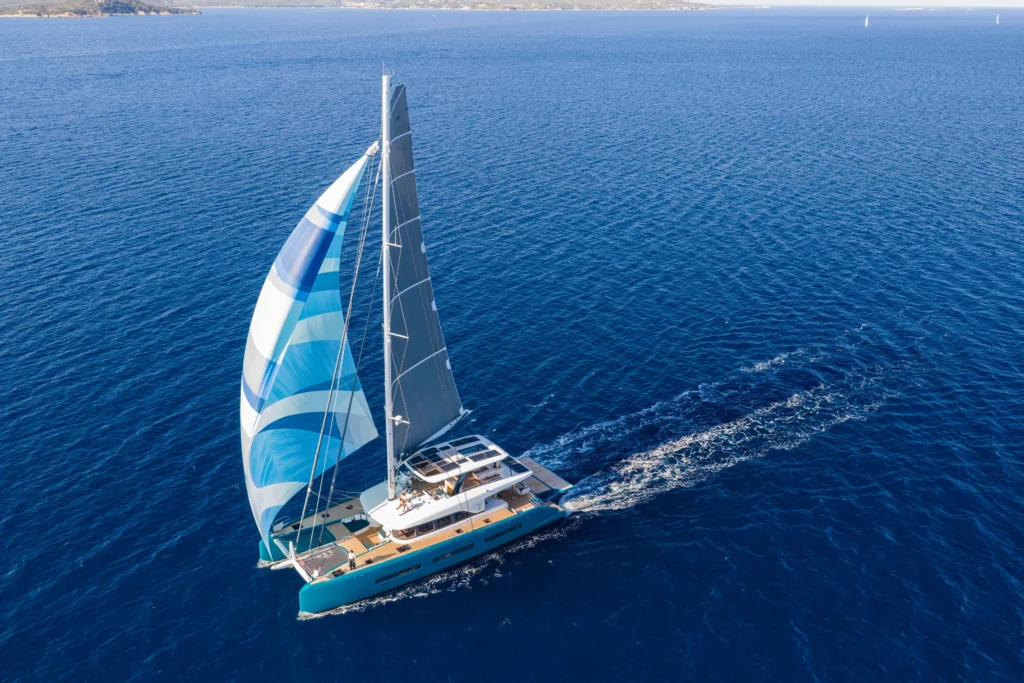
Discovery is the Lagoon Eighty2 sailing the Naora Global Expedition. Her space changes the experience of an ocean passage, but it does not remove the ocean from it. A catamaran generally sails with less sustained heel than a monohull, yet it still pitches, rolls and accelerates as waves pass beneath the hulls. Depending on the sea, water can strike the structure between them with a force that is heard and felt inside.
It matters to say this plainly. A level floor is not a motionless floor, and a spacious cabin is still a cabin on a vessel under way. Secure objects, reliable handholds and sensible movement remain part of daily life. Familiarity should make those habits easier, not make them disappear.
For us, offshore preparation has to reach beyond checking that equipment switches on. Chafe protection needs to be in the right place before a line spends days working under load. A replacement part is useful only if it fits and someone knows how to install it. A pump needs power as well as a functioning motor, and the means of isolating a leak must be accessible rather than buried behind provisions.
Under way, repeated checks establish a baseline. A changed sound, unexpected water or a line beginning to wear becomes meaningful because someone knows what normal looked like earlier. The value of a log is partly this continuity: it lets one watch inherit more than a collection of instruments.
Sven, Naora’s founder and captain, plans every weather window and sails every leg himself. The person making the departure decision also lives with its consequences offshore. That continuity matters more than any confident description of how comfortable a passage ought to be.
The Day Is Built Around Sleep
On land, sleep is often whatever remains after the day has been filled. Offshore, that arrangement fails. Watchkeeping continues through darkness, and tired people become less observant before they necessarily recognise themselves as impaired. Rest belongs in the passage plan alongside fuel, water and weather.
Sven sailing every leg does not mean keeping every watch. Competent relief, clear responsibilities and a handover that communicates what has changed are essential. Course and traffic matter, but so do a developing cloud line, an adjustment to the sails, an equipment concern and the conditions under which the captain should be called. A tired watchkeeper should not have to guess how much uncertainty they are expected to carry alone.
Guests should not be treated as an assumed source of watchkeeping labour. Participation can be absorbing, but responsibility has to match ability, briefing and agreement. Watching the horizon beside someone experienced is different from being left responsible for it. Both the invitation to learn and the freedom to rest need to be genuine.
Below, sleep has its own unfamiliar texture. A change in the water noise travels through the hull. A cupboard latch that was inaudible in harbour becomes very clear in the dark. The body wakes, listens and gradually learns which sounds belong to ordinary sailing. We can make that adjustment kinder by keeping unnecessary noise down and protecting sleeping time from casual interruptions.
Seasickness can complicate the beginning, and it is not a failure of character or enthusiasm. It should be discussed before departure, including suitable prevention with a clinician where needed. Once at sea, reporting difficulty early is far more useful than quietly trying to prove that nothing is wrong.
A Small Household Under Way
The galley makes passage planning tangible. Food has to be bought for the likely duration with a sensible reserve, then stored so that the reserve remains usable. Filling every space is not the same as provisioning well. Refrigeration capacity, ripening, access and the ability to cook safely in motion all change what belongs aboard.
We favour local sourcing where practical, but the market still has to be read through the needs of the passage. Fruit bought ripe gives pleasure early and waste later if there is too much of it. Delicate leaves and robust vegetables do not belong on the same timetable. The order in which food will be eaten begins at the point of purchase.
There is a particular usefulness to a meal that can be served in a bowl and eaten with one hand free. A stew or a pot of lentils can offer warmth and substance without demanding elaborate assembly while the boat moves. The pleasure lies partly in the smell reaching someone coming off watch, and partly in the fact that another person has thought ahead for them.
Batch cooking still requires care. A large pot left to cool slowly is not made safe by good intentions. Smaller portions cool more readily, refrigeration must be dependable, and reheating should be thorough. In warm conditions, food handling deserves the same disciplined attention as a line under load.
Water production and independent energy systems extend the yacht’s reach, but they remain systems with power demands, filters and maintenance needs. Waste storage also has to last the passage. Self-reliance means understanding those dependencies, rather than imagining they have vanished.
The same realism applies to work and privacy. Connectivity cannot be promised without interruption. Important responsibilities ashore need cover before departure. Within the boat, privacy is also a matter of manners: allowing someone to read without drawing them into conversation, keeping a call from occupying shared space, recognising that a quiet afternoon is not an empty one requiring entertainment.
What An Atlantic Crossing Changes
Much of a passage consists of repetition. The horizon can remain almost unchanged while the log records real progress. For someone accustomed to visible results, that can be disconcerting. Distance is being made, but there is little to display at the end of the day except the boat still in good order and the people aboard fed and rested.
Attention finds smaller measures. A cloud begins to matter because of what may be beneath it. The direction of the swell becomes something felt before it is discussed. A flying fish is briefly visible above the surface, driven out of the water by its tail and gliding on enlarged fins, an animal escaping danger rather than appearing for our benefit.
When bioluminescent plankton are present, disturbance can produce light along the hulls and in the wake. It is not a nightly promise. Neither are clear stars or a dramatic sunrise. The encounter has value partly because no one has arranged it, and because much of the day around it may have been ordinary.
This is the reference a crossing can leave behind. Weather ceases to be only information on a screen. Rest becomes part of competence. Another person’s small act of care acquires weight because everyone lives with the same conditions.
Naora’s worldwide route runs from 2027 to 2031, and members choose when, where and for how long they join it. An ocean passage is one choice within that freedom, not a test that makes other choices less meaningful. Once offshore, however, stepping out is no longer a casual option. That commitment should be understood before it becomes part of the experience. The yacht continues around the world; each person’s time aboard needs to fit both their life and the realities of the leg.
The Arrival In Barbados
Landfall begins before anyone can make out the coast. The arrival plan has to be revisited with current weather, daylight, traffic and local requirements in mind. The final approach comes after accumulated fatigue, just when anticipation makes it tempting to relax. This is a time to simplify work and communicate clearly, not to assume the difficult part has finished.
Barbados is a destination. Carlisle Bay is a possible anchoring context that still needs to be assessed on the day, not an automatic full stop at the end of a line across the Atlantic. Shelter depends on wind and swell direction. Room to swing, the actual seabed, other vessels and permitted anchoring areas all matter. Clearance requirements determine the arrival procedure before ordinary life ashore can begin.
Where circumstances allow, a daylight approach reduces uncertainty. It gives more information about the water, the shore and the movement of other boats. An arrival estimate that slips into darkness is a reason to reconsider the approach plan, not a reason to hurry towards it.
Then the scale of attention changes again. There are fixed edges to look at, buildings that remain in place while the yacht moves, sounds with a source on land. Barbados has its own working day, its own concerns and its own people. It does not become more authentic because we have reached it under sail, and no one ashore owes us recognition for the distance.
What differs from arriving by air is carried quietly in the body. The shore has been approached through days rather than passed into through a terminal. A glass stands on a table ashore without a hand around it. After the Atlantic, that is something to notice.