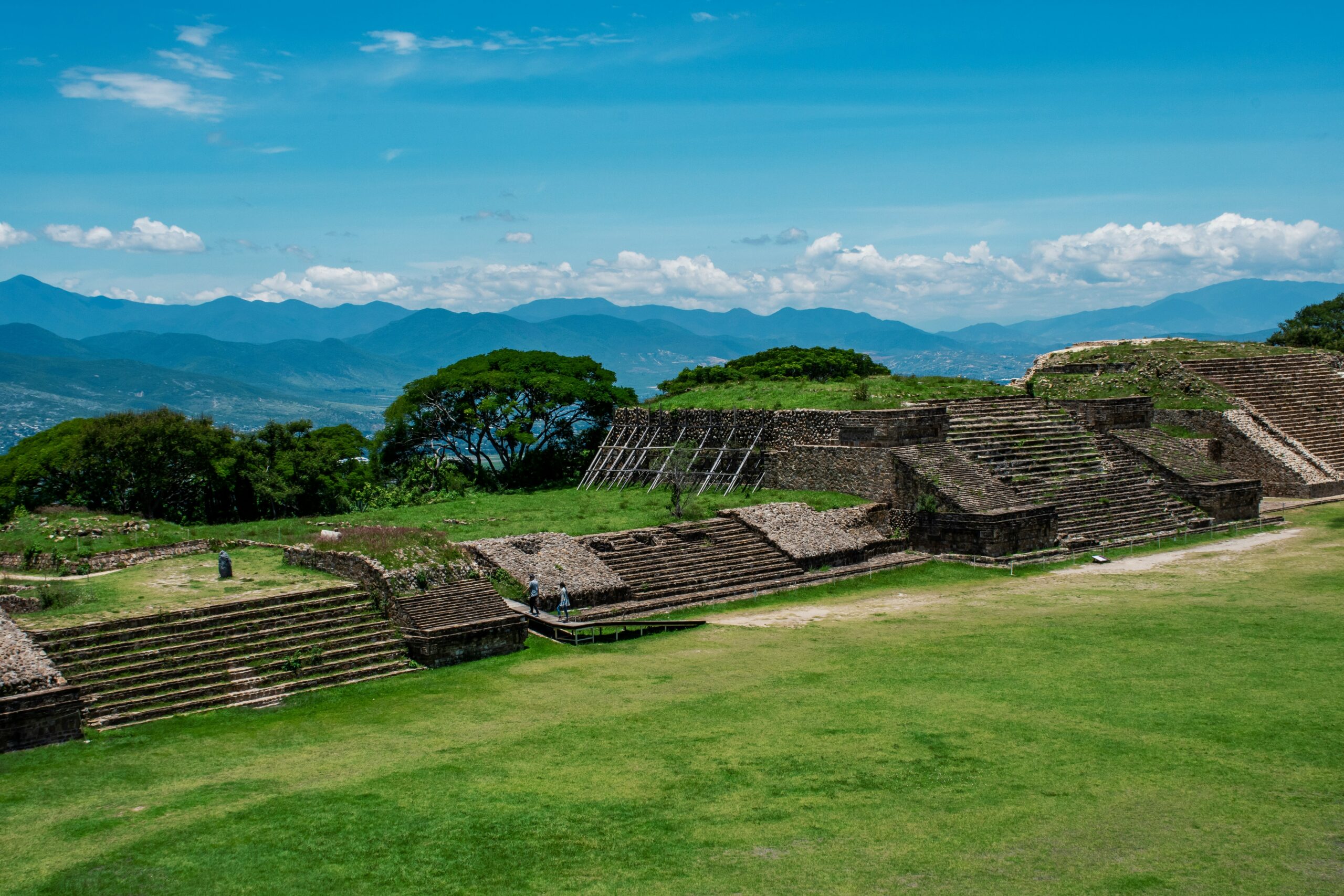
The open ground at Monte Albán looks almost effortless in a photograph. Under a clear sky, with light reflected from the pale surfaces and the climb still present in your calves, its scale becomes physical. The spaces between buildings matter as much as the buildings themselves. A visit to Monte Albán from Huatulco needs to make room for that scale, rather than treating the mountain as a brief interruption to a day on the road.
Coming inland from the Pacific changes how we approach it. At sea, a high ridge is first a feature of the coast, something that shapes wind or helps establish position. Here, the mountain was deliberately remade into a capital. To understand the decision, we need time to look beyond the ceremonial buildings, towards the slopes where people lived and the valleys that sustained them.
Planning Monte Albán From Huatulco
The first useful correction is practical. Huatulco is a coastal starting point for Oaxaca, but the mountain is not a comfortable short drive away. The Sierra Madre del Sur stands between the harbour and the central valleys, and a journey through it deserves a proper place in the plan.
For planning purposes, we would allow roughly four to six hours from Huatulco to Oaxaca city in reasonable conditions, with the transfer up to Monte Albán considered separately. That is a provisional allowance, not a promised journey time. The road chosen, traffic, rain, works and interruptions can all alter it. A faster connection across the mountains does not make every departure point on the coast equally close to the city.
A long day return may be possible, but possibility is a poor measure of whether a visit will be worthwhile. It can leave the archaeological site occupying the hottest, most hurried part of the day, with Oaxaca reduced to a meal eaten while watching the time. The return then becomes a substantial drive undertaken when everyone is tired.
We would generally favour two nights ashore if the coastal sailing plan permits it. That gives the arrival its own afternoon, the mountain a morning without a departure pressing against it, and the city an evening that belongs to the people walking through it. The cost is time away from the yacht. The gain is enough attention to distinguish what is being seen.
Before committing, we would reconfirm the usable road, site opening arrangements and access restrictions, and agree the driving plan with someone familiar with the route. Those details belong at the beginning, not in a conversation beside the car after breakfast.
Leaving Discovery In Good Order
For Naora, an inland visit begins with the boat. Discovery, the Lagoon Eighty2 sailing the Naora Global Expedition, cannot be treated as a hotel room whose door we simply close. A marina name on a map does not establish that a particular berth is suitable for a large sailing catamaran.
We need to know the depth at the lowest expected water level, the width and approach to the berth, the room available to manoeuvre, and how the boat will lie if the wind changes. Harbour access and local clearance requirements also need to be settled. Until those questions have satisfactory answers, an overnight stay inland remains an intention.
The watch aboard needs clear responsibilities for mooring checks, onboard systems and changing weather, together with a reliable way to reach the party ashore. Leaving people on board is only useful if they have the information and support to act. A quiet waterfront does not remove that responsibility.
Sven, Naora’s founder and captain, plans every weather window and sails every leg himself. Time inland therefore has to sit within the coastal passage plan rather than consume its margin. Strong northerly wind events can affect the wider southern Mexican Pacific coast during the cooler part of the year, even when a particular harbour feels benign. We consider the conditions along the next passage, not only the water beside the pontoon.
This is the discipline that allows a visit to feel unhurried. Once the boat and the return plan are in good order, there is no reason for every conversation on the mountain to end with someone checking a phone.
The Mountain As A Capital
Monte Albán was established around 500 BCE. Its position above the central valleys gave it an imposing setting, but the summit was not a ready-made building plot. Successive generations cut, filled, levelled and terraced the hill to create the monumental centre visible today. The scale belongs to accumulated labour, not a single act of construction.
The main plaza measures roughly 300 metres by 200 metres. Those dimensions are worth holding in mind because a photograph compresses the open ground. Walking it reveals how platforms, stairs and temple buildings organise movement and sightlines, allowing some people to stand above others and making an approach to an important building conspicuous.
That is an interpretation of the architecture, not a claim that we know every ceremony performed there. What can be seen plainly is that the centre was designed to gather people and direct their attention. The mountain made authority visible across the landscape, while the buildings gave it an ordered setting close at hand.
The ceremonial core was only part of the city. Residential terraces extended across the slopes, and the capital depended on cultivation and communities beyond the summit. Looking down towards the valley is therefore part of looking at Monte Albán, not a distraction from it. The buildings could not feed themselves. Water, food and materials had to be obtained, carried and managed.
Its dominance as a political centre had diminished by around AD 800, long before the Spanish arrival. Yet political decline and complete abandonment are different things. Later funerary use, including Mixtec use of earlier tombs, shows that the hill retained significance after its great period as a capital. Calling it an empty city leaves out that continued relationship.
Reading The Carved Stones
The carved figures known as the danzantes require a slower look than their name suggests. The Spanish word means dancers, a description prompted by the figures’ unusual postures. It should not be mistaken for an explanation of what they represent.
These early carvings are generally interpreted as captives, often shown naked, with some bearing signs of mutilation or death. Their bent limbs and altered bodies belong to a political language very different from the cheerful movement implied by the name. Details remain debated, and it is sensible to resist a guide who supplies a complete biography for every figure. Even so, the broad change in understanding is important: these stones are usually read as statements about defeat and power, not illustrations of a festival.
Building J introduces another useful distinction between what survives and what we infer. Its angular plan and oblique alignment set it apart from the surrounding arrangement. It is often called an observatory, and astronomical explanations have been proposed for its orientation. That label does not establish exactly which observations were made there or how the building was used. Carved place signs associated with it have also been interpreted as records of conquest.
We would rather leave with a careful explanation of that uncertainty than a confident story unsupported by the stones. A good local guide can make the difference visible, separating the shape of a building, the interpretation of an inscription and the questions that remain open.
The ball court deserves the same restraint. The ballgame had ceremonial and political meanings as well as a physical form, but the presence of a court does not establish a universal rule that losing players were sacrificed. A familiar dramatic story can obscure more than it explains.
It is also worth asking which carvings are original, which have been moved and which are replicas, and where restoration begins. Bare masonry is not necessarily the surface people originally saw. Plaster and colour formed part of the architecture. Once that is understood, the present appearance becomes easier to read honestly: an archaeological site, preserved and interpreted, rather than a city left unchanged at the instant its inhabitants departed.
Monte Albán From Huatulco Through The Seasons
The site stands at approximately 1,940 metres above sea level. For someone arriving from the yacht, the change is noticeable even without a strenuous walk. The air can feel cooler than on the coast while the exposed sun remains strong, and the combination of height, steps and heat affects people differently. We would begin gently rather than decide everyone’s pace from the temperature beside the car.
On a dry morning, the physical details are simple and insistent: grit moving under a shoe, the warmth held by stone, the relief when a little wind reaches the back of a damp shirt. There is less shade across the ceremonial centre than the surrounding mountain landscape might suggest. A hat, drinking water and shoes that hold well on uneven ground are more useful than an ambitious circuit of every structure.
The wetter period, broadly May through October, changes both the visit and the drive. Rain can make stone slippery and mountain roads slower; thunderstorms can make an exposed summit an unsuitable place to linger. We would look for a suitable morning window, but not assume that morning guarantees settled weather. If storms threaten, shortening or postponing the visit is better than waiting against exposed masonry for conditions to improve.
With children or several generations together, the central plaza can provide a satisfying visit without everyone climbing every accessible stair. Rest is part of seeing the place properly. Someone sitting quietly at the edge of the open ground may notice more about its arrangement than someone collecting viewpoints.
We follow the marked access and keep off closed structures. Archaeological stone is not a convenient handhold simply because it looks substantial. Before setting off, we would establish where proper shelter and a straightforward exit are available, then allow the weather and the people present to determine how much ground we cover.
The Living Culture Below The Mountain
Oaxaca should not be treated as the place to eat after the important part is finished. The mistake is particularly clear after Monte Albán, where it is easy to speak about Zapotec people only in the past tense. Zapotec languages are spoken today, and living communities have distinct histories, customs and relationships with the land. The archaeological capital is part of that history, not its endpoint.
Nor does every craft or dish in Oaxaca belong to a single cultural tradition. The region contains many communities and ways of making things. When something interests us, the useful conversation concerns the particular object: who made it, where, from which material, and for what purpose. We should not expect a shopkeeper or a person at work to stand in for an entire culture. Asking before taking a photograph is a small but meaningful place to begin.
Food offers a direct way into this living knowledge. A tortilla begins well before it reaches the griddle. In nixtamalisation, maize is cooked and rested in alkaline water made with food-grade lime, then washed and ground. The process loosens the outer skins, changes how the grain becomes dough and improves the availability of some nutrients. What reaches the table carries practical knowledge about turning a crop into a sustaining daily food.
A warm tortilla is pliable, faintly toasted at the surface and fragrant when torn. It asks for attention before anything is put inside it. After the exposed light and walking of the mountain, sitting at a shaded table with something freshly cooked can make the body settle before conversation resumes.
Mole rewards a similar refusal to simplify. Depending on the preparation, dried chillies, seeds, nuts, spices and other ingredients may be toasted, ground and cooked into a sauce whose balance depends on the handling of each component. Chocolate is neither present in every mole nor a sufficient explanation of one. Asking which mole is being served tells us more than assuming there is a single recipe that represents Oaxaca.
We do not need to turn lunch into a lesson. An unhurried meal, a question answered properly and the willingness to taste before describing are enough. Local sourcing begins with that interest in what a place actually produces, rather than what we expected it to provide.
Returning To The Coast
Naora is a private sailing expedition around the world, and its continuity allows people to choose when they join, where along the route they step aboard and how long they remain. The yacht keeps sailing as lives meet it and move away again. That freedom matters ashore too, but it does not make geography or weather negotiable.
For a visit from Huatulco, the useful choice is how much time to give the coast and its interior. Someone staying briefly may prefer not to spend a substantial part of that time crossing the mountains. Someone with longer aboard may value leaving the sea long enough to understand the country beyond the harbour. Neither choice needs defending. What matters is making it with an honest picture of the distances and the effort involved.
We would return to Discovery with enough margin to rest and prepare for the next passage, rather than make departure depend on the punctual arrival of a car from the mountains. Monte Albán deserves that absence of pressure. So does the sea.
There is no need to resolve the mountain and the coast into a single story. Above Oaxaca, the platforms hold their open ground. Below them, the city is occupied with the ordinary work of the present.