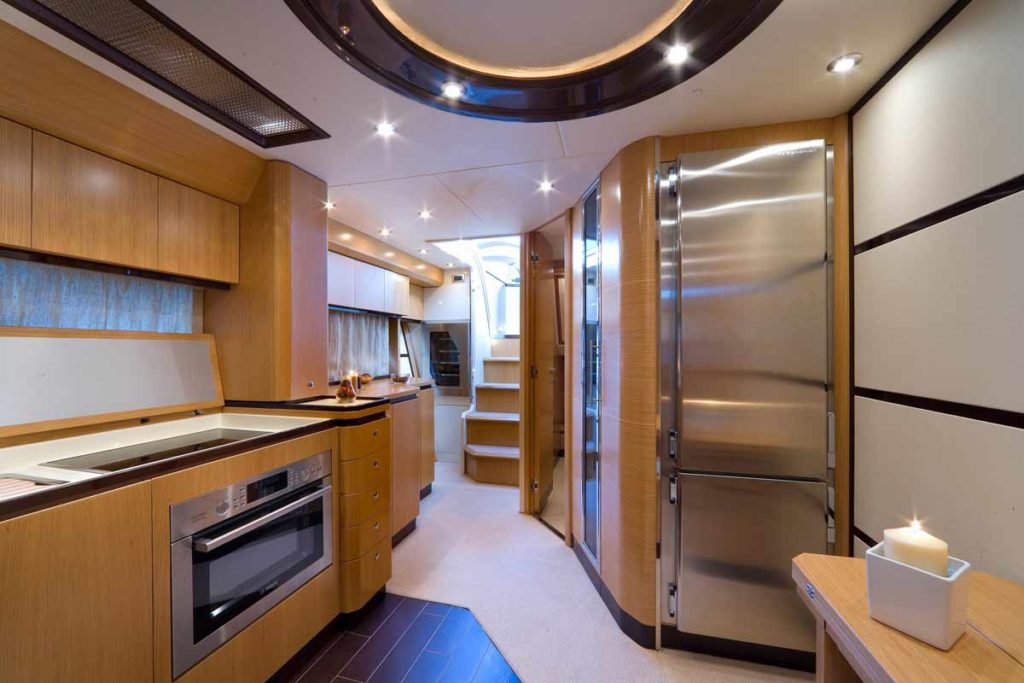
Every refrigerator works on the same principle: a fluid called the refrigerant circulates through a closed loop, absorbing heat in one place and releasing it in another, moving heat from the inside of the fridge to the outside. The compressor compresses the refrigerant gas, raising its temperature and pressure. The hot, high-pressure gas passes through the condenser, where it releases its heat to whatever is doing the cooling and condenses back to a liquid.
The liquid passes through an expansion valve that reduces its pressure sharply, which drops its temperature dramatically. The cold, low-pressure liquid passes through the evaporator inside the fridge, absorbing heat from the food stored there and returning to the compressor as warm gas to repeat the cycle. This is the refrigeration cycle and it has been running in every fridge in the world in essentially this form since the nineteenth century.
The difference between the domestic refrigerator and the marine refrigerator on the Eighty2 is what does the cooling at the condenser. At home, the condenser at the back of the fridge or in the outdoor unit of the air conditioner releases the heat into the ambient air. In a twenty-degree European kitchen, this works reasonably well — the ambient air is cool enough to receive the heat efficiently. In the Coral Triangle anchorage where the ambient air is thirty-five degrees and the Eighty2 is sitting in ocean water at twenty-six degrees, the ambient air is a poor choice for condenser cooling.
The seawater is significantly cooler and eight hundred times denser, making it far more effective at removing the heat from the refrigerant. The Eighty2’s refrigeration uses seawater pumped from the hull intake as the condenser cooling medium. The result is a refrigeration system that is thirty to fifty percent more efficient in tropical conditions than the equivalent air-cooled system would be.
The Chest Freezer and the Provisioning Strategy
The freezer on the Eighty2 is a top-opening chest design. This matters more than it sounds. Cold air is denser than warm air — it falls rather than rises. When you open a front-opening upright freezer, the cold air that was stored inside falls out of the opening immediately, the warm room air rushes in to replace it, and the compressor has to run to re-chill the air that just escaped.
When you open the top of a chest freezer, the cold air stays where it is because there is no opening for it to fall through. The warmth lost in each opening of the chest freezer is the warmth that penetrates through the open top from above — a fraction of the warmth lost in the equivalent upright freezer opening. Over a day in the tropics with twelve people accessing the freezer multiple times, this design difference is a meaningful contribution to the energy budget and the ice temperature maintenance.
The freezer is the specific piece of equipment that makes the provisioning strategy of the long passage possible. The Atlantic crossing from the Canaries to the Caribbean is twenty-two days with no provisioning opportunity in between. The fish from the trolling line supplements the stored provisions but cannot replace them. The frozen meat and fish from the Las Palmas provisioning morning goes into the freezer before departure and comes out at the rate the meal plan requires across the three weeks of the passage.
The freezer is the bridge between the last market and the first Caribbean island, and its capacity and efficiency determine what the Long Table eats in week three of the crossing. This is not a small responsibility for a box of cold air in a hull.