A calm lagoon is not evidence of an easy entrance. In a Polynesian atoll, a strip of broken water can lie between the open ocean and water smooth enough to hold a reflection. When I consider expedition sailing vs expedition cruise, I begin with that contrast: the destination is one thing; the decisions needed to reach it, and the life possible once inside, are another.
A good expedition cruise deserves a fair comparison. It can bring experienced naturalists, a substantial expedition team and well-organised landings to places that require serious preparation. Some ships offer diving. Some operate with remarkably small groups ashore. Neither the word expedition nor a passenger count tells you enough about the experience.
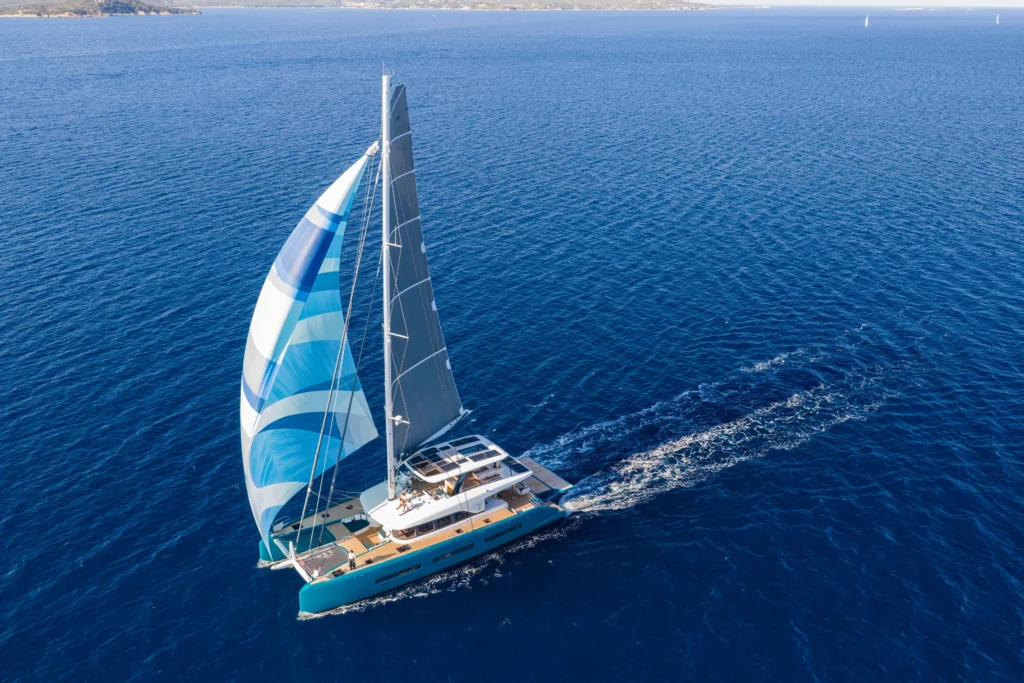
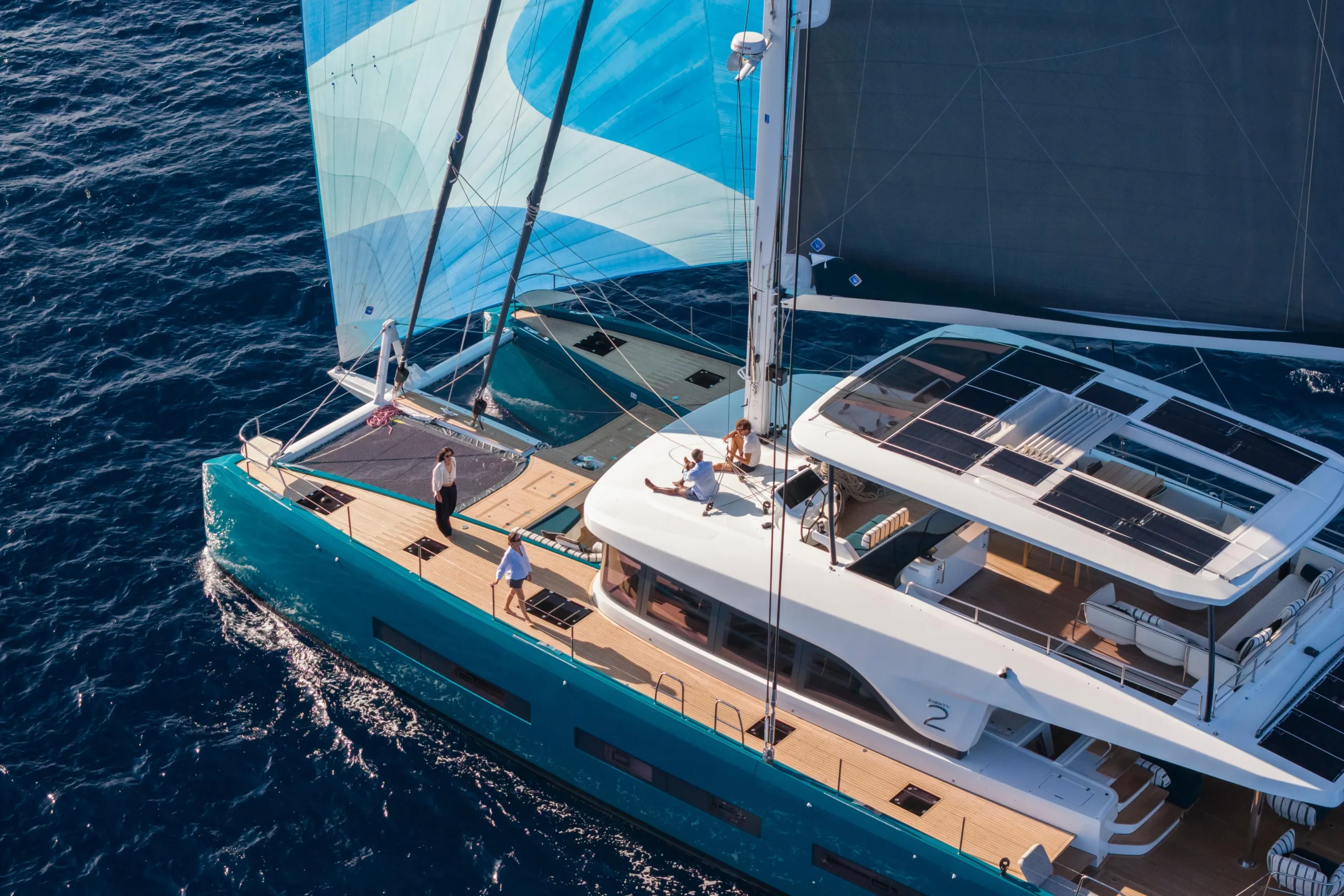
Naora is built around a different continuity. The Naora Global Expedition is planned across roughly 49,000 Nm over five years, from 2027 to 2031. Discovery, our 2025 Lagoon Eighty2 sailing catamaran, carries that voyage forward while guests join and leave. The distance belongs to the yacht. Each person chooses how much of it becomes their own.
Expedition Sailing Vs Expedition Cruise At The Waterline
The first difference is how much of the passage enters your day. On an expedition ship, the vessel can provide a degree of separation from the work of travelling: a lecture while the bridge manages a difficult approach, a meal while the ship makes progress offshore. That separation is useful. For someone whose principal interest is wildlife interpretation or time ashore, it may be exactly right.
On a sailing yacht, the passage remains closer. A change of heading alters the light through the saloon. A sail adjustment changes the sound above you. Even without taking part in sailing, you gradually notice the connection between the wind, the course and the way the boat moves. There is less distance between a decision and its physical consequence.
This is not a claim that sailing is always quiet, or that the engines never run. Manoeuvring, unsuitable wind and the demands of safe progress all have their place. Following the tradewinds means planning around seasonal patterns, not expecting an uninterrupted breeze of convenient strength.
It also means accepting that the sailing itself occupies time. An ocean passage cannot offer a new landing every morning. There are days when the event is a change in the swell, and the pleasure depends on finding that change worth noticing. That is a genuine distinction, not a shortcoming to conceal.
The Water Between The Yacht And The Shore
A smaller vessel can have more options near a coast, but the useful word is options. A yacht cannot anchor anywhere. Draught is only one part of access, alongside the width of an entrance, chart reliability, overhead clearance, swell, local restrictions and the room required to turn or leave.
In the Polynesian atolls, an entrance can concentrate the exchange of water between lagoon and ocean. Tide predictions help, but high or low water does not automatically mean slack current in a pass. Wind and waves pushing water over the reef can also affect the flow. A quiet-looking lagoon therefore tells the captain very little about the safety of the entrance at that moment.
Light matters too. With low sun ahead, glare can erase the distinction between deeper water and a shallow patch. Better light may make a visual approach more legible, but it does not replace a chart, a depth sounder or a conservative decision. Waiting outside can be the more competent way to arrive.
Once inside, the anchoring calculation continues. Sand may offer suitable holding, but a thin covering over rock may not. The anchor and chain need to remain clear of coral, and the swinging room must still work if the wind changes. Scope is judged against the vertical distance from the bow roller to the seabed, not simply the number displayed on the sounder.
A ship standing farther offshore may still provide excellent access by tender. A yacht lying closer may still face an awkward landing through surf. The relevant comparison is the whole movement from cabin to shore and back, rather than which vessel appears nearest on a map.
Who Decides What Happens Next
An expedition cruise needs to coordinate a substantial operation. Tender crews, landing permissions, meal service and the movement of passengers all impose structure. Good operators work skilfully within it, and weather can change their plans just as decisively as ours.
Aboard one yacht, fewer people and fewer simultaneous activities can make a change simpler. A swim can wait until the wind eases. Time ashore can move around a passage rather than around a programme for several landing groups. But flexibility should not be mistaken for control over the sea.
Sven is Naora’s founder and captain. He plans every weather window and sails every leg himself. The responsibility behind that continuity is practical: the person considering tomorrow’s departure also knows how the yacht has been behaving, what maintenance needs attention and how the people aboard are coping with the conditions.
There are limits he cannot negotiate away. An anchorage comfortable in one wind direction may become exposed after a shift. Leaving before that shift can matter more than another afternoon ashore. A downwind passage can still bring cross swell and squalls, and a shorter route is not necessarily the more comfortable one.
This is why we distinguish preferences from commitments. A preferred bay belongs in a plan with alternatives. An onward flight needs margin appropriate to the passage before it. The freedom lies in being able to make a sensible change early, while there are still several good choices, rather than in promising that nothing will change.
The People You Share The Passage With
On a ship, a larger social world allows both discovery and distance. You can meet different people over successive days, attend a talk without conversation, or disappear into the wider life aboard. For some travellers, that variety is an important part of the pleasure.
A small yacht makes company more continuous. You will hear the same voices at breakfast and recognise who likes to sit outside after dinner. Familiarity can become easy and warm, but proximity does not make compatibility automatic. Small groups need consideration precisely because there is less anonymity to absorb a mismatch.
Naora’s private circle begins with an understanding of how people want to live at sea. Expectations about sociability, quiet, passage time and involvement matter more than a shared professional label. A person who wants long offshore stretches and someone who wants frequent afternoons ashore may both love sailing while needing different parts of the route.
Privately hiring Discovery for a family or a group of friends changes that arrangement again. The company is already known, and daily decisions can follow that group’s rhythm. Even then, sharing the yacht does not require sharing every hour. Privacy can mean leaving someone to read without asking why, or understanding that a closed cabin door needs no explanation.
Discretion is made of these small permissions. It does not require remoteness, and remoteness does not guarantee it.
What Happens Below The Surface
Diving is a poor subject for broad claims about vessel size. An expedition ship may carry specialist guides and a substantial support operation. A yacht may offer a smaller group and more flexibility around a site. Neither arrangement makes the water safe by itself.
The useful comparison is how a dive is assessed. Current, surface conditions, entry and exit, individual experience, equipment readiness and recovery arrangements all matter. So does the practical plan for an incident, including oxygen provision, communications and access to appropriate medical care. Remoteness makes those questions more important, not less.
Even a one-knot current represents one Nm of movement in an hour. That is a modest-looking number with a serious meaning for someone separated from the boat. A pleasant entry tells you nothing about how easy it will be to return to a ladder after the current strengthens or the wind rises.
The same care belongs to freediving. Breath-hold diving requires trained buddy supervision, including attention through surfacing and recovery. It is not made safe by being close to the yacht or by feeling comfortable in warm, clear water. Hyperventilation is not a shortcut to a better dive.
Discovery is equipped for diving and water activities, but equipment is not a promise to use every site. Sometimes the worthwhile decision is to snorkel in more sheltered water, or remain aboard. Even without descending, the reef rewards patience: fish resuming their feeding after a swimmer stops pursuing them can reveal more than a hurried circuit of the coral.
How A Place Reaches The Table
A larger ship needs consistency across many meals, dietary requirements and service times. Its provisioning reflects that responsibility. A small yacht has a different opportunity: a modest quantity of something good can become dinner rather than a special item available to only part of the ship.
That makes local buying useful in a very concrete way. It allows the galley to respond to what is sound, ripe and available, rather than insist that a distant place supply an unchanged menu. It also requires restraint. We should not empty a small shop of something residents depend on simply because buying locally sounds virtuous.
The less visible decisions happen around storage and passage conditions. Delicate produce needs to be used before more durable ingredients. Cold storage remains a limit however appealing the market looks. Food for an unsettled passage should be possible to prepare and serve safely, with less exposed hot liquid and fewer last-minute operations.
In a galley under way, the smell of onions softening can be entirely domestic while the floor beneath the cook is not. A hand pauses on the worktop as the yacht meets a wave. A bowl needs somewhere secure before anyone reaches for the next ingredient. The meal feels unhurried because someone has thought about movement before beginning.
There are limits to the romance of fresh fish as well. Lime juice changes the texture of fish; it does not reliably make unsafe raw fish safe. Local fishing rules, species selection, careful handling and refrigeration still govern what should reach the table.
The Comfort You Can And Cannot Expect
Discovery has the space and systems of a substantial cruising catamaran. The separation between living areas and cabins can make time together less demanding, and the yacht carries onboard water production and independent energy systems. Those are practical foundations for spending time away from shore infrastructure.
They do not make the yacht independent of maintenance, consumables or good judgement. Water production needs functioning equipment and suitable intake conditions. Climate control draws power. Refrigeration, navigation and communications continue to make demands when no one is thinking about them. Remote comfort depends on understanding those dependencies before they become interruptions.
Nor does a catamaran remove the sea. Its motion differs from that of a monohull or a larger ship, but wave direction, speed and sea state still matter. A heading that reduces uncomfortable impacts can be worth extra distance. Reducing sail early can protect the ease of the people aboard as well as the yacht.
At night under sail, you may hear water gather against a hull, then fall away, followed by a change in the load on a sheet. The darkness removes the visual explanation for motion. A hand finds the edge of the berth before the mind has quite woken. Some people settle readily into that rhythm. Others need time, and their comfort deserves attention rather than a lesson in toughness.
A larger expedition ship may be the better choice for someone seeking less immediate exposure to offshore life or particular medical facilities. The sensible comparison is between the actual vessels and support arrangements. Calling both experiences luxury does not make their capabilities interchangeable.
Expedition Sailing Vs Expedition Cruise Over Time
The final difference is the shape of the commitment. An expedition cruise usually offers a defined departure and return, with the experience contained between them. That clarity has value. It gives a traveller a bounded period in which the operator coordinates a complex sequence of travel.
Naora’s 166 planned legs divide a continuous world route into sections people can join. Guests choose when they come aboard, where along the route they meet Discovery and how long they stay. One week or many, the yacht’s larger voyage continues after they leave.
That freedom works only when the chosen section suits the time available. A Bodrum loop and an Atlantic crossing both belong to the route, but they ask different things of a calendar and a person. A coastal stay can offer more opportunities for landing and adjustment. An ocean crossing requires acceptance of a sustained passage, with fewer ways to change your mind halfway through.
Boarding and departure therefore need to be planned around suitable ports, entry formalities, shore connections and the passage itself. The ability to choose does not mean joining at any point on the chart. It means having a worldwide route from which to choose something that genuinely fits your life, rather than forcing your life into the demands of the wrong leg.
I find that continuity more interesting than a contest over which format reaches the most remote shore. It changes the meaning of departure. Going home does not close the route; it leaves Discovery somewhere along it, with another weather window to consider and another coast ahead. For a while, your own days have belonged to that larger passage. They remain yours when you step ashore.