At a Polynesian reef entrance, an outgoing current meeting ocean swell can raise a ridge of white water across what looks, on the chart, like an uncomplicated gap. The lagoon beyond may be flat. The entrance is not. The comparison of expedition sailing vs expedition cruise becomes more useful here: less about the photograph of the destination, more about how each vessel brings people into a place, and what those people accept along the way.
A good expedition cruise deserves to be considered on its own terms. Specialist guides, landing teams and a ship organised around exploration can make unfamiliar environments intelligible and accessible. Private sailing offers a different relationship with the water between destinations. Neither format owns the right to a meaningful encounter. For us at Naora, the distinction begins with the practical arrangement of life aboard, then reaches into almost everything that follows.
Expedition Sailing Vs Expedition Cruise At Sea
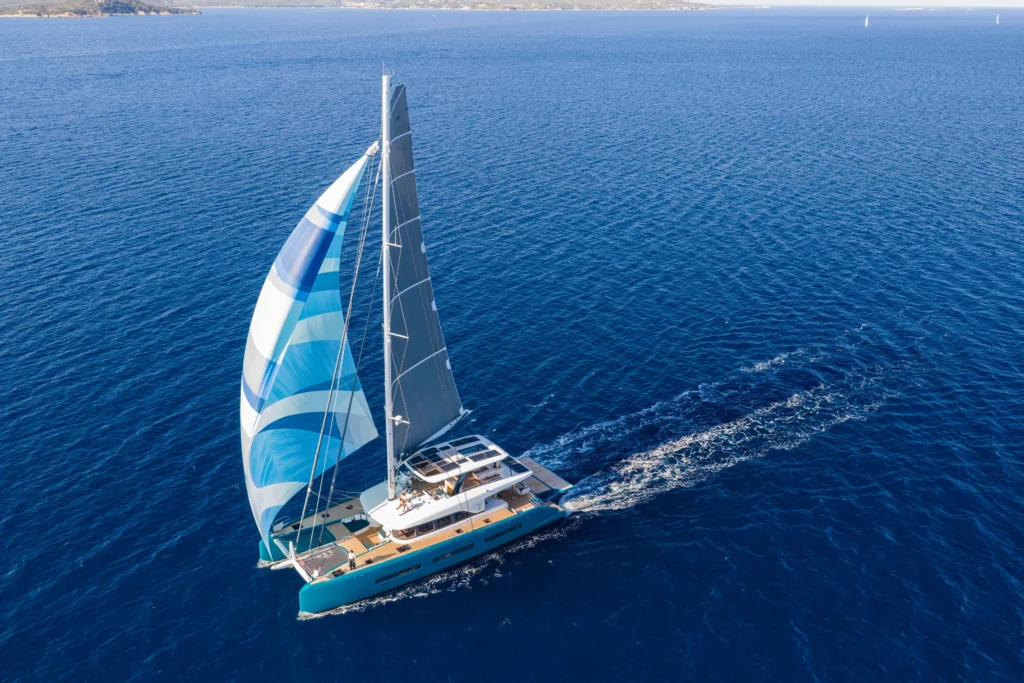
Discovery is a 2025 Lagoon Eighty2 sailing catamaran. That description matters more than a general promise of comfort. Two hulls provide a broad platform and substantial resistance to heel, but they do not remove motion. In a short, steep sea, a catamaran can pitch abruptly, and waves can strike the underside of the structure between the hulls. Heading, speed and wave direction affect how that feels. Comfort is something the captain manages, not something the builder can make independent of weather.
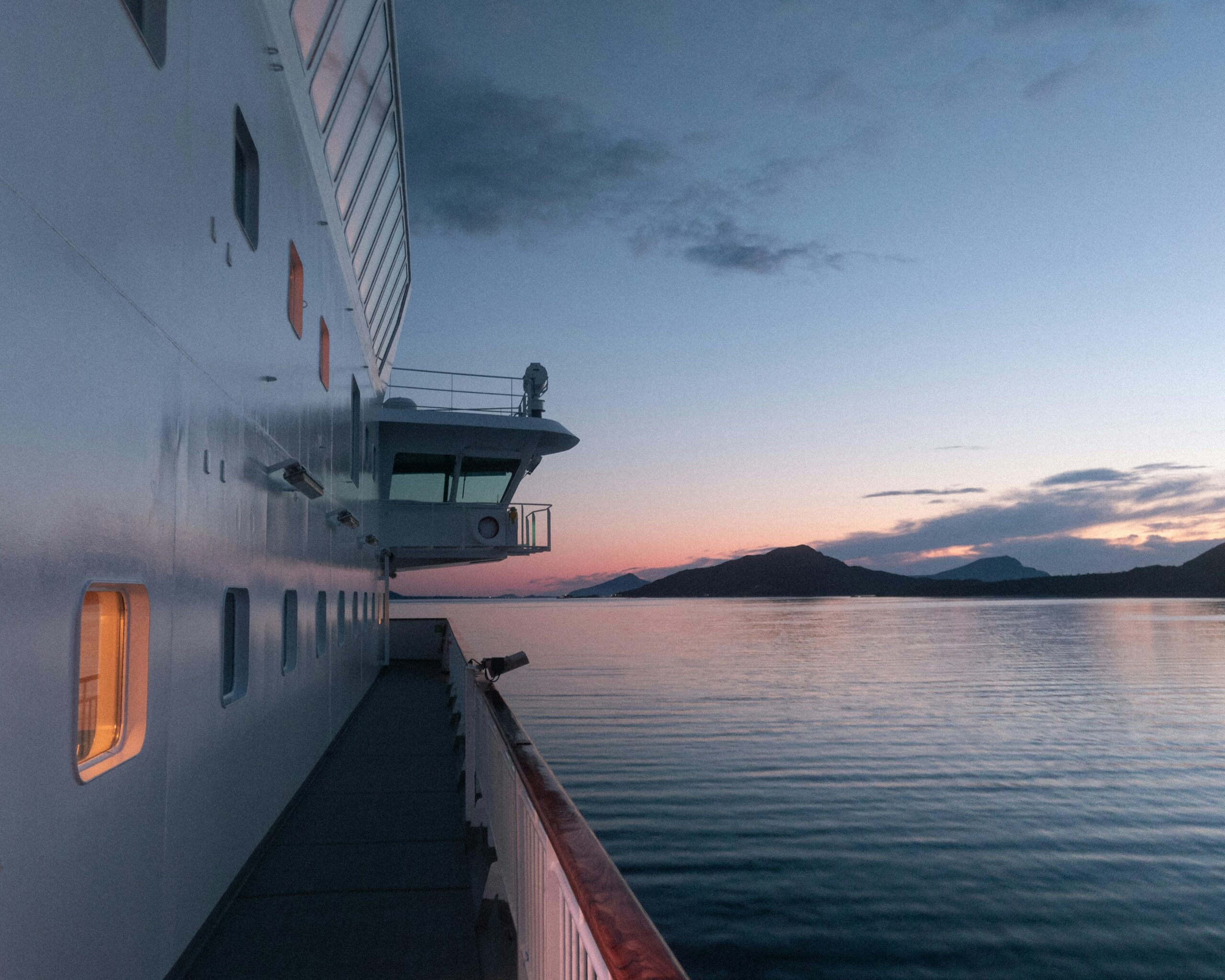
An expedition ship generally has more displacement and a different motion, sometimes moderated by stabilisation systems. Its size can also support more separation between sleeping, dining, lectures and other activities. These are genuine advantages for someone who wants considerable distance between the workings of the vessel and their own day. They are not guarantees against seasickness.
On a yacht, the sea is physically closer. Spray reaches the windows; the angle of the sunlight changes as the boat alters course; a cup needs a secure place before you take your hand away. This proximity is part of the pleasure, provided it is also part of the expectation.
For a family, the useful conversation concerns mobility, confidence around water, susceptibility to motion and the character of the chosen leg. A sheltered coastal voyage and an ocean crossing aboard the same yacht are different propositions. Choosing the right passage is more consequential than choosing a larger cabin.
Access Is A Navigation Decision
The claim that a yacht can anchor anywhere is one we should retire. Smaller draught may create options that a larger vessel does not have, but draught is only one part of access. Entrance width, chart reliability, coral heads, current, turning room, local restrictions and the conditions expected overnight all belong in the decision.
In French Polynesia, an atoll pass makes this particularly clear. Waves breaking over the surrounding reef can feed water into the lagoon, which then has to escape through its openings. The resulting flow need not behave like a simple tide prediction. Water that appears manageable from outside may accelerate through a constriction or stand up sharply against the swell. Waiting for better conditions is sometimes the most useful thing a smaller vessel can do.
Inside, finding enough depth is not the same as finding an anchorage. The anchor needs suitable holding ground, and the chain needs room to lie and move without damaging coral. Sand is a candidate, not proof of good holding. The set must be checked, and the boat needs clearance throughout its possible swing, including a change in wind direction.
Even a depth reading requires interpretation. An instrument may display depth below the transducer, below the keel or below the waterline. That reference must be understood before the number can inform a decision.
A ship may remain outside and use landing craft. Discovery may also need a tender, or may decline the entrance altogether. The honest advantage of a yacht is a different range of options, not a private exemption from geography.
The Weather Shapes The Day
Both expedition ships and sailing yachts change plans for weather. The distinction lies in how deeply weather enters the ordinary movement of the vessel. For a sailing yacht, wind direction influences the course that can be sailed comfortably, the sail area carried, the load on equipment and the likely arrival time. A forecast is therefore part of the day’s structure, not simply an assessment of whether an excursion will run.
In the Cyclades, summer northerlies can make the difference between an agreeable passage and a tiring one, particularly where wind accelerates around headlands and between islands. A quiet breakfast in the lee of land says little about conditions beyond it. The departure decision needs the wider picture: forecast strength, gusts, sea state, the exposure of the next anchorage and an alternative if the first choice becomes unsuitable.
Sven, Naora’s founder and captain, plans every weather window and sails every leg himself. That continuity matters because decisions accumulate. The condition of the boat, the people aboard and the passage just completed all inform the next departure. Reducing sail before an exposed stretch may preserve an easier motion and avoid a more demanding manoeuvre later.
The freedom to stay another morning is real, but it has consequences. Provisions, clearance formalities and onward travel still exist. We cannot honestly describe flexibility as freedom from planning. It works because there is enough planning to recognise what can change without transferring the cost to safety, fatigue or someone else’s departure.
Being Close To The Work
On an expedition ship, much of the work that carries you between landfalls takes place beyond the spaces where you spend your day. That separation can be restful. A yacht makes more of the work visible: a line checked for chafe, a hatch secured before the sea reaches it, a change of course that settles the motion enough for someone to finish lunch.
There is an opportunity to understand these actions without turning the voyage into a sailing course. A reef shortens sail area so the boat carries less load. A lookout watches for things that an electronic display may not show reliably. A forecast is compared with the actual sky, wind and sea because the latest information is sometimes outside the window.
On a night passage, the change is physical. Your feet begin to anticipate the deck. A cooler breath of air reaches the cockpit, and the dark beyond the rail takes longer to resolve than it did at sunset. A bright phone screen can erase some of that developing night vision. Keeping light low has a purpose before it has an atmosphere.
Guests can be curious, learn and participate appropriately, but curiosity does not replace a qualified watchkeeper. Nor does a private passage require everyone to stay awake to prove they belong. Sleep is part of safe seamanship. The crew’s working rhythm must protect it, and a guest who needs rest should be able to take it without apology. Understanding the work often makes the ease aboard more valuable.
Time In The Water Is Conditional
The water programme is a poor place for sweeping comparisons. Some expedition ships carry substantial diving expertise. Others concentrate on shore landings and interpretation. A yacht may allow a more personal rhythm, but neither its size nor its equipment establishes that a particular dive is suitable.
Clear water is especially persuasive in the Polynesian atolls. It lets the eye travel farther than the body should necessarily follow. Visibility and safety are separate questions. At a current speed of 1 knot, water moves 1 Nm in an hour, even if its surface looks almost undisturbed. The practical issue is where that water is going, and how a swimmer or diver will be recovered rather than expected to fight it.
A responsible decision considers entry, exit, current, surface support, weather, the least experienced person and the consequences of a delay. For scuba diving, certification and recent experience matter alongside depth, gas planning and access to appropriate emergency care. Being far from a harbour changes the margin required; it does not make those considerations less relevant.
Freediving asks for a different form of attention. A dedicated, capable buddy must be watching and able to intervene, rather than making a simultaneous dive. Hyperventilation is not a shortcut to a safer breath hold. A beautiful reef does not alter the physiology.
There are days when the right choice is a sheltered snorkel, a different site or no water session. The value of a smaller party is the ability to make that decision around the actual people present. It is not permission to promise every activity every day.
Independence Has A Supply Chain
A private yacht can remain away from shore infrastructure because work has been done before departure. Water production and independent energy systems are useful capabilities aboard Discovery, but self-sufficiency is always conditional. Pumps need power, filters need attention, equipment needs spare parts and someone must notice a developing fault while it is still manageable.
A ship can distribute these responsibilities across larger departments and may carry greater redundancy. A yacht has less room for duplication. This makes maintenance, sensible reserves and decisions about when to seek shore support particularly important. Remote cruising should never be described as having no need of anyone else.
The galley expresses the same principle in a gentler form. Local provisioning creates a relationship with a place, but it also means working with what is actually available. Ripe produce belongs early in the meal plan. More durable ingredients support the later days. A reserve remains a reserve rather than being used simply because it is convenient to reach.
Menus can follow a market closely on a coastal leg; an ocean passage requires a longer view. Neither is inherently the better table. They ask different things of the cook.
There is an environmental limit to the language of independence, too. Sail propulsion does not by itself establish carbon neutrality. Engine use, electricity generation, supplies, waste and travel to the yacht all belong in the account. Naora aims to move with care, source locally and stay as close to carbon neutral as possible. That is a working direction, not a measured achievement we can claim merely because Discovery carries sails.
A Small Circle Changes Privacy
A larger ship offers a kind of social freedom that deserves recognition. You can meet someone over dinner and spend the following day elsewhere. There may be several places to sit, different activities to choose from and enough people for a conversation to remain pleasantly incidental.
A small yacht creates a different intimacy. The same people share passages, meals and the consequences of a changed plan. There is less anonymity within the group, even though there can be considerably more privacy from the outside world. Compatibility therefore matters. So does the ability to let someone read without turning their silence into a problem that needs solving.
Guests join Naora through its private circle, or arrange the private hire of Discovery for their own party. Having the yacht for a family, friends or a discreet company gathering allows daily life to reflect those relationships. A meal can follow a child’s need for an earlier evening. Time ashore can be discussed around different energy levels. A conversation can continue without an activity announcement interrupting it.
These choices still sit inside the captain’s operating limits. A private party cannot vote away an unsafe departure or an unsuitable anchorage.
Discretion is similarly practical. Photographs should not make another person’s presence public without their agreement. Quiet space should remain quiet. Dietary, health and mobility needs are better discussed before sailing than discovered after leaving harbour. None of this requires a performance of secrecy. It requires consideration, including respect for the officials and communities encountered along the route.
Expedition Sailing Vs Expedition Cruise Over Time
Most expedition cruises are sold as a defined sailing with an established beginning and end. The Naora Global Expedition has a different underlying structure: a private sailing expedition around the world, planned across roughly 49,000 Nm and 166 legs. Those figures describe a continuing undertaking, not a distance each guest is expected to complete. They also imply maintenance, provisioning and seasonal decisions extending far beyond any individual stay.
The plan spans five years, from 2027 to 2031, and more than 187 destinations. It follows the tradewinds and parts of the Coconut Milk Run through the Mediterranean, Atlantic, Caribbean, Panama, French Polynesia, Pacific, Asia, Indian Ocean, Africa and the Red Sea. This is a route organised around the movement of a yacht through seasons, rather than a collection of unrelated holidays.
Members choose when they join, where along that route they step aboard and how long they stay. One week or many can belong to the same continuing voyage. The yacht keeps sailing after they leave. That freedom needs to be reconciled with suitable joining points, formalities, passage conditions and the practicalities of getting home. A route map offers possibilities; it does not make every coastline a sensible changeover point.
For someone drawn to the Polynesian atolls, the important choice may be between time among islands and time crossing the ocean that separates them from the next chapter. Both can be deeply worthwhile. They require different appetites for motion, distance and uncertainty.
Beyond the reef, the lagoon has no opinion about the vessel that brought you. There is the light moving across the bottom, and the time you have allowed yourself to notice it.