The rice is ready before the robes are fully visible. In Luang Prabang at dawn, the work of the morning begins inside houses, with grain that has been soaked and steamed while the street is still dark. The monks’ walk is the part a visitor sees. The preparation belongs to a longer rhythm of household and monastery, and it is there, rather than in the photograph of saffron against an old wall, that the morning starts to make sense.
For us, this is the reason to make room for Luang Prabang beside a sailing voyage. The town asks for a different kind of attention from a coast. There is no anchorage to read, no reef passage to enter. There is a daily practice already under way, and the first useful decision is how little we need to interrupt it.
The Practical Distance From The Sea
Luang Prabang is inland, in northern Laos, and Discovery does not sail there. Our Lagoon Eighty2 follows the Naora Global Expedition around the world; a visit to the Mekong belongs alongside the Asian chapter, reached by air through an appropriate regional connection. Those two journeys need to remain distinct. An inland stay has to fit the yacht’s confirmed coastal position, rather than be described as though the temples lie a tender ride beyond an anchorage.
Bangkok and Ho Chi Minh City should not be treated as interchangeable gateways with a fixed flying time. Direct services, connections and schedules need checking for the actual travel dates. So do entry requirements for the passports involved. A short flight can occupy much of a day once the transfer from the yacht, airport formalities and onward travel are included. That is time worth acknowledging before deciding how much of the town a brief stay can reasonably hold.
Naora members choose when they join, where along the worldwide route they step aboard and how long they stay. The yacht continues its voyage, so a return from inland belongs at an agreed rendezvous, which may differ from the place someone left. Sven, Naora’s founder and captain, plans every weather window and sails every leg himself. We would leave room between the return flight and an onward passage rather than make the sailing plan dependent on an aircraft arriving exactly on time. Freedom works better when the practical edges have been thought through.
Luang Prabang At Dawn And The Daily Offering
Tak bat, the morning giving of alms, connects lay households with the monastic community. Monks and novices receive food that supports their daily life; those who give practise generosity and make merit, an important part of Theravada Buddhist life. Calling it a ceremony is understandable, but the word can suggest a performance with a beginning arranged for an audience. This is a recurring religious observance. Its purpose does not depend on anyone coming to watch.
There is no single procession representing the whole town. Monastic communities follow their local rounds, and the timing varies with the season and the route. Roughly 05:30 to 06:30 is a useful planning range, not a promise that everything begins at six. Ask locally the previous evening, then arrive before the giving starts. Searching for a position while monks are already passing turns the visitor’s uncertainty into an obstruction for somebody else.
In the cooler dry months, roughly November to February, the early air can warrant a light layer even when the afternoon will feel warm. In the low light, rooflines emerge before their details; the colour of a robe can become distinct before a face does. Sound carries differently when there is little competing with it. A conversation that seems ordinary over breakfast, or an engine left idling nearby, can occupy an entire stretch of pavement. Quiet here is something visitors help preserve, not something the town owes them.
Watching Luang Prabang At Dawn With Care
Watching respectfully is a complete way to be present. There is no obligation to give rice, and participation without understanding can place more attention on the visitor than on the offering. If giving matters to you, learn the practice beforehand from a knowledgeable local host who is willing to explain it. Arrange suitable, freshly prepared food rather than treating a last-minute purchase as all the preparation required. The rice is someone’s food, not a prop that has finished its purpose when the photograph is taken.
Those giving commonly remove their shoes and sit or kneel low, placing a modest portion into the open bowl as the monk passes. The local arrangement should guide the visitor, including where to sit and how to handle the food. Keep clear of robes and bowls, and avoid physical contact. There is no need to prolong the exchange, request acknowledgement or make a gesture larger than the people around you are making. The offering has a rhythm that is easier to follow after watching than after rehearsing for a camera.
For an observer, distance does most of the work. Choose a position that leaves the monks’ path and the seated givers unobstructed, cover shoulders and knees, and remain still as the line passes. Moving alongside it to keep a camera trained on one person changes observation into pursuit. Flash is intrusive, and a long lens does not remove the need for consent when making a close portrait. Novices may be children; their robes do not make them public property.
The practical test is simple: can the morning continue as it would without you? If people have to walk around your body, wait for your photograph or negotiate their own doorstep, move back. This need not make the experience anxious or solemn. Once the need to secure the best view is set aside, there is considerably more room to notice the care with which an ordinary action is repeated.
The Town Beyond The Procession
Luang Prabang’s religious life belongs to its history as a Lao royal centre, but the town is more than a collection of royal and monastic remains. Its heritage status dates to 1995 and recognises a meeting of Lao religious and domestic architecture with buildings introduced during the French colonial period. That gives the visitor a more useful way to look than simply seeking attractive old facades. The relationship between houses, temple compounds, gardens and streets matters as much as an individual roof.
Walk again after breakfast, when the morning’s religious observance has given way to the business of the day. The river peninsula is compact enough to reward returning along the same streets rather than constantly seeking somewhere new. The Mekong provides the larger orientation, but small thresholds explain the town: the change from public pavement to domestic space, the entrance to a temple compound, the point where a visitor should pause rather than assume access.
Within a temple compound, being allowed to walk through does not mean every building is open. Look for signs, remove shoes where required before entering sacred interiors, and keep clothing appropriate beyond the early morning procession. When sitting before a Buddha image, fold the legs so the feet do not point towards it. If worship or teaching is taking place, let that determine where you stand and whether the camera stays away. These are modest adjustments, but they allow a working religious place to remain one.
Heritage protection cannot turn a living town into a still life. There are livelihoods behind the shopfronts and ordinary domestic needs behind the walls. A useful visit leaves room for both the building and the person using it, without asking either to resemble an older photograph.
The Rice Before And After Dawn
The sticky rice in an alms bowl is also a way into the everyday kitchen. Lao glutinous rice behaves differently from the long-grain rice many visitors cook at home. Despite its English name, it contains no gluten; its starch is rich in amylopectin, which helps produce the cohesive texture. That texture is intentional. Cooking it as though the aim were separate, dry grains misses both the ingredient and the way it is eaten.
For white glutinous rice, soaking for roughly six to eight hours is a useful starting point, often achieved simply by leaving it overnight. The grain and equipment still matter more than a rigid clock. Rinse, soak and drain, then steam above water rather than submerging the rice in it. A woven bamboo steamer allows steam to pass through the grain; turning the rice during cooking helps it cook evenly. A finished grain should yield without a hard, chalky centre. Loosen the cooked rice briefly to release excess steam, then serve it warm.
At a meal, sticky rice is often taken with clean fingers, shaped into a small portion and used to gather other food. A jeow, a pounded relish, might bring the heat of chilli, the sweetness of charred shallot or the softness of roasted aubergine. The rice gives those concentrated flavours somewhere to settle. This is useful knowledge to carry back to Discovery: sourcing locally means learning the preparation that makes an ingredient itself, rather than buying it and immediately forcing it into a familiar recipe.
It also changes the morning offering. Once you understand the soaking, the steam and the need to have the rice ready early, generosity acquires a more physical meaning. Someone has given part of the previous evening and the beginning of this day.
Kuang Si In Changing Water
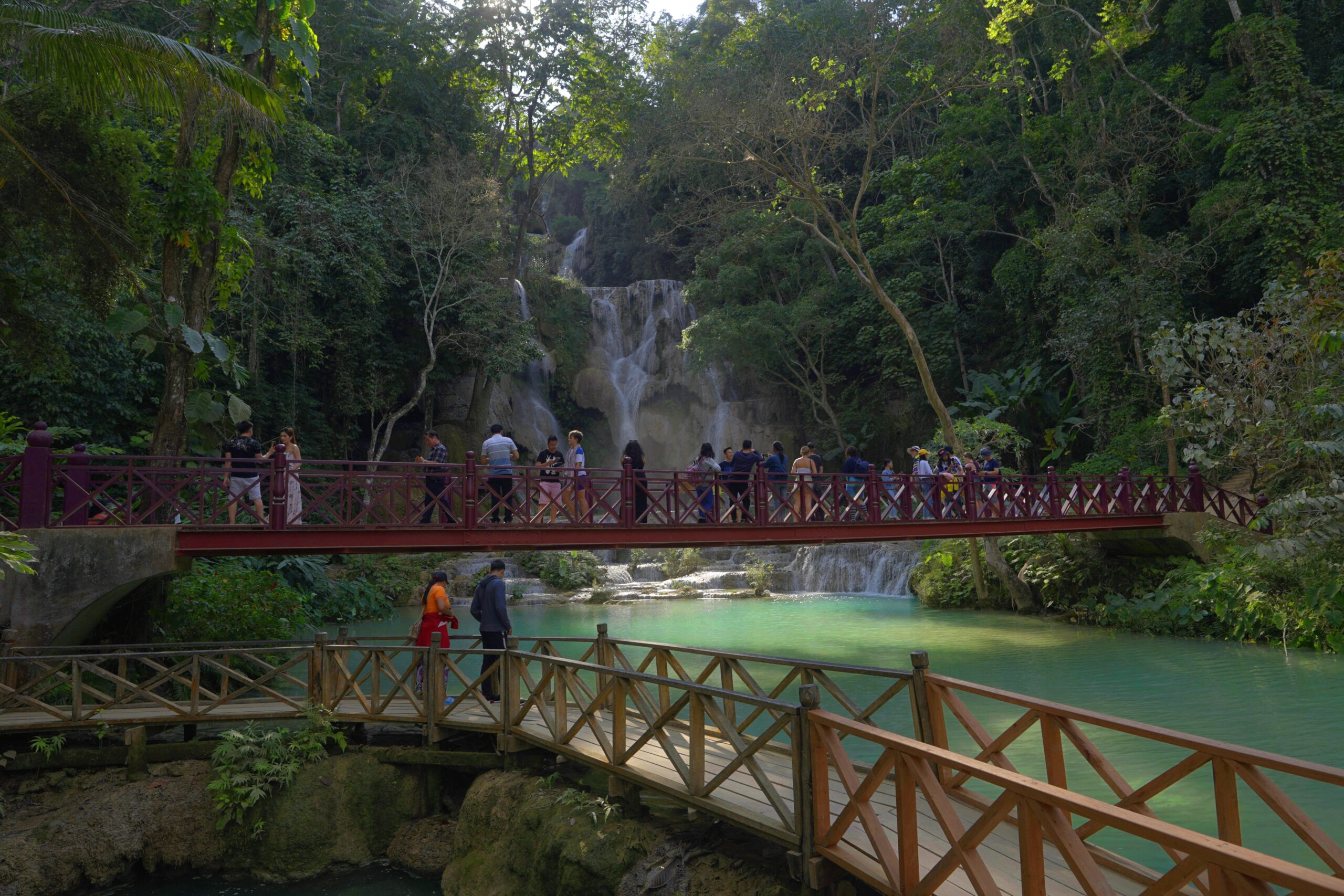
Kuang Si belongs to the same inland stay, but it deserves more than the remaining space between lunch and a flight. As a planning estimate, allow roughly 45 minutes to an hour each way by road from town, depending on traffic and road conditions. Walking, changing and simply remaining beside the water take additional time. An afternoon works better when it is genuinely available, rather than borrowed from an airport transfer that cannot move.
The terraces are part of the reason the water is so memorable. Water passing through limestone carries dissolved calcium carbonate; as conditions change and carbon dioxide escapes, carbonate can be deposited, gradually building the ledges and pools. The pale bed, water depth, light and suspended material all influence the colour. The familiar blue-green appearance is therefore a condition of the water and the day, not a permanent finish applied to the landscape.
During the wetter months, broadly May to October, rainfall can increase the flow and carry sediment into the pools. Brown or clouded water is not the waterfall failing to resemble its photograph. It is the catchment responding to rain. Conversely, clear water is not proof that swimming is safe. Follow current local restrictions, use only permitted swimming areas and leave the carbonate formations alone. A pool may look still while water accelerates towards its outlet; slippery margins also deserve more attention than the view beyond them.
Near falling water, spray can cool the skin before the eye has found the main cascade. Wet soles meet stone differently from dry ones. The sound makes conversation less useful, and the body becomes more attentive to its next step. We recognise that adjustment from the yacht: look first, understand what the water is doing, then decide how to enter it. Staying on the bank can be the right decision without making the afternoon any less complete.
Time For A Second Morning
For a first visit, we would prefer at least two nights, allowing two dawns without requiring arrival and departure to carry the whole experience between them. That is a judgement about pace, not a claim that the town can be understood in a short stay. The first morning may involve finding the right place to stand and correcting an assumption about the hour. On another morning, some of that practical uncertainty has gone. Attention can move away from the visitor’s own arrangements.
With children, the preparation is best done before the early alarm. Explain that the people in the procession are going about their religious life, that quiet observation is enough, and that questions can wait until the line has passed. Choose a position from which leaving is easy if tiredness takes over. A short, considerate encounter teaches more than insisting on a long one that becomes difficult for everyone nearby. The same permission to step away applies to adults.
An inland flight has its own environmental cost, which the sailing passage does not erase. We should be honest about that trade-off and deliberate about why we make it. Luang Prabang offers a reason to stay attentive beyond the coast, but it does not need to become another compressed achievement on the world route. The return to Discovery can remain a practical matter, agreed in advance, leaving the time ashore free of a constant calculation about what can still be fitted in.
If there is a second dawn, it need not produce a second set of photographs. It can be a chance to stand farther back, with less to do. The street has its own reason to wake.