There is shade beneath the raised houses in Komodo Village. Above it are floors and doorways; below it is ground that a Komodo dragon can cross. The separation is visible, but it is not absolute. Looking at those houses, it is tempting to imagine that their entire purpose is to keep the animals out. Coastal architecture, and life alongside a wild predator, are both more complicated than that.
The village on Komodo Island belongs in our understanding of the place as much as the guided wildlife walk does. People were living here before the island became part of a national park, and they remain here after visiting boats leave. Fishing, earning a living, raising children and moving safely between houses continue without an audience.
That continuity is what interests us. A dragon sighting may last a few minutes. Living where dragons occur asks something of a person every day.
Komodo Village Was Here Before The Park
Komodo National Park was established in 1980. The date matters because it separates two histories that visitors can easily confuse: the history of a protected area and the much older history of people inhabiting the islands within it. A park map is an administrative picture of a landscape, not the beginning of its human life.
Komodo Village is an inhabited coastal settlement inside that protected landscape. Its relationship with the sea is practical before it is scenic. A fishing boat is transport, working equipment and something that must be maintained; a waterfront is a place where access has to remain possible, even when a visitor wants to stop for a photograph.
There is also a local story of human and dragon siblings, born to the same mother. Versions differ, but the relationship at its centre is kinship rather than conquest. It offers a way of understanding why the animal can belong in a community’s account of itself without becoming a pet or a harmless neighbour.
We should leave room for both the story and the caution. Neither replaces the other. Residents do not all have to feel the same way about dragons, tourism or conservation, and a short visit will not tell us what everyone thinks. We can listen to the person in front of us without making that person speak for an entire island.
What Living With Dragons Actually Requires
The largest male Komodo dragons can reach about 3 metres in length. That is an upper-end size, not a description of every animal we might encounter, but it explains why distance is a working precaution rather than a matter of photographic taste. A resting dragon remains a powerful wild animal.
Dragons are ectotherms, drawing much of the heat that governs their activity from their surroundings. Sun and shade therefore matter. A cool morning can bring basking; increasing heat can send an animal towards shelter. Feeding opportunities and disturbance also change its behaviour. There is no dependable morning patrol that we can put into an itinerary.
Their forked tongues gather chemical traces that are analysed by a sensory organ in the roof of the mouth. What looks like an idle flick is part of how the animal reads its surroundings. Food scraps and fish waste matter for that reason. Feeding a dragon, or drawing it closer for a picture, creates a problem that remains after the photographer leaves.
Raised floors can help separate domestic space from ground-level activity, but stilt building also belongs to a wider maritime tradition, with benefits including ventilation. It cannot honestly be explained as a single invention against dragons. Young dragons climb trees readily. Height is not a substitute for careful behaviour.
For a visit, the practical consequence is simple: stay with the locally authorised guide, follow the current briefing and let the guide decide when to stop or withdraw. Familiarity among residents does not transfer to guests. A guide’s forked stick is a tool, not a guarantee. Children need close adult supervision, and if the local arrangements cannot support a safe visit for the people aboard, we change the plan.
The Water Between Discovery And The Shore
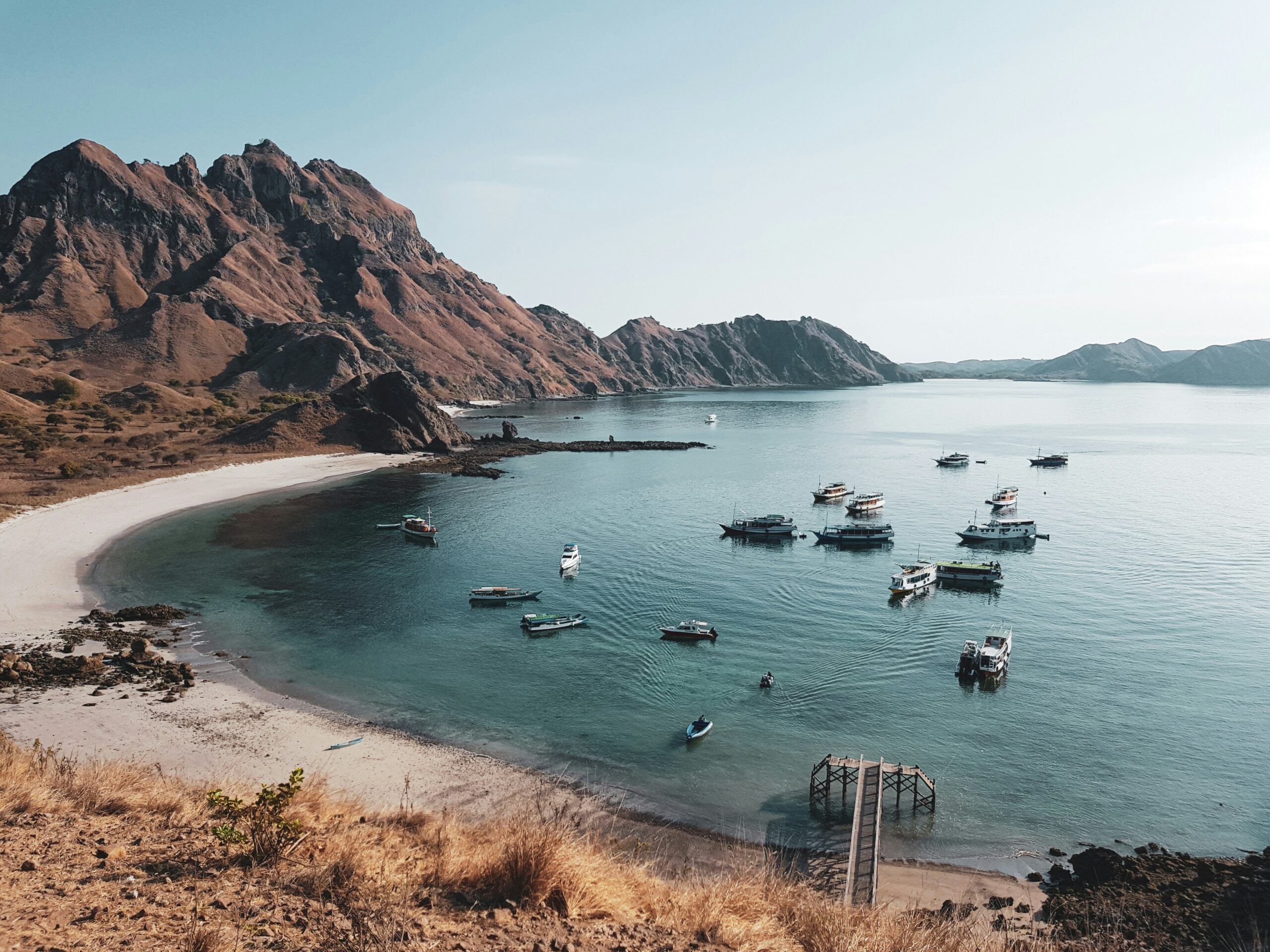
For Discovery, reaching the village begins with the water, not the walking route. An overnight stay is a possibility to assess, never an entitlement attached to arriving under sail. A bay can look quiet from deck while its landing is awkward, its seabed unsuitable or its use restricted.
The southeast monsoon generally brings drier conditions around Komodo from May to October. The wetter northwest monsoon is broadly associated with December to March, with unsettled transitions between the seasons. These are planning tendencies, not a local forecast. An anchorage sheltered from one wind direction can become uncomfortable when the wind changes, and rain can reduce visibility during an approach.
The channels around Komodo also require respect for tidal flow. Strong streams can develop where water is squeezed between islands; the height of the tide alone does not establish the current in a particular channel. Wind and current opposing each other can steepen the water over a short distance. A calm patch beside the yacht tells us little about the return route in a tender.
Sven, Naora’s founder and captain, plans the weather window and sails every leg himself. Here, the decision would include up-to-date charts, local restrictions, the forecast through the intended stay and a workable way back aboard. We would establish where anchoring is permitted, assess depth and swinging room, and confirm suitable holding ground without putting an anchor or chain onto coral. Any mooring would also need permission and suitability for Discovery, not merely an empty buoy.
At the landing, the same discipline becomes smaller in scale. The tender must not obstruct working boats; a change in water level must not leave its return impractical. Communication and an alternative pickup arrangement need to be agreed.
Then comes the physical change: moving air across the tender gives way to heat ashore, and the reflected glare off the water stays in the eyes for a moment. Water, sun protection and secure footwear have to leave the yacht with us. They are much less useful waiting in a cabin.
A Visit To Komodo Village Starts With Permission
A coastal path on a map is not an invitation to walk it independently. A landing used for ranger-led wildlife visits and a village landing are not automatically interchangeable. Before anyone steps ashore, we need to establish the permitted approach to the village, who will accompany us and whether the proposed route is appropriate that day.
Formal permission to enter a protected area does not give us permission to enter a home, photograph a child or follow someone through a working space. These are different kinds of access. Each requires its own consideration, and sometimes a direct question.
Komodo Village is predominantly Muslim. Clothing that covers shoulders and knees is a considerate starting point for going ashore. Swimwear belongs back aboard. Around homes or places of worship, we follow the host’s lead about shoes, seating and where to stand rather than treating a general rule as a substitute for noticing.
A greeting can carry more warmth than a camera. Selamat pagi means good morning in Indonesian; terima kasih means thank you. We do not need to turn either into a performance. The important part is to pause long enough to receive an answer.
If someone declines a photograph or has work to finish, the visit can remain pleasant without one. The best evidence that we understand a welcome is our ability to accept its limits.
The Work Behind A Waterfront
Fishing and visitor-related trade help support the village, but those words conceal different kinds of work. Catching fish requires access to grounds, sound gear, favourable conditions and somewhere for the catch to go. A day with little catch still consumes time, and damaged equipment needs attention before another trip. Selling to visitors requires goods, time, language and the patience to explain something repeatedly to people who may never return.
It would be a mistake to set these livelihoods against each other as though one were authentic and the other were an intrusion. Tourism can be work too. A person selling a souvenir is not less a resident than a person mending fishing gear, and neither owes us a demonstration.
What matters to us is the connection between a purchase and the place. If fish is offered, we need to know what it is, how it was caught and whether buying it is consistent with local rules and responsible provisioning. Within a protected area, permissions can depend on zone, species and method. Seeing a catch brought ashore does not tell us where it was taken or what a visiting boat is allowed to do.
There is a practical obligation after buying, too. Fish for the galley needs prompt chilling, an insulated transfer to the tender and refrigeration aboard. The smell of fresh fish alone cannot establish safe handling, and cooking it the same day does not undo hours spent warm. A purchase made with good intentions still has to survive the journey to the plate.
We should also be prepared to buy nothing. There may be no suitable catch, no spare supply or simply no reason to interrupt what someone is doing. Sourcing locally begins with finding out what can reasonably be offered.
What We Buy And What We Assume
Cloth deserves the same interest in its making as food does in its handling. A textile bought in Komodo Village may have been woven elsewhere. Buying locally and buying something locally made are different acts, both potentially worthwhile, but they should not be confused.
Before describing a pattern as ancestral or a seller as a weaver, we would ask where the cloth came from and who produced it. A motif does not establish provenance by itself. Work made in another Indonesian community can still be beautiful, useful and fairly sold here; its actual history is enough.
Carved dragons offer another point of contact between wildlife and livelihood. The useful conversation concerns the maker, the material and the work, rather than a demand for a story that makes the object seem rarer. We avoid wildlife products and any material whose purchase or export would break conservation rules.
The transaction has a rhythm of its own. Pause over the object. Ask before photographing the person holding it. If there is bargaining, keep it friendly and proportionate. The object, and the work behind it, are the reason for the exchange.
If we are invited to sit in the shade, the pace can change. Eyes adjust after the hard light of the lane; the body notices air moving against damp skin. There need be no remarkable exchange to justify staying a little longer. Someone may simply want to talk, or to rest before returning to work.
Leaving Room For An Ordinary Day
The Indonesian part of the Naora Global Expedition sits within a five-year voyage from 2027 to 2031. Discovery, our Lagoon Eighty2 sailing catamaran, keeps moving around the world while members choose where to join, when to come aboard and how long to stay. That flexibility has a useful consequence here: a visit need not carry the impossible burden of revealing an entire place before a return transfer.
It does not remove weather, park rules or the limits of an anchorage. We cannot promise an overnight stay, a dragon between the houses or an invitation indoors. What we can do is avoid making any of those things the condition for a worthwhile visit. Time gives us more room to listen and more room to decide against going ashore when that is the better judgement.
A guided wildlife walk can teach a great deal. A village visit, when welcomed and properly arranged, adds a different scale of understanding. It brings attention back from the size of the animal to the daily adjustments required of people who share its range, and from the protected landscape to the households living within it.
When we return to the yacht, those households remain. The steps still lead to someone’s doorway. There are meals to make, gear to look after and the next day’s work to consider. Komodo Village does not become more real because we have seen it. It was already somebody’s home.