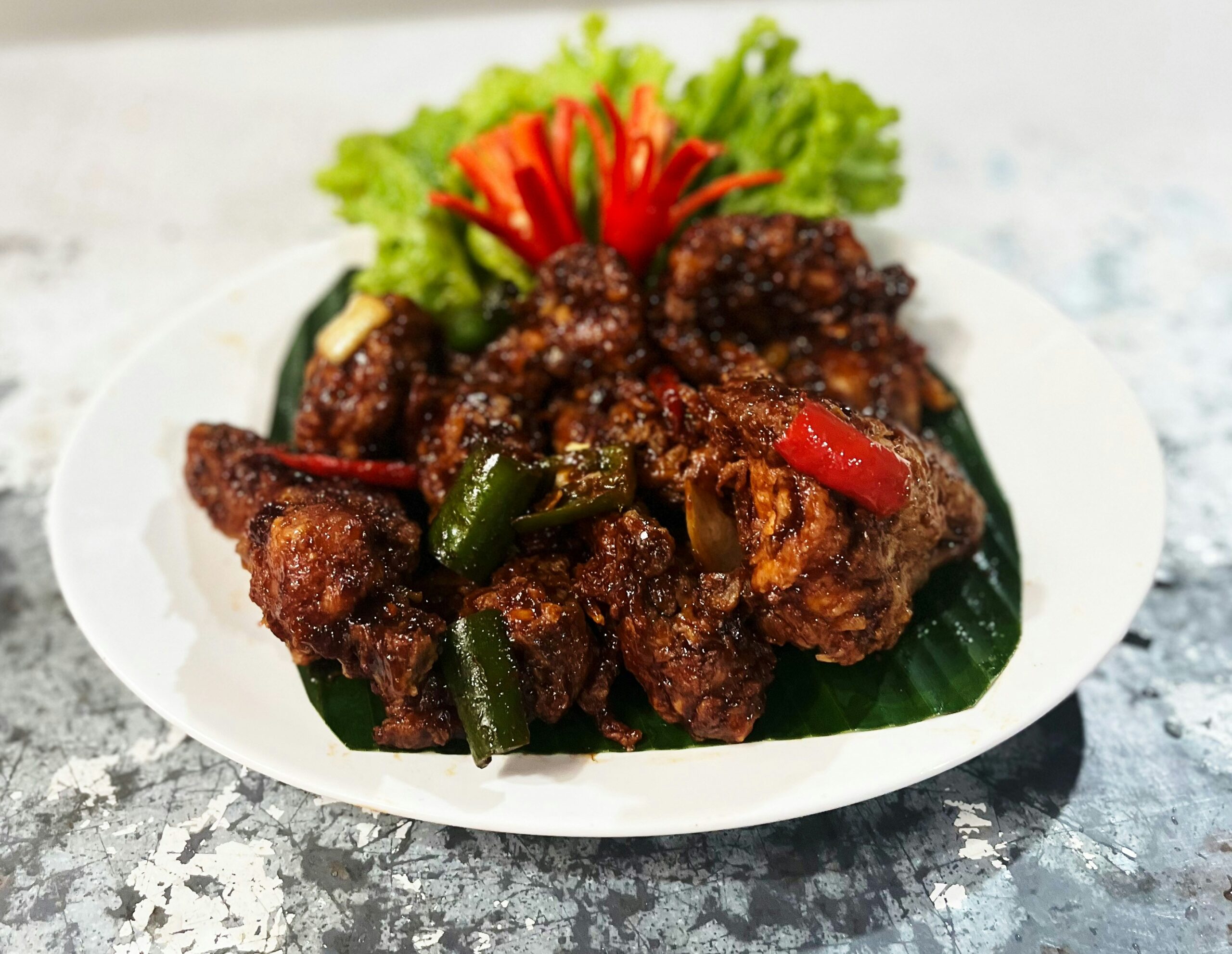
Near the end of cooking, beef rendang begins to sound different. The soft bubbling of coconut milk gives way to a closer, drier hiss. A spatula drawn across the bottom of the pan leaves a path that no longer immediately fills. Steam becomes less abundant, the paste darkens, and the cook has to stay beside it now, because the distance between a deeply browned coating and a burnt one is becoming small.
For Naora’s Indonesian chapter, the plan is to give this meal room across three days: provisioning in Ambon, cooking and resting, then dinner during our passage through the Banda Sea. The three days belong to the organisation of the meal. They are not a requirement of the dish, and they certainly do not mean leaving a pan simmering through successive nights.
That distinction matters aboard. Patience is useful in a galley. An unattended stove is not.
Buying For Beef Rendang In Ambon
The first decision is the cut of beef, rather than the quantity of chilli. Rendang needs meat that can endure prolonged cooking while its connective tissue softens. Shoulder and shin are sensible starting points, although their cooking times differ and the animal itself matters. Very lean, tender steak is not an improvement. Muscle fibres can become dry while sitting in liquid; the presence of sauce does not protect an unsuitable cut from everything heat does to it.
We would look for pieces roughly four to five centimetres across, substantial enough to survive stirring and reduction without disappearing into shreds. Consistency matters more than perfect cubes. A few small scraps among much larger pieces will be ready long before the rest, then break apart while we wait for the tougher meat. The aim is a piece that yields under a spoon but still reaches the plate whole.
Buying in Ambon does not, by itself, establish where an animal was raised or how its meat has been handled. Those are questions to ask. The practical sequence is to have cold storage ready aboard, collect perishables towards the end of provisioning and bring them back without an extended detour. The market is part of understanding a place, but meat should not spend the afternoon accompanying that understanding.
Coconut milk deserves similar attention. It is made from grated mature coconut flesh, pressed with water, rather than from the clear coconut water inside the shell. The fat and suspended solids are essential to what happens later in the pan. Fresh extraction can be excellent, but freshness requires prompt use or chilling. We would choose a reliably stored, sealed coconut milk over a fresh extraction whose handling we could not establish. Sourcing locally means paying attention, not suspending judgement.
A Dish With Its Own Home
Rendang belongs to the Minangkabau cooking traditions of West Sumatra. Preparing it after provisioning in Ambon does not make it an Ambon dish, any more than eating it in the Banda Sea makes its ingredients a record of everything grown on the nearest island. Indonesia is too varied for that kind of shorthand. Part of arriving respectfully is allowing a dish to retain its own geography.
There is also no single household formula that gives a visiting cook permission to dismiss every other version. Shallots, garlic, chilli, ginger and galangal build the paste; lemongrass and citrus leaves bring another register of fragrance. Turmeric appears in many preparations. Candlenuts appear in some, but are not a universal requirement, and must be thoroughly cooked if used. The proportions, supporting leaves and final degree of dryness differ between kitchens.
A stone mortar offers useful control, especially over fibrous galangal and lemongrass. It lets the cook feel what has become paste and what remains stringy. A blender can do the work well too, with enough liquid to move the ingredients and an allowance for evaporating that liquid later. Labour is not automatically flavour. Breaking the aromatics down properly is what matters.
The fragrance changes as the paste cooks. Raw shallot sharpness recedes; galangal remains more resinous and peppery than ginger, while the bruised lemongrass contributes a citrus note without the acidity of juice. These distinctions are worth learning separately. Otherwise, a long list of spices becomes an impression of complexity rather than an understanding of what each contributes.
Reading Beef Rendang As It Reduces
Rendang asks the cook to bring two processes into agreement: the beef must become tender, and the coconut mixture must lose enough water to become a coating. They do not necessarily finish together. This is the useful thing to understand before turning on the heat, because it explains almost every adjustment that follows.
For a modest galley batch, roughly four to six hours is a reasonable planning allowance, not a promised cooking time. The cut, the size of the pieces, the concentration of the coconut milk and the width of the pan all change it. A broad pan evaporates water more quickly than a narrow one. Doubling the ingredients in the same pan will not preserve the original timing.
During the wetter stage, gentle bubbling gives the connective tissue time to soften while the aromatics disperse through the liquid. Later comes the thick, glossy stage often called kalio, which is itself a valued preparation rather than an unsuccessful rendang. Continuing towards a drier rendang means watching what happens as the coconut emulsion separates and oil becomes visible around the paste.
In many sauces, splitting would be a fault. Here it is part of the method. With much of the water gone, the coconut solids and finely ground aromatics begin to fry in the released coconut oil. The coating becomes darker and more concentrated. It is not principally the beef frying in its own rendered fat, and it is not simply a curry left until the liquid disappears.
If the sauce is approaching dryness while the meat still resists, a little hot water buys more gentle cooking time. If the meat is already fragile while the sauce remains loose, it may be better to lift the pieces out carefully and reduce the sauce separately. Neither adjustment betrays the dish. Both follow what is actually in the pan.
Near the finish, the spatula needs to reach the bottom without repeatedly breaking the beef. Brown deposits must be moved before they blacken. We taste for salt late because reduction concentrates everything already added. The endpoint is a dark, fragrant coating and yielding meat, not the darkest colour we can force from the stove.
The Work Between Stove And Sea
Discovery, the Lagoon Eighty2 sailing the Naora Global Expedition, offers a generous platform for life aboard. She is still a moving yacht. A broad stance at the worktop does not stop a sudden movement from shifting a heavy pan, and a mortar that feels immovable in harbour becomes a considerable loose weight if it has not been secured.
The galley plan therefore begins with the passage plan. Sven, Naora’s founder and captain, plans every weather window and sails every leg himself. A meal that needs several hours of heat, followed by close attention at the stove, has to fit the conditions he judges suitable. It cannot become another reason to leave an anchorage or continue towards one.
Wind speed alone does not describe the working conditions below. A short, steep sea arriving across the yacht can make a manageable forecast much less comfortable for someone lifting hot liquid. Wave period, direction and the yacht’s motion matter. Even on a catamaran, the final reduction may be better completed in shelter than during a lively crossing.
This is one reason a dish prepared ahead can serve a passage so well. Most of the demanding work can happen when the cook has a steady surface and uninterrupted attention. The pan still needs proper restraint, handles kept out of the working route and someone explicitly responsible for the heat. A person keeping a navigational watch should not quietly inherit a second watch over the stove.
There is an energy cost too. We are carrying the means of producing that heat, rather than drawing on an invisible supply ashore. A suitable pan, a controlled simmer and a sensible batch are more useful than making a virtue of unnecessarily prolonged cooking. The finish should take as long as it needs. No longer.
Three Days Without Three Days Of Heat
The workable sequence is straightforward. On the first day, provision and cook when conditions permit. Cool the finished rendang promptly and refrigerate it. Let the second day be a cold rest, not another ceremonial warming. On the third, reheat the portion needed for dinner. Weather or provisioning may change that sequence, and there is no culinary obligation to preserve it.
Cooling is the part of this story that deserves more precision than the simmer. A deep pot retains heat at its centre long after its sides feel merely warm. Putting the whole vessel into a refrigerator can also warm the food already stored around it. Dividing the rendang into shallow containers, using an ice bath where appropriate and checking the centre with a clean probe gives much better control. Waiting for a large pot to become cool on the worktop is not the answer.
A useful two-stage cooling benchmark is to bring the food from 60°C to 21°C within two hours, then to 5°C or below within a further four hours. Those figures explain why container depth and active cooling matter: the centre must lose heat, not merely the surface. Refrigeration must then maintain that cold temperature.
For dinner, reheat only what will be served, ensuring it reaches at least 74°C throughout. A little water can loosen the chilled coating while the heat penetrates; gentle turning helps without reducing the beef to fibres. The probe belongs in the food, including the centre of a substantial piece, rather than only in the hot sauce around it.
Rendang has a genuine history as food valued for its keeping qualities. That does not make every modern rendition shelf-stable. Its moisture content varies, and neither chilli nor a layer of coconut oil removes the need for careful handling aboard.
Resting can make the flavours seem more settled, but it is a preference rather than a law. Freshly cooked rendang needs no apology. We make it ahead because the dish tolerates that rhythm well, and because dinner should not depend on someone spending the entire passage beside a hot pan.
Nutmeg And The Shore Beyond The Galley
The Banda Islands enter this meal through the place around it, not through a claim that every spice in the paste originated there. Their historic importance centred on nutmeg and mace. Both come from the same fruit: nutmeg is the seed kernel, while mace is the lacy covering around the seed. They are related flavours, but distinct ingredients. Neither is necessary to make the rendang described here.
That separation makes the history clearer. In 1621, the Dutch East India Company, known as the VOC, used conquest, massacre and forced removal against the Bandanese people in its pursuit of a nutmeg monopoly. Plantation production subsequently depended on enslaved labour brought from elsewhere. A cultivated hillside in Banda cannot honestly be reduced to an attractive background for a story about fragrant food.
Nor should the islands be held permanently inside the violence of that history. People live and work there now. A visit to a plantation, if welcomed, means entering someone’s working ground. Paths, harvesting and photography deserve the same ordinary courtesy we would expect around work at home. Coming from the water confers no special permission.
This is where Naora’s wish to understand places over time becomes practical. We can distinguish the dish’s Minangkabau origin from the market where we provision, and both from the history of the islands beside the passage. There is no need to make them tell one convenient story. The differences are more interesting, and a dinner becomes richer when we leave them intact.
What Reaches The Table
The accompaniments should give the rendang room. Freshly steamed white rice receives the concentrated coating without competing with it. Cucumber brings water and coolness; lightly pickled cucumber adds acidity that the coconut-rich beef does not provide on its own. Fresh chilli can remain on the side, allowing each person to choose more heat rather than making tolerance a condition of enjoying dinner.
Prawn crackers contribute a brief, brittle contrast. In humid air they soften quickly, so they belong in a sealed container until the meal is ready, not arranged on the table long beforehand. Their shellfish content also needs to be understood rather than hidden behind the word cracker. Small details like these are part of feeding people well.
At serving, the experience is immediate: steam against the wrist as the rice is spooned out, the darker fragrance released when the rendang is turned, a cool piece of cucumber after the warm, dense coating. The first bite needs little meat because so much flavour has gathered around it. The rice is not incidental. It changes the intensity into something we can eat slowly.
Members choose when they join Naora, where along the world route they step aboard and how long they stay. Some may share only a short part of the Indonesian chapter; others may have been living with the yacht’s rhythm much longer. There is no required duration before a meal can become familiar, or before someone recognises the sound of the lid being lifted.
The work behind this dinner is quite exact: the cut chosen, the coconut watched, the cooling measured, the passage allowed to change the plan. At the table, that work can become unobtrusive. What remains is dark beef against white rice, the coast beyond the yacht, and time enough to eat while it is warm.