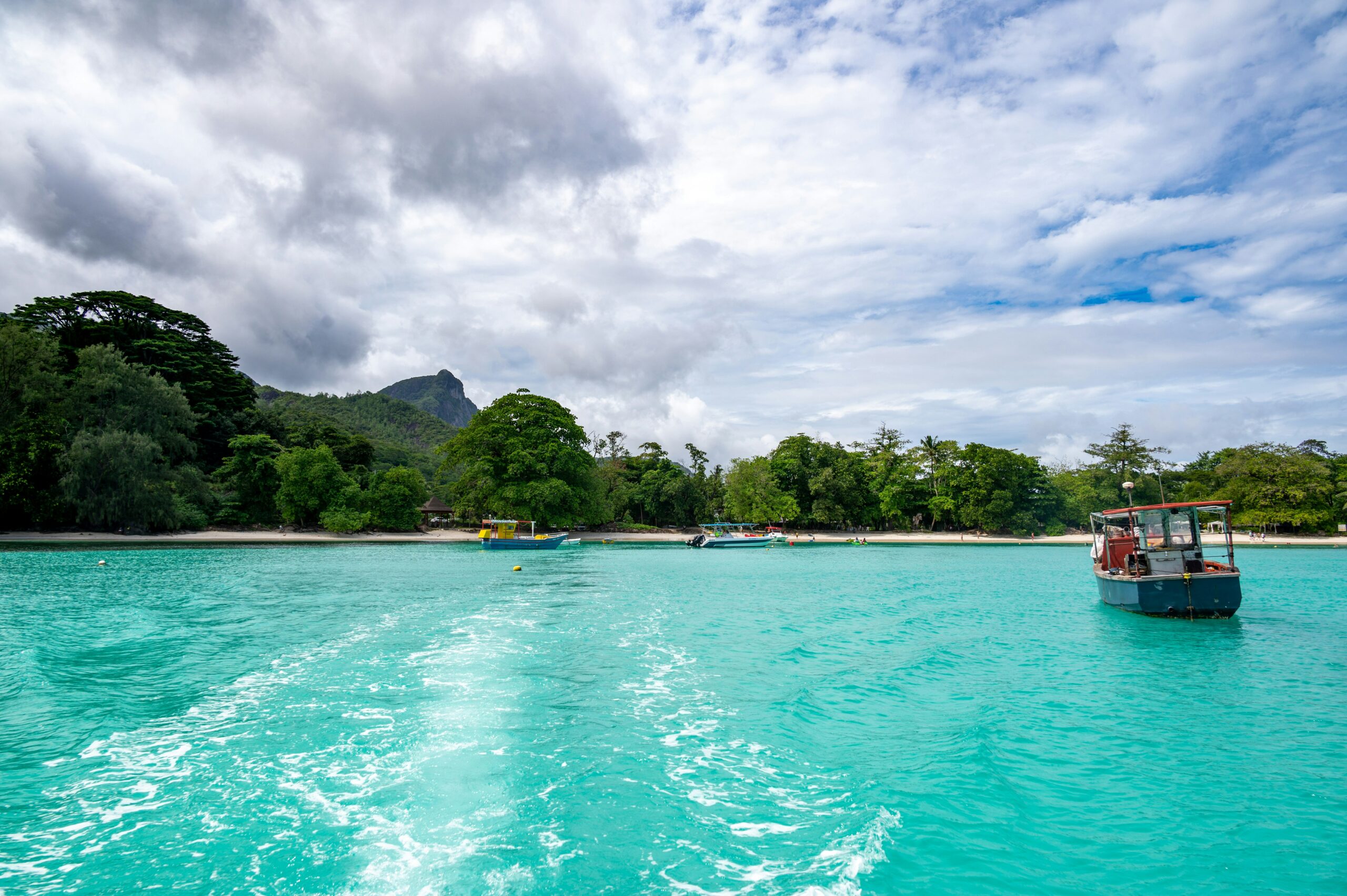
A line of white water across a reef entrance can remain almost stationary while everything beneath it moves. On an Indian Ocean sailing route, that line deserves more attention than the anchorage behind it. Swell meeting an outward-running current can become shorter and steeper precisely where a yacht needs room to manoeuvre. The lagoon may look quiet. The entrance is telling a different story. Before thinking about where to drop the anchor, we need to understand what the water is doing between here and there.
For Naora’s circumnavigation, planned from 2027 to 2031, this is the useful distinction between a continuous expedition and a succession of sailing holidays. It is not that Discovery possesses access denied to every other yacht. She does not. It is that her voyage need not be shaped around returning to the same base at the end of the week. That changes what we can consider, and how patiently we can approach it.
What Shapes An Indian Ocean Sailing Route
The Seychelles, the Maldives and the coastal waters of the Andaman Sea all support established sailing operations for good reasons. There are places to provision, people who know the waters, transport connections and practical ways to maintain a yacht. A voyage within reach of that support can give guests considerable time in the water and ashore without asking them to spend much of their stay making an offshore passage.
The return to base nevertheless has consequences. An outward passage must leave time for the return, and a weather delay consumes the same finite holiday. Remote destinations may be technically reachable but unsuitable within that operating pattern. Private yachts and specialist operators also cross the Indian Ocean and visit remote islands. The distinction is one of continuity and planning, not sole access.
Naora’s Indian Ocean chapter considers a wider geography: East African waters, the Seychelles and Maldives, Sri Lanka and the Andaman Sea. These belong to the same ocean, but they do not share a single weather window or a single approach to pilotage. The sheltered side of an island changes with the season. A harbour convenient for an international arrival may be a poor place to spend the following days.
Within a world route of roughly 49,000 Nm, Discovery can continue rather than retrace her track. That distance matters less as an achievement than as a planning obligation. Maintenance, provisioning and rest must be carried forward through the voyage. The freedom to stay longer somewhere depends partly on having prepared properly somewhere else.
The Seasons Along The Indian Ocean Sailing Route
In the northern Indian Ocean, the monsoon is the first large piece of the passage plan. Broadly, December to March favours the northeast monsoon, while June to September lies within the southwest monsoon. Those are seasonal patterns, not promises of departure weather. Their onset, strength and withdrawal vary across the basin, and the conditions around Sri Lanka cannot simply be assumed to match those in the Maldives or farther east.
The reversal changes more than the direction from which the sails fill. It changes which shores offer shelter, which entrances receive swell and how comfortable an anchorage may become after dark. A bay remembered as quiet in one season can be exposed in another. Around Sri Lanka, the coast receiving the monsoon’s wind and rain changes with the season. In the Andaman Sea, southwest monsoon conditions can make exposed western shores a different proposition from their appearance during the more settled northeast period.
Transitions require their own attention. Lighter average winds can arrive with squalls, thunderstorms and unsettled local weather. A blank-looking patch on a wind forecast is not necessarily an easy passage. We also need to examine swell direction and period, likely squall activity, current and the conditions expected at landfall. Comfortable sailing offshore is of limited value if it delivers the yacht to an unsafe entrance.
Farther south and west, the planning changes again. The southwest Indian Ocean’s main cyclone season runs broadly from November to April. That matters to southern routing and Mozambique Channel passages, but it should not be applied indiscriminately to every island in the ocean. The channel also contains large, moving eddies rather than a dependable conveyor of current. Wind opposing a strong local flow can build a steep sea. A useful weather window therefore includes the water beneath the yacht, not just the air above her.
Reading The Entrance Before Entering
The Seychelles make the difference between island types particularly clear. The granitic inner islands and the low coral islands farther out demand different expectations of shelter and underwater shape. A coastline rising steeply above the water does not tell us where suitable anchoring depth begins. Nor does a broad, apparently protected lagoon tell us that its entrance is navigable in the conditions we have.
At an atoll, tide height and current must be treated as related but separate information. Where the tide is predominantly semidiurnal, successive high waters are roughly twelve hours and twenty-five minutes apart. That helps explain why a convenient arrival time today may not remain convenient tomorrow. It does not establish slack water in a reef pass. Water draining from a lagoon can continue flowing after the tide outside has turned, and swell breaking over the reef can add water that must escape through the entrances.
In low sunlight, the view from the deck can become a sheet of reflected silver. Standing higher may improve the angle, but glare can still erase the distinction between deep water, pale sand and coral. Polarised glasses help; they do not restore information that the light has concealed. The useful decision may be to hold safely offshore until visibility improves, rather than let confidence in the chart replace a clear view.
Charts, tide predictions, current information and direct observation have different jobs. Soundings need to be understood against their chart datum, then considered with the predicted water level and a margin for motion and uncertainty. Discovery still needs clearance beneath her deepest point. Around sandy coastal systems such as Bazaruto, channels and banks can shift, making recent local knowledge particularly important. Once inside, the whole swinging area matters: sufficient depth, sound holding ground, room for a wind change and no chain sweeping across living coral. A quiet surface is only the beginning of an anchoring assessment.
What Self-Sufficiency Actually Requires
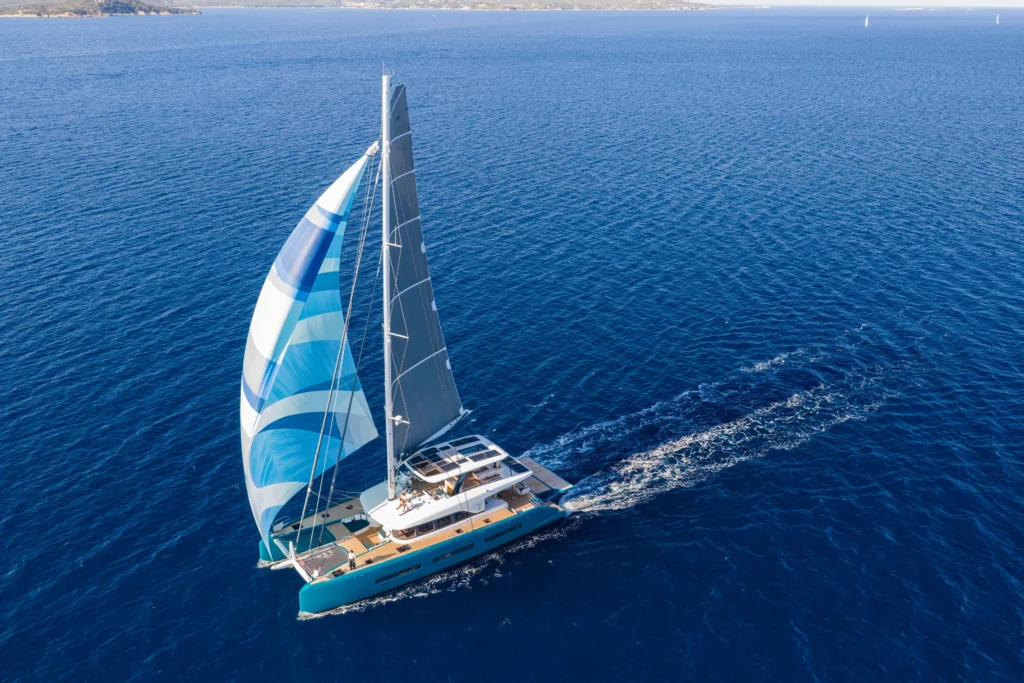
Discovery is a 2025 Lagoon Eighty2 sailing catamaran, with onboard water production and independent energy systems. These capabilities reduce dependence on shore infrastructure. They do not remove the need to conserve resources or maintain equipment. Remote sailing becomes less credible, not more, when self-sufficiency is described as though it were a permanent condition delivered by the shipyard.
A water-maker forces seawater through a membrane under pressure, separating much of the dissolved salt from the product water. It needs electrical power, suitable feed water, clean filters and maintenance. Production depends on operating conditions as well as the machine’s nominal capacity. Dirty harbour water may make running it inappropriate. Stored drinking water and a conservative reserve therefore remain important even when water production is working normally.
Fuel has similar obligations. It may be needed for manoeuvring, charging, an adverse stretch of weather or a departure that cannot sensibly be made under sail. A reserve must remain a reserve rather than quietly becoming part of the expected passage consumption. Sailing when conditions support it reduces engine use, but a low-consumption ambition cannot override safe navigation. The practical discipline is to understand actual demand and preserve room for a change of plan.
Sven, Naora’s founder and captain, plans every weather window and sails every leg himself. That continuity connects the forecast to the yacht’s condition and the people aboard. Before a remote passage, the relevant questions include steering and propulsion checks, the state of running rigging, usable spare parts, the next realistic repair opportunity and whether the crew has had adequate rest. Much of what makes the passage feel easy is work completed before the anchorage disappears astern.
Permission Is Part Of The Passage
Aldabra illustrates why reaching an island and visiting it are different matters. Its remoteness is only part of the difficulty. A visit also depends on conservation permission, the conditions attached to that permission, a safe approach and a workable departure. It cannot honestly be presented as a guaranteed reward for making a sufficiently long passage.
Permission to enter a protected area need not include permission to anchor wherever convenient, land independently, dive or fish. Each activity has to be considered separately. An approval also does not settle questions of insurance, current security conditions or medical support. These need reviewing against the intended voyage, not merely recording once during early planning. If the conditions are not acceptable, the responsible outcome is to omit the visit.
The Maldives require a different kind of care in the imagination. An outer atoll is not simply a more distant version of a resort anchorage. It may contain inhabited islands, working harbours, fishing grounds and channels used by local traffic. Going farther from the familiar visitor centres brings us closer to someone else’s ordinary life. Landing arrangements, dress ashore and the timing of visits should reflect that.
We also have to distinguish local sourcing from assuming that a small community can supply whatever a large yacht needs. Buying food locally can be a good exchange when supplies are sufficient and the purchase is welcome. Arriving with the essentials already aboard leaves us free to make that judgement without transferring our provisioning problem to the shore.
The Water And The Table
Distance changes the experience of a meal long before it changes the menu. On a passage morning, a cup needs somewhere secure to rest. A cupboard has to be latched again. Water moves audibly between the hulls, and the smell of warm bread or rice from the galley arrives in a cabin before anyone calls breakfast. The pleasure is ordinary and physical. Someone has considered what people can comfortably eat in motion, and how to prepare it without making the cook’s work unnecessarily difficult.
Provisioning for these waters means separating food for the passage from food we hope to find at the next landfall. Fresh produce is chosen for condition and keeping quality, then used in an order that respects how it ripens. Dry staples provide continuity if weather delays a market visit. Coconut, spices and local vegetables can bring the shore into the galley, but the essential technique offshore is often restraint: a manageable pan, secure preparation space and a meal that can wait if navigation needs attention.
The same judgement belongs in the water. Clear visibility does not establish an easy dive. A reef entrance carrying food past fish may also carry a swimmer away from the planned recovery point. Current, exposure, diver experience, surface support and the realistic response to an emergency all belong in the decision. Remoteness should make the assessment more conservative, however inviting the reef looks.
Fishing has its own limits. Local rules and protected areas come before the wish to put a catch on the table. Species identification matters, as does regional knowledge of reef-fish toxins, some of which cooking does not destroy. Catching a fish ourselves is not proof that it is safe to eat. There should always be another meal available.
Joining One Part Of A Continuing Voyage
The scale of this ocean does not require everyone aboard to give it the same amount of time. Naora is a private sailing expedition around the world, and guests can join through its private circle or arrange the private hire of Discovery for a carefully designed voyage. They choose when they join, where along the route they step aboard and how long they stay. The yacht continues around the world as people step in and out where the voyage fits their lives.
That freedom works best when the nature of the chosen passage is understood. Time based around island anchorages feels different from time spent crossing open water. An offshore passage includes night watches for the crew, changing motion and days when there is no useful distinction between travelling and being there. Someone joining for a shorter stay may reasonably prefer to keep more of that time for swimming, shore visits and unhurried meals.
Joining points must also work in practice. An island on the route is not automatically a suitable place for an international arrival or departure. Clearance arrangements, shore access and onward transport need to fit, with breathing room between an offshore landfall and a flight that cannot move. This is particularly important for a family travelling with children or someone whose responsibilities require a dependable return. Freedom of choice becomes useful when its practical limits are explained early.
The Indian Ocean gives us reasons to travel farther, but it also gives us reasons to stop. A forecast may favour remaining in shelter. An entrance may need better light. Or, with the yacht secure and the next passage properly considered, there may simply be no need to leave yet. Breakfast can remain on the table a little longer.