A cloud crossing the sun can take the bottom out of sight. What looked like a readable patch of sand inside a reef becomes a flat sheet of reflected sky. The chart is unchanged, but the information available from the bow has gone. On an Indian Ocean sailing route, that loss of light can matter more than the remaining distance.
It is a useful place to begin thinking about reach. A yacht may have the range to arrive at an island without having the conditions to enter, the permission to land or a sensible place to spend the night. For Naora, those distinctions belong inside the route from the beginning. The Naora Global Expedition is planned across roughly 49,000 Nm over five years, from 2027 to 2031. Its Indian Ocean passage is part of that continuing life at sea, rather than a separate holiday that must finish where it started.
An Indian Ocean Sailing Route Beyond The Charter Base
A yacht operating from a fixed base has good reasons to stay within a defined area. Maintenance support, provisions, crew changes and the next party arriving all depend on its return. The Seychelles inner islands and the established sailing areas of the Andaman Sea offer plenty within that arrangement. A bounded itinerary can be exactly right for someone who wants a known departure port and a predictable return.
The constraint becomes more noticeable when a destination requires a substantial offshore passage, when the anchorage needs a particular wind direction, or when waiting for permission consumes the days intended for exploring. Every day spent outward must leave enough time to get back. A distant island can therefore be geographically close enough and operationally too far away.
It would be wrong to turn this into a claim that charter yachts cannot cross the Indian Ocean or visit remote places. Some do. Nor does any yacht gain special access merely by calling its voyage an expedition. The useful distinction is the structure of the voyage: Discovery continues around the world instead of returning to the same provisioning dock after each stay.
That changes the use of time. We can plan a region as a succession of passages, replenishment stops and longer pauses, while keeping alternatives for weather and maintenance. It does not remove deadlines altogether. Immigration formalities, seasonal changes and people travelling home still matter. But it allows the next sensible harbour to be ahead rather than necessarily behind us.
The Indian Ocean Sailing Route Follows The Season
The Indian Ocean does not have a single sailing season. North of the equator, the monsoon changes the prevailing wind across much of the basin. Broadly, December to March brings the northeast monsoon, while June to September brings the southwest monsoon. Those are planning patterns, not promises about a departure morning. The transitions can bring variable winds, squalls and periods when motoring becomes a practical consideration.
For the Maldives, Sri Lanka and the Andaman Sea, the important question is what that seasonal direction does to the particular coast. A bay that provides shelter in one monsoon may face the sea in the other. An anchorage can also sit out of the wind while receiving swell that has travelled around the island. Shelter has to be assessed for both. A quiet wind instrument does not necessarily mean a quiet night.
Farther southwest, the principal tropical cyclone season runs roughly from November to April, although exposure differs greatly between island groups and coasts. The southeast trades provide another broad pattern, but a favourable seasonal wind cannot settle the details of a passage through the Mozambique Channel. Current, swell and developing weather still need to be considered together.
Sven, Naora’s founder and captain, plans every weather window and sails every leg himself. The departure decision must include the arrival: remaining daylight, likely current, an alternative anchorage and enough reserve to use it. Purely as passage arithmetic, 600 Nm at an average of 6 knots takes 100 hours. At 5 knots it takes 120 hours. Neither figure is a prediction for Discovery. The difference demonstrates why a modest change in average speed can move an arrival from daylight into another night offshore.
We would rather allow for that night than depend on making up time. A forecast can support a decision without making it certain. Keeping another workable option is part of reading it properly.
What Self-Sufficiency Really Requires
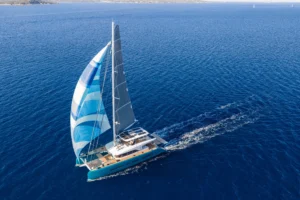
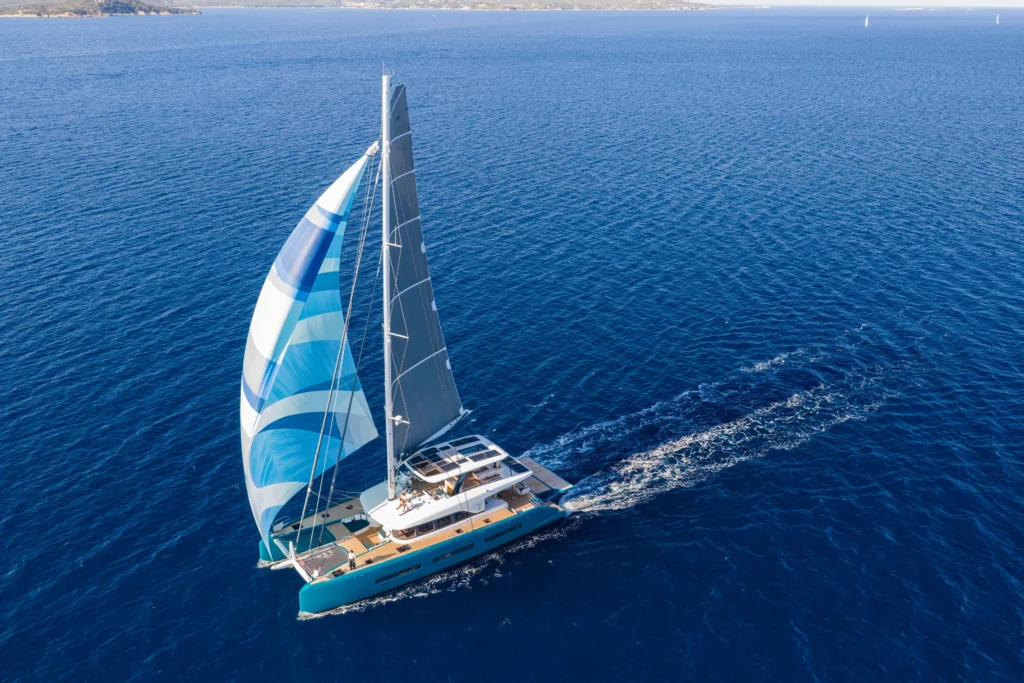
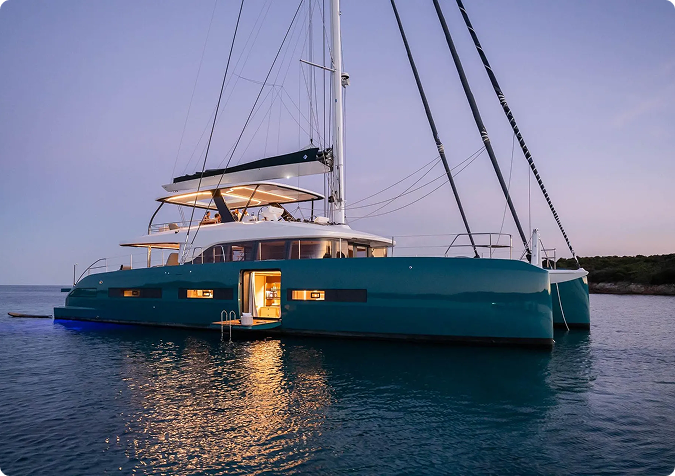
Discovery is a 2025 Lagoon Eighty2 sailing catamaran. Onboard water production and independent energy systems extend the distance between shore services, but self-sufficiency is better understood as a set of dependencies we can manage than as freedom from dependencies altogether.
A water-maker needs power, serviceable filters and suitable intake water. Production can be interrupted by a fault or by water conditions in an anchorage. The useful reserve is therefore the fresh water already stored, measured against actual consumption, not simply the output written on a specification sheet. The same reasoning applies to fuel. A fuel calculation has to include charging and other machinery use, time without useful wind, and the possibility that the intended replenishment stop becomes unsuitable.
Maintenance becomes more consequential with distance. A replacement part that can arrive easily in an established port may be difficult to obtain at the next island. Knowing what is aboard, what has been used and which component could stop an essential system matters more than carrying an impressive but poorly understood collection of spares. There must also be time to inspect and repair things before they become passage problems.
The galley works to the same logic. Rice, lentils and other durable staples provide meals when the fresh supply is smaller than expected. Produce needs sorting by ripeness and condition, not merely putting away. Something bruised in transit belongs in an early meal; something sound and slow to ripen can wait. Refrigeration space is finite, and warm provisions add to its workload.
These are not details guests need to manage, but they shape the ease of living aboard. A remote anchorage feels different when dinner does not depend on finding a shop and the next shower does not depend on running machinery immediately. Preparation gives ordinary comforts room to remain ordinary.
Aldabra And The Meaning Of Permission
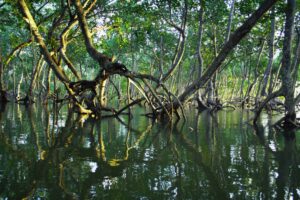
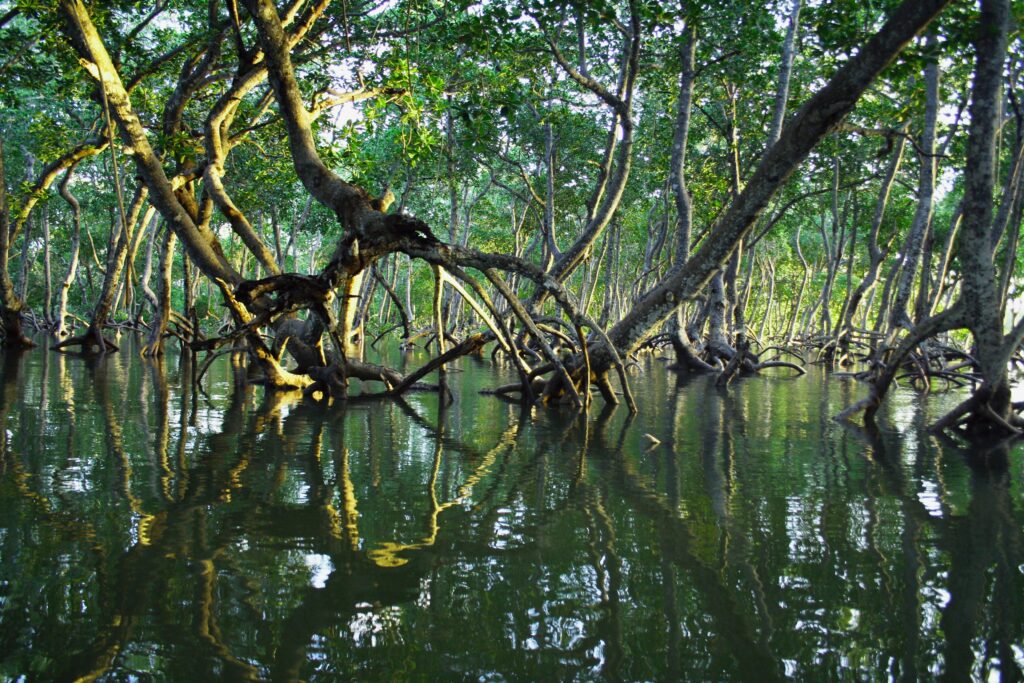
Aldabra is one of the places that gives the western Indian Ocean its particular pull. Its raised coral landscape, mangroves and lagoon support a living system very different from a harbour island. Giant tortoises are part of that landscape, not an attraction assembled for visiting boats. Green turtles use its beaches. The reasons to want to see it are also reasons to limit how a visit takes place.
We should be precise about what a name on a route plan means here. It identifies an intention worth investigating. It does not confirm access. Permission, conservation requirements, the arrangements for a visit and the conditions on arrival all have to align. No responsible plan treats an application as an approval, or an approval as an instruction to continue when the weather argues otherwise.
An atoll also demands more than recognition of the opening in its reef. Water moving into and out of a large lagoon can create strong flows through restricted passages. Tide height and current speed are different pieces of information: high water does not automatically mean slack water, and local timing matters. A predicted height alone cannot tell us how an entrance will behave.
Nor should the lagoon be assumed to be an available anchorage. Visiting arrangements may limit movement independently of what appears navigable. Before approaching, we need to know where a vessel may go, where people may land and how the visit can end safely if conditions change.
There is something valuable in accepting that boundary without resentment. Aldabra does not become less extraordinary if we cannot visit it. The decision to leave it undisturbed can belong to a serious voyage as fully as a landing.
The Maldives Beyond A Resort Landing
The outer Maldivian atolls offer a different kind of distance. Their remoteness is not adequately described by a measurement from Malé. A place can be relatively close to the capital and still lack a suitable anchorage, an easy transfer or the services a yacht needs. Resort infrastructure is not automatically public infrastructure, and an inhabited island has its own working waterfront.
Atoll navigation begins with the relationship between ocean, reef and lagoon. Wind can drive water across a reef, adding to the flows associated with the tide. Different channels may behave differently at the same stage of the tide. An apparently inviting entrance therefore needs local understanding as well as a chart, and the colour of the water is supporting evidence rather than a depth measurement.
With the sun behind a lookout, changes in the seabed can become easier to distinguish. Looking towards low sun, glare can erase those differences. A depth sounder reports what is beneath its transducer, not every obstruction ahead. The practical response is an approach slow enough to stop or turn away, with somebody looking outside the instruments. If visibility becomes inadequate, waiting preserves information we would otherwise be trying to guess.
The same water movement governs diving and swimming. Clear ocean water entering a channel may bring good visibility and a current too strong for an unplanned swim. A safe dive needs a considered entry, a likely drift, surface support and a realistic recovery plan. The fact that a reef is visible from the yacht does not make it an appropriate place to enter the water. Spearfishing is prohibited in the Maldives, so the relationship with fish here is observation, not taking something back to the galley.
Ashore, discretion becomes practical courtesy. Clothing appropriate to an inhabited island may differ from what is normal on a resort beach. Prayer and religious observance shape daily life. Asking before photographing someone, or before leaving a tender where boats are unloaded, makes the encounter less extractive. Arriving privately should mean imposing less, not assuming more.
The African Coast And The Limits Of A Plan
The Comoros and the Bazaruto Archipelago bring the route into the varied conditions of the western Indian Ocean. In the Mozambique Channel, broad southward water transport is complicated by large eddies. The current helping one part of a passage may not help the next. Where wind opposes a strong current, seas can become shorter and steeper, changing comfort and speed more sharply than the wind forecast alone suggests.
Closer to Bazaruto, banks and channels require a different kind of attention. An entrance through shallow water cannot be planned only from the yacht’s draught. Tide, swell, seabed change and the room needed to turn around all affect the margin. A catamaran’s access to relatively shallow water is useful, but it is not an exemption from those considerations.
Bazaruto’s seagrass beds are feeding habitat for dugongs. That gives apparently empty water a significance that is easy to miss from deck level. Tender routes and speed deserve care, and wildlife should never have to alter its behaviour so that we can get a better view. Local restrictions are part of understanding the place, not an inconvenience separate from it.
Some names need an even firmer distinction between interest and commitment. Socotra requires a current security assessment before any passage can be considered. Permission alone would not settle that decision. Dahlak, meanwhile, belongs geographically to the Red Sea, not this Indian Ocean chapter, and needs its own assessment of permissions, security and access. Neither should appear as an assured stop simply because it is compelling on a map.
The farther we sail from dependable support, the more important it becomes to recognise a limit early. Turning away while several options remain is a different experience from being forced away after they have narrowed.
Time Aboard A Continuing Voyage
For the people joining us, a continuous world route changes the meaning of a stay. Through Naora’s private circle, guests choose when they join, where along the route they step aboard and how long they remain. Discovery can also be privately hired for a family or private party on a carefully designed part of that route. The yacht’s wider voyage continues before and after their time aboard.
That freedom works best when it is matched honestly to the character of the sailing. A coastal stay and an offshore passage ask different things of a person. During a crossing, sleep and appetite may need time to adjust to motion. A remote island may be a wonderful place to spend time and an impractical place to change guests. Boarding and departure arrangements need workable transport, clearance and enough margin that a flight does not become a reason to make a poor maritime decision.
We want that understood before anyone arrives, especially when a family has different expectations within it. Some people are drawn to the passage itself. Others want the mornings after arrival, when the boat is settled and there is time to look properly at the shore. Neither preference needs correcting. The useful work is finding the part of the route that suits them.
What we are making room for is often quite modest: an evening sheltered from the swell, rice steaming in the galley, the warmth of a plate held on the way to the table. Water sounds against the hulls. Damp swimming things hang where they can dry, and the conversation has somewhere to go without anyone checking the time. Beyond the deck lights, the anchorage is dark. For the moment, the yacht and the plan are both at rest.