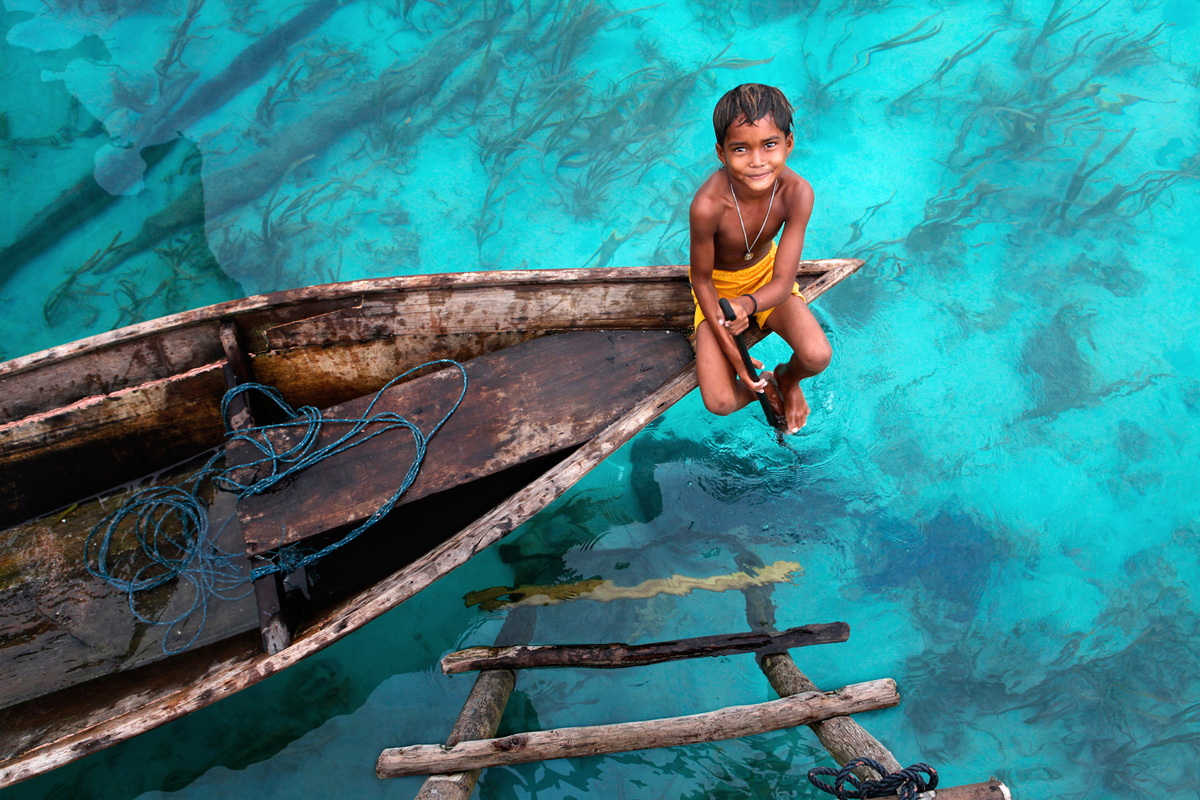
The Bajau are the sea nomads of the Sulu and Banda Seas. For centuries, and in some communities until recently, they lived entirely on their boats: born on the water, married on the water, dying on the water, the land a place visited for provisions and for the trees that the boats required rather than a place of habitation.
The Bajau community that the Naora route encounters in the Indonesian archipelago is in transition between the traditional boat-dwelling life and the land settlement that government policy has progressively encouraged, but the relationship with the water that the boat-dwelling life produced is not in transition. It is present in the bodies of the Bajau freedivers as a physiological adaptation so specific that science has only recently begun to understand it: the Bajau spleen is significantly larger than the non-Bajau human spleen, an adaptation produced by generations of selection for the oxygen storage that extended breath-hold diving requires.
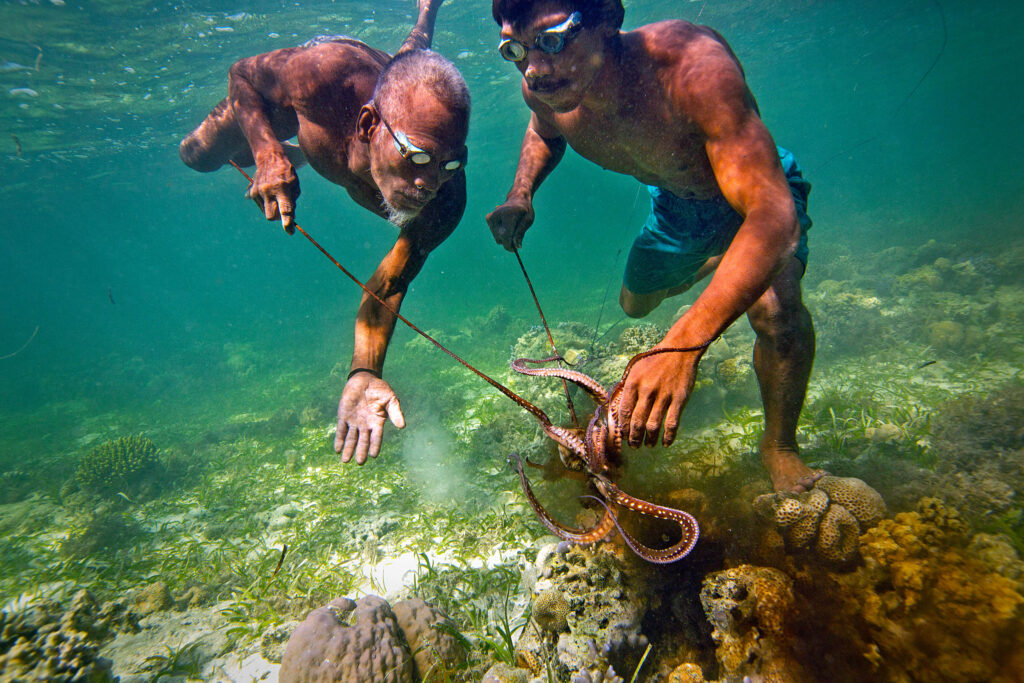
They dive to twenty metres on a single breath with a wooden spear and a pair of handmade wooden goggles. No wetsuit. No fins. No buoyancy compensator. The water temperature that requires a five-millimetre wetsuit for the European freediver produces no visible response in the Bajau diver whose body has adapted to the thermal demand over a lifetime of daily immersion.
The specific technique of the Bajau freedive, the descent that uses the body’s negative buoyancy at depth rather than fighting it, the stillness at the bottom that conserves the oxygen that the ascent will require, is not learned from a manual. It is learned from watching older Bajau divers from before the age at which the learning is conscious.
Alongside
The Bajau diver does not move through the water with the careful deliberation of the trained freediver. They move the way the water moves: the response to the current is the response of something that belongs in the current rather than something that is managing it. The direction change that the reef requires is the direction change of a creature that has always lived here rather than a visitor who has learned to navigate.
The hunt itself is silent in both directions: the Bajau diver approaches the reef at a specific angle that the fish does not register as a threat before the spear is within range, which is an approach developed by a specific understanding of fish behaviour that no dive course teaches and that the Bajau fisherman has been observing since childhood.
Watching the approach is watching generations of accumulated knowledge expressed in a single movement: the angle, the depth, the timing of the descent, the stillness that precedes the strike. It is the most sophisticated hunting technique available in the ocean, developed without books, passed from body to body across the centuries that the Bajau have been the sea’s most skilled inhabitants.
Being a Guest in Someone’s Ocean
The ocean that the Naora voyage crosses is not, in the Banda Sea, an open space that belongs to no one. It is the Bajau’s home, mapped in their knowledge and their bodies and their relationship with every reef and current and seasonal pattern in the region across a history that predates any Western chart of the area.
The visiting boat in this ocean is a guest, and the specific quality of the guest posture, curiosity without extraction, presence without the assumption of ownership, the willingness to receive rather than to document, is the posture that produces the encounter with the Bajau that the visiting boat deserves and that the tourist vessel’s transactional relationship with local cultures does not.
The Naora voyage moves through this ocean with the specific awareness of being in someone else’s place. Not with the guilt of the colonial legacy, which is real and separate, but with the practical awareness that the knowledge of this ocean that the Bajau hold is knowledge that the visitor does not have and that the visitor’s presence in the ocean is enriched rather than diminished by acknowledging this.
The Bajau diver who allows the visiting freediver to be in the water alongside them is offering a form of hospitality that the offering is not always conscious of, and that the receiving deserves the specific quality of attention and respect that hospitality has always deserved.