The pale coral and dark volcanic stone of the Huahine marae around Maeva make boundaries that are easy to overlook. Much of the architecture stays close to the ground: a court, an alignment of slabs, a platform raised above the surrounding surface. Arrive expecting a building and you can look straight across the thing you came to see. The open space belongs to the structure. The sky has not replaced a missing roof.
That is a useful first adjustment for us as sailors. We are accustomed to looking for the conspicuous feature, the entrance through the reef, the landmark that confirms a position. At Maeva, attention needs to settle lower and move more slowly. These sacred places belong to a landscape of water, settlement and chiefly authority, rather than standing apart from it. Understanding even a little of that relationship changes an afternoon ashore on Huahine from a visit to old stones into something that continues to occupy the mind after returning aboard.
Reading The Huahine Marae From Ground Level
A marae in the Society Islands tradition was a place where relationships between people, ancestors and gods acquired a physical setting. Religious ceremony and political authority were closely connected. Genealogy could establish a person’s standing and obligations, while ritual helped affirm the order through which land and leadership were understood. Calling a marae a temple is a useful beginning, provided we do not imagine that worship was separated neatly from government, family or territory.
The court is therefore worth noticing before the most prominent stones. Its boundaries established a particular space, and its arrangement helped give ceremony an order. A raised stone platform, known as an ahu, is a central architectural element in many Society Islands marae. The surviving forms vary. It would be a mistake to turn one recognisable feature into a universal plan, or to assume that every upright slab has the same meaning.
Coral limestone and basalt also tell different material stories. The coral belongs to the island’s reef environment; basalt belongs to its volcanic foundation. Their contrast is immediately visible, pale and irregular against darker stone, but appearance alone cannot establish why a particular piece was selected or placed. Nor are upright slabs automatically gravestones. A familiar shape can encourage a completely unfamiliar building to be read incorrectly.
In strong daylight, the pale surfaces return the sun towards the eyes while the darker stone holds a heavier outline. Step into shade and the edges become easier to follow. There is a bodily reason to slow down: looking carefully takes less effort when we stop squinting. From outside the structure, follow the boundary before trying to interpret the platform. Notice what is enclosed, what remains open and where the ground rises. This gives the place a form without pretending to supply every meaning that once belonged to it.
Maeva And The Water Beside It
Maeva was an important centre of chiefly life, and its concentration of marae makes more sense when understood as a social landscape rather than a collection of separate monuments. The structures beside the water and on the slopes above it were connected to people, lineages and authority. Their proximity does not mean that they were interchangeable, any more than neighbouring family lands would have been interchangeable.
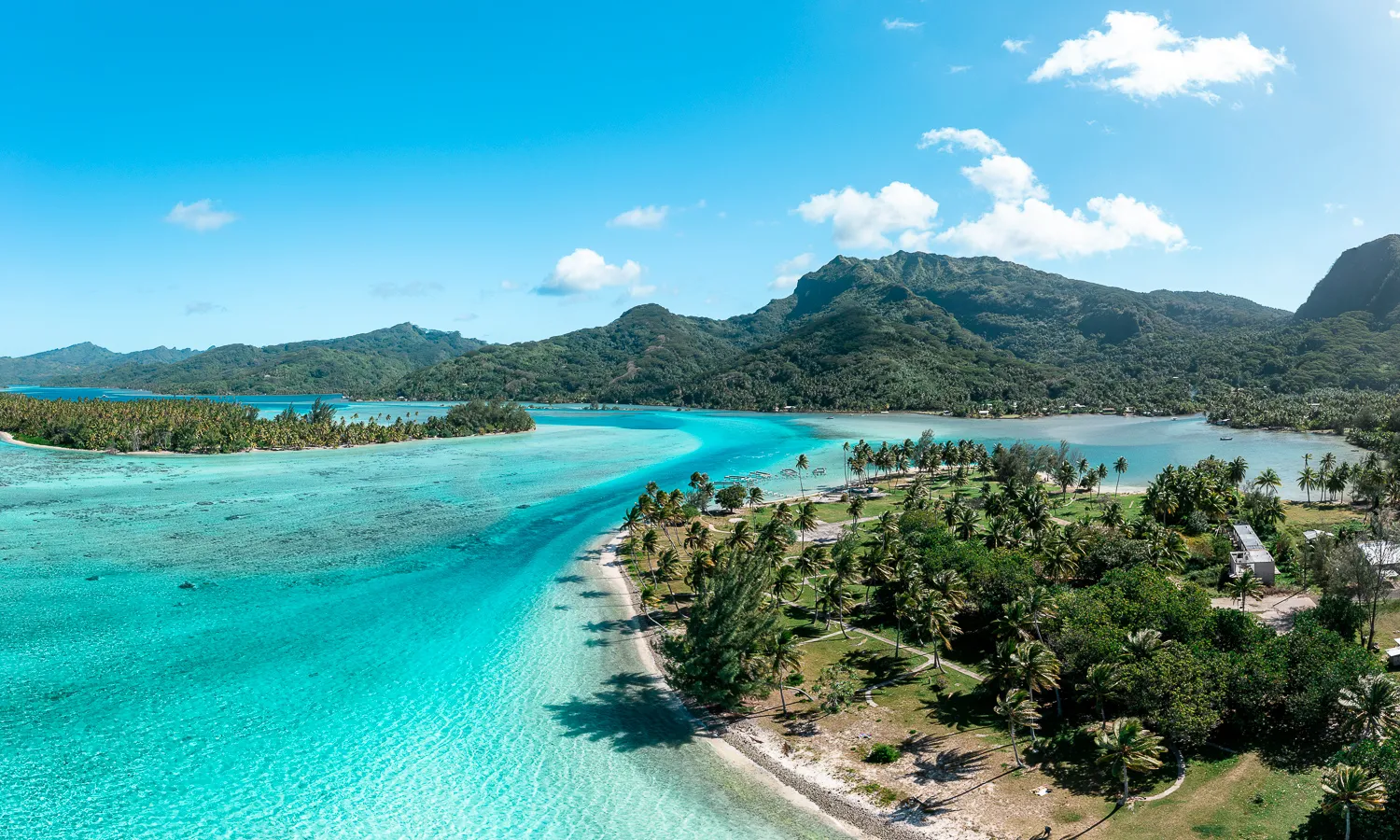
The water commonly described as Maeva’s lake is connected to the sea. That matters because it belongs to a working coastal environment, not simply to the scenery behind the archaeological remains. Water exchange, fishing and access formed part of the practical life around the sacred places. A community needed food and maintained relationships with the waters that provided it. Ceremony did not happen outside those everyday dependencies.
The stone fish traps associated with Maeva make that connection particularly legible. Their walls guide fish moving through the exchanging water into spaces where they can be caught. The principle depends on knowing how fish move and how water behaves, rather than pursuing each fish individually. It is an arrangement of landscape and observation, built from knowledge that has to remain attentive to local conditions.
We should be careful about turning that ingenuity into a claim that every old practice was automatically sustainable. A fishing structure does not, by itself, tell us the rules governing its use or the condition of the fish population. What it does show is that the water was understood in detail. The traps also deserve the same restraint as the marae: no walking on walls, no rearranging stones and no assumption that an old method makes the fishery open to a visitor.
This is one reason a local explanation is worth making time for. A visitor can identify a platform or recognise the outline of a trap. Understanding whose place it is, how its history is remembered and which distinctions matter now requires listening.
The Forest Was Not The Only Keeper
There is an appealing story in the idea that the jungle kept Huahine’s sacred sites. Vegetation can conceal structures from casual disturbance, and the shade around old stone can make the distance from the present feel unusually deep. But roots also displace masonry. Leaf litter obscures edges. A place covered by growth is neither necessarily forgotten nor reliably protected.
The first recorded European visit to Huahine was in 1769. That date is useful as a marker of contact, not as the beginning of the island’s history. The chiefly and sacred landscape encountered by Europeans already had its own past. Later changes in religion, political power and daily life altered the use of marae, but a change of use does not tell us that every family connection or memory disappeared with it.
Archaeological investigation and restoration during the twentieth century helped make parts of Maeva readable again. Clearing, recording and resetting displaced elements are human acts of care. The visible site is therefore not simply something nature handed back intact. Nor does restoration make it false. It means we should distinguish surviving material, reconstructed arrangement and what remains uncertain, rather than expecting every stone to have stood untouched in its present position for centuries.
Moss is not a dating method. A clean face is not proof of recent manufacture. Colour and weathering respond to shade, moisture and exposure as well as age. This is a small but useful discipline when looking at any archaeological place: do not let an attractive surface become evidence for a story it cannot support.
Huahine also does not need to be called untouched to deserve our attention. Maeva is a village as well as an archaeological landscape. Ordinary life around the remains is not an interruption of their significance. It is a reminder that the people who live here do not owe arriving sailors an older version of their lives.
Bringing Discovery To Fare
For Naora, an afternoon at Maeva begins with a decision on the water. Discovery, the Lagoon Eighty2 sailing the Naora Global Expedition, needs a suitable anchorage before anyone starts thinking about bicycles. Fare is the natural reference point for this visit, but a place name in a plan is not a decision about where to put the anchor. That depends on current charts, local restrictions, the forecast and the bottom actually available.
Sand between coral is useful only if there is enough of it for the whole anchoring arrangement. An anchor can be set in sand while the chain still sweeps across coral as the yacht moves. The relevant space is the swing circle, not merely the point where the anchor lands. Depth, the height of the bow above the water, expected changes in water level and the room available all affect the amount of chain and the position chosen.
From May to October, the Society Islands generally have a drier season with more established southeast trade winds. That is a planning context, not a guarantee of settled weather. A sheltered position under the prevailing wind may be less comfortable when the wind changes, and swell can matter even when the sky overhead is clear. Water driven across a reef must find its way out again. An offshore tide prediction alone cannot describe every current in a lagoon entrance.
Sven, Naora’s founder and captain, plans every weather window and sails every leg himself. Time ashore has to remain compatible with his judgement about the yacht, the landing and the return. A squall in the forecast or an exposed dinghy landing is a reason to adjust the afternoon, not something to ignore because the visit has been discussed over breakfast.
The road journey from Fare to Maeva is roughly 3 Nm each way. That is modest on a passage chart, but a bicycle ride in humid heat belongs to a different scale of effort. We would allow half a day for the outing as a planning judgement, leaving room to stop, listen and return without making the clock the most important thing in the village.
Visiting The Huahine Marae With Care
A bicycle is a good way to keep the transition from harbour to village gradual, if conditions and the people making the ride suit it. It should not become a test of commitment. Heat, mobility and confidence around road traffic matter more than the appealing picture of everyone arriving on two wheels. Another form of local transport can leave more attention for the place itself.
On a warm, still day, the body’s experience of the ride changes as soon as the wheels stop. The airflow that made the heat manageable disappears. Sweat gathers beneath a bag strap; the road’s reflected warmth remains around the lower legs. This is the moment to drink, find shade and let the pulse settle, rather than walk directly into the site with the impatience of someone who has just completed a task. Water, sun protection and shoes that grip uneven ground are more useful preparations than an ambitious list of things to see.
At the marae, keep to established access and observe any local instructions. Where the boundary is uncertain, staying outside the stonework is the sensible choice. A low wall is not a bench, and a platform is not a better position for a photograph. Avoid moving even a loose-looking stone. Its context may carry information that its appearance does not reveal, and moving it can damage both the structure and its meaning.
The reconstructed communal house at Maeva offers another useful distinction. A covered meeting place and an open sacred court have different architectural purposes. Seeing them near one another can help prevent all the surviving and reconstructed elements from merging into a single impression of an ancient village. Reconstruction can make a building form understandable without making the building itself ancient.
Ask before photographing people or private activity. Keep voices at an ordinary, considerate level rather than staging a ceremonial hush that nobody has requested. Sacred places deserve restraint, but respect does not require visitors to invent rituals of their own. We do not need to touch the stones, leave an offering or claim to feel an energy in order to acknowledge that the place matters.
For children, a concrete observation often opens more than a long explanation. The difference between coral and volcanic stone, the shape of an enclosure or the way a fish trap uses moving water can hold attention without turning the site into a playground. Adults benefit from the same approach. One detail properly understood is worth more than several impressive terms repeated on the ride back.
What An Ocean Arrival Changes
Arriving in French Polynesia under sail can make certain questions more immediate. Fresh water, shelter, food and a dependable departure window have occupied real space in the planning. The relationship between a settlement and its surrounding waters is easier to recognise when the yacht has required us to think about those same necessities, however different our circumstances are.
That does not make our arrival equivalent to Polynesian voyaging. We carry navigation equipment, communications, engines and stores that change the consequences of uncertainty. Traditional Pacific navigation drew on learned relationships between stars, swells, winds and living signs, within a much wider body of maritime knowledge. Crossing an ocean on Discovery can sharpen our curiosity about that achievement. It does not give us ownership of its meaning.
Maeva adds something that a passage alone cannot teach. Voyaging was connected to the work of making and maintaining a society ashore: belonging to land, sustaining families, exercising authority and meeting obligations. The ocean connected places whose importance did not end at their shorelines. The marae make some of those relationships visible in stone.
On Naora’s world route, members choose when they join, where along the route they step aboard and how long they stay. Someone arriving for a shorter stretch in French Polynesia has no less reason to give Maeva a patient afternoon than someone who has made a long passage. Sea miles are not a qualification for attention. The freedom that matters here is having enough room in the day for an unfamiliar place to resist the first explanation we give it.
I would rather leave Maeva knowing the difference between the court and its platform, and still uncertain about much else, than carry away a complete story assembled from assumptions. There is room to stand beside the stones without making them ours.