One of the questions people ask when they start thinking seriously about life at sea is a practical one: where does the fresh water come from? When you are anchored in a bay with no shore facilities, two days into an open-ocean passage, or lying off a coastline where the nearest marina is twenty miles away, the answer cannot be a tap on the dock.
The answer is a watermaker. And understanding how it works tells you something important about what genuine offshore self-sufficiency actually looks like aboard a vessel like Naora.
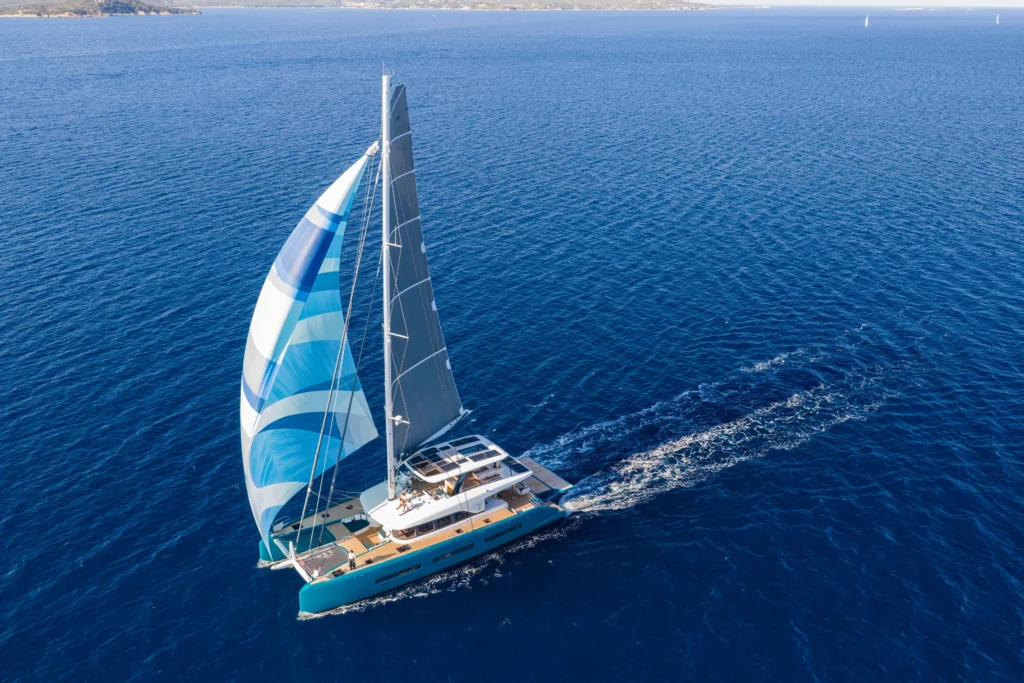
We run two high-capacity reverse osmosis watermaker aboard the Lagoon Eighty2. It is one of the systems that makes extended passages into remote waters genuinely possible, not just in theory but in daily practice: fresh water for drinking, cooking, showering, and all the other uses that ten to twelve people generate over a day at sea. What follows is an explanation of how it works, written for people who are curious about the mechanics of living offshore rather than simply staying comfortable near a marina.
The Principle: Reverse Osmosis
Osmosis, in its natural form, is the process by which water moves through a semi-permeable membrane from an area of low salt concentration toward an area of high salt concentration. It is how plant roots draw water from soil, and how cells regulate themselves throughout living organisms.
Reverse osmosis does the opposite. By applying significant pressure to seawater, you force it through a membrane in the direction water would not naturally travel. The membrane has pores small enough to allow water molecules to pass but small enough to block salt molecules, minerals, bacteria, and most other dissolved contaminants. What comes out on the other side is fresh water. What does not pass through is discharged back into the sea as brine.
The pressure required is substantial. Seawater typically needs around 55 to 70 bar of pressure to push through the membrane effectively, which is why high-pressure pumps are at the heart of every marine watermaker. The engineering challenge, particularly on a sailing vessel running primarily on battery and solar power, is achieving that pressure efficiently without drawing the electrical system down to the point where other onboard systems are compromised.
The Process, Step by Step
The water that comes out of the tap aboard Naora has passed through several distinct stages before it reaches you. Each stage has a specific function, and the sequence matters: skipping or compromising any one of them affects the quality of the output and the longevity of the most expensive components.
Here is the full process, from ocean to glass.
| Stage | What happens | Why it matters |
|---|---|---|
| Seawater intake | Raw seawater is drawn in through a hull fitting below the waterline by a low-pressure feed pump | The intake location and depth affects the turbidity and particle load of the incoming water |
| Pre-filtration | The water passes through sediment filters, typically 20 micron then 5 micron, removing sand, particles, and suspended solids | Protects the membrane from physical damage and abrasion, which is irreversible and expensive |
| High-pressure pump | The pre-filtered seawater is pressurised to 55 to 70 bar and pushed toward the RO membrane | This is the energy-intensive step. The pump quality and efficiency determines the power draw of the whole system |
| RO membrane | Pressurised seawater passes through the semi-permeable membrane. Water molecules pass through. Salt, minerals, bacteria, and dissolved solids are rejected and exit as brine | The membrane is the core of the system. It typically rejects 95 to 99 percent of dissolved salts |
| Brine discharge | Concentrated saltwater is discharged back overboard through a separate hull fitting | Brine is roughly twice the salinity of seawater and must be discharged clear of the intake to avoid recirculation |
| Post-filtration and taste adjustment | The product water passes through a final carbon filter to remove any residual taste compounds and balance the mineral profile | Reverse osmosis removes almost everything, including beneficial minerals. Post-treatment restores drinkability and improves taste |
| Storage | Finished fresh water is directed into the vessel’s water tanks for distribution through the onboard plumbing | Tank capacity determines how much water can be stored between watermaker runs and how much operational flexibility the vessel ha |
The Numbers That Matter Offshore
The practical question for any offshore vessel is not whether a watermaker works in principle, but whether it produces enough water, reliably enough, for the people aboard. The calculation involves three variables: daily consumption, production rate, and power availability.
Daily water consumption per person aboard a well-managed offshore vessel runs between 30 and 60 litres per day, covering drinking, cooking, and showering. With ten to twelve people aboard, that means a daily requirement of between 300 and 700 litres. A capable marine watermaker for a vessel of our size produces between 200 and 300 litres per hour of operation, which means the system needs to run for two to four hours daily to maintain comfortable water levels, depending on conditions and consumption.
The power side of that equation is where things become interesting on a sailing vessel. Traditional high-pressure watermakers are energy-hungry, drawing 20 amps or more at 12 volts, which is a significant load on a battery bank that is also running navigation electronics, lighting, refrigeration, and communication systems. Modern systems with energy recovery technology, which captures and recycles hydraulic pressure from the brine discharge stream, reduce that draw substantially, in some cases by 60 to 80 percent. That efficiency matters enormously on long passages where the solar and wind generation profile is the primary energy input.
The other variable is water quality. Seawater in a busy marina anchorage, close to shore, or in areas with agricultural or industrial runoff carries a heavier burden of contaminants than open ocean water. Our crew monitors intake conditions and adjusts the pre-filtration and run schedule accordingly. In genuinely clean offshore water, the membranes run more efficiently, last longer, and produce water of higher quality. One of the less-obvious benefits of the remote anchorages we seek is that the water feeding our watermaker tends to be among the cleanest available anywhere.
Maintenance: What Keeps the System Running Across 45,000 Miles
A watermaker that fails offshore is not a minor inconvenience. It is a voyage-limiting event. On a five-year circumnavigation covering more than 185 destinations, the reliability of this system is not optional. Our approach to watermaker maintenance reflects the same philosophy we apply to every critical onboard system: prevention rather than repair, routine attention rather than crisis management.
The membrane is the most expensive single component and the one most sensitive to neglect. After every run, the system is flushed with fresh water to displace the residual brine and prevent salt crystallisation on the membrane surface. During extended layups, the membrane is treated with a preservation solution to prevent biological fouling. Pre-filters are replaced on a regular schedule based on run hours and water quality, not when they fail.
What Our Crew Monitors Every Day
The quality of the product water is checked against a target salinity level each time the system runs. A properly functioning membrane produces water with a total dissolved solids reading well below 500 parts per million, against a seawater baseline of around 35,000 parts per million. If the reading drifts upward, it is an early indicator of membrane degradation or a seal failure, and it is caught before it becomes a problem.
- Product water TDS checked against baseline after every run
- Pre-filters inspected and replaced on a fixed hour-based schedule
- Fresh water flush run automatically after every production cycle
- Membrane preservation treatment applied during any layup over two weeks
- High-pressure pump seals and O-rings inspected at scheduled service intervals
- Intake sea strainer cleared before every run in anchorages with high particle loads
- Brine discharge confirmed clear of intake before starting production
Why This Matters for How We Sail
The watermaker is not the most exciting system aboard. It does not appear in the photographs. Nobody talks about it over dinner. But it is one of the systems that determines which anchorages we can reach and how long we can stay there.
Without it, every passage planning decision would have to account for the distance to the next reliable water source. A remote anchorage off the Turkish coast with no facilities ashore, a protected bay inside a Croatian national park, an isolated atoll with no marina within a hundred miles, an island in the Indian Ocean where the only settlement is a fishing village: none of these would be feasible as extended stays. The vessel would need to return to marinas and provisioning ports on a schedule dictated by water capacity rather than by what we actually want to see.
With a well-maintained, high-capacity watermaker aboard, the ocean becomes genuinely navigable on its own terms. We go where the conditions and the route take us. We stay as long as the place deserves. We leave when we are ready. The water follows us, produced from the same ocean we are sailing through, and the places that most boats cannot reach for lack of infrastructure become exactly the places we prefer to anchor.
That self-sufficiency, built from systems like this one, is what makes the Naora journey what it is. Not the destinations listed on a map, but the ability to actually reach them and stay.