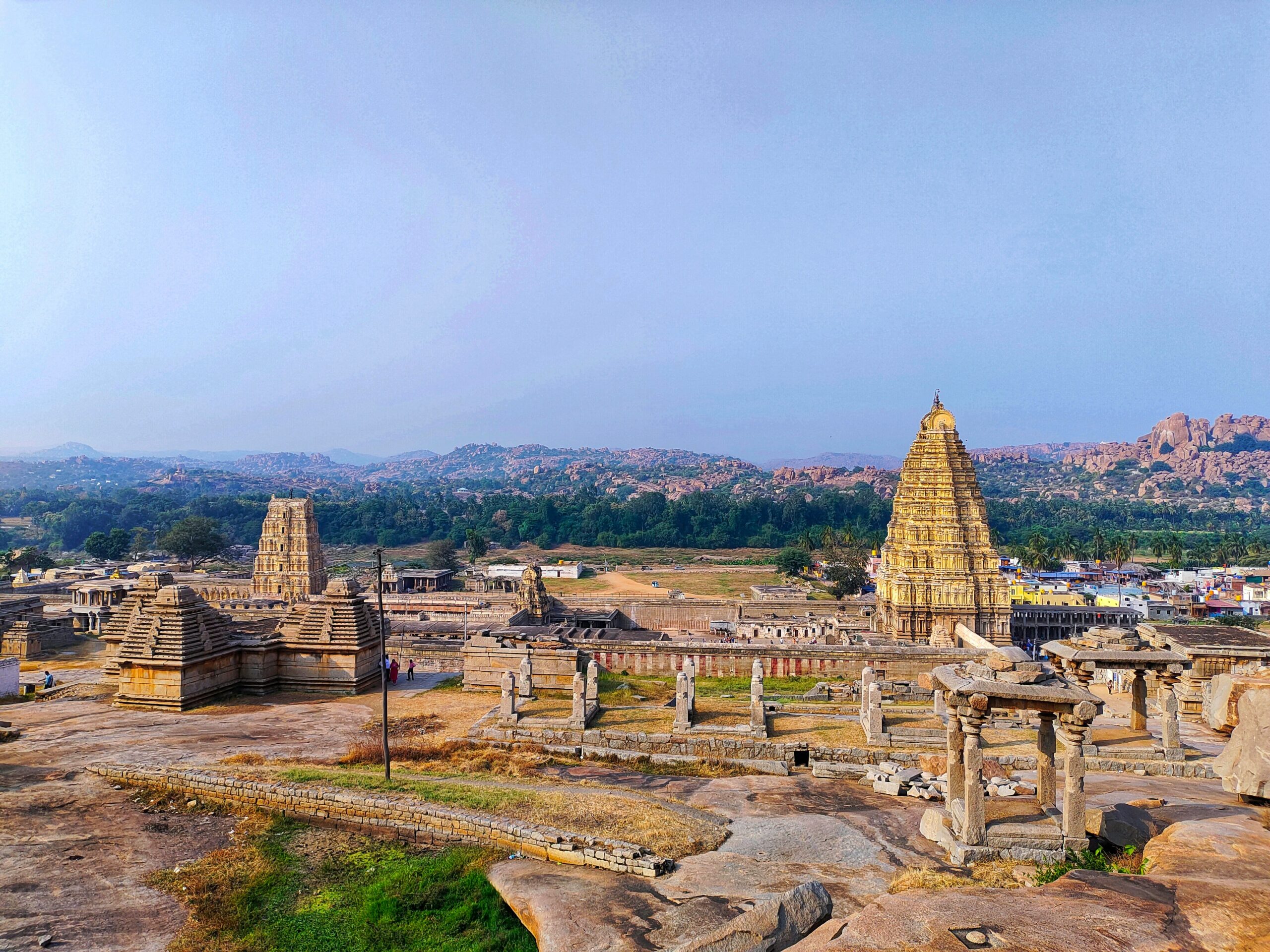
At the Hampi ruins, the shade beneath a stone colonnade belongs to a different temperature from the path outside. Step into the open and the light comes back from the ground as well as down from the sky. Before the city becomes a historical subject, it becomes something physical: the distance to the next patch of shade, the weight of drinking water, the discovery that standing still can reveal more than continuing to walk.
Goa is the provisioning point for this part of Naora’s Indian Ocean chapter. Hampi lies inland, southeast of Goa in Karnataka, and reaching it means leaving the coast properly, rather than adding an ambitious afternoon to a harbour stop. That distinction matters. We would rather give the place sufficient time or leave it for another occasion than turn a substantial inland journey into a hurried photograph of a stone chariot.
The boulders are the first attraction. What holds our attention is how much human work survives between them.
Reading The Hampi Ruins In The Granite
Hampi’s granite often looks as though it has been stacked: rounded blocks resting against one another, narrow points of contact carrying apparently unreasonable weight. But these formations were not assembled by the river, nor are they simply piles left by some single geological disturbance. Their appearance comes largely from the slow weathering of a fractured body of rock.
Granite formed below the surface. Water later penetrated its joints, and weathering worked inward from those fractures, attacking corners and edges from several directions and gradually rounding the blocks. As the surrounding weathered material was removed, resistant masses remained exposed. Gravity, erosion and the Tungabhadra River continued to shape the landscape, but the river did not arrange the entire boulderscape.
This explanation makes the view more interesting rather than less strange. A rounded boulder and a squared temple block can be expressions of the same material, one shaped through weathering, the other through deliberate labour. Once you notice that relationship, the eye starts separating the natural fracture from the cut surface, the rock that a builder accepted from the rock that someone patiently altered.
The builders did not treat the terrain as an empty platform. Outcrops, slopes and the river helped determine where things could stand and how people could move between them. Granite offered building material and formidable natural obstacles, but also imposed work: quarrying, dressing, carrying, fitting.
A useful way to begin is to look away from the most elaborate carving. Find the meeting between a built wall and an unworked outcrop. That junction tells you something about the intelligence of the city: where its builders spent effort, and where they allowed the landscape to do part of the work.
The Capital Before The Ruin
The Vijayanagara Empire is conventionally dated from 1336. Its capital grew into a major centre of government, worship and trade, and Hampi’s surviving monuments belong to a city whose wealth depended on much more than the royal court. Agricultural production, workshops, markets and long commercial connections supported the monumental stonework that now receives most of the attention.
The coast was part of that system. Imported horses, important to the empire’s military power, arrived through western ports before travelling inland. Approaching Hampi from Goa therefore has a useful historical logic, although our modern transfer should not be mistaken for a reconstruction of a particular old trading route. The inland capital and the maritime world were not separate stories.
The decisive military defeat came at Talikota in 1565, when Vijayanagara’s forces faced a coalition of Deccan sultanates. These were successor states to the fragmented Bahmani kingdom, not a single Bahmani Sultanate defeating its southern neighbour. The capital was subsequently sacked, and its position as the imperial centre was broken. The empire itself continued elsewhere.
That distinction prevents a familiar simplification: a great city exists, a battle happens, and everything ends. Political authority can move more quickly than religious attachment. Buildings can lose their patrons while worship continues nearby. Some structures survive because they remain useful; others become material for later lives.
It also matters that much of what has disappeared was less durable than stone. A surviving platform may once have supported a substantial building whose upper fabric has gone. An apparently empty space need not have been empty when the city was inhabited.
We find it more rewarding to ask what a structure required around it than merely what it was called. A market needed supplies and customers. A court needed food, water, labour and access. Those questions restore people to a landscape too easily described as abandoned.
Following The Water Through The City
The Tungabhadra explains something the boulders alone cannot: how a large settlement could sustain itself here. A river provides a source, but a source is not yet a supply. Water has to reach fields, households, places of worship and royal precincts in usable amounts and at useful times.
Hampi’s channels, tanks and other hydraulic remains deserve the same attention as its carved pillars. In the royal enclosure, the geometric order of the stepped tank is immediately attractive. The more revealing exercise is to look for the infrastructure associated with it, then imagine the continuing work of keeping water moving and sediment from accumulating.
A gravity channel needs a fall, but the gradient must serve its purpose. Too little movement encourages deposition; water moving too aggressively can damage an unprotected course. Storage helps bridge differences between supply and demand. None of this becomes less important because the setting is monumental. The system depended on inspection and maintenance as well as design.
Nor should every tank be assigned the same purpose simply because it holds water. Ritual use, storage and irrigation belong to different questions, and a beautiful form does not answer all of them. This is where time with a knowledgeable local guide can change the visit. Ask how a feature connected to the next one, rather than asking only its name.
On Discovery, we are accustomed to thinking about water through production, storage and consumption. Ashore, that habit offers a way into the city. A palace expresses authority. The means of supplying it reveal the obligations behind that authority.
Walking The Hampi Ruins Without Rushing
The sacred areas beside the river and the royal precincts tell different parts of the story. Trying to combine them into an uninterrupted march tends to flatten those differences. We would divide the visit by geography and purpose, allowing time to understand one area before travelling to another.
Virupaksha remains a place of worship. That changes the visitor’s role. Shoes come off where required, clothing should respect the setting, and access to particular spaces follows the rules in force when you arrive. A service is not an interruption to sightseeing. It is one of the reasons the building is still alive.
Photography requires similar judgement. Permission to enter a temple is not permission to make someone’s prayer the subject of a close photograph. We can wait, ask, or put the camera away. The quieter choice often leaves more room to notice how a place is actually used.
At the Vittala temple complex, the celebrated stone chariot is a shrine in the form of a vehicle, not an ordinary wagon translated into granite. That is a small distinction with considerable value: it moves the eye from novelty toward religious meaning and workmanship. The pillars associated with musical resonance deserve restraint too. Their reputation is not permission to strike them. Repeated demonstrations impose wear on the very fabric people have come to admire.
The elephant stables offer another architectural language. Their eleven chambers, with varied domed roof forms, make the building’s scale legible even before the detail is examined. Arches and domes within the royal landscape also complicate any account of Vijayanagara as a culture sealed off from its neighbours. Political conflict and the exchange of building ideas could coexist.
A bicycle can be useful between areas when roads, heat and the rider’s confidence suit it. It does not make every archaeological path rideable, and it should not become a commitment that dictates the afternoon. Walking within a precinct and using a vehicle between more distant areas may preserve more attention for the place itself.
Letting The Heat Set The Pace
November to February generally brings the gentlest conditions for visiting Hampi, although afternoon temperatures can still exceed 30°C. That number matters because a route that looks modest on a map can involve long stretches without dependable shade. Naora’s timing must follow the wider Indian Ocean passage plan; the most comfortable season inland is not, by itself, a sailing schedule.
The sensible division of the day is physical rather than ambitious. Use the cooler hours for exposed walking. Keep the middle of the day for food, rest and less demanding movement. Carry drinking water from the outset rather than relying on finding it precisely when it becomes necessary. With children or anyone less tolerant of heat, choose the next shaded stopping place before tiredness makes the decision urgent.
In an open courtyard, the body becomes a more useful clock than the wristwatch. Dust works into a sandal. The back of the neck warms while the eyes are still occupied with a carving. Under a stone roof, the glare falls away and footsteps acquire an echo. It is tempting to call that pause lost time, until the relief allows you to look properly again.
Lunch can belong to the region without becoming another expedition. In northern Karnataka, jowar rotti, a sorghum flatbread, is part of everyday cooking. Because sorghum does not form the elastic gluten network of wheat dough, the bread is commonly shaped by patting rather than stretching. With a pulse dish and cooked vegetables, it makes a meal whose interest lies in grain, technique and appetite rather than ceremony.
We would favour food freshly cooked and served hot, and drinking water whose treatment or seal we can verify. Local eating and sensible food hygiene are compatible. So are curiosity and an unremarkable early lunch. There is no obligation to make every meal memorable when the day already contains enough to absorb.
Making The Inland Journey From Goa
The transfer needs more thought than the original idea of a short escape suggests. Hampi is not northeast of Goa, and a dependable six-hour journey should not be assumed. The departure point within Goa, road conditions, railway operating days and the final connection all change the calculation.
Hospet, also written Hosapete, is the railway gateway, followed by a road transfer to Hampi. A rail plan should begin with the service actually running on the intended date, not with the attractive phrase overnight train. Arrival time matters as much as departure time. A journey that deposits tired travellers at an awkward hour still requires transport, somewhere to wait and a realistic start to the following day.
Our preference would be to treat the outward transfer as a travel day and allow two nights ashore. That is a judgement about the quality of the visit, not a minimum imposed by the destination. It buys an unbroken day in Hampi, with room to rest through the heat, rather than forcing the main monuments into the hours between arrival and departure.
A shorter visit is possible, but the cost is paid in fatigue and attention. The question is not simply how much can be reached. It is how much remains interesting when everyone is tired.
The return deserves a margin before Discovery is due to sail. An inland delay should not become pressure on a departure decision. We would settle transport, accommodation and the meeting point before leaving Goa, carry the essential details offline, and make sure the people aboard know the shore plan. These are modest arrangements. They allow the time away to feel unencumbered.
Leaving The Yacht In Good Order
Discovery, the 2025 Lagoon Eighty2 sailing the Naora Global Expedition, remains a working yacht while some of the people aboard travel inland. A provisioning call does not suspend weather, local formalities or the need to care for the boat.
The shore plan therefore begins with the yacht’s arrangements in Goa. We would not name a marina or an anchorage without assessing what is suitable at the time. Shelter depends on wind direction and swell exposure. An anchorage also requires appropriate holding, swinging room and a workable way to get people ashore; a berth brings its own questions about access, lines and local conditions.
Sven, Naora’s founder and captain, plans every weather window and sails every leg himself. The inland visit has to fit around that responsibility, with proper care remaining aboard. If the stop needs to be shorter, or the weather makes the shore arrangements unsuitable, Hampi is something to reconsider rather than squeeze into a diminishing gap.
Members choose when and where they join the world route, and how long they stay. That freedom should extend to the texture of their days. Some will want the inland journey. Others will prefer the coast, a quiet morning aboard, or simply less movement. A shared voyage does not require identical interests.
For those who go, the lasting impression may be smaller than the panoramic view: the neatly fitted edge of a channel, a threshold still being crossed, the difference between stone shaped for ceremony and stone shaped to make daily life possible. Along the foot of a wall, a narrow strip of shade offers enough room to sit. For a while, nothing needs to be added.