At the foot of the theatre, Harbour Street runs towards flat ground rather than water. Its direction is unmistakable, a broad approach made for people arriving somewhere important, but the waterfront it served has disappeared. Visiting Ephesus from Kuşadası gives that absence a particular force. Behind you is a harbour still doing its work. Ahead is a city whose streets remember a coast that no longer exists.
For us, this is the useful starting point. Before the library, before the names of emperors and the effort of putting centuries in order, there is the practical question of how a ship reached this place. Ephesus becomes more comprehensible when we think of it as a working port whose access needed maintaining, whose prosperity depended on movement, and whose relationship with the sea was never as permanent as its buildings suggest.
Ephesus From Kuşadası Begins At The Berth
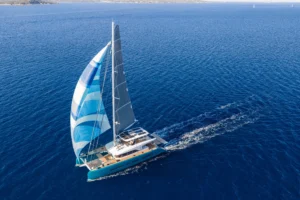
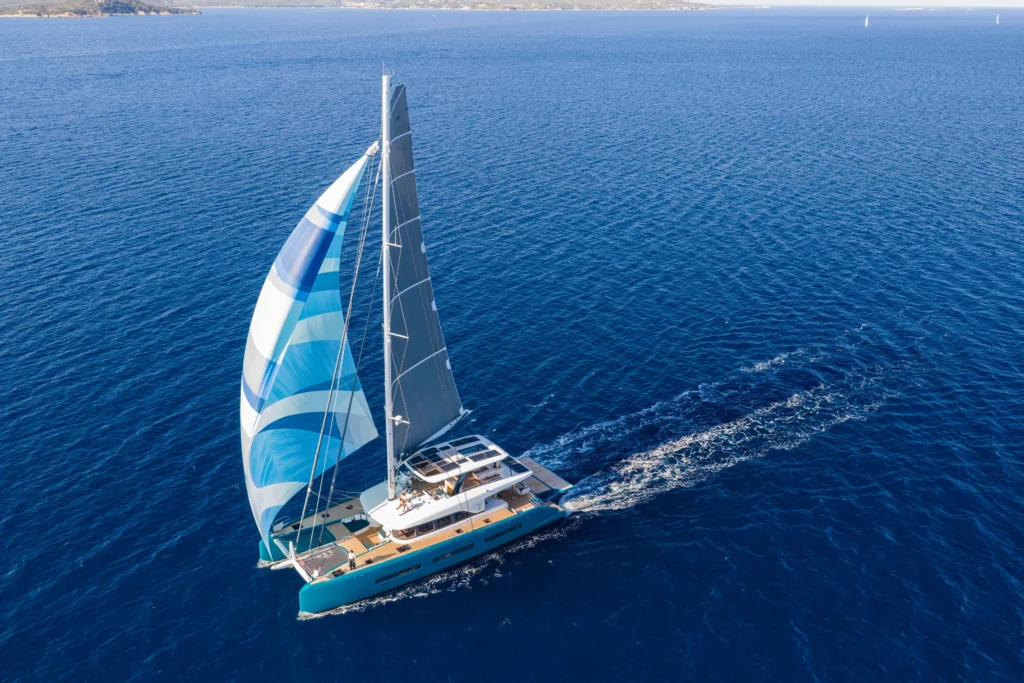
A day among the ruins begins with an ordinary decision about the yacht. Discovery, the Lagoon Eighty2 sailing the Naora Global Expedition, needs a secure arrangement for the conditions expected throughout our absence, not merely the conditions at breakfast. A visit ashore cannot be planned independently of the boat that makes it possible.
For a large catamaran, confirming a marina berth means discussing beam as well as length, the depth and approach, the position allocated and the arrangements for coming alongside. A space long enough for the yacht is not necessarily wide enough. An anchorage is not an automatic alternative if a berth cannot be arranged. Restrictions, holding ground, swinging room, exposure and the means of getting everyone ashore and back all need to support that choice. The people remaining aboard and their responsibilities belong in the same conversation.
Summer in the eastern Aegean often brings northerly winds, and afternoon conditions can be livelier than the early morning suggests. Local sea breezes add another influence. Neither the regional wind pattern nor a calm departure replaces the forecast for the actual coast. Sven, Naora’s founder and captain, plans every weather window and sails every leg himself; time ashore has to fit that continuing responsibility.
For the road transfer from the Kuşadası waterfront, we would allow roughly 30 to 45 minutes as a planning margin, depending on traffic, the departure point and the entrance being used. That is an allowance, not a guaranteed journey time. Walking off the yacht, meeting the driver and entering the site take additional time. Leaving room around these small transitions is what prevents a supposedly quiet morning from becoming a sequence of people being hurried.
How The Harbour Became Land
The excavated city now lies roughly 3 Nm from the open coast, with the exact distance depending on the points measured. For a sailor, that is enough to change the scale of the story. This is not a quay left a little above the tide. A substantial landscape has accumulated between the city and the sea.
The Küçük Menderes river carried sediment down from its catchment. Where moving river water entered quieter coastal water and lost speed, some of the material it carried settled. Over time, deposition built the delta outward and altered the channels through which vessels could reach the harbour. The shore advanced into the former gulf. Ephesus did not lose its water in a single event, and the sea did not simply withdraw from a finished city.
This distinction matters because it gives the people who lived here their proper place in the story. They were dealing with a persistent maintenance problem, not waiting passively for an inevitable picturesque ruin. The harbour and its approach required repeated intervention to preserve access. A harbour can remain economically useful while becoming progressively more demanding to keep open, until the work required and the trade it serves cease to justify each other.
Silting was central to the changing fortunes of Ephesus, but it is too neat to make it the only cause. Earthquakes, political change and the movement of settlement also mattered. Life continued in the wider area as the ancient urban centre changed. What looks from the theatre like a deserted city was, over a much longer timescale, a community adapting its geography. The harbour plain is evidence of that slow adjustment, not the scene of one final departure.
Reading The Streets From The Waterfront
The layout becomes easier to read once its separate streets are understood. Harbour Street, also called the Arcadiane, connected the harbour area with the theatre. Marble Street runs from the theatre towards the Library of Celsus. Curetes Street climbs farther into the city. They do not form one unchanged marble road directly from a ship’s gangway to the library, although the connection between maritime arrival and civic display is clear.
The setting of the city we walk through owes much to Lysimachus, one of Alexander the Great’s successors, who relocated and fortified Ephesus in the early third century BC. Much of the monumental fabric visible today belongs to its later Roman development, with further alterations in late antiquity. Recognising those layers keeps the place from becoming an imaginary afternoon in which every surviving building was new at once.
The theatre is generally estimated to have accommodated about 25,000 people. The useful meaning of that number is civic rather than theatrical: a port needs places where a large population can gather, hear and be seen. This was space for public assembly as well as performance. From the accessible seating, the view west towards the former harbour helps connect the scale of the auditorium with the movement once passing below it. There is no need to reach the highest rows to understand the relationship, and access can change with conservation work.
A carved footprint on Marble Street is commonly explained as an advertisement directing customers to a brothel. It is a memorable interpretation, but not a securely established fact. We would rather leave a little uncertainty in the pavement than turn an attractive possibility into history. The city is interesting enough without requiring every mark to deliver a perfect story.
What The Library Was Built To Remember
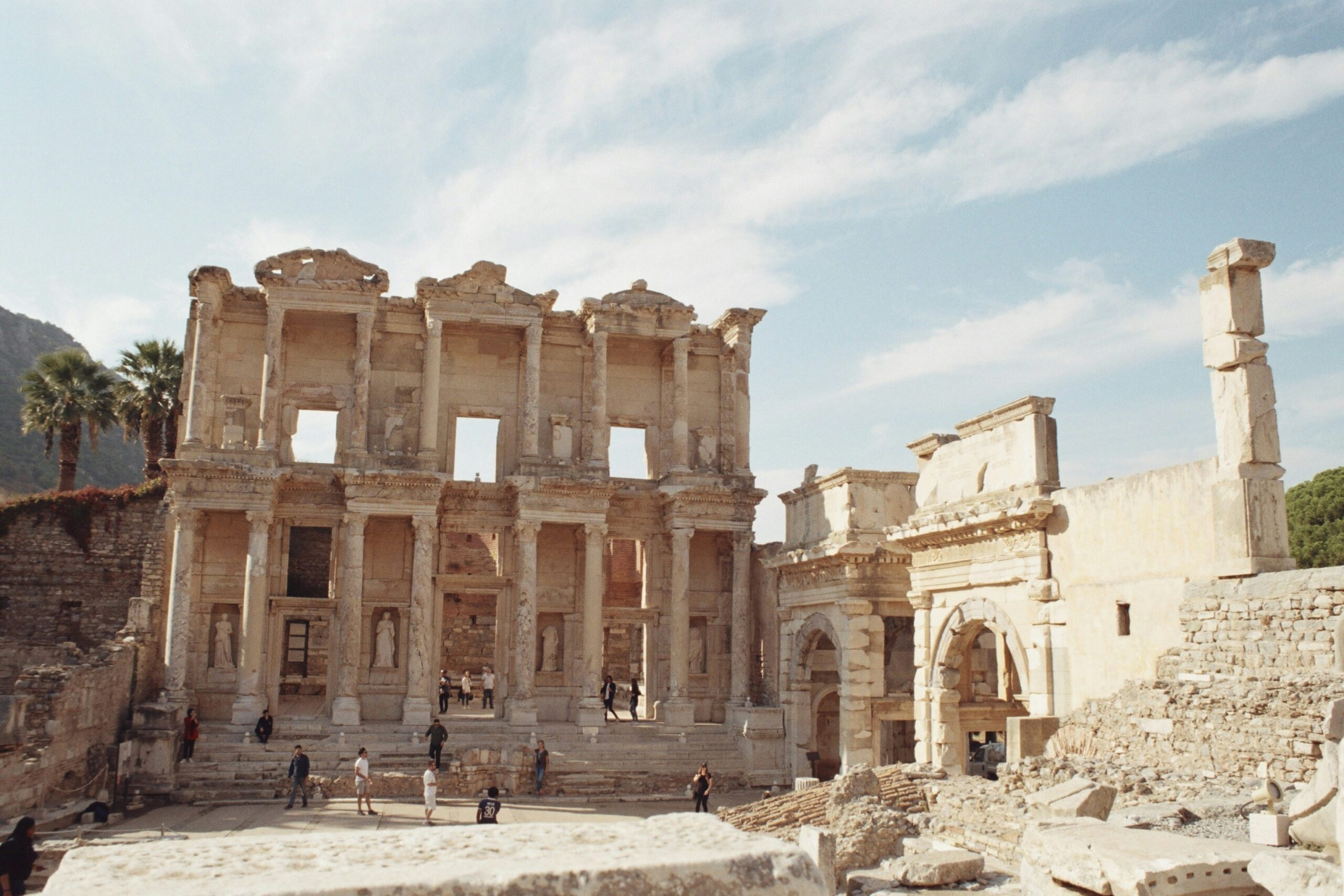
The Library of Celsus is easy to approach as a facade and difficult to leave as anything else. Its columns and niches organise the eye so effectively that the building can seem complete even when we know it is not. The facade standing today was reassembled in modern times from surviving architectural pieces, with reconstructed elements where necessary. What we see is both ancient workmanship and the careful work of making fragments intelligible.
Built in the early second century AD, the library honoured Celsus, a Roman senator and former provincial governor. His son commissioned it, and Celsus was buried beneath the building. That changes the encounter. A place associated with reading was also an act of family remembrance and a public statement about the person being remembered. Affection, reputation and civic ambition occupied the same architecture.
Inside, the collection would have consisted of scrolls rather than rows of bound books as we tend to imagine them. Niches in the walls held the storage arrangements. The precise number once kept here cannot be recovered with confidence, and repeating a capacity estimate tells us less than considering the labour involved: acquiring texts, copying them, protecting them and making them available. A library was a continuing commitment, not simply a handsome room containing knowledge.
Outside, in strong summer light, the pale stone makes the eyes narrow. Looking upwards means stopping, finding a secure place for the feet and letting other people pass. The building deserves that small pause. The longer we look, the less it resembles a single monument and the more it becomes a set of decisions made by people who wanted something of their family and their city to endure.
The City Inside The Houses
The covered Terrace Houses offer a different scale of attention. Their wall paintings, mosaics, courtyards and household arrangements bring the city indoors. These were prosperous homes, and they should not be mistaken for a representative account of everyone who lived in Ephesus. Their survival gives us an unusually detailed view of a particular level of domestic life.
Under the protective roof, the light changes. Instead of looking across brilliant open paving, the eye settles on a painted wall, a threshold, the relationship between adjoining rooms. Raised walkways allow visitors to look into spaces that were once private. The body slows differently here. There is less distance to cover with the gaze and more reason to notice what is close.
A water supply, drainage and, in some rooms, heating arrangements reveal the infrastructure beneath comfort. Decoration tells us something about taste and status; the services tell us how a household functioned. Maintenance, fuel, cleaning and the labour of servants and enslaved people belonged to this domestic world too. It is worth holding those realities beside the pleasure of the surviving colour.
For anyone travelling with children or several generations, this can be where the city becomes easier to discuss. A room invites ordinary questions about sleeping, eating and living together without requiring a command of Roman chronology. The covered setting does not remove the physical demands of the visit, however. Steps and elevated walkways need to be considered, and the admission arrangements should be checked separately from those of the main site.
Planning Ephesus From Kuşadası In Summer
An early start usually buys cooler walking conditions. It does not buy ownership of the site, and there is no dependable hour at which a major archaeological destination can be promised empty. Opening hours, ticket arrangements and accessible areas can change. They should be checked for the intended day rather than inherited from an account of somebody else’s visit.
For planning, we would allow about three hours for an unhurried walk through the main archaeological area, with additional time for the Terrace Houses, a guide or longer pauses. This is an estimate, not a target. The important allowance is around the visit: the transfer, a meal, somewhere to recover from the heat and a return to the yacht without an immediate departure pressing against it. A full day ashore need not mean a full day standing on stone.
The upper and lower entrances allow a through-walk. Beginning at the upper entrance generally makes the principal route downhill, passing through the civic centre and towards the library and theatre. The driver needs to know the intended exit, not merely the place where everyone was dropped off. Downhill is easier for some people, but uneven paving and changes of level still demand attention. Access needs should be discussed before choosing the route; a shorter visit can be the more generous decision.
In summer, the exposed streets gather heat and return it to the body. The glare arrives from below as well as above. By the time a hat feels insufficient and the mouth is dry, the visit may already have become harder than it needed to be. Carry drinking water rather than planning around finding it, wear shoes with dependable grip and use shade when it is available. Smooth stone can be slippery, especially when wet. A narrow itinerary followed comfortably is worth more than completing the map while everyone grows quiet for the wrong reason.
A knowledgeable local guide can make the difference between recognising buildings and understanding their relationships. It helps to explain the interest at the outset: harbour history, domestic life, architecture, or the attention span of the youngest person present. There is no obligation to absorb the whole city in one visit. Leaving with a clear understanding of a few things is a substantial result.
The Water At The End Of The Day
Naora is a private sailing expedition around the world, and its continuity changes the place of a day like this. Members choose when they join, where along the route they step aboard and how long they remain. Discovery keeps sailing beyond each person’s stay. A visit to Ephesus belongs naturally within the Mediterranean chapter when the passage plan and conditions leave room for it, rather than as an appointment the sea must accommodate.
There is a useful freedom in that distinction. Someone may want the full archaeological walk; someone else may have had enough after the library and prefer to sit over lunch. Sharing a yacht need not mean requiring identical attention from everyone ashore. What matters is that the arrangements are understood and that the return respects the work still happening aboard.
Back at a working waterfront, the practical details become conspicuous in a different way. A channel kept open, a berth maintained, a line taken, a delivery brought down to the quay: these are the activities that allow a harbour to remain a harbour. After Ephesus, it is harder to regard them as background.
The ancient city leaves us with an unusually patient image of dependence. Its buildings were made to last, but their usefulness rested on something softer and more changeable than stone: navigable water, arriving vessels, a maintained connection. Harbour Street still points towards the place where that connection was. The ground beyond it is quiet.