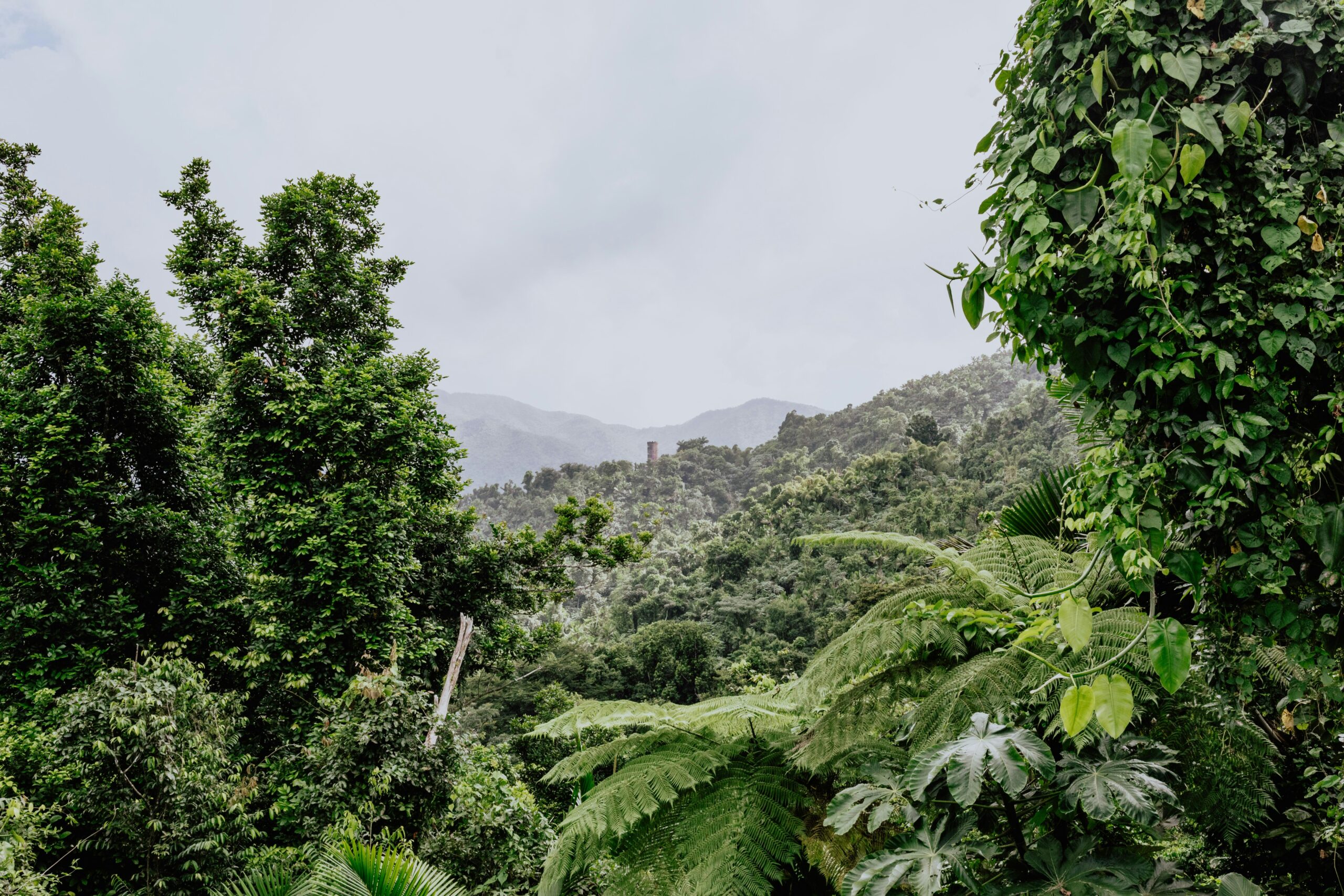
At six in the morning, a clear patch of sky over San Juan can coexist with cloud caught on the mountains to the southeast. For an El Yunque morning, that difference matters more than the prospect of reaching a path before other people. Coffee can wait beside the weather forecast for a moment. A blue sky over the harbour describes the harbour, not necessarily the place where we intend to walk.
During the Caribbean chapter of the Naora Global Expedition, this is part of the attraction of going inland from Discovery, our Lagoon Eighty2 sailing catamaran. The forest lets us follow the weather beyond the coast. Moisture travelling across the sea meets rising ground, becomes cloud and rain, and returns through streams towards the water we have left. A morning ashore can make the island more intelligible from the deck.
Planning An El Yunque Morning
El Yunque is the only tropical rainforest in the US National Forest System, rather than the national park system. It covers roughly 28,000 acres in Puerto Rico’s northeastern mountains. That is a substantial landscape of ridges and watersheds, not a small enclosure around a waterfall. The road and the paths accessible on a morning visit reveal a portion of it. Accepting that scale removes the temptation to treat a visit as something to complete.
Six in the morning is a useful time to prepare, not a promise that a forest gate will be open. Entry hours, road access and individual trail conditions need checking before departure. Hurricane damage, landslips and repair work can affect access long after the weather that caused them has passed. An early start does not override a closure, and a familiar trail name does not establish that the path is currently usable.
For planning, we would allow roughly an hour to an hour and a half each way from San Juan, adjusting for the actual berth, traffic and the accessible entrance. This is an allowance rather than a fixed transfer time. A short estimate can quietly consume the whole margin of a morning, particularly when the drive continues beyond the forest boundary to the intended starting point. The return needs its own margin, rather than whatever time the walk happens to leave.
We would eat something before leaving. Walking in humid air on coffee alone makes little sense, especially for children or anyone still recovering their sleep after a passage. A modest breakfast leaves room for a proper meal later without making that meal responsible for rescuing the morning. The plan should also work for someone who would prefer a shorter walk. Nobody needs to earn their place at the table by reaching a waterfall.
The Trade Wind Reaches The Mountain
The prevailing easterly and northeasterly trade winds bring moist Atlantic air towards Puerto Rico. When that air encounters the mountains, it rises and cools, allowing water vapour to condense. This is orographic rainfall: the shape of the land changes what the atmosphere does. The same broad wind system that helps shape a sailing passage also helps sustain the forest above the coast.
The highest ground rises above 1,000 metres, enough elevation to create noticeably different conditions from those at sea level. Some of the wettest parts receive more than five metres of rain in a year. The useful meaning of that figure is not simply that visitors should carry a rain layer. Water is continually working through this landscape, soaking the ground, feeding streams, supporting plants and sometimes loosening the slopes beneath a path.
Northern winter and early spring are generally relatively drier, but drier is a comparison, not a description of every morning. Trade wind showers still reach the mountains. The Atlantic hurricane season runs from June through November, a planning consideration for both the yacht and the island, although damaging rainfall does not require a named storm. For the walk itself, recent rain and the day’s forecast matter more than the reassuring label of a season.
Sven, Naora’s founder and captain, plans every sailing weather window and sails every leg himself. Going ashore does not require a different attitude towards uncertainty. We distinguish what the forecast suggests from what conditions permit, and leave room to change the plan. There is pleasure in knowing that a forest morning has enough space around it to become shorter, slower or a different morning altogether.
Walking El Yunque Without Hurrying
Under the canopy, the light breaks into smaller pieces. A bright opening overhead may illuminate one leaf while the path beneath it remains in shade. Water gathers at a leaf tip, holds there, then lands with surprising weight on a shoulder. The air can feel cooler than the harbour and still leave a shirt damp against the back, because humidity limits how readily sweat evaporates. Shade reduces the sun’s load. It does not remove the body’s need for water.
Footwear earns its place here through grip. Wet roots and smooth rock can be slippery even when the path looks straightforward, and the descent asks more of tired legs than the outward walk suggested. We choose the route around the least confident footing in the party, allowing for the return rather than judging everyone during the easy opening stretch. A walking pace that permits conversation also leaves attention available for the ground.
There is more to notice at that pace. Tabonuco trees are characteristic of the lower forest, while sierra palms become conspicuous in wetter mountain terrain. Higher, more exposed vegetation can be shorter and more tightly shaped by wind and cloud. The forest is not one uniform wall of green. Elevation, drainage and exposure keep changing the conditions in which a tree has to make its living.
Plants growing on trunks and branches offer another useful distinction. Many are epiphytes, using the tree as support rather than drawing nourishment from its sap. Their position gives them access to light, moisture and material caught among roots and leaves. A crowded branch need not be a tree being strangled. Once that distinction is understood, the canopy becomes easier to read: several lives can occupy the same structure without having the same relationship to it.
The River Has Its Own Weather
La Mina is the waterfall many visitors know by name, but we would not build the day around a promised swim there. Access to its trails and any restrictions on entering the water need confirming at the time. A waterfall’s reputation can outlast the condition of the route leading to it. Where a path is closed, the answer is another open route, not a search for a way around the barrier.
The more important judgement concerns the catchment above the river. Heavy rain upstream can raise the water where the sky is clear. Forest and bends conceal much of what is happening farther uphill, so the view from a pool is an incomplete weather report. An inviting surface does not tell us how much water is already travelling towards it.
Rising water, increasing cloudiness in the stream or a change in its sound are reasons to move away towards higher ground, not to remain beside it watching. Better judgement happens earlier, by avoiding river access when heavy rain is forecast or has recently affected the catchment. A calm-looking pool beneath a fall may also conceal strong circulation and uneven footing. Being a capable swimmer at sea does not settle those questions.
There is no need to replace a cancelled swim with disappointment. Near moving water, the forest changes register. The softer sounds of leaves and birds become difficult to separate from the continuous rush, and cool spray can settle on the forearms without becoming visible rain. Standing back on a permitted path gives the body much of what it came for: a change of air, a change of sound, attention brought out of its usual habits. Entering the water is only one possible part of that experience.
Listening Before Looking For Wildlife
The coquí is often heard before it is understood. The familiar two-note call comes from a small frog and carries with a force that seems disproportionate to its size. Males call most conspicuously in the evening and at night, so a morning visit should not promise the full sound that Puerto Ricans so often associate with home. What we hear depends on the hour, the weather and where we stop.
The common coquí has another detail worth remembering: its young develop inside eggs laid out of open water and emerge as tiny frogs, rather than beginning life as free-swimming tadpoles. Moist shelter therefore matters in ways that are not immediately visible from the path. Leaf litter and small protected spaces are habitat, not untidiness. Lifting logs or disturbing vegetation to improve a sighting can interfere with the very life we hoped to see.
The Puerto Rican parrot belongs to this forest’s story too. Native only to Puerto Rico and still endangered, it has survived through habitat protection and sustained breeding and release work. It is not a dependable sighting for a morning walk. We would rather leave its appearance uncertain than turn a recovery effort into an expectation that someone must fulfil. Its absence from our view says little about the value of the visit.
For birds, stopping often works better than advancing. Movement catches the eye, but our own movement can hide it. A pause allows a shape to separate from foliage and a call to become recognisable against running water. We keep voices low and do not play recorded calls to draw wildlife closer. With children, that pause can become the most absorbing part of the walk: everyone listening towards the same patch of leaves, without needing to name what is there immediately.
Leaving The Forest In Good Order
A wet trail can tempt walkers towards its edges, where the ground appears firmer. Repeated often enough, that small detour widens the disturbed area, damages vegetation and creates another route for runoff. Staying on the established path is therefore more than obedience to a sign. It protects the narrow strip of ground that allows people to enter without gradually enlarging their footprint. Sometimes the considerate choice is to accept muddy shoes.
We carry drinking water rather than assuming a clear stream is safe, and bring food in containers that can return to the yacht. Clear water can still contain organisms that cause illness. Fruit peel is waste here too, even though it will eventually decompose; it does not belong beside a path or in the diet of an animal drawn towards visitors. These are small decisions, but they remain ours to make regardless of how the wider landscape is managed.
The human arrangements deserve similar care. A return pickup should have an agreed place and a realistic time, rather than depend on finding a signal at the end of a walk. Stopping for food locally can be part of the morning without asking a small kitchen to accommodate an impossible deadline. Arriving by sea does not put us outside the ordinary obligations of a visitor. Courtesy is practical: clear arrangements, patient ordering and enough time for people to do their work.
Returning To San Juan
Back in San Juan, breakfast can be allowed to become a meal rather than a hurried correction. A mallorca, the soft coiled bread usually dusted with powdered sugar, offers a particular pleasure after a damp walk: a yielding crumb and sweetness that clings to the fingers. Pan sobao is another Puerto Rican bakery staple, softer and slightly sweet. There is no need to turn the table into a survey of everything the island cooks. Fresh bread and coffee are sufficient reasons to sit still.
On returning to Discovery, wet things need somewhere appropriate to dry and muddy soles need attention before they carry the path through the boat. The ease of life aboard depends partly on these unremarkable transitions. A little care at the point of return protects the comfort of everyone, including someone who chose to stay on board and has had an entirely different morning. Shared travel does not require identical days.
Members choose when they join Naora, where along the world route they step aboard and how long they sail. Discovery continues around the world as people come and go. Within that larger movement, a morning in Puerto Rico can remain modest in scale: a walk selected for the people present, room to pause, no obligation to reach the end of every path. The freedom is partly the ability to leave something for another time.
Later, from the deck, cloud may still be resting on the mountains. The harbour has its own light, the boat its familiar sounds. There is nothing further to arrange for the forest. It can remain there, receiving the weather.