At seven in the morning, a footstep in Dubrovnik Old Town can still be heard separately from the footsteps around it. Sound travels off the limestone, along the narrow streets feeding into Stradun, through spaces that will become much louder as the day gathers. In summer, the shade between the buildings offers a different temperature from the open street. Crossing from one to the other is enough to remind the body why an early start matters.
This is the morning we would plan for. Not an empty city, and certainly not a city belonging to us because we reached it before someone else. Dubrovnik is already at work. The opportunity is to arrive while there is still room to notice that work, before the movements of visitors begin to obscure it.
Dubrovnik Old Town Before Eight
The useful distinction is not between a Dubrovnik with cruise ships and a Dubrovnik without them. Ship arrivals vary, passengers take time to reach the gates, and many people visiting the old town have slept ashore. A harbour schedule can help us anticipate pressure on the streets, but it cannot promise solitude. Early morning improves the odds of a quieter visit. It does not reserve the city.
What changes first is the space available for attention. Along Stradun, the broad limestone street through the old town, it becomes possible to stop without obstructing anyone, to look up at the proportions of a doorway rather than follow the person ahead, to hear a conversation without trying. Later, when the street fills, those same acts require more effort. The buildings have not become less beautiful. There is simply more competing for the senses.
We would begin on the street rather than rush straight towards an attraction. The practical reason is that the walls may not yet be open. The better reason is that a city is easier to understand at eye level before seeing it from above. Deliveries need passage. Doorways remain entrances to homes. A quiet lane is not an invitation to speak loudly beneath an open bedroom window.
Before eight is therefore a useful intention, not a magic boundary. Leaving the yacht early only makes sense if it creates an unhurried morning ashore. If everyone has been rushed through breakfast and hurried into a tender, we have carried the pressure we hoped to avoid through the gate with us.
Choosing Where Discovery Waits
The first decision happens before anyone chooses a café. Discovery, the Lagoon Eighty2 sailing the Naora Global Expedition around the world, needs a suitable place to remain while people go ashore. The photograph of a yacht beneath Dubrovnik’s walls tells us very little about the quality of that decision. It does not show the bottom, the permissions, the forecast or the conditions expected when the tender returns.
ACI Marina Dubrovnik is up the inlet, outside the old town. It should not be imagined as a berth beside Pile Gate with a short walk into the centre. From there, we would plan a road transfer, allowing for traffic and arranging the return meeting point before setting off. That adds a land journey, but it can separate the morning ashore from the complications of landing by tender on an exposed stretch of coast.
A marina berth also requires more than a length that appears sufficient on paper. For a catamaran, width, approach depth, manoeuvring room and the mooring arrangement all matter. Those details need confirming for Discovery herself. A familiar marina name is not a substitute for checking that the actual berth works.
Anchoring nearby is a different proposition, not automatically the simpler one. It depends on local restrictions, suitable holding ground, room to swing and protection throughout the intended stay. The seabed must be assessed rather than guessed from the colour of the water, with seagrass avoided and enough suitable bare ground for the anchor and its movement. Tender landing must be permitted and practical. A quay visible from offshore is not necessarily somewhere we can leave a boat or collect a family.
The additional transfer from a marina may buy a less hurried breakfast. That is a worthwhile trade when the alternative is watching the water between every mouthful.
Planning For The Return
Sven, Naora’s founder and captain, plans every weather window and sails every leg himself. For a morning in Dubrovnik, the important window extends beyond the outward trip. Calm water at departure is only part of the picture. The question is what the yacht, anchorage and landing place will be doing when everyone wants to come back.
The bura, generally a northeasterly wind, can descend from the coastal terrain in sharp gusts. Shelter judged only by the height of the land can be misleading: the same terrain may channel or accelerate the air. The jugo, generally from the southeast, presents a different problem, building sea and swell along exposed approaches. A tender journey can become uncomfortable or unsuitable before conditions look particularly dramatic from a café inside the walls.
In settled summer weather, an afternoon sea breeze can also make the return wetter and more tiring than the outward ride. This is not a reason to treat every morning ashore as a weather exercise for guests. It is a reason for the captain to read beyond the average wind figure, considering direction, gusts, the development of the sea and the exposure of the landing. The Adriatic’s generally modest tidal range does not remove those concerns. Small tides are not the same thing as still water.
A useful shore plan contains a clear meeting place and a way to communicate if it changes. If returning earlier would avoid deteriorating conditions, that decision belongs before lunch becomes a commitment. If the landing is awkward for someone with limited mobility, the route ashore should change rather than expecting that person to manage a moving gap between tender and stone.
None of this needs to dominate the day. Done properly, it allows the people walking through Pile Gate to think about Dubrovnik instead of wondering how they will get home.
The City Beneath The Limestone
Stradun is often described as marble because its limestone has acquired such a smooth surface under generations of feet. The distinction matters most when the stone is wet. Polished limestone can be slippery, particularly on slopes and steps, and shoes chosen for a dry deck are not necessarily comfortable or secure on an old city’s paving. A sole with dependable grip is a more useful preparation than an ambitious walking itinerary.
The street’s apparent unity can also be misleading. Dubrovnik is not one untouched medieval moment. Much of Stradun’s architectural consistency reflects rebuilding after the earthquake of 1667, which devastated the city. The disciplined façades belong partly to recovery: buildings restored within a shared urban order rather than each owner treating the street as an opportunity for display. Knowing this changes the walk. Uniformity begins to look like a collective decision made after loss.
Dubrovnik, historically Ragusa, was a maritime republic whose independence depended on trade, diplomacy and the careful management of arrival. Its harbour connected it to the world, but connection brought danger as well as goods. In 1377, arrivals from plague-affected places were required to undergo thirty days of isolation before entering, an early formal quarantine measure. The initial period was thirty days, not the forty often associated with the later history of quarantine.
Seen from a yacht, that history feels less abstract. A port has always had to decide how to welcome people without neglecting those already living there. The walls were one answer; rules governing ships and arrivals were another. Dubrovnik’s beauty is inseparable from the practical intelligence of a city that survived by dealing with the sea.
Walking The Walls In Summer
The full circuit of the walls is a little over 1 Nm. On a chart, that is a small distance. Underfoot, it includes repeated changes of level, narrow sections, exposed stone and pauses that are part of the reason for coming. As a planning allowance rather than a promised duration, roughly ninety minutes to two hours leaves room to look without turning the circuit into exercise against a clock. Some people will want longer.
The seasonal opening time needs checking close to the visit. We would not build the morning around an assumed eight o’clock admission throughout the year. An early entry is valuable in summer because much of the route is exposed, not simply because fewer people may be ahead. Drinking water, a hat and suitable footwear make more difference to the experience than arriving with a long list of towers to identify.
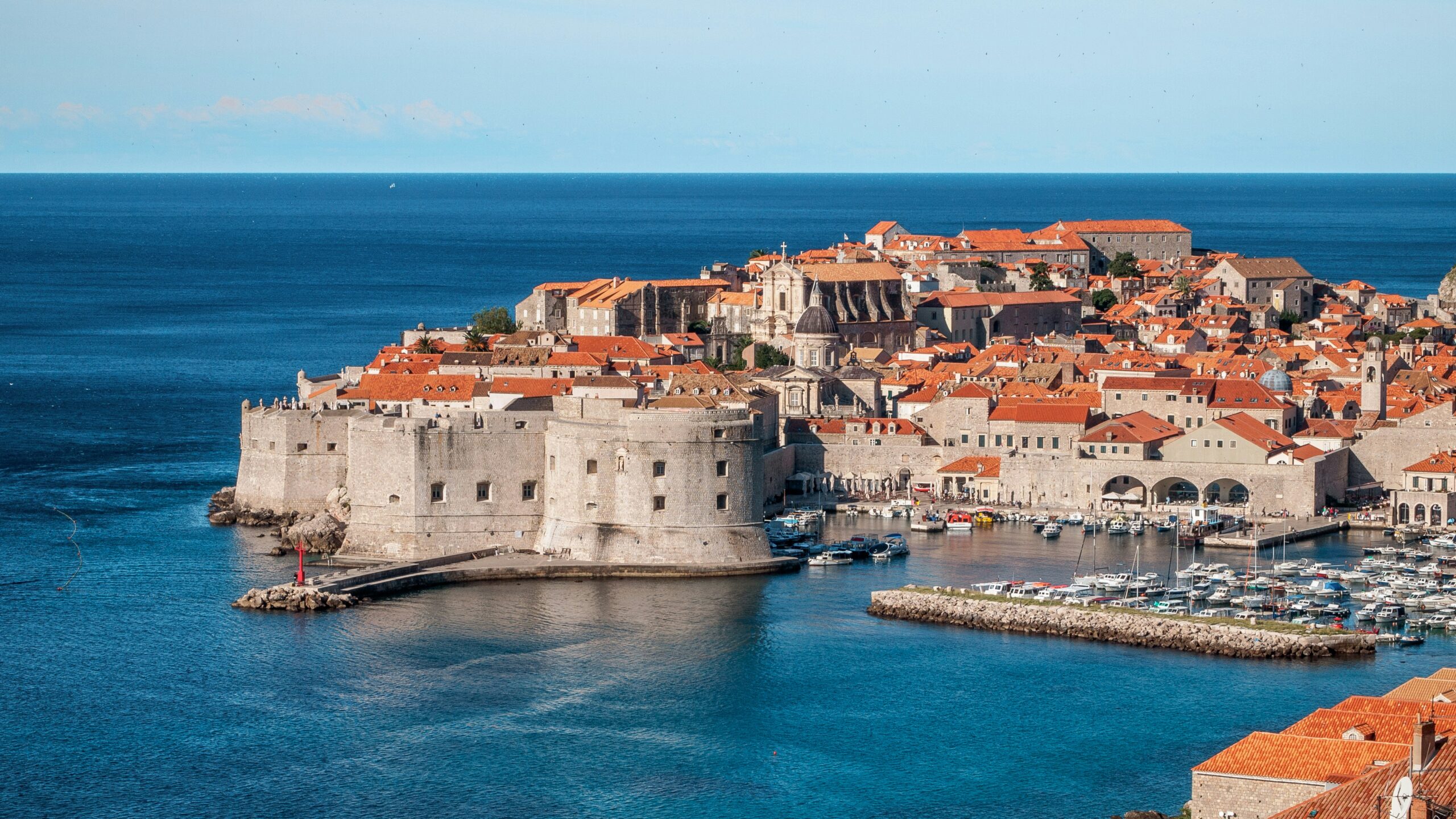
Up on the walls, the body feels the change before the mind has finished admiring the view. Shade falls away. Light comes off pale masonry as well as from the sky, and a breeze that feels pleasant against the face can disguise how warm the exposed walk has become. Below, the roofscape gathers into terracotta planes; beyond it, the Adriatic opens without the interruption of a street corner. The sea looks close enough to cool the stone. It does not.
For a family or several generations walking together, the practical judgement concerns the steps and exposure, not merely the circuit’s length. The walls are not a level promenade or a straightforward pushchair route. Entry and exit arrangements should be understood before starting, and no one needs to complete the circuit to justify having come. A shorter visit that ends with energy left for the city is preferable to finishing with a child or an older relative exhausted.
From above, the old town can briefly appear to be all roofs and monuments. Look more carefully and its domestic scale returns. The houses beneath the viewpoint are still houses, with the demands of ordinary life folded into a place the rest of us have travelled to see.
Breakfast In Dubrovnik Old Town
Breakfast gives the morning somewhere to settle. Coffee and something freshly baked are enough if they leave room for sitting, watching the street and allowing the heat of the walk to leave the body. There is no need to manufacture a ceremonial local breakfast where a simple one would be more honest. Nor should an early departure depend on a particular café being open before its actual hours have been checked.
The modest courtesies are useful here. Dobro jutro is good morning; hvala is thank you. Their value is less in pronunciation than in remembering that the person serving coffee has begun a working day, not appeared as part of our visit. Asking before photographing someone, keeping a passage clear and accepting that service follows the pace of the kitchen are small ways of entering that day without taking it over.
For something to carry back to the galley, Dubrovnik’s arancini offer a compact piece of local food culture. Here the name refers to candied orange peel, not the rice preparation familiar from Italian cooking. The peel is soaked or repeatedly blanched to soften its bitterness, cooked with sugar and dried. The work lies in preserving a little resistance and citrus bitterness rather than reducing everything to sweetness. A strip beside coffee makes more sense than a large serving.
When buying provisions, we would ask what was made locally and what is in season rather than assume that everything sold within the walls comes from nearby. For the galley, quantity matters too: fresh produce needs to suit the next meals, the available storage and the expected motion at sea. Buying generously is not the same as buying well. Something chosen with care, carried aboard intact and eaten while it is good connects the shore visit to the life of the yacht.
Leaving Room In The Day
By late morning in summer, heat and visitor numbers can change the effort required to enjoy Dubrovnik. That may be a sensible time to leave the walls, find shade or return to Discovery. It is not a judgement on everyone arriving later. Cruise passengers come for much the same reasons as anyone else, and the city does not become worthless when its streets grow busy.
The advantage of arriving from a private yacht is the ability to make the decision at a smaller scale. We can decide that the wall walk was enough, that breakfast deserves another unhurried coffee, or that someone would rather return aboard than continue walking. Those choices remain subject to the berth, the weather and the agreed return arrangements. Freedom at sea works best when its practical boundaries are understood.
That is also how this morning fits the larger life of Naora. Members choose when they join the worldwide route, where they step aboard and how long they stay, while Discovery continues around the world. A Dubrovnik visit need not carry the burden of being the only meaningful morning of a short holiday. It can be one carefully considered encounter within a much longer movement through places, with time left to absorb it.
The quiet worth seeking here is not the silence of a city emptied for visitors. It is the quieter interval in which the city can still be heard attending to itself: work beginning, a greeting exchanged, footsteps finding their way through stone. We enter that interval briefly. Dubrovnik has a day of its own.