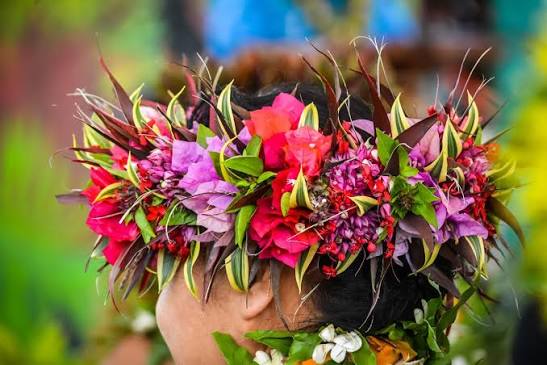
The ei katu is the flower crown of the Cook Islands, the wreath of the tiare maori, the white Tahitian gardenia, woven fresh for the arriving guest as the traditional Cook Islands welcome. The tiare maori grows throughout the Cook Islands and its white, intensely fragrant flowers are the material of the ei that the Cook Islands tradition weaves for every occasion that requires the expression of the welcome and the celebration and the farewell, the arrival of the guest, the celebration of the birthday, the departure of the loved one.
The ei katu worn on the head, the ei worn around the neck: the flower garland as the living expression of the Cook Islands aloha that the Pacific island tradition shares with the Hawaiian and the Tahitian and the Samoan cultures in the specific form that each island group has developed as its own version of the Pacific welcome.
Discovery anchors at Rarotonga after the Pacific passage from the Tuamotu or the Society Islands, the arrival at the Cook Islands chapter that the circumnavigation reaches as the route progresses westward through the central Pacific. The Cook Islands welcome, the ei katu placed on the head of the arriving guest by the person on the beach or the dock who has been weaving it since the boat was spotted on the approach — is the Pacific welcome in its most direct and most fragrant form.
The tiare maori scent is the scent of the Pacific island welcome in the specific sense that the memory holds the smell as the first and the most persistent impression of the arrival, the white flower and the green leaf and the specific sweetness of the gardenia that the Cook Islands air carries before any other impression of the island has been formed.
The Weaving
The members who spend two days at the Rarotonga anchorage have the opportunity to learn the ei weaving from the Cook Islands women who practice it daily for the occasions the island’s life continuously produces. The weaving is the specific technique of the fresh flower threading, the tiare bloom through the pandanus leaf strip, the loop over the previous bloom, the tightening of the strand that holds the flowers in the density that the ei katu requires.
It takes twenty minutes to learn the technique and the rest of the life to perfect the specific consistency of the flower spacing that distinguishes the ei woven by the woman who has been making them since childhood and the ei woven by the offshore member who learned it this afternoon. Both smell the same. The tiare does not discriminate.